

 Français
 Español
 Deutsch

Content
- 1 What Is a Stainless Steel Self-Tapping Thread Insert?
- 2 Why Stainless Steel Is an Effective Insert Material
- 3 Key Advantages Over Conventional Thread Reinforcement Methods
- 4 Type 302 Slotted Self-Inserting Sleeve
- 5 Material Grades: 304 and 316 Stainless Steel
- 6 Typical Applications
- 7 Installation Principles
- 8 Reference Dimensions for Type 302 Inserts
- 9 Manufacturing Process and Production Strengths
- 9.1 Material Preparation
- 9.2 Precision Forming and Machining
- 9.3 External Thread Production
- 9.4 Internal Thread Production
- 9.5 Cutting Groove and Slot Control
- 9.6 Deburring and Surface Treatment
- 9.7 Inspection and Quality Management
- 9.8 Automated Production Capability
- 9.9 Engineering and Customization Support
- 10 Why Work With a Specialized Threaded Connection Manufacturer?
- 11 Application Engineering Considerations
- 12 Comparison With Other Insert Types
- 13 Quality, Packaging, and Supply Reliability
- 14 How to Specify the Product for Purchasing
- 15 Maintenance and Service Benefits
- 16 Performance Testing and Validation
- 17 Common Selection and Installation Errors
- 18 Frequently Asked Questions
- 18.1 What materials can accept stainless steel self-tapping inserts?
- 18.2 Do these inserts require a pre-tapped external hole?
- 18.3 Are 304 and 316 stainless steel interchangeable?
- 18.4 Can a self-tapping insert repair a stripped aluminum thread?
- 18.5 Can these inserts be used in plastic housings?
- 18.6 How should the pilot-hole size be selected?
- 18.7 What is the purpose of the cutting groove?
- 18.8 Are installation tools available?
- 18.9 Can customized sizes be produced?
- 18.10 How can thread quality be checked?
- 18.11 Are stainless steel inserts suitable for high-temperature applications?
- 18.12 What information should be sent when requesting a quotation?
- 19 Conclusion
- 20 References
- 21 Product: Stainless Steel Self-Tapping Thread Insert
Stainless steel self-tapping thread inserts are engineered fastening components used to create, reinforce, or repair internal threads in softer base materials. They are particularly valuable where ordinary tapped holes may strip, deform, loosen, or fail under repeated assembly, vibration, impact, corrosion, or temperature changes. By combining a strong external cutting thread with a durable internal thread, the insert creates a reliable connection between the parent material and the fastening screw or bolt.
Compared with conventional carbon-steel inserts, plastic thread-forming solutions, or standard threaded bushings, stainless steel self-tapping inserts provide a balanced combination of corrosion resistance, mechanical strength, installation efficiency, and long-term dimensional stability. They are suitable for aluminum alloys, plastics, cast iron, light metal housings, sheet metal components, and other materials that require thread reinforcement.
This article explains the design, material advantages, installation characteristics, manufacturing capabilities, application value, dimensional options, quality considerations, and selection principles associated with stainless steel self-tapping thread inserts. It also examines how a specialized manufacturer can support demanding automotive, aerospace, industrial, electronic, rail, and outdoor applications through controlled production and engineering services.
What Is a Stainless Steel Self-Tapping Thread Insert?
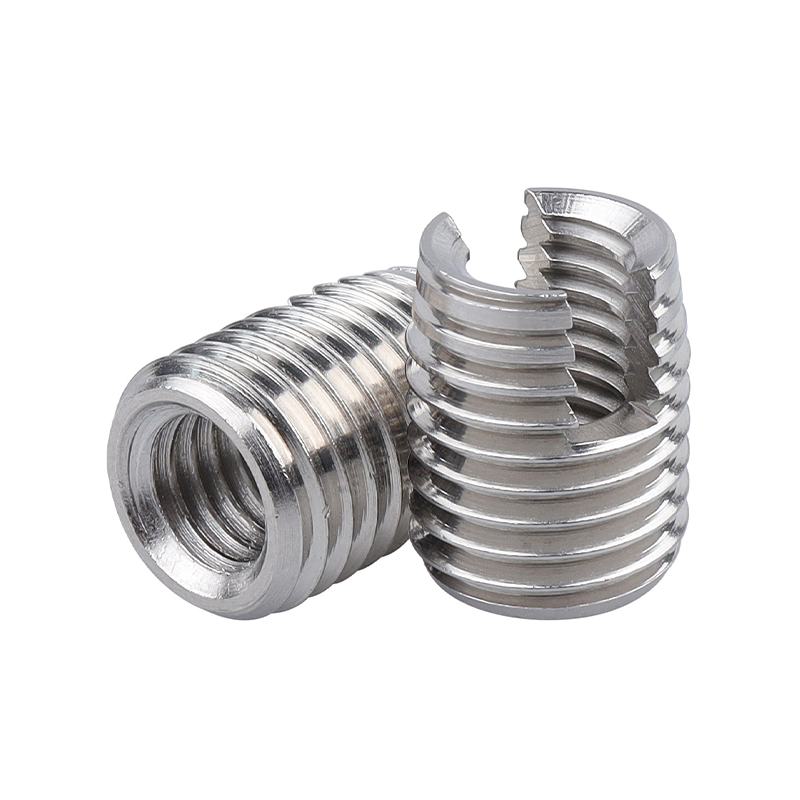
A stainless steel self-tapping thread insert is a hollow metal sleeve with an internal thread and an external cutting or forming thread. The external thread is designed to enter a prepared pilot hole and cut or form its own mating thread in the base material. The internal thread accepts a standard screw, bolt, or threaded stud.
The insert may include one or more cutting slots, grooves, or specialized tooth profiles. In the Type 302 slotted design, a cutting groove at the head or leading portion enables the insert to penetrate the parent material without requiring the operator to tap the external thread first. The insert therefore performs two functions during installation: it creates the external thread in the base material and establishes a high-strength internal thread for later fastening.
This design is different from a conventional wire thread insert. A wire insert is generally formed from diamond-shaped wire and installed into an already tapped hole. A self-tapping sleeve, by contrast, normally uses its own external cutting geometry. This can simplify production, reduce the number of required tools, and make thread reinforcement practical for repair work or low-volume assembly.
The insert is especially useful when the base material has insufficient thread strength. Aluminum and engineering plastics are common examples. These materials may be lightweight and easy to machine, but their internal threads can be vulnerable to stripping, wear, thermal expansion, or repeated removal and installation of fasteners. A stainless steel insert transfers the load into a larger and stronger external thread while providing a wear-resistant internal thread for the service fastener.
Why Stainless Steel Is an Effective Insert Material
Material selection has a direct effect on the service life of a threaded connection. Stainless steel is used because it offers a combination of corrosion resistance, strength, wear resistance, and stability that is difficult to achieve with ordinary low-carbon steel or untreated metals.
Corrosion and Rust Resistance
Stainless steel forms a passive oxide film that helps protect the surface from oxidation and corrosion. Grades such as 304 and 316 stainless steel are widely used in fastening components because they offer useful resistance to moisture, atmospheric exposure, many industrial chemicals, and a range of acidic or alkaline conditions.
Grade 304 stainless steel is suitable for many general industrial, indoor, outdoor, and mechanical applications. Grade 316 stainless steel provides enhanced resistance in environments containing chlorides and salt, making it a preferred choice for marine equipment, coastal installations, chemical processing equipment, and other high-exposure applications.
Although no stainless steel grade is immune to every form of corrosion, the use of 304 or 316 material can significantly reduce the risk of rust-related seizure, thread contamination, and dimensional deterioration. This is particularly important when the insert is installed in a material with a different corrosion potential or when the finished assembly is exposed to condensation, road spray, cleaning chemicals, or saltwater atmospheres.
Strength and Load Distribution
The insert provides a stronger thread form than the surrounding soft base material. Instead of allowing the screw threads to bear directly against a weak aluminum or plastic thread, the insert receives the fastening load and distributes it through the external thread into a larger area of the parent material.
This improves resistance to pull-out, thread stripping, impact, and repeated tightening. It also allows designers to use lightweight housings without sacrificing the reliability of the threaded joint. The result can be a lighter assembly with a more durable fastening point.
Wear Resistance During Repeated Assembly
Many service components must be removed and reinstalled during inspection, maintenance, adjustment, or repair. Direct threads in plastic may become damaged after only a limited number of cycles. Aluminum threads may wear or deform when a steel bolt is repeatedly tightened.
A stainless steel internal thread is better suited to repeated fastening cycles. When the insert is correctly selected and installed, it reduces thread wear and helps preserve consistent torque performance over the life of the assembly.
Temperature Stability
The product information specifies an operating range from approximately -40°C to 600°C for suitable applications. Actual performance depends on the stainless steel grade, base material, fastener material, preload, oxidation conditions, and exposure duration. Nevertheless, stainless steel offers useful dimensional and mechanical stability across a broad temperature range.
This makes the inserts suitable for many low-temperature and elevated-temperature applications, including vehicle compartments, industrial machinery, outdoor equipment, instrumentation, and selected thermal systems. Engineers should confirm the complete joint design whenever the assembly will operate continuously near the upper temperature limit.
Key Advantages Over Conventional Thread Reinforcement Methods
Self-Tapping Installation
The most visible advantage is the self-tapping function. A conventional threaded bushing may require an externally tapped hole before installation. A separate tapping step increases process time, tool requirements, and the possibility of alignment errors.
A slotted self-tapping insert cuts its external thread as it enters the pilot hole. This can reduce the number of production operations and simplify field repair. Standard installation tools may be used, provided the tool, pilot hole, installation torque, and alignment are appropriate for the insert size and parent material.
Reduced Risk of Thread Stripping
Directly tapped threads in soft materials are often limited by the strength and thickness of the material around the hole. The stainless steel sleeve creates a more durable internal thread and can substantially improve the joint’s resistance to stripping.
Compared with an unreinforced plastic or aluminum thread, the insert is better suited to higher tightening loads, vibration, frequent service, and impact. It is also useful when a component has suffered a damaged thread and cannot be economically replaced.
Improved Resistance to Vibration and Loosening
The insert’s external engagement with the parent material helps anchor the sleeve, while the internal thread provides a stable interface for the fastener. The Type 302 slotted design is described as having strong vibration resistance and anti-loosening performance when properly installed.
Thread reinforcement does not replace the need for an appropriate locking strategy. Depending on the application, designers may still require a prevailing-torque nut, mechanical locking feature, thread-locking compound, safety wire, proper preload, or other anti-loosening method. The insert provides a strong threaded foundation, but the complete joint must be engineered for its operating environment.
Compact Design
Self-tapping inserts are generally compact relative to the strength they provide. They can be used in housings, brackets, covers, panels, and equipment frames where space is limited. The sleeve can reinforce a small threaded boss without requiring a large external flange or bulky structural feature.
Compatibility With Multiple Thread Standards
The product range supports metric and selected Unified thread sizes. This allows the same basic insert concept to be used in domestic manufacturing, export equipment, repair work, and mixed-standard assemblies. Metric sizes listed include M2, M2.5, M3, M4, M5, M6, M8, M10, M12, M14, M16, M18, and M20 variants. Unified sizes include examples such as #2-56, #4-40, #8-32, #10-24, 1/4-20, 5/16-18, 3/8-16, 7/16-14, 1/2-13, and 5/8-11.
Thread compatibility must always be checked carefully. The internal thread of the insert must match the selected fastener, while the external thread and pilot hole must match the installation requirements for the parent material.
Stainless Steel Self-Tapping Thread Insert
Type 302 Slotted Self-Inserting Sleeve
The Type 302 slotted style is designed around a cutting groove and a high-strength, wear-resistant thread. During installation, the cutting groove engages the pilot hole and helps the insert form its external thread. This feature supports efficient assembly and can reduce the need for pre-tapping.
The slotted design is useful in production environments where installation speed and process simplicity are important. It is also valuable in maintenance operations where the technician must restore a damaged thread without replacing the entire component.
The sleeve’s internal thread is manufactured to receive the specified fastener. Its external thread is selected according to the base material, hole diameter, engagement length, and required holding strength. Longer inserts generally provide more engagement with the parent material, but length must be selected in relation to the available boss depth and the risk of interference with internal components.
The insert should be installed perpendicular to the surface unless the design specifically requires an angled connection. Misalignment can affect the fastener’s seating, produce uneven load distribution, and reduce the effective strength of the connection.
Material Grades: 304 and 316 Stainless Steel
304 Stainless Steel
304 stainless steel is a versatile austenitic stainless steel commonly selected for general-purpose threaded components. It provides good resistance to moisture, atmospheric exposure, many household chemicals, and a broad range of industrial conditions.
It is appropriate for machine housings, electrical enclosures, indoor equipment, vehicle components, brackets, fixtures, and outdoor structures where chloride exposure is moderate. It also offers a practical balance between cost, availability, strength, and corrosion resistance.
316 Stainless Steel
316 stainless steel contains alloying elements that improve resistance to chloride-related corrosion and certain chemical environments. It is often selected for marine equipment, coastal infrastructure, photovoltaic supports, chemical machinery, food-processing equipment, and outdoor assemblies exposed to salt or deicing agents.
While 316 stainless steel may carry a higher material cost than 304, the additional corrosion resistance can reduce replacement frequency and maintenance requirements. The correct choice depends on the environment, service life, exposure conditions, and total cost of ownership.
Material Verification
For critical applications, buyers should request material certificates, grade confirmation, dimensional inspection records, and any required mechanical or corrosion-related documentation. Traceability is particularly important in automotive, aerospace, rail, energy, and safety-related equipment.
A professional supplier should be able to identify the material batch, production date, inspection status, and applicable quality records. These documents help customers verify that the received inserts match the engineering specification.
Typical Applications
Industrial Machinery
Machine housings, fixtures, frames, covers, and sheet metal components often require durable threaded attachment points. A self-tapping insert can reinforce a hole in aluminum, plastic, or thin-wall material, allowing covers and service panels to be securely installed.
In machinery subjected to vibration, the reinforced thread can help prevent premature wear and loosening. When used with an appropriate bolt grade and tightening procedure, the insert supports repeatable maintenance and component replacement.
Automotive Components
Automotive applications include interior trim, instrument panels, chassis-related components, engine accessories, transmission housings, brackets, and serviceable covers. These assemblies may experience vibration, shock, temperature variation, oil exposure, road moisture, and repeated maintenance.
Thread reinforcement is valuable wherever a lightweight aluminum or polymer component must accept a steel fastener. The stainless sleeve provides a stronger, more durable interface and helps maintain the integrity of the fastening point during vehicle service.
Electronics and Electrical Equipment
Communication devices, control instruments, electrical enclosures, sensors, and electronic housings frequently use plastic or aluminum shells. These materials help reduce weight and improve manufacturability, but their direct threads may not withstand repeated assembly.
Self-tapping inserts can be installed during initial production or used to repair damaged mounting points. They provide a reliable thread for covers, circuit boards, brackets, terminal assemblies, and protective panels.
Aerospace and Rail Manufacturing
Aerospace and rail equipment require consistent fastening performance and careful control of component weight. Thread inserts can support lightweight structural and non-structural components while providing durable fastening points.
These industries often require strict control of material identity, dimensions, surface condition, process records, inspection, and packaging. A supplier serving these sectors must be capable of maintaining repeatability across large production runs and customized orders.
Outdoor and Renewable Energy Equipment
Outdoor railings, photovoltaic supports, communication equipment, lighting structures, agricultural machinery, and transport infrastructure are exposed to rain, humidity, ultraviolet radiation, condensation, and airborne contaminants. Stainless steel inserts help protect threaded connections from rust and deterioration.
Grade 316 may be appropriate where salt spray or coastal exposure is significant. The insert must still be installed correctly, and the surrounding material should be evaluated for galvanic compatibility and water entrapment.
Thread Repair
Repairing a damaged threaded hole with an insert can be more economical than replacing a housing, bracket, or machine component. The damaged hole can be reworked to the specified pilot diameter, cleaned, and fitted with a suitable insert.
Before repair, the technician should confirm that sufficient surrounding material remains to support the new external thread. The repair must also preserve the correct hole depth, fastener alignment, and required thread engagement.
Installation Principles
1. Confirm the Insert Specification
Identify the required internal thread, external thread, insert length, material grade, and application environment. Confirm whether the insert is intended for plastic, aluminum alloy, cast iron, or another parent material.
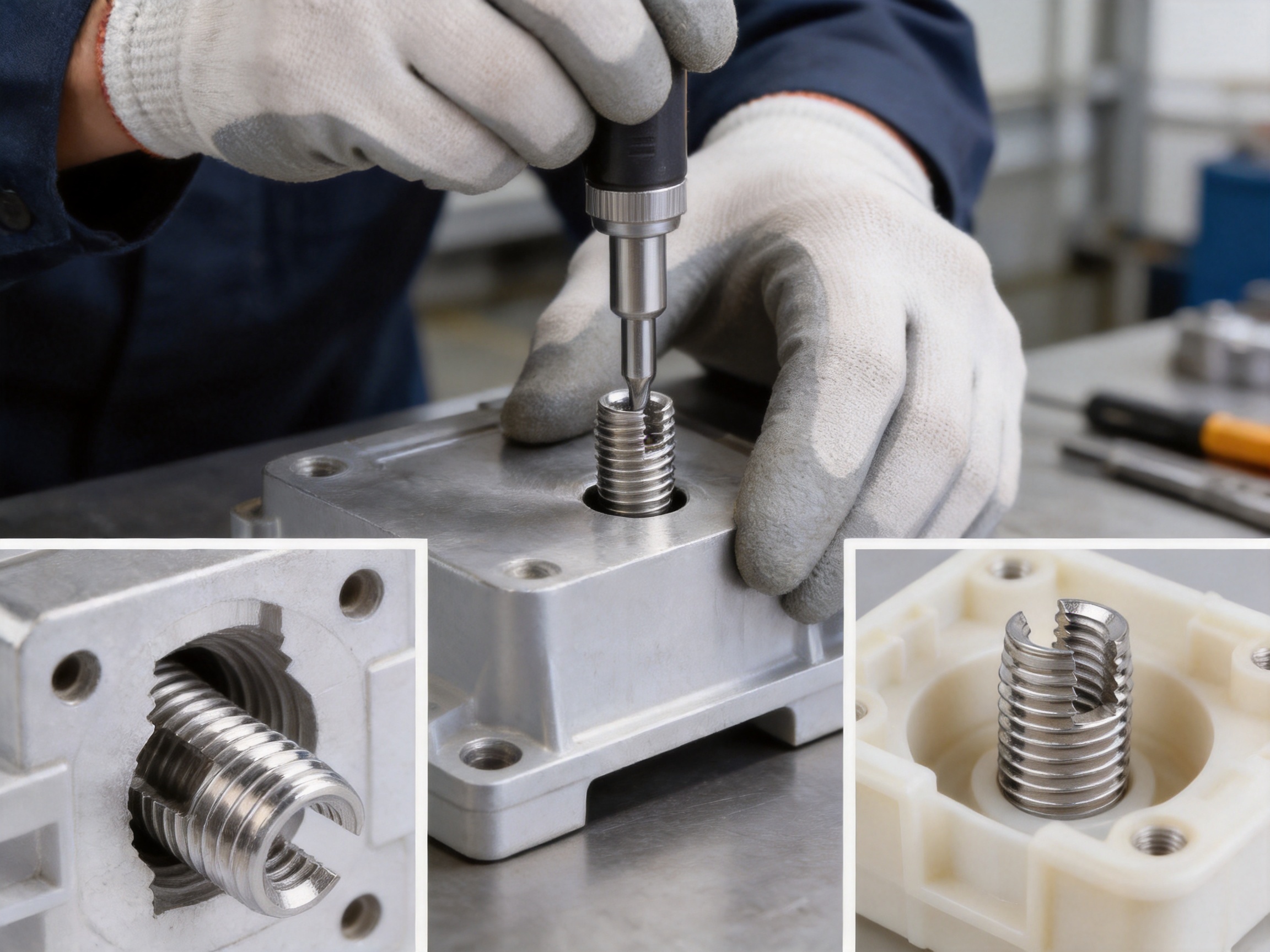
2. Prepare the Pilot Hole
The pilot hole must be drilled to the recommended diameter and depth. A hole that is too small may increase installation torque, deform the insert, or damage the base material. A hole that is too large may reduce external thread engagement and holding strength.
The supplied reference data provides different recommended drilling diameters for plastics, aluminum alloy, and cast iron. This reflects the fact that different materials have different cutting, forming, and holding characteristics. The values should be treated as product reference dimensions and verified against the final engineering drawing or supplier specification.
3. Remove Chips and Contamination
Debris, burrs, oil, paint, and loose material can affect installation quality. The hole should be cleaned before inserting the sleeve. For blind holes, the technician should ensure that chips do not accumulate at the bottom and prevent the insert from reaching the required depth.
4. Align the Installation Tool
The tool should remain aligned with the hole axis. Tilting the insert during installation may damage the external cutting thread or produce an angled internal thread. For production use, controlled tooling and fixtures can improve perpendicularity and repeatability.
5. Apply Controlled Installation Torque
Installation torque depends on insert size, material, hole diameter, lubrication, base material, and thread design. Excessive torque may distort the insert or crack a brittle plastic boss. Insufficient torque may leave the insert inadequately seated.
For high-volume production, the process should be validated with sample testing. Torque-controlled drivers, depth stops, and automated or semi-automated installation equipment can reduce variation between operators.
6. Verify Seating and Thread Function
After installation, inspect the insert for correct depth, alignment, damage, and surface condition. A matching bolt or calibrated thread gauge can be used to verify the internal thread. The fastener should engage smoothly without cross-threading or excessive resistance.
Where the connection is critical, pull-out, torque-out, proof-load, vibration, or environmental testing may be appropriate. Test methods should reflect the actual parent material and operating conditions rather than relying only on the nominal insert size.
Reference Dimensions for Type 302 Inserts
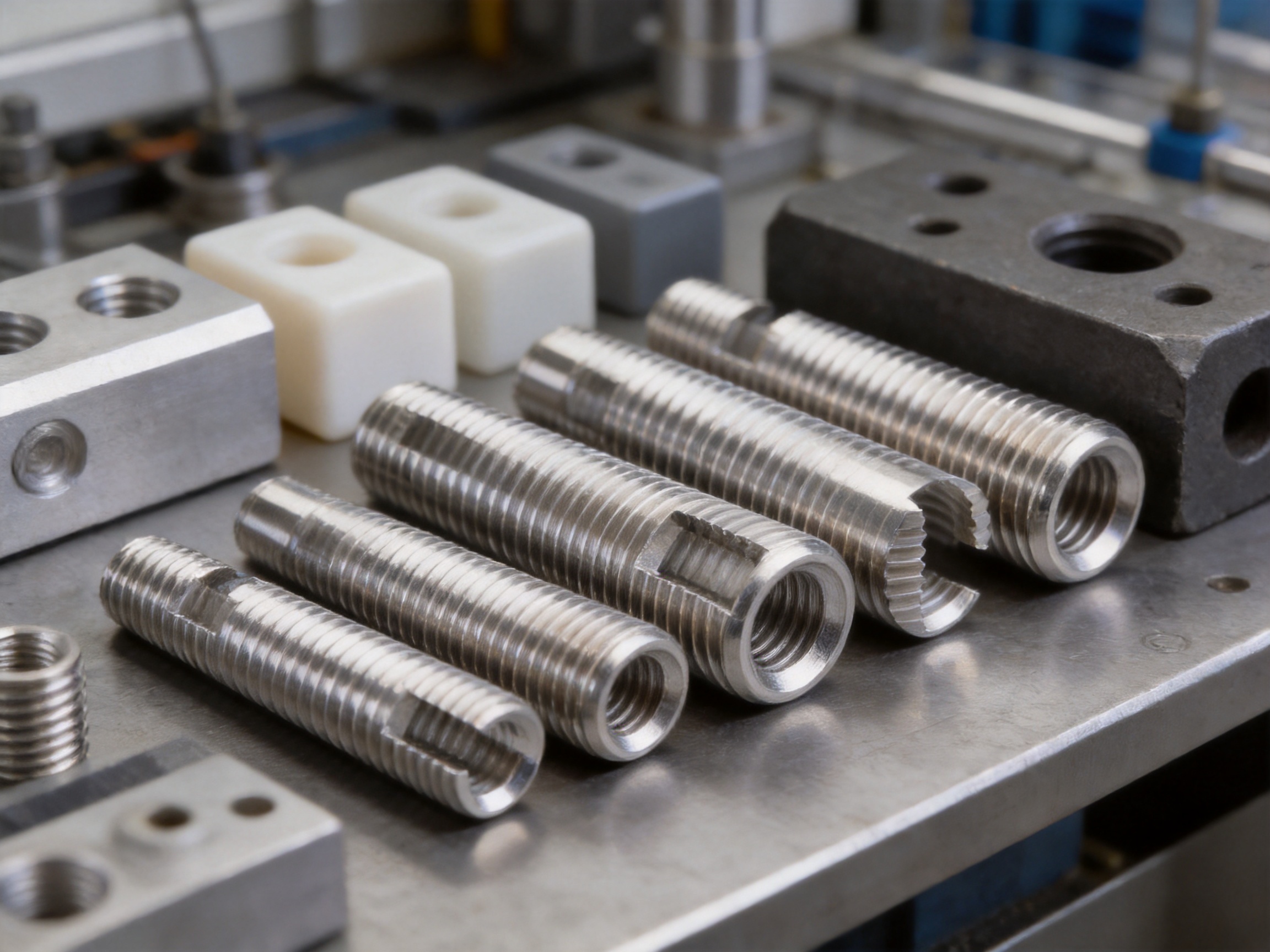
The following table summarizes the supplied reference range for Type 302 slotted self-inserting sleeves. The listed dimensions should be confirmed with the manufacturer before production release, particularly where the source data contains abbreviated or nonstandard notation.
| Metric internal thread | Approximate Unified equivalent | Length | External thread | Plastic pilot diameter | Aluminum alloy pilot diameter | Cast iron pilot diameter | Minimum drilling depth |
|---|---|---|---|---|---|---|---|
| M2-0.4 | Not specified | 6 mm | M4.5-0.5 | 4.0–4.1 mm | 4.1–4.2 mm | 4.2–4.3 mm | 8 mm |
| M2.5-0.45 | #2-56 | 6 mm | M4.5-0.5 | 4.0–4.1 mm | 4.1–4.2 mm | 4.2–4.3 mm | 8 mm |
| M3-0.5 | #4-40 | 6 mm | M5-0.5 | 4.5–4.6 mm | 4.6–4.7 mm | 4.7–4.8 mm | 8 mm |
| M4-0.7 | #8-32 | 8 mm | M6.5-0.75 | 5.8–5.9 mm | 6.0–6.1 mm | 6.1–6.2 mm | 10 mm |
| M5-0.8 | #10-24 | 10 mm | M8-1.0 | 7.1–7.2 mm | 7.3–7.5 mm | 7.5–7.6 mm | 13 mm |
| M6-1.0 | Not specified | 12 mm | M9-1.0 | 8.1–8.2 mm | 8.3–8.5 mm | 8.5–8.6 mm | 15 mm |
| M6-1.0 | 1/4-20 | 14 mm | M10-1.5 | 9.0–9.2 mm | 9.2–9.3 mm | 9.3–9.4 mm | 17 mm |
| M8-1.25 | 5/16-18 | 15 mm | M12-1.5 | 10.6–10.8 mm | 11.0–11.2 mm | 11.2–11.4 mm | 18 mm |
| M10-1.5 | 3/8-16 | 18 mm | M14-1.5 | 12.6–12.8 mm | 13.0–13.3 mm | 13.2–13.4 mm | 22 mm |
| M12-1.75 | 7/16-14 | 22 mm | M16-1.5 | 14.6–14.8 mm | 15.0–15.3 mm | 15.2–15.4 mm | 26 mm |
| M14-2.0 | 1/2-13 | 24 mm | M18-1.5 | 16.6–16.8 mm | 17.0–17.3 mm | 17.2–17.5 mm | 28 mm |
| M16-2.0 | 5/8-11 | 22 mm | M20-1.5 | 18.6–18.8 mm | 19.0–19.3 mm | 19.2–19.5 mm | 27 mm |
| M18-2.5 | Not specified | 24 mm | M22-1.5 | 20.6–20.8 mm | 21.0–21.3 mm | 21.2–21.5 mm | 29 mm |
| M20-2.5 | Not specified | 27 mm | M26-1.5 | 24.6–24.8 mm | 25.0–25.3 mm | 25.2 mm | 32 mm |
Dimensions can vary according to the final design, material grade, external thread profile, tolerance class, and customer requirements. For production applications, the controlled drawing and approved sample should take precedence over a general reference table.
Manufacturing Process and Production Strengths
A reliable self-tapping insert depends on more than the nominal stainless steel grade. Thread geometry, cutting performance, dimensional accuracy, surface quality, heat treatment where applicable, inspection, and packaging all influence field performance. A specialized manufacturer must control these factors across the full production process.
Material Preparation
Production begins with suitable stainless steel wire, bar, or tube stock. The material is selected according to the required grade, size, mechanical properties, and forming characteristics. Incoming material should be checked for identification, surface defects, dimensional conformity, and traceability.
Using controlled raw material helps ensure that the insert maintains consistent cutting behavior and internal thread strength. It also reduces the risk of mixed grades entering the production line.
Precision Forming and Machining
The sleeve body may be produced through cold forming, turning, thread rolling, cutting, drilling, or a combination of processes. The selected method depends on the insert size, geometry, production quantity, material condition, and tolerance requirements.
High-volume automated machinery can provide stable dimensions and efficient cycle times. CNC equipment and specialized thread-processing machines are useful for customized sizes, complex geometries, and smaller production batches.
External Thread Production
The external thread must be manufactured with sufficient accuracy to cut or form the mating thread in the base material. Thread pitch, major diameter, minor diameter, crest condition, lead, and cutting-groove geometry all influence installation torque and holding strength.
A properly controlled external thread allows the insert to enter the pilot hole smoothly while maintaining enough engagement with the parent material. Poorly formed cutting features can cause excessive torque, material cracking, incomplete seating, or weak retention.
Internal Thread Production
The internal thread must match the intended screw or bolt. Production controls should address pitch diameter, thread form, concentricity, lead, surface finish, and gauge acceptance. A stable internal thread ensures that the service fastener can be installed without cross-threading or abnormal friction.
Internal thread inspection may use go and no-go gauges, optical measurement, coordinate measurement, or other methods suitable for the size and tolerance. Critical orders may require documented inspection results for each batch.
Cutting Groove and Slot Control
For Type 302 slotted inserts, the cutting groove is a functional feature rather than a cosmetic detail. Its position, width, depth, and sharpness influence the self-tapping action. The groove must be formed consistently so that the insert cuts the parent material without excessive deformation or unpredictable torque.
The slot must also maintain adequate sleeve strength. If the slot is too deep or improperly positioned, the insert may lose structural integrity. If it is too shallow, the self-tapping function may be reduced.
Deburring and Surface Treatment
After machining or forming, inserts should be deburred and cleaned. Sharp unintended edges, loose metal particles, and residual processing contaminants can interfere with installation or damage the mating component.
Stainless steel inserts may be supplied with a clean natural finish or with a specified surface treatment, depending on customer requirements. Any treatment must be compatible with the base material, service environment, and internal thread function.
Inspection and Quality Management
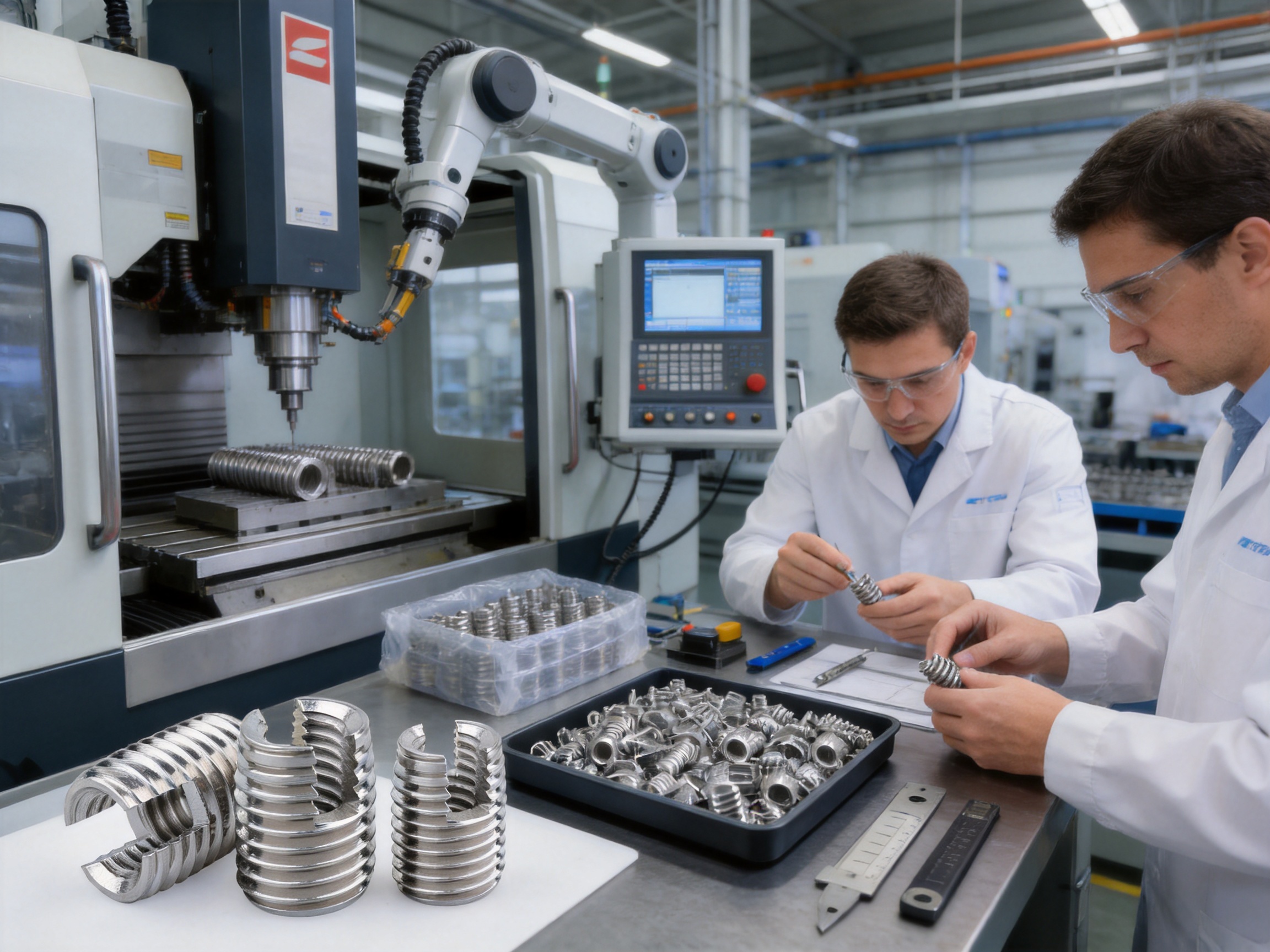
Quality inspection should cover raw material, in-process dimensions, thread accuracy, external geometry, slot condition, appearance, and final packaging. A rigorous quality management system helps identify process drift before nonconforming products reach the customer.
For demanding applications, inspection may include sampling plans, dimensional reports, material certificates, hardness checks, torque testing, pull-out testing, environmental exposure testing, and traceability records. The appropriate inspection level depends on the customer drawing and risk classification.
Automated Production Capability
Dongtai Jinzhize Metal Products Co., Ltd. operates an owned manufacturing plant of approximately 10,000 square meters equipped with hundreds of machine tools and automated production systems. This combination of facility scale, machinery, and process organization supports stable supply for standard and customized threaded connection products.
Automation can improve repeatability by reducing manual variation in feeding, forming, threading, inspection, and counting. It also supports higher production efficiency and helps maintain consistent output when customers require regular replenishment or large batch quantities.
Engineering and Customization Support
Different assemblies may require special external diameters, lengths, thread pitches, slot arrangements, materials, surface finishes, or packaging. A manufacturer with internal design and development capability can review the customer’s application and recommend a suitable insert structure.
Engineering support may include drawing review, prototype production, pilot-hole recommendations, installation guidance, sample validation, and production transition. This can reduce the risk of selecting a standard insert that does not fully match the parent material or loading conditions.
Why Work With a Specialized Threaded Connection Manufacturer?
A specialist in threaded connection products understands the interaction between inserts, taps, fasteners, installation tools, and parent materials. This broader product knowledge is valuable because the performance of an insert depends on the complete fastening system.
Dongtai Jinzhize Metal Products Co., Ltd. produces helical wire inserts, self-tapping inserts, key-locking inserts, threaded adapters, oil plugs, installation taps, and related tools. This product range allows customers to source complementary components from a single technical supplier rather than coordinating several independent vendors.
The company was established in 2015 and serves automotive, aerospace, rail vehicle, machinery, electronics, and other industrial sectors. Its stated production capability includes an experienced design, development, and manufacturing team, automated production systems, and a quality management process supported by after-sales service.
In 2024, the company reported an annual output value of 153 million RMB. This indicates an established manufacturing operation with the capacity to support ongoing customer programs and stable commercial supply. For buyers, production scale can be important when a product is used across multiple factories, vehicle platforms, equipment models, or service networks.
A specialized factory can also provide more direct communication between product engineers, production personnel, and quality teams. This helps accelerate technical clarification, resolve dimensional questions, and manage changes to drawings or specifications.
Application Engineering Considerations
Parent Material
The strength of the final joint depends heavily on the parent material. Plastic, aluminum, cast iron, and sheet metal each require different pilot-hole conditions and installation practices. The material’s hardness, thickness, fiber structure, temperature, and wall geometry should be considered before selecting an insert.
For soft plastics, the main concern may be pull-out and creep. For aluminum, thread stripping, galling, and galvanic effects may require attention. For cast iron, brittleness and cutting resistance can influence the pilot-hole size and installation torque.
Wall Thickness and Boss Design
The surrounding wall or boss must be thick enough to support the external thread. A hole placed too close to an edge may split the material or reduce holding strength. In plastic housings, the boss diameter should allow sufficient material around the insert while avoiding excessive stress concentration.
Insert Length
The insert should provide enough engagement to achieve the required load capacity. A longer insert is not automatically better if the available material depth is limited or if the sleeve interferes with internal components.
Blind holes should include adequate clearance below the insert. The minimum drilling depth listed in the reference data is greater than the nominal insert length, allowing space for the cutting action and installation clearance.
Fastener Selection
The fastener must match the insert’s internal thread standard and pitch. The bolt material, diameter, length, head style, strength class, coating, and tightening torque should be evaluated as part of the joint design.
Using a fastener with an incompatible pitch can cause cross-threading and permanent damage. The fastener should also provide adequate thread engagement without bottoming out in a blind-hole installation.
Environmental Exposure
Humidity, salt spray, cleaning agents, oils, fuels, chemicals, ultraviolet exposure, and temperature cycling can all affect joint performance. Stainless steel grade selection should reflect the actual environment rather than only the expected indoor or outdoor classification.
Galvanic compatibility should be reviewed when stainless steel is installed in aluminum or another dissimilar metal. Proper design, surface condition, drainage, protective coatings, and suitable assembly practices can help manage galvanic corrosion risk.
Comparison With Other Insert Types
Compared With Conventional Threaded Bushings
Conventional bushings may require a pre-tapped external hole or interference-fit installation. They can be effective, but the additional operation may increase production time. A self-tapping insert can simplify installation by creating its own external thread during insertion.
Compared With Wire Thread Inserts
Wire thread inserts are lightweight, flexible, and widely used for high-performance internal thread repair. However, they generally require a dedicated tap and installation tool. A self-tapping sleeve may be more convenient for applications where external thread cutting and sleeve-style construction are preferred.
Compared With Press-Fit Inserts
Press-fit inserts depend on interference between the insert and the parent material. They may require controlled pressing force and precise hole tolerances. Self-tapping inserts use an external thread to create mechanical engagement, which can provide a different balance of installation effort and holding strength.
Compared With Plastic Thread-Forming Solutions
Plastic thread-forming screws can work well in certain applications, but the resulting thread remains part of the plastic component. When repeated service, higher loads, or harsh environments are expected, a stainless steel insert provides a more durable and stable internal thread.
The best solution depends on cost, volume, installation equipment, load, service temperature, corrosion exposure, and maintenance requirements. Stainless steel self-tapping inserts are particularly attractive when reliability and repairability are more important than selecting the lowest initial component price.
Quality, Packaging, and Supply Reliability
Small threaded components can be highly sensitive to contamination, mixing, impact, and incorrect counting. Proper packaging should protect the threads and cutting features during transport and storage. Packaging labels should identify the part number, material, thread specification, quantity, batch, and inspection status where required.
Traceable packaging supports inventory control and helps prevent the accidental mixing of similar sizes. This is especially important where metric and Unified thread standards are both used in the same facility.
For repeat orders, the supplier should maintain the approved drawing, sample, material specification, process requirements, and inspection criteria. Change control is important because even a small modification to external diameter, slot geometry, or material condition may affect installation torque and holding strength.
Reliable supply also involves production planning, raw material availability, capacity management, lead-time communication, and responsive after-sales service. A factory with a broad machine base and automated production systems can often support both regular production and urgent replenishment more effectively than a small trading operation.
How to Specify the Product for Purchasing
A clear purchase specification should include the following information:
Internal thread size and pitch, such as M6-1.0 or 1/4-20.
External thread size and pitch, where specified by the design.
Insert length and overall geometry.
Stainless steel grade, such as 304 or 316.
Insert type, including Type 302 slotted style when required.
Parent material and recommended pilot-hole condition.
Through-hole or blind-hole installation.
Required dimensional tolerances and thread gauge standard.
Surface finish, cleaning, and corrosion requirements.
Packaging quantity, labeling, and traceability requirements.
Inspection documents, material certificates, sample approval, and testing requirements.
Providing these details enables the manufacturer to quote accurately and recommend the correct production method. When the customer does not yet have a complete specification, photographs, drawings, parent-material samples, fastener information, and service conditions can help the supplier develop an appropriate proposal.
Maintenance and Service Benefits
Thread inserts can extend the useful life of an assembly by making serviceable connections more resistant to wear. A reinforced thread is less likely to be damaged during routine maintenance, and a damaged hole may be repairable without replacing the complete component.
This can reduce downtime, spare-parts consumption, labor requirements, and waste. In fleet, industrial machinery, rail, and production-equipment applications, the ability to restore a threaded hole quickly may have significant economic value.
Maintenance teams should use the correct fastener, torque value, and installation procedure. If an insert becomes loose, damaged, or corroded, the cause should be investigated rather than simply replacing the sleeve. Possible causes include an oversized pilot hole, inadequate engagement, excessive torque, repeated overload, wrong fastener pitch, parent-material cracking, or environmental attack.
Performance Testing and Validation
Before approving a self-tapping insert for a critical application, engineers may conduct installation and performance tests in representative materials. Testing should use the actual hole size, component thickness, fastener, torque, and environmental conditions expected in service.
Installation Torque Testing
Installation torque testing determines whether the insert can be installed consistently without damaging the parent material. It also helps establish process limits for manual or automated assembly.
Pull-Out Testing
Pull-out testing measures the axial force required to remove the insert from the parent material. Results depend on insert length, external diameter, material strength, wall thickness, and installation quality.
Torque-Out Testing
Torque-out testing evaluates the resistance of the insert to rotational movement during fastener tightening or removal. This is useful where the service bolt may be tightened to a relatively high torque.
Vibration and Temperature Testing
Assemblies exposed to vibration or temperature cycling should be tested under representative conditions. Testing can reveal loosening, parent-material creep, loss of preload, corrosion effects, and changes in installation performance.
Testing requirements should be agreed with the supplier before production. A qualified manufacturer can help define sample quantities, acceptance criteria, and inspection methods suitable for the application.
Common Selection and Installation Errors
One common error is selecting the insert solely by internal thread size while ignoring the external diameter and pilot-hole requirement. The insert must be compatible with both the fastener and the parent material.
Another error is using the same pilot-hole diameter for every material. Plastic, aluminum alloy, and cast iron behave differently during cutting and thread engagement. The recommended values should be followed and validated where the application is critical.
Insufficient drilling depth is also a frequent problem. Chips or material displaced during self-tapping may prevent the insert from reaching the intended position. Blind holes should provide adequate clearance below the sleeve.
Cross-threading the service fastener can damage the internal thread. The fastener should be started by hand or with a controlled tool until proper engagement is confirmed.
Excessive tightening torque may damage the parent material, deform the insert, or cause cracking around a plastic boss. Torque limits should be established through testing or engineering calculation.
Finally, mixing similar-looking metric and Unified inserts can create serious assembly problems. Clear labeling, separated storage, barcode control, and thread gauges can reduce this risk.
Frequently Asked Questions
What materials can accept stainless steel self-tapping inserts?
They are commonly used in aluminum alloy, engineering plastics, cast iron, sheet metal, and other materials that can support the external cutting thread. The correct insert size and pilot-hole diameter depend on the hardness, thickness, and structure of the parent material.
Do these inserts require a pre-tapped external hole?
The Type 302 slotted design is intended to create its external thread during installation. Therefore, a separate pre-tapping operation is generally not required. A correctly sized and prepared pilot hole is still necessary.
Are 304 and 316 stainless steel interchangeable?
They may be interchangeable for some general applications, but they are not identical in corrosion performance or cost. Grade 316 is generally preferred for chloride-rich, marine, or highly corrosive environments, while 304 is suitable for many standard industrial applications.
Can a self-tapping insert repair a stripped aluminum thread?
Yes, it can often be used for thread repair if enough surrounding aluminum remains to support the larger external thread. The damaged hole must be reworked to the correct pilot diameter and checked for alignment, depth, and structural integrity.
Can these inserts be used in plastic housings?
Yes. They are particularly useful in plastic housings where direct threads may strip during repeated assembly. The plastic type, wall thickness, boss design, pilot-hole size, and installation torque should be validated to avoid cracking or creep.
How should the pilot-hole size be selected?
The pilot-hole size should be selected from the approved product drawing or supplier specification for the specific insert, parent material, and installation condition. The reference values for plastic, aluminum alloy, and cast iron are not automatically interchangeable.
What is the purpose of the cutting groove?
The cutting groove enables the external thread to engage and cut or form the parent material. It helps the insert install efficiently without a separately tapped external hole.
Are installation tools available?
A specialized threaded-connection manufacturer can commonly provide installation taps, drivers, mandrels, and related tools. The correct tool depends on the insert design and production method.
Can customized sizes be produced?
Customization may be possible for internal and external thread sizes, lengths, materials, slot geometry, surface condition, packaging, and inspection requirements. Customers should provide a drawing or application details for technical review.
How can thread quality be checked?
Internal and external threads may be checked with go and no-go gauges, optical instruments, dimensional equipment, and functional fastener tests. Critical applications may also require torque, pull-out, vibration, or environmental testing.
Are stainless steel inserts suitable for high-temperature applications?
They can be suitable for elevated-temperature applications, and the supplied product information identifies a range extending to approximately 600°C. However, the entire joint, including the base material, fastener, preload, oxidation environment, and duration of exposure, must be evaluated before approval.
What information should be sent when requesting a quotation?
Provide the internal thread, external thread if known, length, material grade, quantity, base material, application environment, drawing, required standards, packaging requirements, and inspection documents. Photos and samples can also help clarify a repair or custom requirement.
Conclusion
Stainless steel self-tapping thread inserts provide a practical way to strengthen and repair threaded connections in soft, lightweight, or easily damaged materials. Their self-tapping external thread simplifies installation, while the stainless steel sleeve supplies a durable internal thread with improved resistance to wear, vibration, corrosion, and temperature variation.
The Type 302 slotted design is especially useful for efficient assembly because its cutting groove allows the insert to form the external thread during installation. The availability of metric and Unified thread sizes supports a wide range of equipment and international manufacturing requirements.
Performance depends on correct selection, pilot-hole preparation, alignment, installation torque, insert depth, fastener compatibility, and parent-material design. For critical applications, testing and documented quality control should be included before production approval.
Dongtai Jinzhize Metal Products Co., Ltd. supports the threaded connection market with stainless steel self-tapping inserts and complementary products such as wire inserts, key-locking inserts, threaded adapters, oil plugs, taps, and installation tools. Its owned manufacturing facility, automated production systems, broad equipment base, engineering team, quality management process, and experience in automotive, aerospace, rail, and industrial applications provide a foundation for stable and scalable supply.
For customers seeking a durable alternative to direct threads, a specialized stainless steel self-tapping insert can reduce assembly complexity, improve connection reliability, extend component service life, and support more efficient repair and manufacturing programs.
References
1. Product information supplied for stainless steel self-tapping thread inserts, including Type 302 slotted sleeve dimensions and application guidance.
2. Stainless steel material data for commonly used austenitic grades 304 and 316.
3. General engineering principles for threaded joints, thread engagement, pilot-hole preparation, and torque-controlled installation.
4. General manufacturing practices for precision-machined threaded components, inspection, traceability, and automated fastener production.
5. General design considerations for corrosion-resistant fastening systems in automotive, aerospace, rail, electronic, industrial, and outdoor applications.



