Français
 Español
 Deutsch


Content
- 1 What Is a Stainless Steel Self-Tapping Thread Insert?
- 2 Why Thread Reinforcement Is Necessary
- 3 Material Advantages of Stainless Steel
- 4 Self-Tapping Installation Principle
- 5 Type 302 Slotted Design
- 6 Advantages Compared with Competing Thread Repair and Fastening Methods
- 7 Product Dimensions and Reference Selection Data
- 8 Installation Procedure
- 9 Manufacturing Process and Quality Considerations
- 10 Manufacturing Strengths of Dongtai Jinzhize Metal Products Co., Ltd.
- 11 Application Areas
- 12 How to Select the Correct Insert
- 13 Design and Engineering Recommendations
- 14 Quality, Supply, and Customization Support
- 15 Maintenance and Thread Repair Applications
- 16 Q&A
- 16.1 What is the main purpose of a stainless steel self-tapping thread insert?
- 16.2 Does the insert require a pre-tapped hole?
- 16.3 Can these inserts be used in plastic?
- 16.4 Can these inserts repair damaged aluminum threads?
- 16.5 What is the difference between 304 and 316 stainless steel?
- 16.6 How should the hole size be selected?
- 16.7 What happens if the hole is too small?
- 16.8 What happens if the hole is too large?
- 16.9 Are installation tools required?
- 16.10 Can the insert withstand vibration?
- 16.11 Are the inserts suitable for outdoor use?
- 16.12 What industries use these inserts?
- 16.13 Can custom sizes or specifications be requested?
- 17 Conclusion
- 18 References
- 19 Product: Stainless Steel Self-Tapping Thread Insert
Stainless steel self-tapping thread inserts provide a practical way to create, repair, and reinforce internal threads in soft or easily damaged materials. They are particularly useful when aluminum, plastic, light alloys, sheet metal, or other relatively low-strength substrates cannot reliably withstand repeated screw installation, vibration, impact, or high tightening loads. By combining a corrosion-resistant stainless steel body with an external self-tapping thread and a durable internal thread, these inserts improve connection strength while simplifying installation.
Compared with ordinary threaded holes, adhesive thread repair methods, and some conventional insert designs, self-tapping inserts offer an efficient balance of mechanical performance, installation speed, dimensional consistency, and long-term durability. The cutting geometry allows the insert to form its own external thread as it enters a correctly prepared hole. This eliminates the need for a separate tapping operation in many applications and reduces the number of tools required during assembly.
This article explains the construction, operating principle, material advantages, manufacturing capabilities, installation considerations, applications, and selection criteria associated with stainless steel self-tapping thread inserts. It also introduces the production strengths of Dongtai Jinzhize Metal Products Co., Ltd., a specialized manufacturer of threaded connection and fastening products for automotive, aerospace, rail, industrial, and general engineering applications.
What Is a Stainless Steel Self-Tapping Thread Insert?
A stainless steel self-tapping thread insert is a cylindrical threaded component installed into a prepared hole in a base material. Its outside surface is formed with a cutting or self-tapping thread, while its inside surface provides the finished thread required for a screw, bolt, stud, or other threaded fastener.
During installation, the external cutting edge engages with the substrate and forms a mechanical thread. The insert becomes secured through the interference and engagement between its outer thread and the surrounding material. Once installed, the internal thread provides a stronger and more wear-resistant fastening interface than the original soft-material thread would normally provide.
The product described in this article is a slotted Type 302 self-inserting screw sleeve. Its head and cutting groove support self-tapping installation, while its high-strength internal thread is designed to resist wear, vibration, and repeated fastening. The slotted structure assists cutting and helps the insert enter the base material efficiently when the correct installation method is used.
Unlike a conventional nut placed behind a panel, an insert can be installed directly into a blind or accessible hole without requiring a separate nut on the rear side. Unlike a simple threaded hole in plastic or aluminum, the insert provides a harder and more stable internal thread. Unlike some adhesive-mounted bushings, it does not depend primarily on adhesive bonding to maintain its position.
Why Thread Reinforcement Is Necessary
Many modern components are manufactured from materials selected for low weight, cost efficiency, electrical insulation, corrosion resistance, or ease of forming. Aluminum, magnesium alloys, engineering plastics, thermoplastics, and thin sheet materials can offer excellent overall performance, but their internal threads may have limited resistance to stripping and wear.
A directly tapped thread in a soft substrate can deteriorate for several reasons. Excessive tightening torque may pull the thread out of the base material. Repeated assembly and disassembly can wear the thread profile. Vibration may gradually reduce the holding force. Impact loads can deform the first few thread turns. Environmental exposure can weaken the substrate or promote corrosion when incompatible materials are used.
A stainless steel self-tapping insert addresses these limitations by transferring the threaded connection to a dedicated metal component. The insert distributes the applied load over a larger area of the surrounding material and provides a high-strength internal thread for the mating fastener. This is especially valuable where a screw must be removed and reinstalled during maintenance, inspection, repair, or product servicing.
Thread reinforcement also helps standardize assembly. When the internal thread is supplied by a consistent insert rather than cut directly into a variable substrate, the fastening interface becomes more predictable. This can improve torque control, reduce the risk of thread damage, and support more consistent production results.
Material Advantages of Stainless Steel
The inserts are manufactured from stainless steel grades such as 304 or 316, depending on the requested specification and application requirements. Stainless steel provides a combination of strength, corrosion resistance, dimensional stability, and service durability that is difficult to achieve with ordinary carbon steel in exposed or aggressive environments.
Corrosion and Rust Resistance
Stainless steel is well suited to applications exposed to humidity, rain, condensation, salt air, cleaning agents, and many industrial atmospheres. Grade 304 stainless steel is widely used for general corrosion-resistant applications, while grade 316 stainless steel is often selected for environments involving higher chloride exposure, marine conditions, or more demanding chemical resistance requirements.
Corrosion resistance is particularly important for an insert because the component may be installed inside a housing or assembly where future replacement is difficult. If the insert corrodes, the internal thread may become difficult to use, the installation area may expand or weaken, and the mating fastener may become seized. Selecting a suitable stainless steel grade helps preserve connection function over the intended service life.
Strength and Dimensional Stability
Stainless steel maintains a stable structure under normal mechanical loading and is less likely than many soft materials to deform under repeated tightening. The insert retains the shape of its internal thread and supports a reliable load path between the fastener and the base material.
Dimensional stability is also important during installation. A properly manufactured insert must maintain its outside diameter, thread profile, length, and internal thread dimensions within the applicable tolerance range. Consistent dimensions support predictable insertion torque and reduce the chance of installation failure.
Resistance to Humid and Saline Environments
Outdoor structures, photovoltaic supports, rail equipment, marine assemblies, and transportation systems may be exposed to water and salt. Stainless steel inserts offer improved protection in these conditions compared with unprotected steel alternatives. The actual performance depends on grade selection, surface condition, contact with dissimilar metals, exposure duration, and the surrounding environment, but stainless steel provides a strong foundation for corrosion-resistant design.
Wide Temperature Capability
The product information identifies an operating range from approximately -40°C to 600°C for suitable applications. Actual service limits should be evaluated according to the selected stainless steel grade, load, exposure duration, oxidation conditions, mating materials, and the complete assembly design. Within appropriate conditions, stainless steel provides dependable performance across both low-temperature and elevated-temperature environments.
Self-Tapping Installation Principle
The key feature of the insert is its built-in external cutting thread. A correctly sized hole is drilled into the base material, and the insert is driven into the hole using a suitable installation tool. As the insert advances, the cutting section engages with the substrate and forms the external thread required to secure the insert.
This process differs from a conventional threaded insert installation that requires the operator to tap the hole before inserting the component. Eliminating the separate pre-tapping operation can shorten the assembly sequence, reduce labor, and simplify field repairs. It can also be useful where access is limited and carrying multiple tools is inconvenient.
Self-tapping does not mean that hole preparation can be ignored. The hole diameter, depth, roundness, cleanliness, and alignment must be suitable for the selected insert. If the hole is too small, installation torque may become excessive and the insert or base material may be damaged. If the hole is too large, the external thread may not engage sufficiently and pull-out resistance may be reduced. If the hole is not deep enough, the insert may bottom out before reaching the intended position.
For these reasons, the referenced drilling diameter and minimum drilling depth should be treated as important installation parameters. Different base materials may require slightly different hole sizes because plastics, aluminum alloys, and cast iron respond differently to cutting forces and thread formation.
Type 302 Slotted Design
The Type 302 slotted design incorporates a cutting groove that supports self-insertion. The groove creates a cutting action as the sleeve enters the material, helping remove or displace substrate material and allowing the outer thread to form progressively.
The design is intended to provide several practical advantages:
First, the cutting groove supports efficient assembly and reduces the need for a separate tapping step. Second, the external thread creates a broad mechanical engagement area around the insert. Third, the internal thread provides a durable interface for the mating screw or bolt. Fourth, the metal sleeve helps protect the surrounding substrate from direct wear caused by repeated fastening.
The insert must be installed straight and with a controlled driving method. Misalignment can damage the first thread turns, increase installation torque, or cause the sleeve to sit at an angle. In precision assemblies, the final position should be checked to confirm that the insert is flush, correctly oriented, and free from damage.
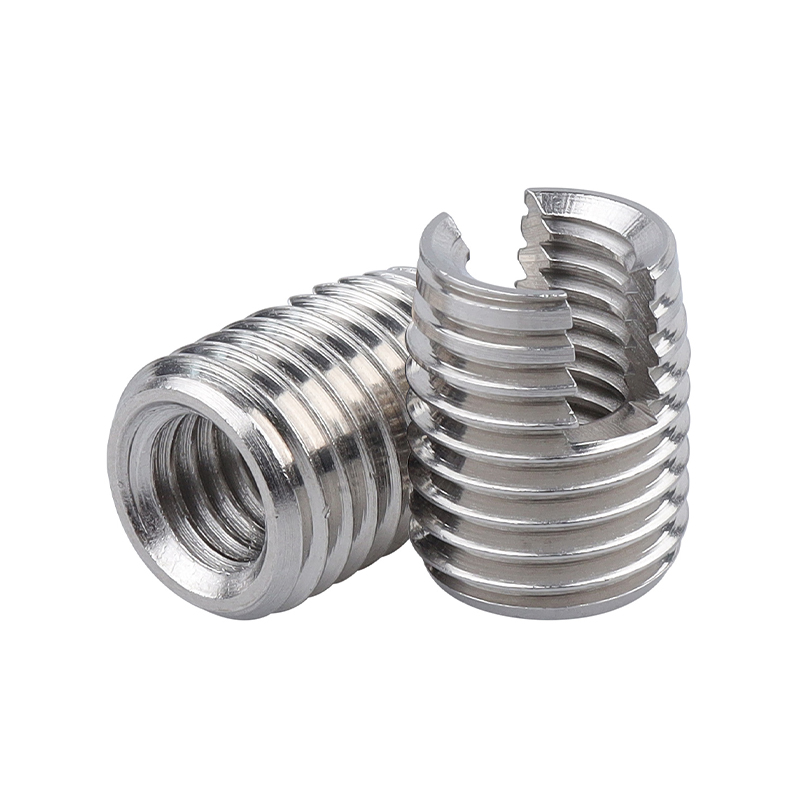
Stainless Steel Self-Tapping Thread Insert
Advantages Compared with Competing Thread Repair and Fastening Methods
Compared with Directly Tapped Plastic or Aluminum
A directly tapped hole is simple and inexpensive when the substrate is thick and strong enough. However, it may not provide sufficient durability in a soft material. The thread can strip during initial assembly, especially when the required clamping force is high. It can also become worn after multiple service cycles.
A stainless steel self-tapping insert creates a stronger internal thread without requiring the entire component to be manufactured from steel. This allows designers to retain the weight, cost, forming characteristics, and other advantages of aluminum or plastic while improving the fastening interface.
Compared with Helical Wire Inserts
Helical wire inserts are effective in many applications and can provide excellent thread repair performance. However, their installation commonly involves tapping the damaged or prepared hole with a special STI tap, installing the wire insert, and sometimes breaking or removing a tang. A self-tapping sleeve can reduce the number of installation steps because its outer thread performs the cutting function directly.
The choice between the two designs depends on the substrate, available space, required strength, installation equipment, and service conditions. A sleeve-style self-tapping insert can be especially attractive when a solid bushing is preferred, when installation speed is important, or when a blind hole must be reinforced without a separate pre-tapping operation.
Compared with Adhesive-Bonded Bushings
Adhesive-bonded bushings depend on surface preparation, adhesive selection, mixing or dispensing control, curing time, and temperature compatibility. These requirements may complicate production and field repair. A self-tapping insert creates mechanical engagement with the substrate and does not rely on adhesive curing as its primary retention method.
Adhesive may still be considered in special situations, such as when additional sealing or retention is required, but the insert itself is designed to provide mechanical installation and load transfer.
Compared with Captive Nuts and Rear-Side Fasteners
Captive nuts, weld nuts, and conventional nuts can provide strong threads, but they may require rear-side access, welding equipment, additional components, or a dedicated forming operation. Self-tapping inserts can often be installed from one accessible side, making them suitable for housings, panels, covers, and enclosed structures.
Compared with Unprotected Carbon Steel Inserts
Plain carbon steel inserts may offer satisfactory strength in dry indoor environments, but they can require plating or coating to resist rust. Coatings may be scratched during installation or damaged in service. Stainless steel provides corrosion resistance as an inherent material characteristic, helping reduce dependence on an external protective layer.
Product Dimensions and Reference Selection Data
The following table summarizes the listed Type 302 size range. The information includes metric and reference English thread designations, insert length, external thread size, recommended drilling diameters for different base materials, and minimum drilling depth. Dimensions should be confirmed against the manufacturer’s current drawing and the actual substrate before production use.
| Internal Thread | English Reference | Length | External Thread | Plastic Hole Diameter | Aluminum Alloy Hole Diameter | Cast Iron Hole Diameter | Minimum Drilling Depth |
|---|---|---|---|---|---|---|---|
| M2-0.4 | — | 6 mm | M4.5-0.5 | 4.0–4.1 mm | 4.1–4.2 mm | 4.2–4.3 mm | 8 mm |
| M2.5-0.45 | U#2-56 | 6 mm | M4.5-0.5 | 4.0–4.1 mm | 4.1–4.2 mm | 4.2–4.3 mm | 8 mm |
| M3-0.5 | U#4-40 | 6 mm | M5-0.5 | 4.5–4.6 mm | 4.6–4.7 mm | 4.7–4.8 mm | 8 mm |
| M4-0.7 | U#8-32 | 8 mm | M6.5-0.75 | 5.8–5.9 mm | 6.0–6.1 mm | 6.1–6.2 mm | 10 mm |
| M5-0.8 | U#10-24 | 10 mm | M8-1.0 | 7.1–7.2 mm | 7.3–7.5 mm | 7.5–7.6 mm | 13 mm |
| M6-1.0 | U/14-20 | 14 mm | M10-1.5 | 9.0–9.2 mm | 9.2–9.3 mm | 9.3–9.4 mm | 17 mm |
| M8-1.25 | U5/16-18 | 15 mm | M12-1.5 | 10.6–10.8 mm | 11.0–11.2 mm | 11.2–11.4 mm | 18 mm |
| M10-1.5 | U3/8-16 | 18 mm | M14-1.5 | 12.6–12.8 mm | 13.0–13.3 mm | 13.2–13.4 mm | 22 mm |
| M12-1.75 | U7/16-14 | 22 mm | M16-1.5 | 14.6–14.8 mm | 15.0–15.3 mm | 15.2–15.4 mm | 26 mm |
| M14-2.0 | U1/2-13 | 24 mm | M18-1.5 | 16.6–16.8 mm | 17.0–17.3 mm | 17.2–17.5 mm | 28 mm |
| M16-2.0 | U5/8-11 | 22 mm | M20-1.5 | 18.6–18.8 mm | 19.0–19.3 mm | 19.2–19.5 mm | 27 mm |
| M18-2.5 | — | 24 mm | M22-1.5 | 20.6–20.8 mm | 21.0–21.3 mm | 21.2–21.5 mm | 29 mm |
| M20-2.5 | — | 27 mm | M26-1.5 | 24.6–24.8 mm | 25.0–25.3 mm | 25.2 mm | 32 mm |
The table is a reference guide rather than a substitute for application testing. The ideal hole size may vary according to material hardness, material thickness, hole-making method, insert tolerance, installation equipment, and required pull-out performance. For critical assemblies, sample testing should be completed before full-scale production.
Installation Procedure
1. Confirm the Insert Specification
Select the internal thread size, length, stainless steel grade, and external thread configuration before preparing the component. The insert length should provide adequate engagement without extending into a moving mechanism, interfering with a bottom surface, or breaking through a thin wall.
2. Prepare the Hole
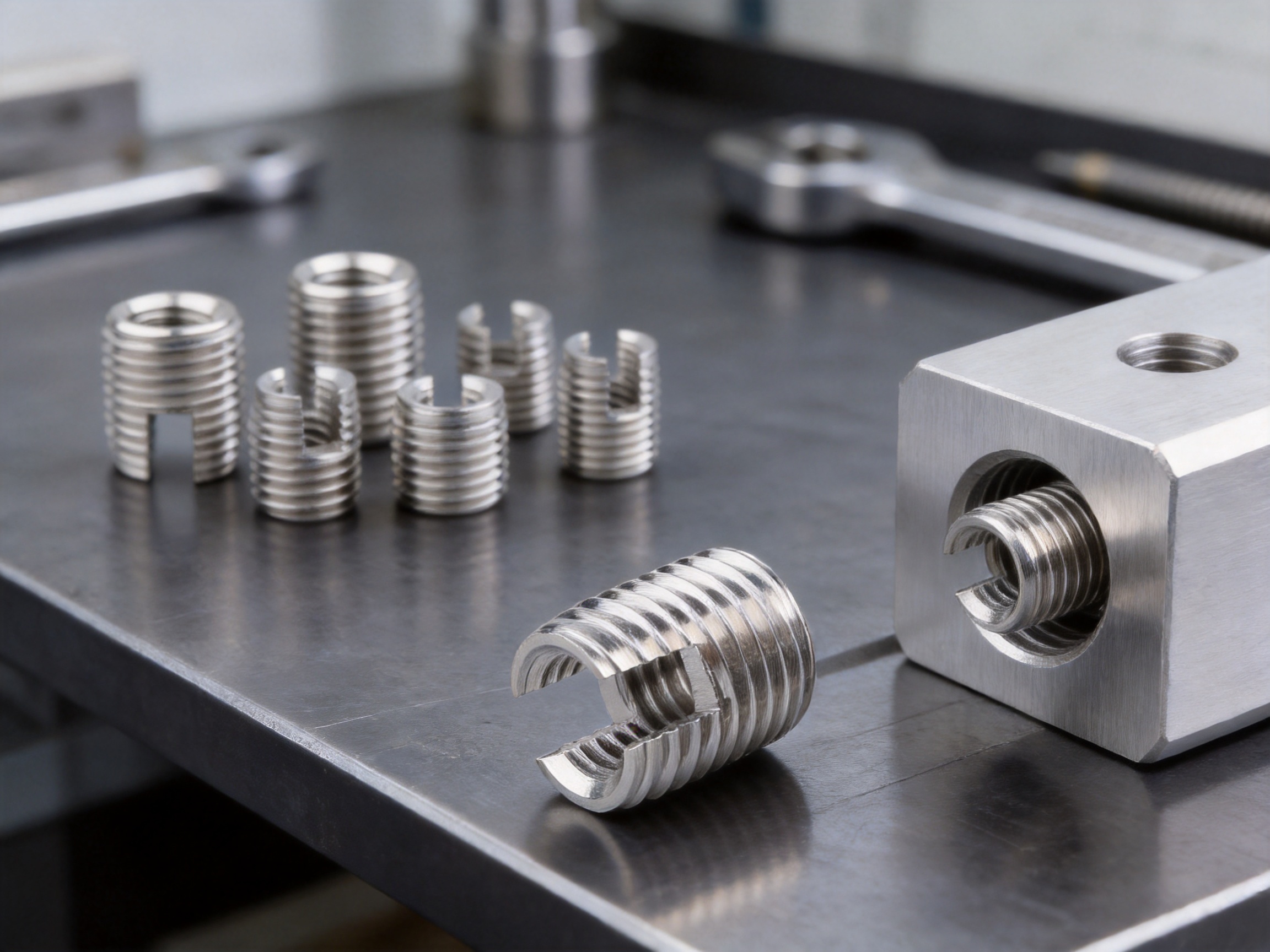
Drill a hole according to the recommended size for the selected base material. The hole should be clean, aligned, and free from burrs that could prevent the insert from entering correctly. In a blind hole, the depth should exceed the minimum recommended drilling depth and should provide sufficient clearance for cutting debris and the complete insert length.
3. Align the Installation Tool
Use an appropriate mandrel, driver, or installation tool that engages the insert without damaging the internal thread. Keep the tool aligned with the hole axis. Angular misalignment can increase insertion torque and produce uneven engagement.
4. Drive the Insert into Position
Apply steady rotational force while maintaining axial alignment. Avoid excessive speed or impact unless the installation equipment is specifically designed for the insert. The insert should cut and engage progressively. If torque rises sharply before the insert reaches the required depth, stop and inspect the hole size, depth, alignment, and presence of debris.
5. Check the Finished Connection
After installation, verify that the insert is seated at the correct depth and that the internal thread is clear. A suitable gauge, test screw, or mating bolt may be used to confirm thread function. The insert should not rotate, tilt, or pull out during normal assembly conditions.
For high-volume production, installation torque, seating depth, tool condition, and inspection frequency should be documented. Process controls help identify tool wear, drill variation, material changes, or incorrect hole preparation before they affect a large number of components.
Manufacturing Process and Quality Considerations
The performance of a self-tapping insert depends on more than the nominal material grade. The cutting groove, external thread, internal thread, end geometry, length, surface condition, and dimensional tolerances must work together. Manufacturing consistency is therefore essential.
Material Control
Production begins with the selection and verification of stainless steel material. Grade identification, incoming inspection, and traceability help ensure that the finished inserts meet the intended corrosion and strength requirements. For customers operating in marine, chemical, outdoor, or high-temperature environments, material selection should be confirmed before production.
Precision Forming and Machining
The sleeve geometry is produced through controlled forming and machining operations. The external self-tapping thread must have an effective cutting profile, while the internal thread must accept the specified mating fastener. The cutting groove must be positioned and formed consistently so that installation force remains within an appropriate range.
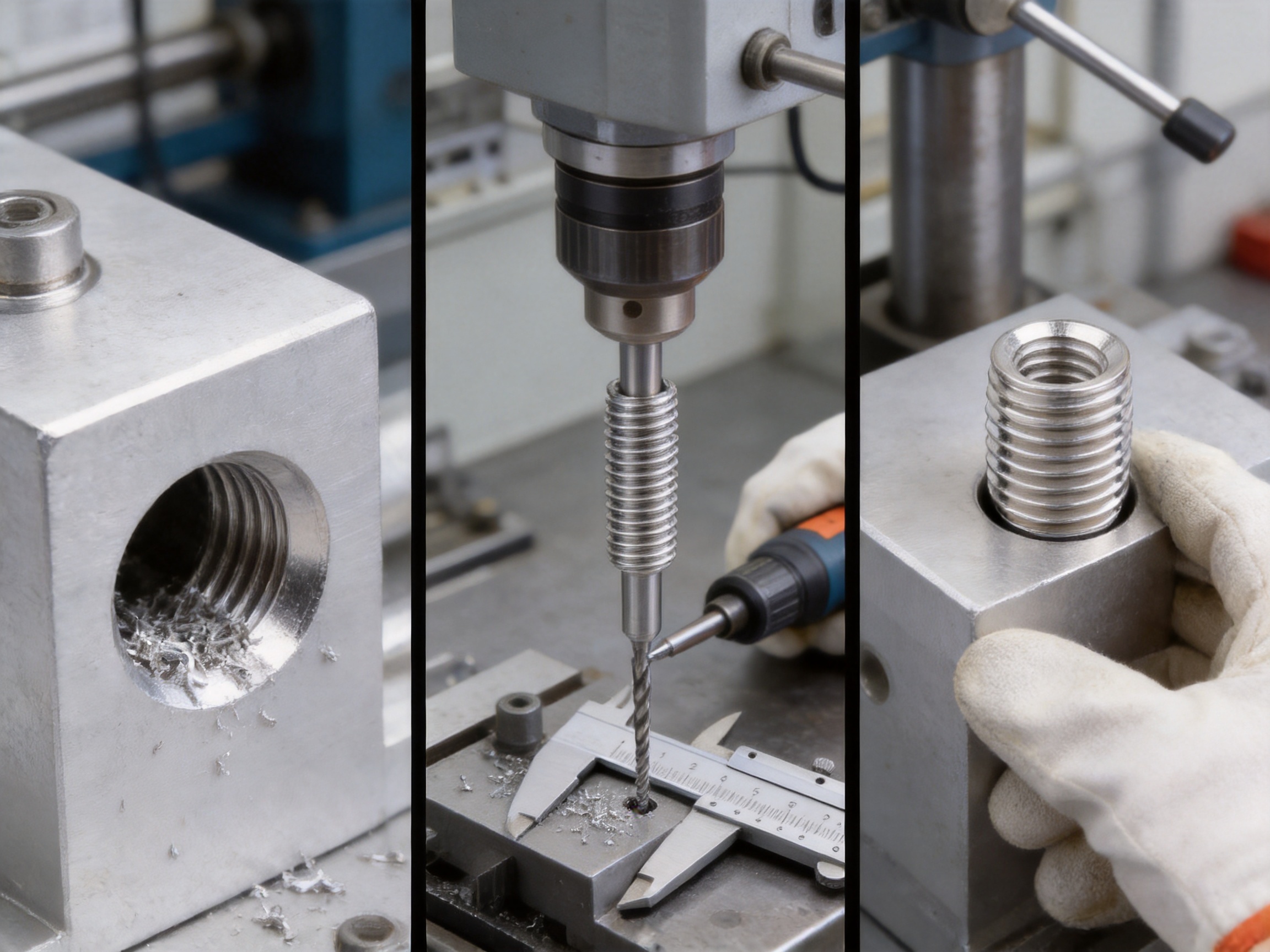
Computer-controlled machine tools and automated production systems can support repeatable dimensions across large batches. Consistent tooling, process parameters, and inspection routines are important for maintaining thread accuracy and reducing variation from one production lot to another.
Thread Inspection
Internal and external threads should be inspected using suitable gauges and dimensional measurement methods. Typical checks may include pitch, major diameter, minor diameter, thread form, length, concentricity, and visual condition. Inspection requirements depend on the customer drawing, applicable standards, and intended application.
Surface and Visual Inspection
Stainless steel inserts should be checked for burrs, cracks, deformation, blocked grooves, damaged thread crests, discoloration, and other conditions that could affect installation or performance. The cutting groove must remain open and functional. The internal thread must be free from material that could obstruct the mating screw.
Process Traceability
Traceability supports quality management by connecting finished products with material batches, production equipment, inspection records, and packaging information. It is especially valuable for automotive, aerospace, rail, and other industries where component history and consistent documentation are important.
Manufacturing Strengths of Dongtai Jinzhize Metal Products Co., Ltd.
Dongtai Jinzhize Metal Products Co., Ltd. specializes in threaded connection products and complementary fastening solutions. Its product range includes helical wire inserts, self-tapping inserts, key-locking inserts, threaded adapters, oil plugs, installation taps, and related tools. This product concentration allows the company to develop experience across multiple thread reinforcement and repair technologies rather than treating inserts as an isolated product category.
Established in 2015, the company operates a 10,000-square-meter owned manufacturing plant. The facility is equipped with hundreds of machine tools and automated production systems. This equipment base supports production capacity, repeatability, and the ability to manage different product sizes and configurations.
For self-tapping inserts, manufacturing capability is important because the product includes several functional features in a relatively compact component. The outer thread must cut and retain the insert, the internal thread must accept the mating fastener, and the body must withstand installation and service loads. A manufacturer with dedicated equipment, experienced personnel, and process controls is better positioned to maintain these requirements consistently.
The company has developed an experienced team covering design, development, and production. This combination supports product customization when customers need a particular size, length, material grade, thread configuration, or application-specific specification. Engineering communication is also important when the insert will be installed in a nonstandard material or used under unusual loads or environmental exposure.
Jinzhize applies a quality management approach supported by production inspection and after-sales service. For customers purchasing fastening components for critical assemblies, service does not end with shipment. Selection guidance, dimensional confirmation, installation recommendations, sample evaluation, and issue response all contribute to reducing procurement and usage risk.
The company reports broad application experience in automotive engines and transmissions, passenger and commercial vehicles, aerospace manufacturing, rail vehicles, and other industrial products. These sectors typically require stable supply, consistent dimensions, reliable traceability, and dependable support because a small thread failure can cause assembly delays or service problems.
In 2024, the company achieved an annual output value of 153 million RMB. This figure reflects an established production capability and the ability to support large-scale supply. Capacity is particularly relevant for customers that require ongoing delivery rather than occasional small batches.
Application Areas
Automotive Manufacturing
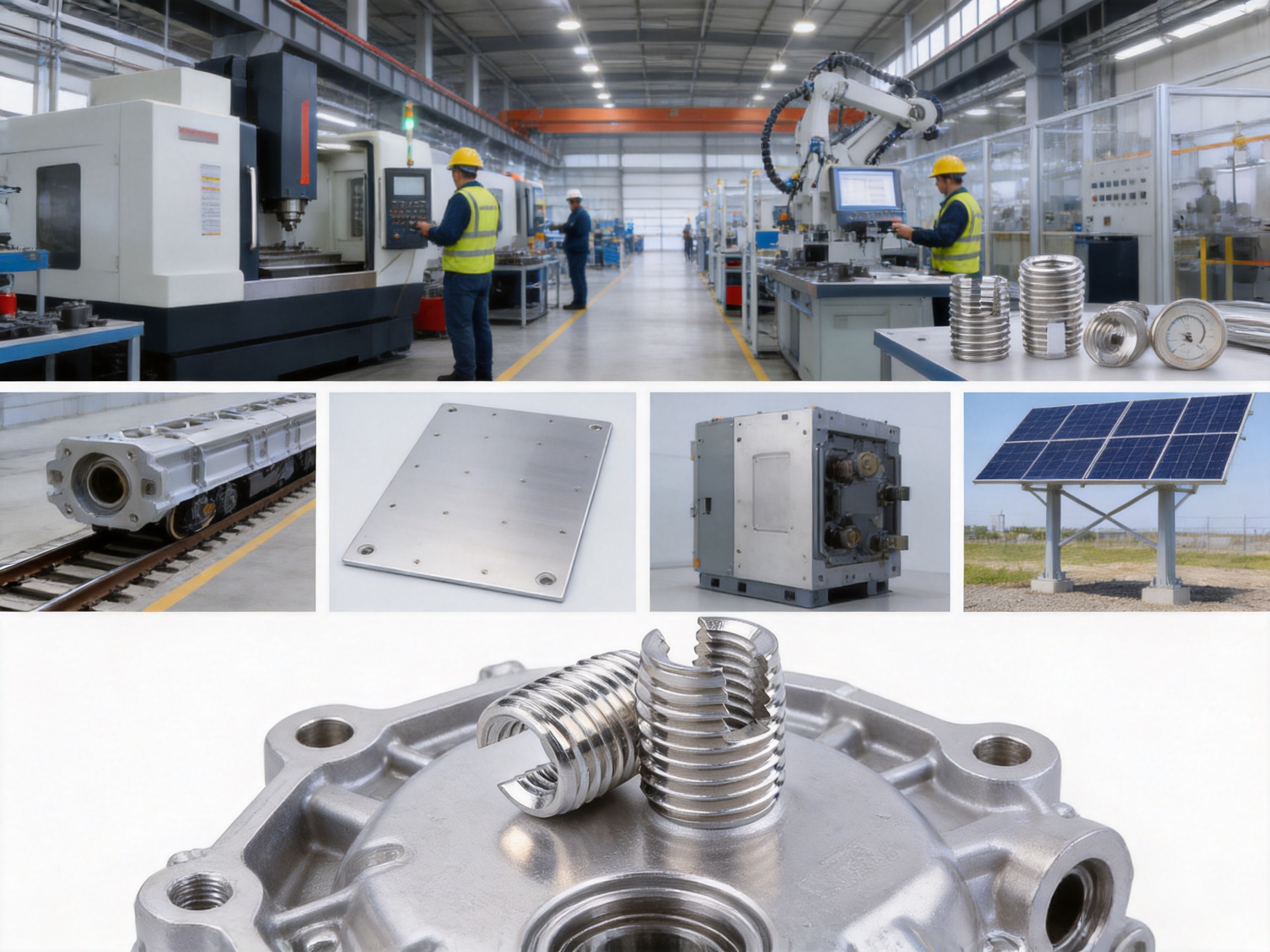
Automotive components are exposed to vibration, thermal cycling, shock, oil, moisture, and repeated maintenance. Self-tapping inserts can reinforce threads in engine accessories, transmission housings, interior components, brackets, chassis-related parts, and other assemblies where the original material is relatively soft or where thread repair is required.
In vehicle production, the insert can help create consistent fastening points in aluminum housings and plastic components. In repair operations, it may restore a damaged threaded hole without replacing the complete housing or component. The correct insert length and material grade should be selected according to the component structure and operating conditions.
Aerospace and Rail Vehicles
Aerospace and rail applications place emphasis on weight control, structural reliability, vibration resistance, maintainability, and documentation. Aluminum and lightweight alloys are frequently used to reduce mass, but their threads may require reinforcement when subject to repeated fastening or high load.
A stainless steel insert can provide a durable internal thread while allowing the surrounding component to remain lightweight. Because aerospace and rail applications can involve strict engineering controls, insert selection, installation procedures, inspection, and traceability should be reviewed against the applicable project requirements.
Electronics and Electrical Equipment
Plastic and aluminum housings for communication equipment, instruments, control systems, and electrical products often need secure threaded connections. The insert can be installed during initial production or used to repair a damaged housing. Stainless steel also provides a clean, durable fastening interface for equipment that may be exposed to humidity or temperature variation.
Outdoor Structures
Railings, photovoltaic supports, outdoor equipment frames, cabinets, and other structures may experience rain, condensation, wind vibration, and salt exposure. Stainless steel self-tapping inserts can improve corrosion resistance and help extend the service life of threaded connections when combined with compatible fasteners and suitable assembly practices.
Industrial Machinery
Machine housings, covers, fixtures, guards, sheet metal parts, and equipment frames may require threads in materials that are too thin or soft for direct tapping. Inserts can increase thread durability and support repeated maintenance. Their availability in metric sizes and reference English sizes helps manufacturers standardize fastening interfaces across different equipment designs.
How to Select the Correct Insert
Consider the Base Material
The base material affects hole diameter, insertion torque, pull-out strength, and resistance to deformation. Plastics may require a different hole size from aluminum alloys, while cast iron and other harder materials may require additional attention to cutting performance and installation force.
Determine the Required Internal Thread
The internal thread must match the intended screw or bolt. The thread system, nominal diameter, pitch, and tolerance should be confirmed before ordering. Mixing metric and inch thread systems can result in poor engagement or damage, even when the nominal diameters appear similar.
Choose the Correct Length
Longer inserts generally provide more internal thread engagement and a larger load-transfer area, but excessive length may interfere with the rear wall or internal components. The selected length should correspond to the component thickness, available hole depth, expected load, and required engagement length.
Evaluate the Environment
For indoor, dry applications, 304 stainless steel may be suitable. For marine or chloride-rich environments, 316 stainless steel may provide a more appropriate level of corrosion resistance. Temperature, chemical exposure, cleaning processes, galvanic contact, and moisture retention should all be considered.
Review Installation Access
Self-tapping inserts are useful where only one side of the component is accessible. However, the tool still requires enough space to remain aligned with the hole. The installation method should be evaluated during product design rather than after the component has entered production.
Define Performance Requirements
Critical applications may require pull-out testing, torque testing, vibration testing, thermal cycling, corrosion testing, or repeated assembly testing. The insert should be validated in the actual substrate, because performance is determined by the complete insert-and-material system rather than by the insert alone.
Design and Engineering Recommendations
Designers should provide enough surrounding material around the insert to prevent cracking, splitting, or local deformation. Edge distance, wall thickness, boss diameter, and hole depth all influence performance. A narrow plastic boss may fail even when the insert itself has adequate strength.
Blind-hole applications should include clearance for cutting debris and should avoid allowing the insert to bottom out before the external thread is fully engaged. Through-holes may provide easier inspection, but the rear side should be evaluated for protrusion and interference.
The mating fastener should have a compatible thread and an appropriate length. The screw should not bottom out inside the insert before clamping the assembly. If a locking feature, seal, washer, or coating is used, its effect on installation torque and corrosion behavior should be considered.
When stainless steel inserts are installed in aluminum, designers should evaluate galvanic compatibility, particularly in wet or saline environments. Suitable fastener selection, isolation methods, protective treatments, drainage, and sealing may be required depending on the application.
Installation torque should be established through testing rather than copied from an unrelated insert or material. Torque is affected by hole diameter, substrate hardness, lubrication, thread condition, tool speed, insert geometry, and alignment. A controlled process window can improve consistency without overloading the insert or damaging the base material.
Quality, Supply, and Customization Support
Industrial customers commonly require more than a standard catalog dimension. They may need a specific material grade, length, thread combination, packaging quantity, inspection report, labeling method, or delivery schedule. A specialized manufacturer can support these requirements through coordinated engineering and production planning.
Jinzhize serves global customers with threaded connection and fastening products. Its manufacturing scope covers standard products and supports application-oriented communication for different industries. The combination of an owned production facility, automated systems, experienced personnel, and a broad product family helps customers consolidate sourcing for related fastening components.
Stable supply is especially important in automotive, aerospace, rail, and industrial machinery programs. Production interruptions caused by inconsistent quality or uncertain delivery can create significant costs beyond the purchase price of the insert. A capable supplier should therefore be evaluated on quality consistency, technical communication, production capacity, traceability, packaging, and response capability.
Customers can improve purchasing accuracy by providing the following information during an inquiry: base material, hole type, component thickness, internal thread size, insert length, required stainless steel grade, operating temperature, corrosion environment, expected load, installation method, annual quantity, and inspection requirements.
Maintenance and Thread Repair Applications
One important advantage of self-tapping inserts is their usefulness in repair work. A stripped or damaged thread in an aluminum or plastic part does not always require replacement of the entire component. After evaluating the damage, the hole may be opened or prepared to the correct size, and a suitable insert may be installed to restore a durable internal thread.
Repair personnel should remove loose material, ensure that the hole is sufficiently round, and verify that enough surrounding material remains to support the insert. If the damage extends into a crack or severely weakened boss, an insert alone may not provide a reliable repair. The repaired connection should be tested under representative assembly conditions.
For maintenance programs, keeping a range of insert sizes and suitable installation tools can reduce equipment downtime. Because the product family includes multiple metric sizes and reference English sizes, maintenance departments can select a compatible replacement for different equipment designs.
Q&A
What is the main purpose of a stainless steel self-tapping thread insert?
Its main purpose is to create or reinforce an internal thread in a soft, thin, or damaged base material. The stainless steel sleeve provides a stronger and more durable thread for the mating screw or bolt than the substrate may provide by itself.
Does the insert require a pre-tapped hole?
The Type 302 slotted design is intended to self-tap into a correctly prepared hole. It normally does not require a separately pre-tapped external thread, although the hole must still be drilled to the recommended diameter and depth.
Can these inserts be used in plastic?
Yes. They are suitable for many plastic applications, especially where direct plastic threads may strip or wear. The correct hole diameter must be selected for the specific plastic because material hardness, elasticity, wall thickness, and temperature behavior vary considerably.
Can these inserts repair damaged aluminum threads?
They can be used for many aluminum thread repair applications when sufficient surrounding material remains. The damaged hole must be prepared to the required dimensions, and the repaired connection should be tested if it is used in a critical or highly loaded assembly.
What is the difference between 304 and 316 stainless steel?
Both grades provide corrosion resistance, but 316 stainless steel generally offers better resistance in chloride-rich and marine environments. The appropriate grade depends on exposure conditions, cost requirements, fastener compatibility, and engineering specifications.
How should the hole size be selected?
Use the manufacturer’s recommended drilling diameter for the selected insert and base material. The listed values differ for plastic, aluminum alloy, and cast iron because each material responds differently to the self-tapping thread. Application testing is recommended for critical connections.
What happens if the hole is too small?
A hole that is too small can cause excessive installation torque, damage the insert, crack the substrate, or prevent the insert from reaching the required depth. It may also distort the internal thread or cutting groove.
What happens if the hole is too large?
A hole that is too large may reduce external thread engagement and pull-out resistance. The insert may rotate, loosen, or fail to develop the intended mechanical connection with the substrate.
Are installation tools required?
A suitable driver, mandrel, or installation tool is recommended to keep the insert aligned and prevent damage. Standard tools may be suitable for some sizes, but production environments should use controlled equipment matched to the insert design.
Can the insert withstand vibration?
The product is designed to provide strong vibration resistance and anti-loosening performance when correctly installed. Actual results depend on substrate strength, installation quality, mating fastener torque, joint design, vibration level, and environmental conditions.
Are the inserts suitable for outdoor use?
Stainless steel inserts are suitable for many outdoor applications because they provide improved resistance to moisture and corrosion. The selected grade, mating fastener, joint sealing, drainage, and exposure to salt or chemicals should be evaluated together.
What industries use these inserts?
Applications include automotive manufacturing and repair, aerospace, rail vehicles, electronics, electrical equipment, industrial machinery, outdoor facilities, photovoltaic supports, communication equipment, and general mechanical assembly.
Can custom sizes or specifications be requested?
Customers should communicate their required thread system, length, material grade, external geometry, application conditions, and quantity. A specialized manufacturer can evaluate whether a standard product is suitable or whether a customized specification is required.
Conclusion
Stainless steel self-tapping thread inserts provide a reliable method for strengthening threaded connections in aluminum, plastic, cast iron, sheet metal, and other materials that may not support durable direct threads. Their self-tapping external geometry simplifies installation, while the stainless steel body supplies corrosion resistance, dimensional stability, wear resistance, and a strong internal thread.
The Type 302 slotted design is particularly useful when assembly efficiency, one-sided access, and thread reinforcement are important. Compared with direct tapping, adhesive bonding, rear-side nuts, and some multi-step insert systems, it can reduce installation complexity while delivering a robust mechanical connection. Correct hole preparation, alignment, material selection, insert length, and process control remain essential to achieving dependable performance.
Dongtai Jinzhize Metal Products Co., Ltd. supports this product category with specialized manufacturing experience, a 10,000-square-meter production facility, hundreds of machine tools, automated production systems, engineering and production personnel, and a broad portfolio of threaded connection products. Its experience in automotive, aerospace, rail, and industrial applications positions it to provide both standard inserts and application-focused fastening solutions.
For customers seeking stable, corrosion-resistant, and efficient thread reinforcement, stainless steel self-tapping inserts offer a practical solution. When the insert is correctly matched to the substrate and installed under controlled conditions, it can extend component life, reduce thread-related failures, simplify repair, and improve the consistency of threaded assembly.
References
1. Stainless Steel Material Selection Principles for Mechanical Fasteners, technical reference literature.
2. General Engineering Practices for Threaded Inserts and Thread Repair, industrial fastening guidance.
3. Thread Form, Pitch, and Dimensional Inspection Principles, mechanical manufacturing reference.
4. Corrosion-Resistant Stainless Steel Applications in Outdoor and Marine Equipment, materials engineering reference.
5. Installation and Quality-Control Practices for Self-Tapping Threaded Inserts, industrial assembly guidance.
6. Product dimensional data and application information supplied for Type 302 stainless steel self-tapping thread inserts.
7. Manufacturing and company capability information supplied by Dongtai Jinzhize Metal Products Co., Ltd.