

 Français
 Español
 Deutsch

Content
- 1 1. What Is a Carbon Steel Three-Hole Thread Insert?
- 2 2. Core Construction and Operating Principle
- 3 3. Main Advantages Compared with Conventional Alternatives
- 4 4. Material and Surface Protection Options
- 5 5. Available Sizes and Dimensional Selection
- 6 6. Recommended Installation Process
- 7 7. Manufacturing Process and Quality Control
- 8 8. Manufacturing Strengths of the Supplier
- 9 9. Application Areas
- 10 10. Design Considerations for Engineers
- 11 11. Quality and Procurement Advantages
- 12 12. Comparison with Other Thread Reinforcement Products
- 13 13. How to Improve Assembly Reliability
- 14 14. Frequently Asked Questions
- 14.1 Q1: What is the main purpose of a three-hole thread insert?
- 14.2 Q2: Which materials are suitable for this insert?
- 14.3 Q3: What is the difference between 307 type and 308 type?
- 14.4 Q4: Does the insert require separate locking keys?
- 14.5 Q5: Can the insert be used in a blind hole?
- 14.6 Q6: Are coatings available?
- 14.7 Q7: How should the drilling diameter be selected?
- 14.8 Q8: Can the insert repair a stripped thread?
- 14.9 Q9: Is carbon steel suitable for outdoor applications?
- 14.10 Q10: What quality advantages does a specialized manufacturer provide?
- 14.11 Q11: Is the product suitable for automotive and aerospace applications?
- 14.12 Q12: What information should be included in an inquiry?
- 15 15. Conclusion
- 16 References
- 17 Product: Carbon Steel 3-Hole Thread Insert
Reliable threaded connections are essential wherever components must remain securely fastened under vibration, impact, repeated loading, temperature variation, and frequent maintenance. In many industrial assemblies, however, the parent material does not naturally provide sufficient thread strength. Aluminum alloys, cast iron, soft steel, plastics, and other relatively soft materials can suffer from stripped threads, loosening, deformation, or premature wear when threaded holes are used repeatedly. A carbon steel three-hole thread insert offers a practical solution by creating a durable internal thread while strengthening the surrounding base material.
The Carbon Steel Three-Hole Thread Insert is a self-tapping threaded sleeve designed for thread reinforcement and thread repair. Its three evenly distributed external grooves or positioning holes allow the surrounding parent material to deform locally during installation. This deformation creates an interlocking effect between the insert and the base material, improving resistance to rotation, loosening, and shifting. Unlike a standard smooth or conventional self-tapping insert, the three-hole design adds a dedicated anti-rotation feature without requiring separate keys, pins, or auxiliary locking accessories.
Manufactured from high-quality carbon steel, the insert combines mechanical strength, impact resistance, and dependable thread performance. It is suitable for industrial applications involving aluminum alloy, cast iron, soft steel, and comparable materials. The internal thread can provide a stronger and more durable fastening point for bolts, screws, studs, and other threaded components.
This article examines the design, material properties, manufacturing considerations, installation process, dimensional selection, application advantages, and quality strengths associated with carbon steel three-hole thread inserts. It also explains why a specialized manufacturer with dedicated production equipment, automated manufacturing systems, inspection procedures, and application experience can offer more consistent results than a general-purpose fastener supplier.
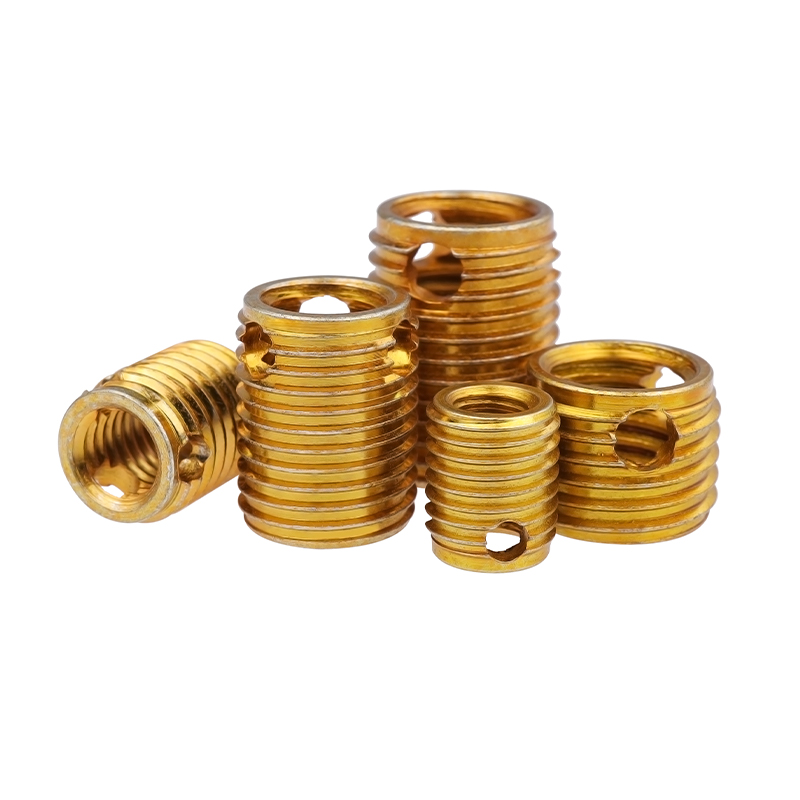
Carbon Steel 3-Hole Thread Insert
1. What Is a Carbon Steel Three-Hole Thread Insert?
A carbon steel three-hole thread insert is a cylindrical threaded sleeve with an internal thread and a specially formed external self-tapping profile. The external surface includes three self-tapping circular grooves or positioning holes arranged around the circumference. During installation, these features interact with the prepared hole in the parent material. The result is a mechanically locked connection between the insert and the surrounding material.
The insert performs two primary functions. First, it reinforces the internal thread by replacing a relatively weak parent-material thread with a stronger carbon steel thread. Second, it resists rotation by allowing the parent material to flow or deform into the external grooves. This combination makes the product particularly valuable in applications where a normal tapped hole would be vulnerable to wear or where vibration could cause a conventional insert to turn.
Three-hole inserts are commonly classified as 307 type and 308 type. Both styles use a three-hole or three-groove structure and are designed for self-tapping installation. The 308 type is generally the reinforced version, while the primary distinction in the supplied dimensional range is length. Selection between the two types should be based on the required engagement length, parent-material thickness, applied load, installation depth, and the engineering requirements of the assembly.
Unlike wire thread inserts, which use a helically wound wire coil, a three-hole insert is a solid sleeve. Unlike key-locking inserts, it does not normally depend on separate locking keys driven into the parent material. Unlike ordinary non-holed self-tapping inserts, it incorporates an external anti-rotation structure. These differences give the product a distinct position among thread reinforcement solutions.
2. Core Construction and Operating Principle
2.1 Solid Carbon Steel Sleeve
The body of the insert is formed from carbon steel. The solid sleeve construction provides a continuous load-bearing surface around the internal thread. When a bolt is tightened, the clamping load is transferred through the insert rather than directly through the softer parent material. This helps distribute stress over a larger area and reduces the risk of internal thread stripping.
Carbon steel also provides greater resistance to impact and deformation than many soft base materials. This is important in machinery, sheet metal structures, automotive components, and industrial furniture, where fasteners may experience shock loads, vibration, or repeated assembly and disassembly.
2.2 Internal Thread Formation
The internal thread is manufactured to receive the specified metric or Unified thread fastener. Once properly installed, the insert creates a stable threaded connection with a steel-on-steel internal engagement surface. This can improve thread life in applications where a bolt must be removed and installed repeatedly for inspection, service, adjustment, or replacement.
The internal thread should be selected to match the bolt or screw used in the final assembly. For example, an insert with an M6-1.0 internal thread is intended for an M6 bolt with a 1.0 mm pitch. Imperial options are also available in the supplied range, including U#4-40, U#8-32, U#10-24, U1/4-20, U5/16-18, U3/8-16, U7/16-14, U1/2-13, and U5/8-11 equivalents.
2.3 Three External Anti-Rotation Features
The defining feature is the three-hole external structure. The positioning holes or circular grooves are evenly distributed around the insert. During self-tapping installation, the parent material is displaced into these features. Once the insert reaches its intended position, the surrounding material forms a mechanical interlock that helps prevent the sleeve from rotating.
This is especially useful when the assembly is exposed to alternating torque. A conventional insert may gradually rotate if the tightening torque, loosening torque, and vibration exceed the frictional holding force between the insert and the parent material. The three-hole structure adds a positive mechanical resistance to rotation, improving stability in demanding service conditions.
2.4 Self-Tapping External Profile
The external profile is designed to cut or form its own engagement in a properly prepared hole. This reduces the number of installation operations compared with solutions that require a separate external thread to be tapped before the insert is fitted. However, the hole diameter and drilling depth remain critical. An incorrectly sized hole can lead to excessive installation force, insufficient retention, parent-material cracking, or inadequate pull-out and torque performance.
3. Main Advantages Compared with Conventional Alternatives
3.1 Stronger Threads in Soft Materials
The most important benefit is the creation of a high-strength internal thread in a base material that may otherwise be unsuitable for repeated or heavily loaded fastening. Aluminum alloy is lightweight and easy to machine, but its internal threads can be more susceptible to wear and stripping than steel threads. Plastic offers design flexibility and electrical insulation, but its thread strength and temperature resistance may be limited. A carbon steel insert provides a more durable interface for the final fastener.
By transferring bolt load through the steel sleeve, the insert helps protect the parent material from localized thread damage. The result can be a more reliable connection without replacing the entire component with a heavier or more expensive steel part.
3.2 Improved Anti-Rotation Performance
Many standard inserts depend mainly on friction between their external surface and the parent material. That approach may be adequate in low-vibration applications, but it can be less effective when a fastener is repeatedly tightened or when the assembly experiences dynamic loads. The three-hole design improves mechanical engagement and helps prevent insert rotation.
This anti-rotation capability is a major advantage over smooth external sleeves and certain conventional non-holed inserts. It also provides an alternative to key-locking systems when separate locking keys are undesirable because of installation time, available space, cost, or the risk of damaging the component.
3.3 No Separate Anti-Rotation Accessories
A three-hole insert can be positioned and installed with dedicated installation tools without adding separate keys, pins, or external locking components. Fewer components can simplify inventory management and reduce assembly steps. It can also help improve process consistency because the installer does not need to perform an additional locking operation after the insert has been driven into the hole.
The absence of separate anti-rotation accessories is particularly beneficial in compact assemblies, blind holes, sheet metal structures, and production lines where reducing handling operations can improve throughput.
3.4 Resistance to Shock and Vibration
Carbon steel provides a robust load-bearing structure, while the three-point external engagement helps resist movement. Together, these features make the insert suitable for machinery and vehicle-related applications where vibration and impact may contribute to fastener loosening.
The insert does not eliminate the need for correct bolt tightening, suitable joint design, or appropriate locking methods where required. Instead, it strengthens the threaded location and adds anti-rotation resistance to the insert itself. The full joint must still be evaluated according to the operating loads, materials, tolerances, and applicable engineering standards.
3.5 Efficient Installation
The self-tapping structure allows the insert to form its external engagement during installation. Compared with a multi-stage repair process, this can reduce labor and tooling requirements. A dedicated driver, installation mandrel, or other suitable tool can be used to control alignment, depth, and torque.
Efficient installation is not simply a matter of speed. A controlled process also reduces the likelihood of tilted inserts, damaged internal threads, inconsistent seating depth, or excessive deformation of the parent material. In production environments, the correct insert and tool combination can support repeatable assembly quality.
3.6 Cost-Effective Thread Reinforcement
Replacing a weak aluminum or plastic component with a steel part may increase weight, cost, machining time, and material consumption. A three-hole thread insert reinforces only the threaded location that needs additional strength. This makes it a cost-effective option for manufacturers seeking to preserve the design advantages of the original base material while improving connection performance.
The product can also reduce scrap and extend the useful life of components with damaged or worn threads, provided the damaged hole can be prepared to the required insert dimensions. In maintenance and repair work, this can be more economical than replacing a complete housing, bracket, cover, or structural part.
4. Material and Surface Protection Options
4.1 Carbon Steel Mechanical Performance
Carbon steel is selected for its balance of strength, toughness, machinability, and cost. In a threaded insert, these properties support the internal thread under tightening and service loads. The material also provides resistance to impact and deformation during installation and operation.
Material selection should be matched to the working environment. Factors such as temperature, humidity, chemical exposure, galvanic interaction, bolt material, parent-material composition, and required service life should be considered before final specification. For highly corrosive environments, surface protection and compatibility evaluation are particularly important.
4.2 Optional Coatings
The product supports zinc, color zinc, and other coating options according to application requirements. A suitable coating can improve resistance to humidity and atmospheric corrosion while also providing a recognizable appearance or product identification.
Zinc coatings are commonly considered for general industrial use where improved corrosion resistance is required. Color zinc may be selected for visual identification, product differentiation, or a particular appearance. The coating thickness, treatment method, dimensional influence, and compatibility with the mating bolt should be confirmed during specification.
Coating selection should also account for the installation process. Some coatings can affect friction, driving torque, dimensional fit, and the interaction between the insert and the parent material. For safety-critical or high-reliability assemblies, coating requirements should be documented together with the insert material, thread size, length, and inspection criteria.
5. Available Sizes and Dimensional Selection
The supplied product range covers a broad selection of metric internal threads with corresponding Unified thread references. The external thread, recommended drilling diameter, minimum drilling depth, and insert length must all be considered together. The following table summarizes the available dimensional information.
| Metric Internal Thread | Unified Thread Reference | 307 Length | 308 Length | External Thread | Aluminum Drilling Diameter | Cast Iron Drilling Diameter | 307 Minimum Depth | 308 Minimum Depth |
|---|---|---|---|---|---|---|---|---|
| M3-0.5 | U#4-40 | 4 mm | 6 mm | M5-0.6 | 4.6–4.7 mm | 4.7–4.8 mm | 6 mm | 8 mm |
| M4-0.7 | U#8-32 | 6 mm | 8 mm | M6.5-0.8 | 6.0–6.1 mm | 6.1–6.2 mm | 8 mm | 10 mm |
| M5-0.8 | U#10-24 | 7 mm | 10 mm | M8-1.0 | 7.4–7.5 mm | 7.6–7.7 mm | 9 mm | 13 mm |
| M6-1.0 | U1/4-20 | 8 mm | 12 mm | M10-1.25 | 9.3–9.4 mm | 9.5–9.6 mm | 10 mm | 15 mm |
| M8-1.25 | U5/16-18 | 9 mm | 14 mm | M12-1.5 | 11.1–11.3 mm | 11.3–11.5 mm | 11 mm | 17 mm |
| M10-1.5 | U3/8-16 | 10 mm | 18 mm | M14-1.5 | 13.1–13.3 mm | 13.3–13.5 mm | 13 mm | 22 mm |
| M12-1.75 | U7/16-14 | 12 mm | 22 mm | M16-1.75 | 15.0–16.2 mm | 15.3–15.5 mm | 15 mm | 26 mm |
| M14-2.0 | U1/2-13 | 14 mm | 24 mm | M18-2.0 | 17.0–17.2 mm | 17.3–17.5 mm | 17 mm | 28 mm |
| M16-2.0 | U5/8-11 | 14 mm | 24 mm | M20-2.0 | 19.0–19.2 mm | 19.3–19.5 mm | 17 mm | 28 mm |
The table is a reference for product selection and should not replace a controlled engineering drawing or application-specific validation. Drilling recommendations can vary according to the actual parent material, production method, hole condition, coating, and required installation torque. Before mass production, manufacturers should confirm the hole size and depth through representative testing.
5.1 Selecting the Internal Thread
The internal thread must match the fastener used in the completed assembly. Thread diameter and pitch determine compatibility, while the fastener grade and engagement length influence the load capacity. Metric and Unified thread standards should not be mixed unless a specifically designed conversion product is being used.
5.2 Selecting the Insert Length
The selected length should provide sufficient internal thread engagement while respecting the thickness and geometry of the parent component. A longer insert generally provides more engagement area, but it must not extend into a cavity, interfere with another component, or break through a thin wall. The 307 and 308 options provide different length choices across the range, with the 308 version generally offering the longer or reinforced configuration.
5.3 Selecting the Drilling Diameter
The recommended drilling diameter depends on the parent material. The supplied data differentiates between aluminum alloy and cast iron. This distinction reflects differences in hardness, deformation behavior, and cutting resistance. Using an incorrect drilling diameter can directly affect installation torque and retention performance.
5.4 Confirming Minimum Drilling Depth
The minimum drilling depth must exceed the insert length sufficiently to accommodate the complete sleeve and any installation lead or tool clearance. Blind holes require particular attention because insufficient depth may cause the insert to bottom out before reaching the intended seating position. The drilling process should also account for chip clearance and the geometry of the hole bottom.
6. Recommended Installation Process
6.1 Inspect the Component
Before installation, inspect the parent material for cracks, excessive damage, distortion, contamination, or insufficient wall thickness. A thread insert cannot compensate for a structurally unsound component. If the original hole is damaged, it should be machined or drilled to the specified preparation diameter rather than simply forcing the insert into the damaged opening.
6.2 Prepare the Hole
Drill the hole to the recommended diameter for the insert size and parent material. Keep the drill aligned with the original hole axis. Inaccurate alignment can produce an angled insert, uneven wall engagement, or difficulty starting the self-tapping profile.
For a blind hole, verify that the available depth is greater than the specified minimum. Remove chips, burrs, cutting fluid residue, and other contaminants. The entrance edge should be clean and suitable for starting the insert. If the application requires a countersink or chamfer, it should be produced according to the approved drawing or installation procedure.
6.3 Select the Correct Tool
Use a dedicated installation tool that matches the insert size and design. The tool should support the insert without damaging the internal thread. A suitable driver helps control axial alignment, driving torque, and installation depth.
Production facilities may use manual, pneumatic, electric, or automated installation equipment depending on volume and product geometry. Regardless of the equipment, the process should prevent cross-threading, tilting, over-driving, and damage to the insert surface.
6.4 Start the Insert Carefully
Position the insert perpendicular to the prepared hole. Apply steady axial pressure while rotating the tool in the specified direction. The first threads must engage evenly. If unusual resistance is encountered at the start, stop and inspect the alignment and hole condition rather than applying excessive force.
6.5 Drive to the Required Depth
Continue installation until the insert reaches the approved position. The insert should normally be seated at the specified depth relative to the component surface. Over-driving can damage the parent material, distort the internal thread, or place the insert below the intended fastening plane. Under-driving can leave insufficient thread engagement or create interference with the mating part.
6.6 Inspect the Finished Installation
After installation, check the insert for correct depth, alignment, surface condition, and internal thread quality. Pass a suitable thread gauge or mating fastener through the insert by hand where appropriate. The fastener should engage smoothly without binding caused by debris, distortion, or incorrect thread specification.
For critical production applications, inspection may include installation torque monitoring, internal thread gauging, visual checks, pull-out testing, torque-out testing, and periodic destructive verification. The exact inspection plan should reflect the performance requirements and risk level of the assembly.
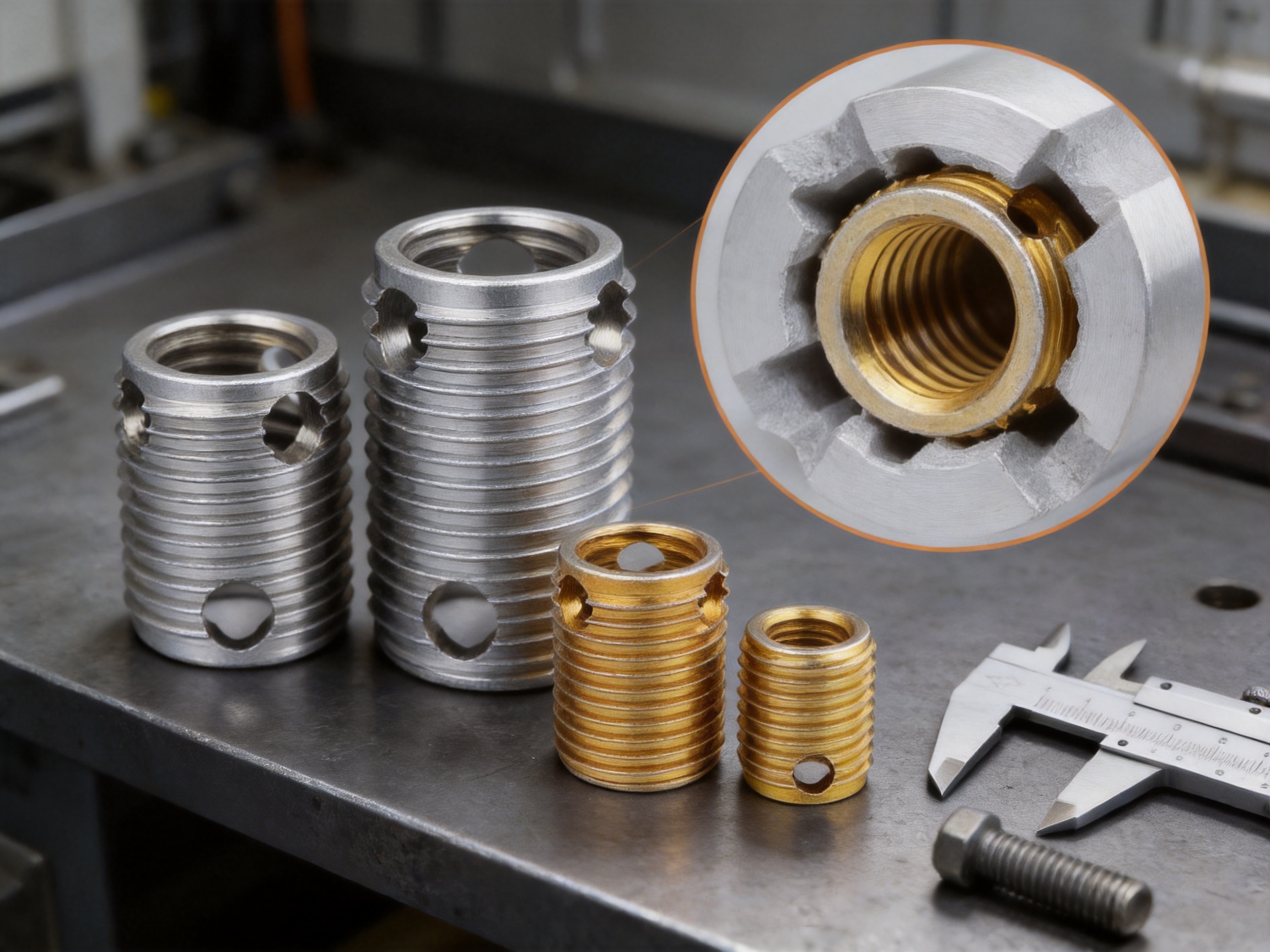
7. Manufacturing Process and Quality Control
The performance of a three-hole thread insert depends not only on its nominal dimensions but also on material consistency, thread accuracy, external groove geometry, surface finish, heat treatment where applicable, coating quality, and process control. A specialized manufacturer can provide advantages by controlling these stages within an integrated production system.
7.1 Material Preparation
Production begins with suitable carbon steel raw material selected according to the required mechanical and dimensional properties. Incoming material can be reviewed for size, composition documentation, surface condition, and traceability. Consistent raw material helps stabilize forming, cutting, threading, and finishing operations.
7.2 Precision Forming and Machining
The cylindrical body is produced using controlled forming and machining operations. The external self-tapping profile and three evenly spaced circular grooves must be formed with consistent geometry. Variations in groove depth, spacing, or edge condition can affect installation torque and anti-rotation performance.
The internal thread is machined or formed to the specified metric or Unified thread requirement. Thread tools must be selected and maintained to preserve pitch, diameter, flank geometry, and surface quality. Process monitoring helps identify tool wear before it produces large quantities of nonconforming inserts.
7.3 Automated Production Systems
The manufacturing facility operates hundreds of machine tools and automated production systems within an owned plant of approximately 10,000 square meters. This equipment base supports stable production capacity and helps reduce dependence on manual handling for repetitive operations.
Automation can improve repeatability in part feeding, machining, threading, groove formation, dimensional checking, and batch handling. It also supports more consistent cycle times and production planning. For customers purchasing large quantities or requiring regular supply, manufacturing scale is an important advantage because product availability and batch continuity can be maintained more effectively.
7.4 In-Process Inspection
In-process quality checks can be applied at critical stages rather than relying only on final inspection. Typical control points include external diameter, internal thread dimensions, insert length, groove geometry, surface condition, coating appearance, and installation performance.
Inspection equipment may include thread gauges, dimensional measuring tools, optical systems, torque testing equipment, and other application-specific instruments. The purpose is to detect deviations early, limit process variation, and improve traceability from raw material to finished product.
7.5 Surface Treatment Control
When zinc, color zinc, or another coating is specified, coating control is required to preserve both corrosion resistance and dimensional compatibility. Important considerations include coating coverage, adhesion, thickness, appearance, and the effect of treatment on the internal thread and external self-tapping profile.
A professional production process treats coating as an engineered part of the product rather than merely an aesthetic finishing step. The coating must support the intended storage, installation, and service environment without preventing the insert from fitting correctly or increasing installation force beyond the acceptable range.
7.6 Traceability and Batch Consistency
Traceability is valuable for automotive, aerospace, rail, machinery, and other applications where customers need to identify the production batch, material information, inspection records, or coating details. A controlled quality management system can connect production records with shipment information and customer specifications.
Batch consistency is especially important when inserts are used in automated assembly. Small changes in external diameter, thread fit, or driving torque can influence machine settings and line productivity. Stable manufacturing reduces the need for repeated adjustment and helps customers maintain predictable assembly conditions.
8. Manufacturing Strengths of the Supplier
The supplier is Dongtai Jinzhize Metal Products Co., Ltd., a specialized manufacturer focused on threaded connection and fastening products. Established in 2015, the company has developed dedicated experience in helical wire inserts, self-tapping inserts, key-locking inserts, threaded adapters, oil plugs, installation taps, and related tools.
Its product focus provides an important advantage over suppliers that treat threaded inserts as a minor product category. Specialized production experience supports better understanding of thread standards, insert geometry, installation tooling, parent-material behavior, and customer application requirements.
The company operates from an owned manufacturing facility measuring approximately 10,000 square meters. The plant includes hundreds of machine tools and automated production systems. This combination of facility ownership, equipment capacity, and product specialization supports stable manufacturing and coordinated production planning.
In addition to equipment, the company has an experienced design, development, and production team. This allows it to support standard products as well as application-related requirements involving thread size, insert length, surface treatment, packaging, tooling, and production quantities. The ability to coordinate product development and manufacturing within one organization can shorten communication cycles and reduce the risk of specification misunderstandings.
The company also maintains a quality management system and an after-sales service mechanism. For industrial customers, after-sales support is not limited to responding to a delivery issue. It may include assistance with product selection, installation procedures, sample evaluation, dimensional confirmation, tool matching, and corrective action when an application requires investigation.
According to the supplied company information, the facility achieved an annual output value of 153 million RMB in 2024. This figure indicates substantial production capability and a proven ability to support large-scale, stable supply. Capacity is especially relevant to customers that require multiple insert sizes, regular replenishment, or a transition from small-batch testing to mass production.
The products are used in automotive engines and transmissions, passenger and commercial vehicle components, aerospace manufacturing, rail vehicles, industrial equipment, and other demanding sectors. Experience in these fields encourages a disciplined approach to dimensional control, consistency, documentation, and application reliability.
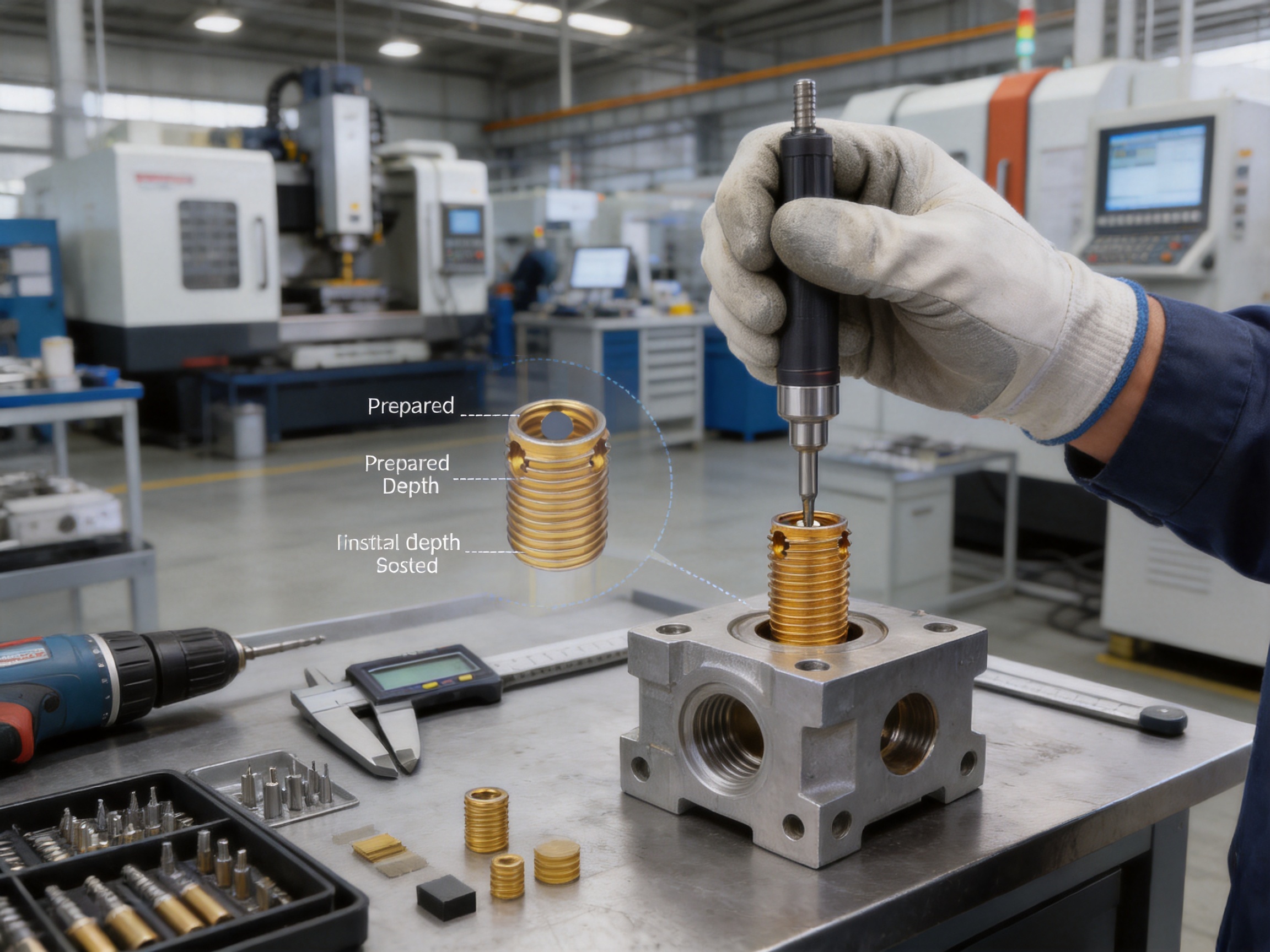
9. Application Areas
9.1 General Industrial Equipment
Machine tools, printing equipment, production machinery, and indoor industrial systems often contain aluminum housings, covers, brackets, and panels. These components benefit from reinforced threads when fasteners must be tightened securely or removed during maintenance.
The three-hole insert is suitable for mounting plates, inspection covers, control cabinets, drive housings, and other locations where vibration or repeated servicing could damage a direct thread in the base material.
9.2 Sheet Metal Processing
Sheet metal enclosures and cabinets frequently require threaded connection points in relatively thin sections. A suitable insert can provide a stronger internal thread without welding a nut or adding a bulky external component.
When using inserts in thin sheet structures, designers should confirm edge distance, wall thickness, hole roundness, and the risk of local deformation. The three-hole anti-rotation structure can improve retention, but the surrounding sheet must still have enough material to support the installation and service loads.
9.3 Heavy-Duty Furniture Assembly
Industrial racks, heavy office furniture, equipment frames, and storage systems may require stronger threaded joints than ordinary furniture hardware provides. Inserts allow manufacturers to use a durable threaded connection in tubular sections, panels, brackets, and formed components.
For furniture subjected to repeated assembly, relocation, or vibration from nearby equipment, the steel internal thread can offer better durability than a thread cut directly into soft material. The anti-rotation structure also helps maintain insert position during repeated fastening operations.
9.4 Automotive Parts Manufacturing
Automotive applications may include chassis-related parts, interior components, brackets, housings, covers, and other assemblies made from aluminum alloy or comparable materials. Thread reinforcement can help support serviceable fastening points while preserving lightweight component designs.
Automotive customers often require stable dimensions, reliable batch control, and clear documentation. A specialized insert manufacturer can support these needs through controlled production, inspection procedures, application consultation, and coordinated supply.
9.5 Construction Machinery Components
Small construction machinery and related structural components can experience vibration, impact, dust, and repeated maintenance. Thread inserts can reinforce connection points in brackets, housings, panels, and structural parts made from aluminum alloy, cast iron, or soft steel.
The correct insert length and coating are important in this environment. Components exposed to moisture or outdoor storage may require additional corrosion protection, while high-load joints may require validation of installation torque, pull-out strength, and torque resistance.
9.6 Aerospace and Rail Vehicle Manufacturing
The company’s broader product experience includes aerospace and rail vehicle manufacturing. These sectors demand careful control of material, dimensions, traceability, and process documentation. A three-hole insert may be considered for suitable non-critical or approved structural and equipment applications where design engineers have validated its performance.
For regulated or safety-critical assemblies, the insert must be evaluated against the applicable customer specifications, industry standards, environmental conditions, and qualification procedures. Product suitability should always be confirmed through engineering approval rather than assumed solely from the insert type.
10. Design Considerations for Engineers
10.1 Parent-Material Compatibility
The product is described as suitable for aluminum alloy, cast iron, and soft steel. Engineers should evaluate the specific grade, hardness, wall thickness, porosity, casting quality, and heat-treatment condition of the component. Materials with unusual hardness or brittleness may require different hole preparation or an alternative insert design.
10.2 Load Direction and Joint Design
Thread insert performance depends on the direction and magnitude of the applied loads. Tensile, shear, torsional, vibration, and combined loads should be considered. The insert length, external engagement, parent-material thickness, and bolt engagement must work together to support the expected service condition.
10.3 Edge Distance and Spacing
Holes placed too close to an edge or another hole may weaken the parent material or prevent proper deformation around the three-hole structure. Adequate edge distance and hole-to-hole spacing should be established through design standards, testing, or supplier recommendations.
10.4 Fastener Engagement
The mating fastener should engage the internal thread over an appropriate length without bottoming out. Excessively long bolts may contact the bottom of a blind insert installation, while insufficient engagement may reduce joint strength. The designer should account for component thickness, washer thickness, clamping parts, insert length, and any chamfered or unthreaded section.
10.5 Corrosion and Galvanic Effects
Carbon steel inserts installed in aluminum components can create a galvanic corrosion risk in the presence of moisture and an electrolyte. Surface coating, sealants, joint design, environmental protection, and fastener material selection should be considered. A zinc or color zinc coating may improve general corrosion resistance, but the complete material combination must still be evaluated.
10.6 Temperature and Chemical Exposure
Temperature cycles, lubricants, cleaning agents, fuels, hydraulic fluids, and other chemicals can affect the insert coating, parent material, and joint behavior. Before approval, the assembly should be checked for compatibility with the intended service environment.
11. Quality and Procurement Advantages
Purchasing from a specialized threading and fastening manufacturer can provide advantages beyond the basic product itself. A focused supplier can help consolidate several related products, including self-tapping inserts, helical wire inserts, key-locking inserts, threaded adapters, oil plugs, installation taps, and installation tools. This can simplify sourcing and improve compatibility between inserts and tools.
Product-family coordination is useful when a customer has different repair and reinforcement requirements across one assembly. For example, a three-hole insert may be selected for an anti-rotation connection, a wire insert for a lightweight repair, and a key-locking insert for a high-load application requiring positive locking keys. A supplier with knowledge of all these solutions can assist with more consistent technical evaluation.
Stable production capacity also supports inventory planning. Customers may need standard sizes for routine assembly as well as customized lengths, coatings, packaging, or labeling. A manufacturer with automated systems and broad equipment resources is better positioned to manage these requirements while maintaining repeatable output.
After-sales support can reduce the risk of installation problems. If a customer experiences high driving torque, incomplete seating, thread interference, or inconsistent retention, the supplier can review the insert size, hole preparation, tool configuration, and parent material. This type of application support is often more valuable than selecting a product based only on nominal dimensions.
12. Comparison with Other Thread Reinforcement Products
12.1 Three-Hole Insert Versus Standard Non-Holed Insert
A standard non-holed insert may rely primarily on friction or external thread engagement. The three-hole design adds mechanical interlocking through evenly distributed external positioning features. This can improve anti-torsion performance and reduce the likelihood of rotation under vibration.
12.2 Three-Hole Insert Versus Wire Thread Insert
A wire thread insert is lightweight and flexible, and it can be useful where internal thread repair or size conversion is required. A three-hole insert is a solid sleeve with an external self-tapping profile and integrated anti-rotation features. The better choice depends on the parent material, required load, installation space, weight constraints, thread standard, and service conditions.
12.3 Three-Hole Insert Versus Key-Locking Insert
A key-locking insert uses keys driven into the parent material to prevent rotation. This can provide strong positive locking, but it requires additional installation operations and adequate space for the keys. A three-hole insert achieves anti-rotation through its external groove structure and parent-material deformation, reducing the number of separate components.
12.4 Three-Hole Insert Versus Press-Fit Bushing
A press-fit bushing may require a precise interference fit and specialized insertion force. A self-tapping three-hole insert can be installed into a prepared hole by forming its own external engagement. This may offer greater flexibility for repair and field-service operations, although the correct drilling and installation procedure remains essential.
13. How to Improve Assembly Reliability
Product performance depends on the entire installation system. The insert should be purchased with a clear specification covering internal thread, external thread, type, length, material, coating, parent material, drilling diameter, minimum depth, and packaging requirements.
Operators should receive instructions that explain hole preparation, cleaning, tool alignment, installation depth, and post-installation inspection. For high-volume lines, installation torque should be monitored and periodically verified. A controlled work instruction can reduce variation between operators and shifts.
Manufacturers should also maintain records of insert lot numbers and component batches where traceability is required. If a quality issue occurs, these records can help identify the affected production range and support an efficient investigation.
Prototype testing is recommended before mass production. Testing may include installation torque, insert rotation resistance, pull-out force, bolt tightening and removal cycles, vibration exposure, temperature cycling, corrosion evaluation, or other application-specific tests. Results can be used to confirm the selected insert type and identify any necessary changes to hole size, length, coating, or installation tooling.
14. Frequently Asked Questions
Q1: What is the main purpose of a three-hole thread insert?
The main purpose is to create a strong internal thread in a soft or damaged parent material while improving resistance to insert rotation. The steel sleeve reinforces the thread, and the three external positioning features interlock with the surrounding material during installation.
Q2: Which materials are suitable for this insert?
The supplied product information identifies aluminum alloy, cast iron, and soft steel as suitable materials. The exact suitability depends on the material grade, hardness, wall thickness, hole condition, and application load. Testing or technical confirmation is recommended for unusual materials.
Q3: What is the difference between 307 type and 308 type?
The 308 type is described as the reinforced version, while both types use a three-hole structure. In the supplied size range, the main dimensional distinction is length, with the 308 option generally longer than the corresponding 307 option. The correct selection should be based on the required thread engagement and component geometry.
Q4: Does the insert require separate locking keys?
No separate anti-rotation keys are normally required. The three-hole external structure allows the parent material to deform into the positioning features, creating mechanical resistance to rotation. A dedicated installation tool is still required for controlled fitting.
Q5: Can the insert be used in a blind hole?
Yes, provided the blind hole has sufficient diameter, depth, chip clearance, and alignment. The minimum drilling depth must be observed, and the insert must not bottom out before reaching the intended seating position.
Q6: Are coatings available?
Yes. Zinc, color zinc, and other coating options can be supported according to the application. Coating requirements should be specified together with corrosion conditions, dimensional tolerances, fastener compatibility, and installation requirements.
Q7: How should the drilling diameter be selected?
The drilling diameter should be selected according to the insert size and parent material. The supplied data provides different recommended ranges for aluminum alloy and cast iron. These values should be confirmed against the approved drawing, installation procedure, and application testing before production release.
Q8: Can the insert repair a stripped thread?
It can be used for suitable stripped or damaged threaded holes after the hole has been correctly prepared to the required installation diameter and depth. The surrounding component must remain structurally sound, and the repaired location should be inspected after installation.
Q9: Is carbon steel suitable for outdoor applications?
Carbon steel can be used outdoors when an appropriate coating and environmental protection system are specified. Humidity, salt, chemicals, temperature, and galvanic contact with the parent material or fastener must be evaluated. Uncoated carbon steel may not be suitable for severe corrosive environments.
Q10: What quality advantages does a specialized manufacturer provide?
A specialized manufacturer can provide dedicated knowledge of insert geometry, thread standards, installation tools, parent-material behavior, coatings, and application requirements. Automated equipment, numerous machine tools, process inspection, traceability, and after-sales technical support can further improve batch consistency and supply reliability.
Q11: Is the product suitable for automotive and aerospace applications?
The company’s products are used in automotive, aerospace, rail vehicle, and related manufacturing sectors. However, every specific application must be approved according to its design loads, material requirements, regulatory obligations, qualification tests, and customer standards. Use in a critical assembly should never be based solely on a general product description.
Q12: What information should be included in an inquiry?
An inquiry should identify the internal thread, thread standard, 307 or 308 type, insert length, parent material, hole diameter, available depth, coating, expected quantity, operating environment, and any required inspection or certification documents. A drawing or sample component can help the supplier confirm the selection more accurately.
15. Conclusion
The Carbon Steel Three-Hole Thread Insert is a practical thread reinforcement solution for industrial assemblies that require stronger and more stable threaded connections in aluminum alloy, cast iron, soft steel, plastic, and similar materials. Its solid carbon steel body provides a durable internal thread, while its three evenly distributed external positioning features improve anti-rotation performance through mechanical interlocking with the parent material.
Compared with standard non-holed inserts, the design offers stronger resistance to loosening and shifting. Compared with key-locking systems, it can avoid separate anti-rotation accessories and additional locking operations. Compared with direct threads in soft materials, it provides improved wear resistance and better support for repeated assembly. Optional zinc and color zinc coatings can further adapt the insert to different corrosion and appearance requirements.
Correct selection remains essential. Engineers and installers must consider internal thread size, insert length, parent-material type, recommended drilling diameter, minimum drilling depth, hole alignment, installation tooling, coating, load direction, and service environment. Production validation and inspection are especially important for high-load, vibration-prone, automotive, aerospace, rail, and construction machinery applications.
With a specialized product range, an owned 10,000-square-meter manufacturing facility, hundreds of machine tools, automated production systems, experienced technical personnel, quality management procedures, and established after-sales support, Dongtai Jinzhize Metal Products Co., Ltd. is positioned to support both standard and application-specific threaded connection requirements. Its manufacturing scale and focus on threaded fastening products provide customers with a practical source for consistent inserts, compatible tools, and broader fastening solutions.
For customers seeking a dependable anti-rotation thread insert, the three-hole carbon steel design combines strength, efficient installation, simplified assembly, and cost-effective reinforcement in one solid component.
References
1. Product specification information for Carbon Steel Three-Hole Thread Insert, including 307 and 308 type dimensions and recommended drilling data.
2. General engineering principles for threaded joint design, thread engagement, installation torque, and parent-material reinforcement.
3. General manufacturing practices for carbon steel machining, thread production, surface coating, dimensional inspection, and batch traceability.
4. General considerations for corrosion protection and galvanic compatibility between carbon steel inserts and aluminum alloy components.
5. Supplier-provided company information concerning manufacturing facilities, production equipment, product categories, quality management, application sectors, and service capabilities.



