

 Français
 Español
 Deutsch

Content
- 1 What Is a Blue Zinc Plated Self-Tapping Thread Insert?
- 2 Core Product Advantages
- 3 Design Features of the Type 302 Slotted Insert
- 4 Material and Application Compatibility
- 5 Dimensional Selection Guide
- 6 Installation Procedure
- 7 Advantages Compared with Alternative Threading Methods
- 8 Manufacturing Strengths and Quality Considerations
- 9 Application Areas
- 10 How to Specify the Product for Purchasing
- 11 Performance Testing and Validation
- 12 Maintenance and Troubleshooting
- 13 Why Supplier Manufacturing Capability Matters
- 14 Q&A: Frequently Asked Questions
- 14.1 What is the main purpose of a blue zinc plated self-tapping thread insert?
- 14.2 Does the insert require adhesive?
- 14.3 Can the insert be installed in plastic?
- 14.4 Can it repair a stripped aluminum thread?
- 14.5 Is blue zinc plating suitable for marine environments?
- 14.6 How should the correct pilot-hole size be selected?
- 14.7 Can the insert be removed after installation?
- 14.8 What tools are needed?
- 14.9 What industries use these inserts?
- 14.10 What information should be provided when requesting a quotation?
- 15 Conclusion
- 16 References
- 17 Product: Blue Zinc Plated Self-Tapping Thread Insert
Threaded connections are essential in mechanical assemblies, enclosures, furniture systems, vehicles, appliances, and countless industrial products. However, creating a durable internal thread in a soft or relatively weak base material can be difficult. Aluminum, plastic, magnesium alloys, composite panels, and thin-walled components may not provide enough material strength for repeated screw installation, vibration resistance, or long-term loading. Directly tapping these materials can result in stripped threads, loose fasteners, damaged housings, and expensive repairs.
Blue zinc plated self-tapping thread inserts provide a practical solution to these challenges. They are designed to create or reinforce internal threads in soft materials without requiring a separately pre-tapped hole. Their external cutting thread allows the insert to form its own seating path during installation, while the internal thread accepts a standard screw or threaded fastener. The result is a stronger, more durable, and more serviceable threaded connection.
The blue zinc plated surface treatment adds another important advantage. A dense blue-white zinc coating helps protect the insert against rust and oxidation, particularly in humid, dusty, outdoor, and moderately corrosive environments. Compared with uncoated inserts, the treated surface provides improved resistance during storage, assembly, and service. The coating also gives the finished component a clean and uniform appearance.
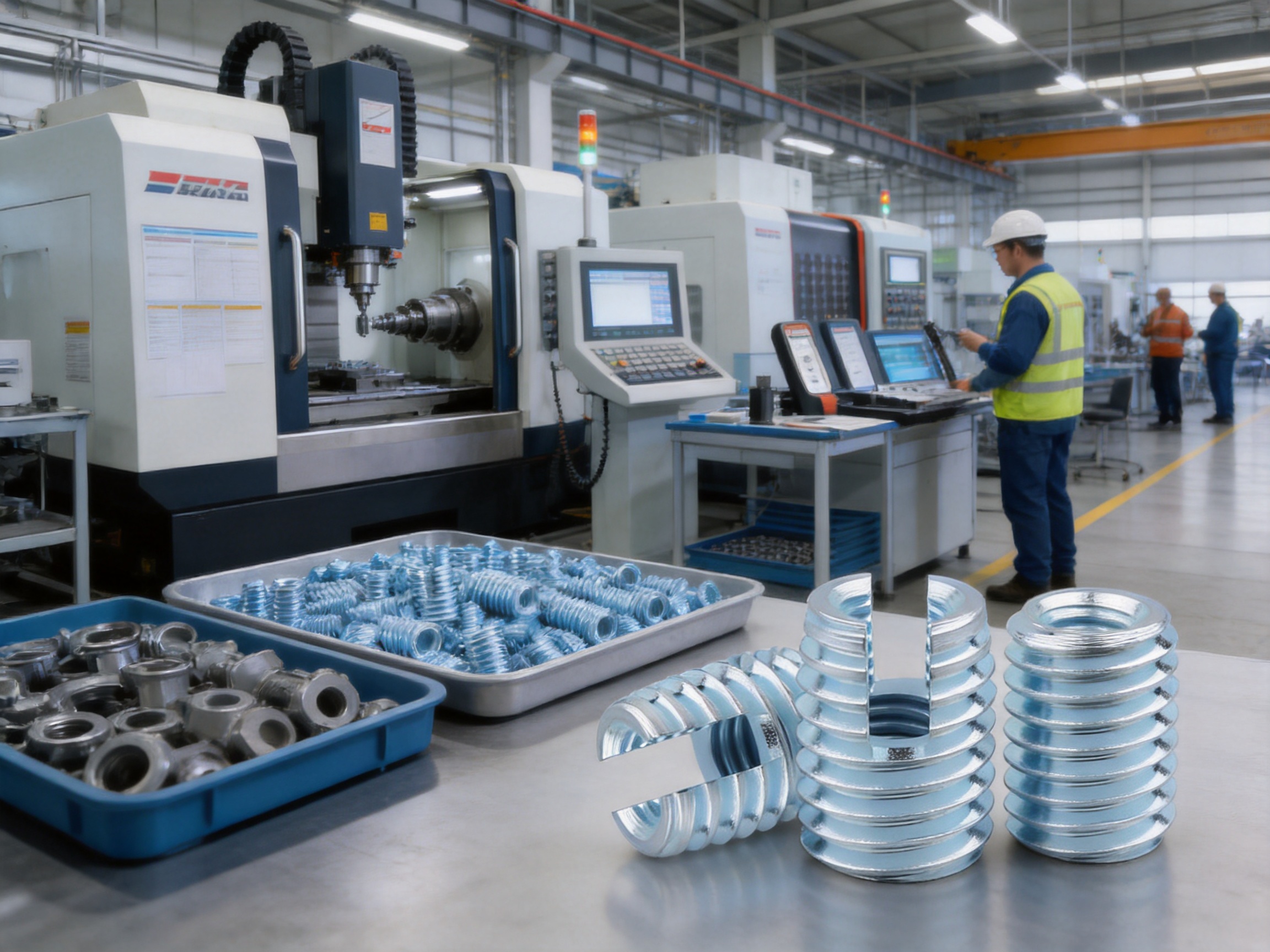
Manufactured by Dongtai Jinzhize Metal Products Co., Ltd., these inserts are part of a broader range of threaded connection and fastening products. The company specializes in self-tapping inserts, helical wire inserts, key-locking inserts, threaded adapters, oil plugs, installation taps, and related tools. Its manufacturing capabilities, automated production systems, quality controls, and experience in automotive and aerospace-related applications support stable production for customers requiring consistent and traceable fastening components.
What Is a Blue Zinc Plated Self-Tapping Thread Insert?
A self-tapping thread insert is a metal sleeve with an internal thread and an external cutting or forming thread. The outer thread is designed to engage directly with a prepared pilot hole in a base material. During installation, the cutting features remove or displace a controlled amount of material, allowing the insert to seat securely without the need to tap the external hole first.
Once installed, the internal thread functions as a durable female thread. A screw, bolt, or other threaded component can then be installed into the insert. The load is transferred through the insert rather than directly through the weaker base material. This increases the connection’s resistance to stripping, impact, repeated assembly, and vibration.
The blue zinc plated version receives a protective zinc coating after manufacturing or during the approved finishing process. Zinc acts as a protective barrier between the steel substrate and the surrounding environment. It also provides a degree of sacrificial protection if the surface is lightly damaged, because zinc is generally more chemically active than the underlying steel.
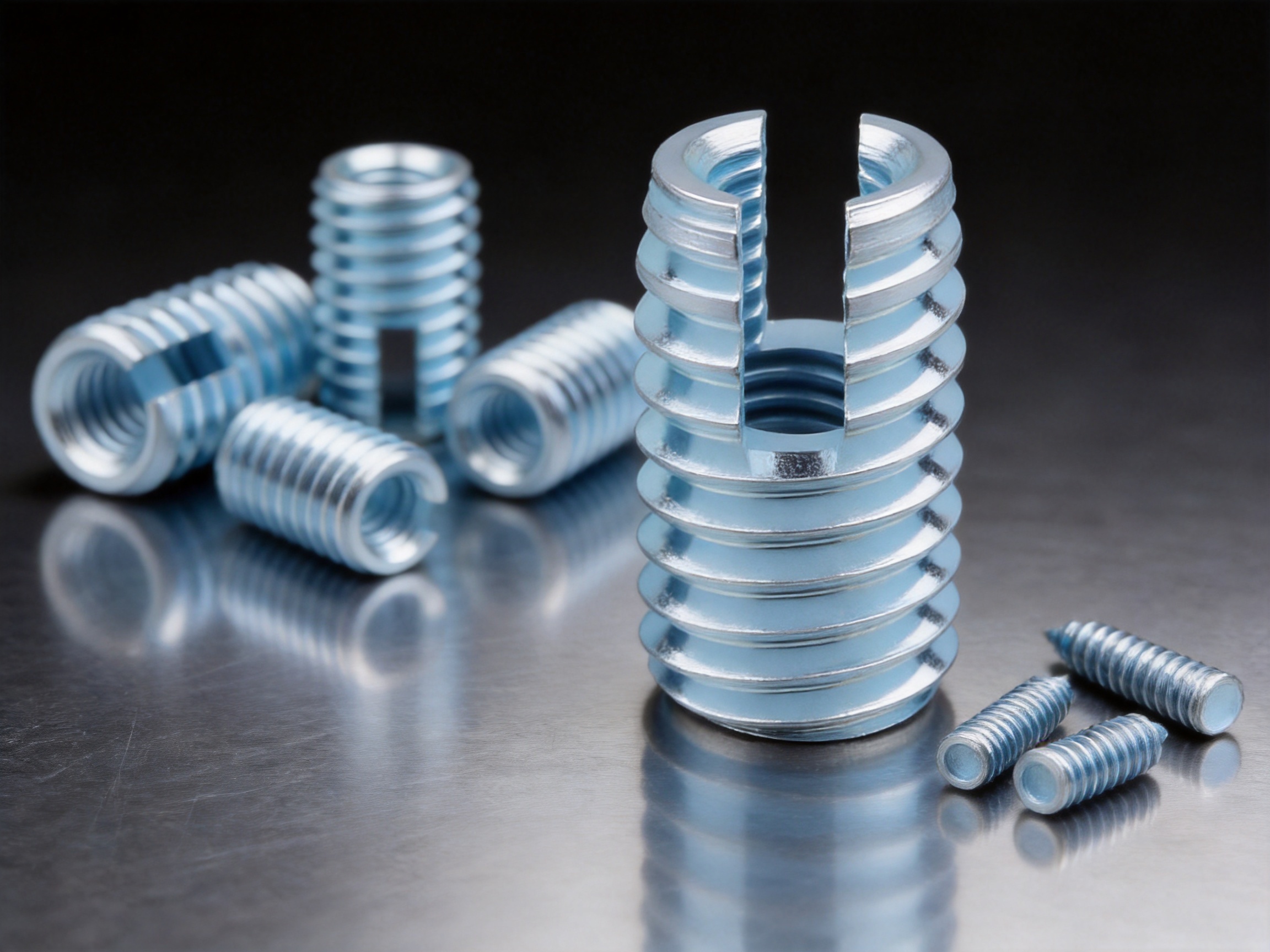
The product described in this article is identified as a Type 302 slotted self-inserting screw sleeve. Its head includes a cutting groove, and its outer profile incorporates a high-strength, wear-resistant thread. The cutting groove supports self-tapping installation, while the thread profile provides strong engagement with the base material. The insert is suitable for both new component production and the repair or reinforcement of damaged threaded holes.
Core Product Advantages
Blue Zinc Coating for Improved Corrosion Resistance
The most visible feature of the insert is its blue-white zinc plated finish. The coating is intended to provide better resistance to rust and oxidation than an uncoated steel insert. According to the supplied product information, the finish offers approximately 48 to 96 hours of salt spray resistance, depending on the applicable production and testing conditions.
This level of protection is useful for products that may experience humidity, condensation, dust, handling, transport, or outdoor exposure. Examples include furniture hardware, electrical housings, architectural fittings, automotive interior components, and general industrial assemblies. The coating helps the insert maintain a cleaner appearance while reducing the likelihood of early surface corrosion.
Surface treatment also provides practical benefits during warehousing and assembly. Uncoated steel parts may develop visible discoloration or rust if they are stored in humid conditions or exposed to contaminants. A zinc plated surface gives the component a more stable appearance and helps protect it before it reaches the final application.
Blue zinc plating is not a substitute for selecting the correct material or coating for severe chemical, marine, or high-temperature exposure. Nevertheless, it represents a useful balance between corrosion protection, appearance, availability, and cost for many general-purpose fastening applications.
Self-Tapping Installation Without Pre-Tapping
Traditional threaded inserts often require a hole to be drilled and then tapped before the insert can be installed. This two-stage process adds equipment requirements, labor, and opportunities for alignment errors. It may also be inconvenient in production environments where cycle time and process simplicity are important.
The Type 302 slotted design reduces these steps. After the correct pilot hole has been prepared, the insert can be driven directly into the base material using suitable standard installation equipment. The cutting groove helps the outer thread engage the material and form its own thread path.
Eliminating the external pre-tapping operation can reduce assembly time and simplify line organization. Operators do not need to change from a drilling process to a separate tapping process before installing the sleeve. Fewer operations may also reduce handling, tool changes, and the chance of using the wrong external tap.
Installation still requires correct hole diameter, depth, alignment, torque, and tooling. The self-tapping feature does not mean that preparation can be ignored. A pilot hole that is too small may cause excessive installation torque or damage the insert. A hole that is too large may reduce pull-out strength. The dimensional recommendations must therefore be matched to the base material and production method.
Reinforcement of Soft and Thin Materials
Soft materials are often attractive because they are lightweight, easy to machine, electrically insulating, or economical. However, their native threads may wear quickly. Repeated screw removal and installation can enlarge the hole, while vibration or impact may cause the fastener to loosen.
A metal insert creates a more durable internal thread within these materials. The insert distributes the screw load over a larger external engagement area, allowing the surrounding material to support the connection more effectively. This is particularly valuable in plastic housings, aluminum components, panel furniture, and thin-wall structures.
The insert can be used when a threaded hole has already been damaged or as part of the original design. In repair work, it may restore a connection without replacing the entire component. In new production, it allows designers to use lighter or softer materials while still providing a dependable threaded interface.
The improvement in performance depends on several factors, including insert length, external thread engagement, base material strength, hole quality, screw grade, installation depth, and applied load. Proper product selection and installation are essential for achieving the intended reinforcement effect.
Resistance to Stripping and Loosening
Thread stripping occurs when the material around the internal thread shears or deforms under tightening or service loads. This is a common problem in plastics and low-strength alloys. By placing a durable metal thread between the screw and the base material, the insert helps prevent the internal thread from being directly damaged by the screw.
The external thread also contributes to retention. Once installed, it engages with the surrounding material along the length of the sleeve. This engagement helps resist axial pull-out and movement. The slotted cutting design supports firm seating, while the high-strength outer thread is intended to withstand repeated loading and vibration.
No threaded insert can eliminate all loosening risks under every operating condition. For high-vibration assemblies, the complete connection may require a suitable locking screw, prevailing torque feature, thread-locking compound, washer, or mechanical locking method. The insert provides a strong threaded foundation, but the fastener system must be evaluated as a whole.
Clean Appearance and Consistent Finish
The blue-white zinc surface provides a smooth, uniform appearance without the dark or irregular look that may be associated with untreated steel. This is useful in visible assemblies, furniture hardware, decorative fittings, and consumer products where both function and appearance matter.
A clean finish can also make inspection easier. A consistent surface allows operators to identify burrs, damage, contamination, or coating irregularities more readily. For manufacturers, consistent appearance supports product presentation and helps maintain a uniform visual standard across assembled components.
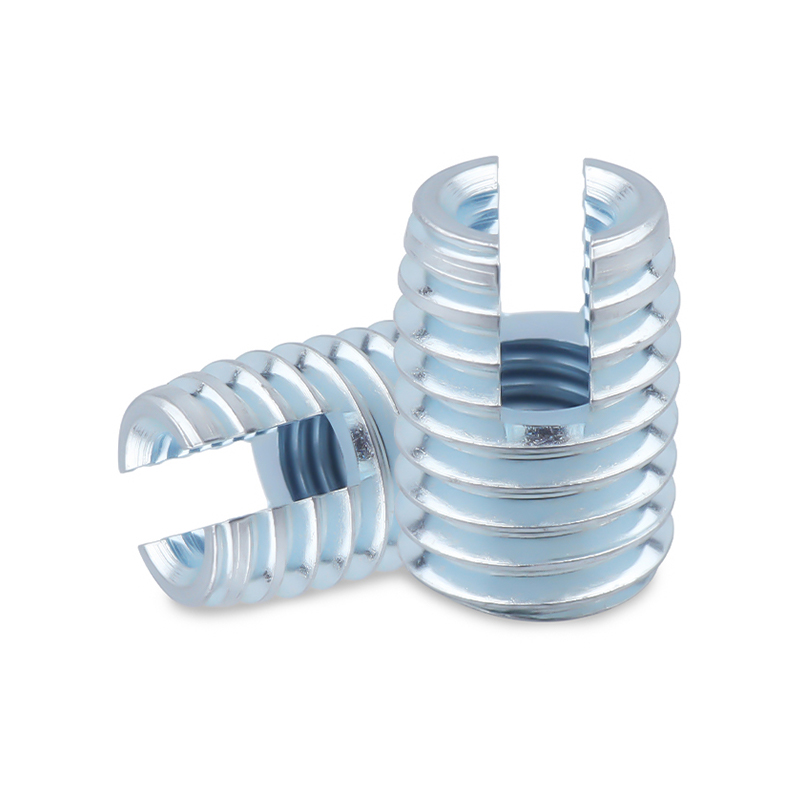
Blue Zinc Plated Self-Tapping Thread Insert
Design Features of the Type 302 Slotted Insert
Cutting Groove
The cutting groove is one of the principal features that enables self-tapping installation. As the insert enters the pilot hole, the groove helps initiate material cutting or displacement. This reduces the need for an externally tapped hole and allows the insert to establish engagement during installation.
The groove must remain sufficiently sharp and properly formed to function reliably. Manufacturing consistency is therefore important. If the groove is incomplete, obstructed, or incorrectly positioned, installation torque may increase and the insert may not seat correctly. Precision forming and inspection help ensure that the cutting function is consistent from part to part.
External Thread
The external thread is responsible for holding the sleeve in the base material. Its diameter and pitch must match the recommended pilot-hole range and the characteristics of the workpiece. A properly selected external thread provides sufficient engagement without creating excessive stress in the surrounding material.
The supplied specifications show different recommended drilling diameters for plastics, aluminum alloys, and cast iron. This distinction is important because each material responds differently to cutting and forming. Plastics may deform or crack if the hole is too small, while cast iron may require a different clearance to accommodate its hardness and brittleness.
Internal Thread
The internal thread is manufactured to accept the specified metric or English fastener. It forms the service interface for the final screw or bolt. Internal thread accuracy affects installation smoothness, tightening consistency, load transfer, and the ability to remove and replace the fastener.
Customers should specify the required thread standard, nominal size, pitch, insert length, and application material when ordering. Metric and English sizes are not interchangeable, and the mating fastener must match the insert exactly. Using an incorrect screw can damage the internal thread or create an unsafe connection.
Insert Length
Insert length affects the amount of external engagement with the base material. Longer inserts generally provide a greater load-distribution area, although the best length depends on the available wall thickness, hole depth, expected load, and component geometry.
The product range includes short and long configurations, with listed lengths from 6 mm through 27 mm for the sizes shown. The selected insert should be long enough to achieve reliable retention but should not bottom out before it reaches the intended position. Blind holes require special attention to minimum drilling depth and chip clearance.
Material and Application Compatibility
Plastics
Plastic housings and panels frequently need threaded connections for covers, brackets, terminals, hinges, and service access points. Directly molded or tapped plastic threads may be adequate for low-cycle applications, but they can wear when fasteners are repeatedly removed. A metal insert provides a more durable internal interface.
When installing into plastic, heat generation and installation torque should be controlled. Excessive force may crack brittle plastics or deform softer thermoplastics. The recommended pilot-hole diameter should be selected according to the material type, density, reinforcement, and process temperature. A trial installation can help determine the best production parameters.
Aluminum Alloys
Aluminum is lightweight and widely used in automotive, electronics, machinery, and transportation applications. Its relatively low hardness can make small or frequently used internal threads vulnerable to damage. A self-tapping insert can reinforce the connection and extend the service life of the component.
Aluminum also forms an oxide layer that can affect machining and assembly behavior. Correct drilling, deburring, cleaning, and lubrication practices may improve installation consistency. The supplied table provides aluminum-specific drilling ranges that differ from the values recommended for plastic and cast iron.
Cast Iron and Other Metal Components
Cast iron and other harder materials may be used where stiffness, heat resistance, or dimensional stability is needed. Although these materials can support stronger threads than many plastics, repairs may still be necessary after thread damage. Inserts can restore a serviceable internal thread without replacing the entire casting.
Harder base materials require attention to cutting performance and installation torque. The pilot hole must be accurate, and the installation tool must provide sufficient power without overloading the insert. The product table includes a separate reference range for cast iron, helping users begin the selection process with material-specific dimensions.
Dimensional Selection Guide
The following table summarizes the supplied Type 302 slotted insert dimensions. The English equivalents are provided where listed. Drilling values are reference ranges and should be validated through application testing, especially when the base material, equipment, or production conditions differ from standard assumptions.
| Internal Thread | English Equivalent | Length (mm) | External Thread | Pilot Hole in Plastic (mm) | Pilot Hole in Aluminum Alloy (mm) | Pilot Hole in Cast Iron (mm) | Minimum Drilling Depth (mm) |
|---|---|---|---|---|---|---|---|
| M2-0.4 | Not listed | 6 | M4.5-0.5 | 4.0-4.1 | 4.1-4.2 | 4.2-4.3 | 8 |
| M2.5-0.45 | U#2-56 | 6 | M4.5-0.5 | 4.0-4.1 | 4.1-4.2 | 4.2-4.3 | 8 |
| M3-0.5 | U#4-40 | 6 | M5-0.5 | 4.5-4.6 | 4.6-4.7 | 4.7-4.8 | 8 |
| M4-0.7 | U#8-32 | 8 | M6.5-0.75 | 5.8-5.9 | 6.0-6.1 | 6.1-6.2 | 10 |
| M5-0.8 | U#10-24 | 10 | M8-1.0 | 7.1-7.2 | 7.3-7.5 | 7.5-7.6 | 13 |
| M6a-1.0 | Not listed | 12 | M9-1.0 | 8.1-8.2 | 8.3-8.5 | 8.5-8.6 | 15 |
| M6-1.0 | U/14-20 | 14 | M10-1.5 | 9.0-9.2 | 9.2-9.3 | 9.3-9.4 | 17 |
| M8-1.25 | U5/16-18 | 15 | M12-1.5 | 10.6-10.8 | 11.0-11.2 | 11.2-11.4 | 18 |
| M10-1.5 | U3/8-16 | 18 | M14-1.5 | 12.6-12.8 | 13.0-13.3 | 13.2-13.4 | 22 |
| M12-1.75 | U7/16-14 | 22 | M16-1.5 | 14.6-14.8 | 15.0-15.3 | 15.2-15.4 | 26 |
| M14-2.0 | U1/2-13 | 24 | M18-1.5 | 16.6-16.8 | 17.0-17.3 | 17.2-17.5 | 28 |
| M16-2.0 | U5/8-11 | 22 | M20-1.5 | 18.6-18.8 | 19.0-19.3 | 19.2-19.5 | 27 |
| M18-2.5 | Not listed | 24 | M22-1.5 | 20.6-20.8 | 21.0-21.3 | 21.2-21.5 | 29 |
| M20-2.5 | Not listed | 27 | M26-1.5 | 24.6-24.8 | 25.0-25.3 | 25.2-25.2 | 32 |
Some source dimensions use abbreviated or inconsistent notation, such as “M6a-1.0,” “M12-175,” and “U/14-20.” These designations should be confirmed with the supplier before production release. Customers should also verify whether dimensions are nominal, measured, or tolerance-controlled values for their specific purchase order.
Installation Procedure
Step One: Confirm the Insert and Fastener Specification
Before drilling or installing, confirm the internal thread size, pitch, length, external thread, surface treatment, and base material. The mating fastener must use the same thread standard and pitch. Verify that the selected insert length is compatible with the component wall thickness and hole depth.
Step Two: Prepare the Pilot Hole
Drill the pilot hole to the recommended diameter for the actual base material. The hole should be straight, clean, and free from excessive burrs. In a blind hole, provide sufficient depth for the insert length, the cutting action, and any chips or displaced material generated during installation.
Hole diameter is one of the most important variables in insert performance. An undersized hole may increase torque and cause cracking, distortion, or premature tool wear. An oversized hole may reduce external thread engagement and weaken pull-out resistance. Production teams should use calibrated drills, reamers, or other suitable processes when tight dimensional control is required.
Step Three: Align the Installation Tool
The insert should be aligned with the hole before force is applied. Angular misalignment can damage the first external threads, create uneven engagement, or cause the insert to sit at an angle. In automated production, a guide fixture or controlled spindle can improve repeatability.
Step Four: Drive the Insert
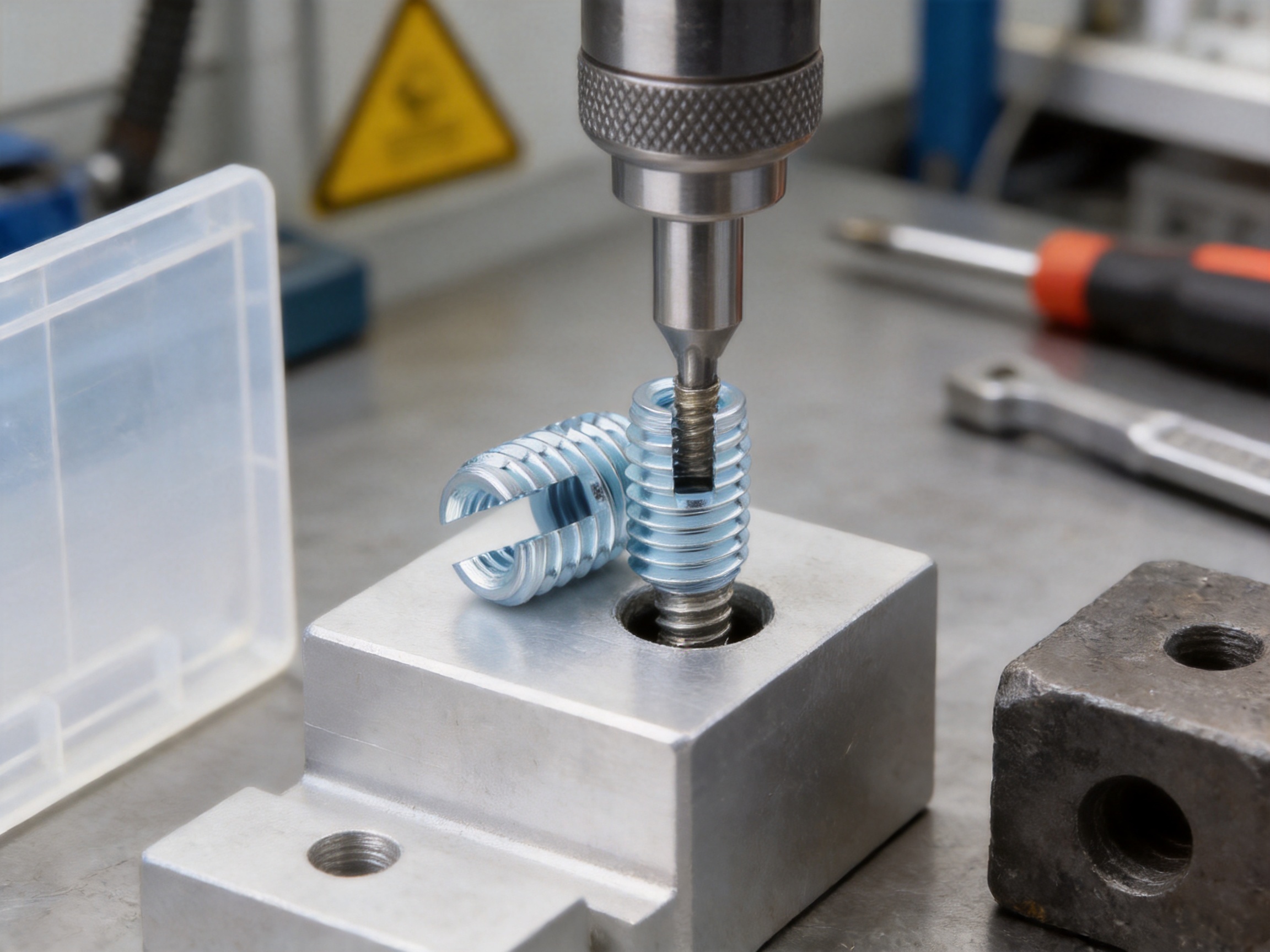
Use an appropriate driver, mandrel, or installation tool to turn the insert into the pilot hole. Apply steady torque and avoid sudden impact unless the installation system has been specifically designed for impact operation. The insert should advance smoothly and seat at the intended depth.
Lubrication may be helpful in some metal applications, but compatibility with the base material, coating, final assembly, and cleaning process must be evaluated. Lubricant can reduce friction, but excessive lubrication may affect retention or contaminate nearby components.
Step Five: Inspect the Finished Connection
After installation, check the insert position, alignment, surface condition, and internal thread. The insert should not protrude beyond the specified surface unless the design requires it. Test-fit the mating screw by hand or with a controlled tool to ensure smooth engagement.
For production applications, inspection may include visual checks, go/no-go gauges, torque monitoring, pull-out testing, and sample-based torque-to-failure testing. The appropriate inspection plan depends on the risk level and function of the final assembly.
Advantages Compared with Alternative Threading Methods
Compared with Directly Tapped Plastic or Aluminum
Directly tapped threads are simple and economical when the base material is strong enough and the connection is not frequently serviced. However, they may have limited thread engagement and reduced resistance to repeated assembly. A self-tapping insert adds a metal internal thread and distributes the load through the external sleeve, making it better suited to repeated fastening and higher mechanical demand.
The insert also supports repair. If the original thread has been stripped, installing an insert may restore the component without machining a completely new part or replacing the housing. This can reduce downtime, material waste, and repair expense.
Compared with Press-Fit Inserts
Press-fit inserts depend on interference between the insert and the hole. They may require specialized pressing equipment and carefully controlled hole tolerances. If the fit is too loose, the insert may rotate or pull out. If it is too tight, the base material may crack or deform.
A self-tapping insert creates mechanical engagement through its external thread. This can provide a more adaptable installation method, particularly for repair work or low-volume production where a press-fit process is less convenient. The installation force is converted into controlled thread engagement rather than relying only on radial interference.
Compared with Heat-Set Inserts
Heat-set inserts are common in thermoplastic components because heat softens the surrounding material and allows the insert to be embedded. They can provide excellent results when the plastic type, temperature, dwell time, and equipment are controlled correctly.
However, heat-set installation requires heating equipment and careful thermal management. It may not be suitable for heat-sensitive materials, painted components, assembled electronics, or field repairs. A self-tapping insert can be installed mechanically without introducing heat, making it more flexible across a broader range of applications.
Compared with Adhesive-Bonded Inserts
Adhesive-bonded inserts rely on chemical bonding and curing. They can be useful when the base material is difficult to machine or when a sealed connection is required. Nevertheless, cure time, surface preparation, temperature, shelf life, and chemical compatibility can complicate production.
The Type 302 insert does not require adhesive for ordinary installation. Mechanical engagement provides immediate retention, allowing the component to continue through the assembly process without waiting for a bonding agent to cure. This can simplify production scheduling and reduce dependence on chemical consumables.
Compared with Uncoated Steel Inserts
An uncoated steel insert may be adequate in dry indoor environments, but it offers less protection during storage and service. The blue zinc plated surface helps resist visible oxidation and provides a more attractive finish. For applications exposed to humidity or occasional outdoor conditions, this additional protection may extend the useful service life of the connection.
The coating also provides a practical advantage for manufacturers supplying finished products to customers who expect consistent appearance and basic corrosion resistance. It allows a standard self-tapping design to be used in more demanding environments without immediately moving to a more specialized and expensive material system.
Manufacturing Strengths and Quality Considerations
Specialized Threaded Connection Production
Dongtai Jinzhize Metal Products Co., Ltd. was established in 2015 and focuses on threaded connection products. Its product range includes helical wire inserts, self-tapping inserts, key-locking inserts, threaded adapters, oil plugs, installation taps, and complementary tools. This specialization supports knowledge across the complete threaded connection process, from insert geometry to installation tooling.
A supplier that produces both inserts and related tools can better understand the interaction between the component, the pilot hole, the driver, and the final fastener. This integrated perspective is useful when customers need help selecting sizes, developing installation procedures, or diagnosing problems such as excessive torque, cross-threading, or incomplete seating.
Owned Manufacturing Facility and Equipment Base
The company operates a 10,000-square-meter owned manufacturing plant equipped with hundreds of machine tools and automated production systems. This infrastructure supports stable production capacity and provides room for multiple manufacturing stages, inspection operations, inventory management, and process development.
Automated production systems can improve repeatability by controlling feeding, forming, turning, threading, and handling operations. Automation does not replace engineering oversight, but it can reduce variation caused by inconsistent manual operations. It also supports higher-volume supply for customers in automotive, transportation, electronics, and general industrial markets.
Process Control from Forming to Finishing
Self-tapping inserts require several controlled characteristics. The internal thread must meet the intended dimensional requirements. The external thread must have a consistent profile and cutting action. The slot must be correctly formed. The insert length and overall geometry must remain within specification. Finally, the zinc coating must cover the surface uniformly without interfering with thread function.
Effective production control may include incoming material verification, tool-life management, dimensional inspection, thread gauging, visual inspection, coating checks, and sample-based functional testing. Monitoring these characteristics helps prevent problems from reaching the assembly line.
Thread gauging is particularly important because a part can appear visually acceptable while still producing poor screw engagement. Internal and external thread gauges, optical measurement, and controlled trial assembly can provide complementary information. For high-reliability applications, customers may request inspection records or traceability documents for defined production lots.
Experience in Critical Vehicle Applications
The company reports experience serving automotive and aerospace-related sectors, as well as rail vehicle manufacturing. These industries place strong emphasis on repeatability, traceability, vibration resistance, dimensional control, and dependable supply. Experience in such environments can be valuable when a customer is developing a connection for an engine, transmission, vehicle interior, enclosure, structural panel, or serviceable assembly.
In 2024, the company achieved an annual output value of 153 million RMB. This figure indicates an established manufacturing operation with the capacity to support substantial production volumes. For purchasers, production scale can reduce the risk of supply interruptions when a product moves from prototype quantities to regular mass production.
After-Sales and Technical Support
Threaded insert performance depends on more than the component itself. A suitable insert may fail if the pilot hole is incorrect, the installation tool is misaligned, or the mating fastener is incompatible. Technical support is therefore an important part of supplier value.
Jinzhize describes a comprehensive after-sales service mechanism and a commitment to consistent, traceable products. In practice, customers may benefit from support with size selection, sample evaluation, installation recommendations, packaging, inspection requirements, and production troubleshooting.
Application Areas
Furniture Manufacturing
Panel furniture, cabinet systems, office equipment, and household hardware often require screws to be removed and reinstalled during assembly, transport, adjustment, or repair. A metal internal thread can improve the serviceability of particleboard-associated hardware, plastic fittings, aluminum profiles, and other furniture components where direct threads may wear.
The blue-white finish is also suitable for visible hardware because it provides a clean appearance. When properly selected and installed, the insert can support stable joints while helping the manufacturer maintain a consistent visual standard.
Electronics and Electrical Equipment
Communication devices, appliances, control boxes, electrical enclosures, and instrument housings frequently use plastic or aluminum shells. These components may need threaded interfaces for covers, brackets, cable management parts, heat sinks, grounding components, or service panels.
Self-tapping installation can simplify housing production by reducing the number of operations required to create a durable thread. The zinc coating provides basic protection during handling and use, although the complete electrical and environmental compatibility of the assembly must be evaluated.
Architectural Decoration
Doors, windows, railings, display systems, partitions, and decorative fittings may be exposed to humidity, condensation, or outdoor air. A zinc plated insert can provide a cleaner and more corrosion-resistant connection than an uncoated component in moderate environments.
For exterior architectural applications, designers should consider the full environmental exposure, including rain, salt, cleaning chemicals, temperature variation, and contact with dissimilar metals. Where severe corrosion is expected, additional coating systems or corrosion-resistant materials may be required.
Automotive Components
Automotive interior panels, trim parts, plastic brackets, instrument assemblies, and other vehicle components are exposed to vibration, temperature cycling, repeated service, and dimensional changes. A reinforced internal thread can improve connection reliability in these conditions.
The insert may be used for original production or for repairing damaged threads in plastic and light-alloy components. Selection should consider vibration level, tightening torque, service temperature, chemical exposure, and the required number of installation cycles.
Aerospace and Rail Applications
Aerospace and rail vehicle manufacturing require carefully controlled fastening solutions because access for repair may be limited and component reliability is important. Self-tapping inserts can be useful in lightweight structures and serviceable panels where a durable internal thread is needed.
Any application in a regulated or safety-critical industry must be assessed against the customer’s engineering standards, approved materials, inspection plans, and qualification requirements. The product’s general capabilities are a starting point, not a substitute for application-specific validation.
How to Specify the Product for Purchasing
A clear purchase specification reduces the risk of receiving an insert that is dimensionally correct in one respect but unsuitable for the actual assembly. The specification should identify the internal thread standard, nominal size, pitch, external thread, length, material, surface treatment, quantity, packaging, and inspection requirements.
The base material should be stated because the recommended pilot-hole diameter differs between plastic, aluminum alloy, and cast iron. If the plastic is reinforced, filled, brittle, or temperature-sensitive, that information should also be supplied. Material samples or drawings can help the manufacturer recommend the correct installation conditions.
Environmental requirements should include humidity, outdoor exposure, salt spray expectations, temperature, chemicals, and contact with dissimilar metals. Blue zinc plating is suitable for many general and moderately corrosive environments, but the customer should not assume that all zinc plated parts have identical performance. Coating thickness, conversion treatment, substrate, handling, and test method all affect results.
Quality documentation may include dimensional inspection reports, coating inspection, thread gauge results, lot traceability, material certificates, or sample test data. For high-volume customers, a control plan and agreed acceptance criteria can help maintain consistency over repeated orders.
Performance Testing and Validation
Before mass production, the insert should be tested in the actual base material and component geometry. Laboratory results using a standard block may not fully represent a thin wall, curved housing, reinforced plastic, or blind-hole design.
Useful evaluations include installation torque, seating depth, pull-out force, rotational resistance, screw installation torque, removal and reinstallation cycles, vibration exposure, temperature cycling, and corrosion testing. The test plan should reflect the expected service conditions rather than relying on a single value.
Corrosion testing can help compare the blue zinc plated surface with alternative finishes. Salt spray testing is a controlled comparative method, but it does not reproduce every outdoor environment. Results should be interpreted alongside real-use exposure, coating handling, assembly damage, and contact with other materials.
Thread performance should be checked after coating and after installation. A coating that is too thick or uneven may affect internal thread fit. A coating that is damaged during driving may reduce surface protection. Proper production controls help balance corrosion resistance with accurate thread function.
Maintenance and Troubleshooting
Excessive Installation Torque
High installation torque may result from an undersized pilot hole, misalignment, damaged cutting groove, unsuitable lubrication, excessive material hardness, or an incorrect driver. Check the hole diameter and depth first, then inspect the insert and installation tool.
Insert Rotation or Pull-Out
Rotation or pull-out may indicate an oversized pilot hole, insufficient engagement length, weak base material, inadequate seating, or an applied load that exceeds the design capacity. The solution may involve selecting a longer insert, reducing the hole diameter within the recommended range, increasing wall thickness, or revising the connection design.
Cracking of the Base Material
Cracking is more likely when the pilot hole is too small, the material is brittle, the component wall is thin, or the installation force is excessive. Use the material-specific hole recommendation and conduct trial installations before releasing the process to production.
Cross-Threading of the Mating Screw
Cross-threading usually results from an incorrect screw specification, poor alignment, damaged internal threads, contamination, or excessive starting force. The screw should be started carefully and checked against the insert’s thread standard and pitch. A controlled driver with suitable speed and torque can improve consistency.
Surface Discoloration or Corrosion
Discoloration may be caused by storage humidity, contact with corrosive chemicals, coating damage, salt exposure, or galvanic interaction with another metal. Store inserts in clean, dry packaging and avoid unnecessary handling that could scratch the finish. For severe environments, request a coating or substrate specifically qualified for that exposure.
Why Supplier Manufacturing Capability Matters
The apparent simplicity of a threaded sleeve can hide significant production requirements. A reliable insert must combine accurate internal and external threads, a functional cutting groove, suitable hardness, consistent dimensions, and a protective finish. Small variations can influence installation torque, retention, screw fit, and corrosion performance.
Working with a specialized manufacturer provides access to equipment and knowledge developed specifically for threaded connection products. It can also simplify communication when the customer needs several related products, such as wire inserts, key-locking inserts, taps, drivers, or oil plugs.
Jinzhize’s owned facility, automated systems, extensive machine-tool base, and quality management approach support the needs of customers seeking stable supply. Its experience in automotive, aerospace, and rail-related applications further demonstrates familiarity with industries where consistency and traceability are important.
The company’s production scale also supports customization. While the listed Type 302 range covers many common metric and English thread combinations, customers may require special lengths, thread standards, packaging formats, materials, or inspection plans. Such requests should be reviewed against tooling, performance, and production feasibility before approval.
Q&A: Frequently Asked Questions
What is the main purpose of a blue zinc plated self-tapping thread insert?
Its main purpose is to create or reinforce a durable internal thread in a soft, thin, or damaged base material. The blue zinc plating adds protection against rust and oxidation, while the self-tapping external thread allows installation without pre-tapping the pilot hole.
Does the insert require adhesive?
Ordinary installation does not require adhesive. Retention is provided by mechanical engagement between the external thread and the base material. An adhesive may be considered for a special application, but compatibility and process requirements should be evaluated first.
Can the insert be installed in plastic?
Yes. The product is suitable for many plastic applications, including housings, panels, furniture components, and appliance parts. The correct pilot-hole diameter depends on the plastic’s hardness, reinforcement, wall thickness, and design. Trial testing is recommended.
Can it repair a stripped aluminum thread?
Yes, it can be used to repair or reinforce damaged threads in aluminum components when the remaining material permits a suitable pilot hole. The repair design should provide enough surrounding wall thickness and insert engagement for the required load.
Is blue zinc plating suitable for marine environments?
Blue zinc plating provides useful general corrosion protection, but severe marine exposure may require a more specialized coating or corrosion-resistant alloy. Salt spray performance should not be treated as a complete prediction of long-term marine service life.
How should the correct pilot-hole size be selected?
Use the recommended value for the specific base material and insert size. The supplied table gives separate reference ranges for plastic, aluminum alloy, and cast iron. Final dimensions should be validated through installation torque and retention testing in the actual component.
Can the insert be removed after installation?
Removal may be possible, but it depends on the base material, installation depth, damage condition, and available access. Removing an installed insert can damage the surrounding material, so replacement or repair procedures should be planned before production.
What tools are needed?
A suitable drill or hole-preparation tool and an insert driver or installation mandrel are generally required. The tool must match the insert design and provide proper alignment. Automated or torque-controlled equipment may be preferred for high-volume production.
What industries use these inserts?
Common applications include furniture, electronics, electrical equipment, automotive components, architectural decoration, machinery, rail vehicles, and aerospace-related assemblies. The final selection must be based on the actual load and environmental requirements.
What information should be provided when requesting a quotation?
Provide the internal thread size and pitch, English or metric standard, insert length, base material, pilot-hole conditions, surface-treatment requirement, order quantity, packaging needs, and any testing or traceability requirements. Drawings and component samples are helpful for custom applications.
Conclusion
Blue zinc plated self-tapping thread inserts combine three useful functions in one compact component: they create a strong internal thread, simplify installation, and provide improved surface protection against rust and oxidation. Their Type 302 slotted design supports direct installation into suitable pilot holes, reducing the need for external pre-tapping and helping manufacturers shorten assembly processes.
Compared with direct threads in plastic or aluminum, the insert offers better reinforcement and improved resistance to stripping. Compared with adhesive, heat-set, or press-fit alternatives, it provides a mechanically engaged installation method that can be convenient for production and repair. The blue-white zinc finish further improves appearance and storage protection compared with uncoated steel.
Performance depends on correct sizing, pilot-hole control, alignment, installation torque, base-material compatibility, and environmental evaluation. Customers should validate the product in the actual component and define appropriate inspection requirements before mass production.
Dongtai Jinzhize Metal Products Co., Ltd. supports this product with specialized threaded-connection manufacturing, a 10,000-square-meter owned facility, hundreds of machine tools, automated production systems, quality management practices, and experience serving demanding industrial sectors. Its broader product range and technical support capabilities make it a suitable manufacturing partner for customers seeking consistent threaded connection and fastening solutions.
For applications requiring reliable thread reinforcement in soft or light materials, corrosion-conscious surface treatment, and efficient installation, the blue zinc plated self-tapping thread insert is a practical and versatile engineering option.
References
1. Product specification and application information supplied for the Type 302 slotted blue zinc plated self-tapping thread insert.
2. General principles of mechanical threaded fastening, thread engagement, and insert installation.
3. General guidance for pilot-hole selection in plastic, aluminum alloy, cast iron, and other engineering materials.
4. General zinc coating and salt spray evaluation practices for steel fastening components.
5. Manufacturer information concerning threaded connection products, production capabilities, quality management, and application experience.



