

 Français
 Español
 Deutsch

Content
- 1 Introduction
- 2 What Is a Stainless Steel Self-Tapping Thread Insert?
- 3 Key Advantages Over Conventional Threading Methods
- 4 Material Options and Environmental Performance
- 5 Type 302 Slotted Self-Inserting Screw Sleeve
- 6 Dimensional Selection Guide
- 7 Installation Procedure
- 8 Manufacturing Process and Quality Strengths
- 9 Why Manufacturing Scale Matters to Buyers
- 10 Applications Across Industrial Markets
- 11 Comparison with Alternative Threaded Solutions
- 12 Design Recommendations for Reliable Performance
- 13 Quality Assurance and Customer Support
- 14 Purchasing and Customization Considerations
- 15 Frequently Asked Questions
- 15.1 What materials can receive a stainless steel self-tapping thread insert?
- 15.2 Does installation require a pre-tapped external thread?
- 15.3 Are these inserts suitable for repairing stripped threads?
- 15.4 Should I choose 304 or 316 stainless steel?
- 15.5 Can the inserts be used in high-temperature applications?
- 15.6 How do I select the pilot-hole diameter?
- 15.7 What happens if the pilot hole is too small?
- 15.8 What happens if the pilot hole is too large?
- 15.9 Can the insert be installed manually?
- 15.10 Are these inserts resistant to vibration?
- 15.11 Can a stainless steel insert be used with an aluminum component?
- 15.12 How should installed inserts be inspected?
- 15.13 What information should be included in a purchase inquiry?
- 16 Conclusion
- 17 References
- 18 Product: Stainless Steel Self-Tapping Thread Insert
Introduction
Stainless steel self-tapping thread inserts are engineered fastening components used to create, repair, and reinforce internal threads in soft, weak, or easily damaged base materials. They are particularly valuable in aluminum, plastic, magnesium alloy, sheet metal, and other materials where a conventional tapped thread may strip under repeated assembly, vibration, impact, or high tightening loads.
Unlike ordinary threaded sleeves that require a pre-tapped hole, a self-tapping insert incorporates external cutting features that form their own engagement in the prepared pilot hole. This simplifies installation, reduces the number of machining operations, and allows manufacturers to reinforce a component without redesigning the surrounding structure. Once installed, the insert provides a stronger and more wear-resistant internal thread for screws, bolts, studs, and other threaded fasteners.
The stainless steel construction of this product provides an additional advantage over standard carbon-steel or unprotected alloy inserts. Stainless steel offers strong resistance to rust, humidity, salt spray, many chemicals, and outdoor exposure. Depending on the selected grade, 304 or 316 stainless steel can support demanding applications in transportation, electronics, industrial equipment, marine environments, and outdoor structures.
This article examines the construction, performance, applications, installation method, dimensional options, quality considerations, and manufacturing strengths associated with stainless steel self-tapping thread inserts. It also explains why these inserts can provide a more reliable and economical solution than directly tapping soft materials or using lower-grade threaded repair components.
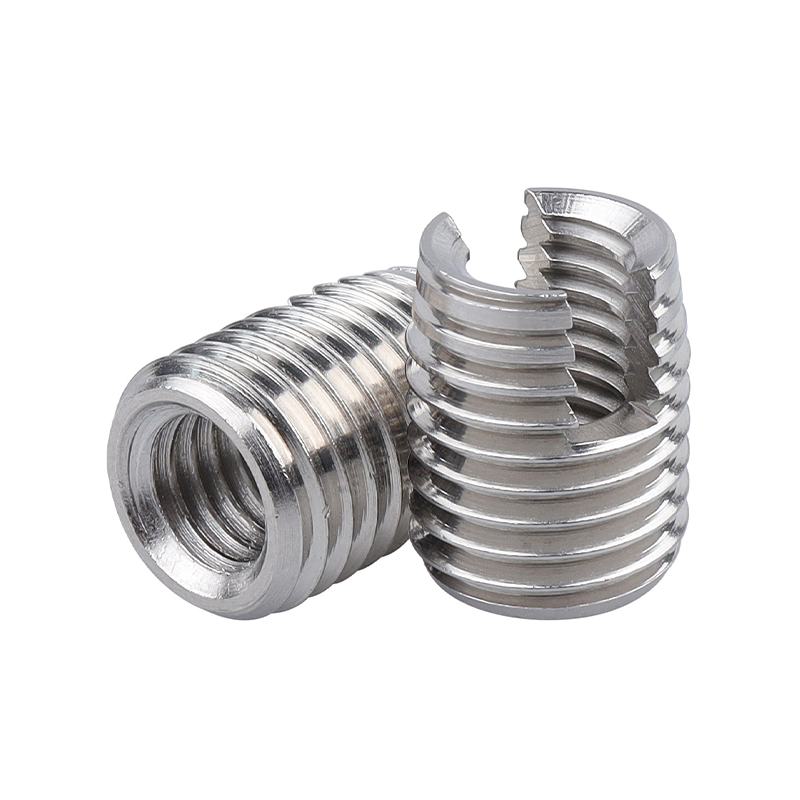
Stainless Steel Self-Tapping Thread Insert
What Is a Stainless Steel Self-Tapping Thread Insert?
A stainless steel self-tapping thread insert is a sleeve-shaped threaded fastener with an internal thread and an external self-tapping thread or cutting structure. The internal thread is designed to receive a standard screw or bolt. The external thread engages directly with the parent material and forms a secure mechanical connection during installation.
The insert is normally installed into a correctly sized drilled hole. As the insert is driven into the hole, its external cutting section removes or displaces material and creates an external thread in the workpiece. The result is a metal-reinforced internal thread that is substantially more resistant to wear, stripping, pull-out, and repeated fastening than a thread formed directly in a soft substrate.
In a conventional assembly, a screw installed directly into plastic or aluminum may gradually damage the internal thread. This can happen when the fastener is removed and reinstalled several times, when excessive torque is applied, or when the joint is exposed to vibration. A self-tapping insert distributes the load through a larger external surface and transfers the fastener load into a stronger, more durable sleeve.
These inserts are different from wire thread inserts. A wire insert is made from a helically wound wire section and is normally installed into a specially tapped hole. A self-tapping insert is a more rigid sleeve with an external thread or cutting profile. It is often selected where a solid, robust insert is preferred, where the base material is relatively soft, or where installation speed is especially important.
Basic Construction
The main functional areas of the insert include the internal thread, external self-tapping thread, cutting groove or slot, lead-in section, and cylindrical body. The internal thread must be produced with suitable dimensional accuracy so that the mating screw or bolt can be installed smoothly while maintaining adequate thread engagement.
The external thread provides mechanical retention inside the parent material. Its diameter, pitch, and profile determine the required pilot-hole size and the amount of material engagement. The cutting groove allows the insert to cut into the workpiece during installation. In the Type 302 slotted design, the cutting groove contributes to the self-inserting function and helps the sleeve form its own external thread.
The insert length is selected according to the required load capacity, available wall thickness, and depth of the component. Longer inserts generally provide more thread engagement with the base material, although the correct length must always be matched to the design geometry. A hole that is too shallow may prevent complete installation, while an insert that is too long may interfere with internal components or create a protrusion on the opposite side.
Key Advantages Over Conventional Threading Methods
Improved Thread Strength in Soft Materials
The most important advantage is the reinforcement of a weak internal thread. Plastic, aluminum, and thin-wall materials may not provide enough shear area to support repeated tightening and loosening. A stainless steel insert creates a durable internal thread that is better able to withstand installation torque, service loads, and repeated maintenance.
The insert also spreads the load over its external thread and the surrounding base material. This reduces the concentration of stress that often causes directly tapped plastic or aluminum threads to deform. In applications with frequent service access, such as equipment covers, electrical housings, vehicle panels, and machine guards, this improvement can significantly extend component life.
Self-Tapping Installation
Many standard threaded inserts require the workpiece to be drilled and tapped before the insert can be installed. Stainless steel self-tapping inserts reduce this requirement by using an external cutting design. After the correct pilot hole is prepared, the insert can be driven into the material using suitable installation equipment.
Removing the separate pre-tapping operation can reduce cycle time and simplify production planning. It may also reduce the number of tools required on the assembly line. For repair work, the self-tapping design is valuable because it can often be used with practical field equipment where a complete tapping operation would be inconvenient or time-consuming.
Corrosion Resistance
Stainless steel provides strong protection against atmospheric moisture, condensation, industrial humidity, and many corrosive environments. Grade 304 stainless steel is widely used for general industrial, outdoor, and electrical applications. Grade 316 stainless steel offers improved resistance in environments containing chlorides, salt spray, and certain chemical agents.
Corrosion resistance is especially important when the insert is installed in a dissimilar material. In aluminum components, for example, the fastening system may be exposed to moisture and galvanic conditions. The material selection should be evaluated together with the mating fastener and the parent material, but stainless steel provides a strong foundation for long-term service.
Resistance to Vibration and Loosening
Threaded connections in vehicles, rail equipment, machinery, and industrial systems may be exposed to continuous vibration. A damaged or weak parent thread can allow the fastener to loosen or lose clamping force. A properly installed self-tapping insert provides a more stable and wear-resistant thread form, helping maintain the integrity of the joint.
The Type 302 slotted configuration includes a cutting groove and a high-strength external thread. The structure is intended to support effective assembly while providing strong resistance to vibration-related loosening. The insert itself is not a substitute for correct torque control, thread locking, or joint design, but it can substantially improve the mechanical foundation of the threaded connection.
Repair and Original Equipment Installation
These inserts are suitable for both new components and damaged-thread repair. In new production, an insert can be installed during the manufacturing process to strengthen a threaded point before the product reaches the customer. In maintenance applications, it can restore a stripped or weakened threaded hole and avoid replacing an otherwise serviceable component.
Repairing the thread rather than replacing the entire housing, bracket, cover, or panel can reduce downtime and material waste. This is particularly useful when the damaged component is expensive, difficult to remove, or no longer readily available.
Material Options and Environmental Performance
304 Stainless Steel
304 stainless steel is a widely used austenitic stainless-steel grade. It offers a useful combination of corrosion resistance, strength, formability, and availability. It is appropriate for many indoor and outdoor applications, including machinery, electronic housings, automotive components, general industrial equipment, and architectural hardware.
When the assembly is exposed to ordinary humidity, rain, condensation, or moderate industrial contamination, 304 stainless steel may provide a practical balance between performance and cost. It is also a common choice where the service environment is not strongly exposed to chloride ions or aggressive chemicals.
316 Stainless Steel
316 stainless steel contains molybdenum, which improves resistance to pitting and crevice corrosion in chloride-bearing environments. It is often preferred for marine equipment, coastal installations, chemical processing equipment, outdoor infrastructure, and applications exposed to salt spray.
The choice between 304 and 316 stainless steel should be based on the complete environmental assessment, including temperature, humidity, chemical exposure, salt concentration, contact with dissimilar metals, and expected service life. Selecting a higher-grade insert does not eliminate the need for proper joint design and corrosion control, but it can improve the reliability of the fastening system.
Temperature Capability
The product information identifies an operating range of approximately -40°C to 600°C for the specified stainless steel self-tapping insert solution. This broad range supports applications involving low-temperature storage, outdoor winter operation, engine-adjacent components, industrial equipment, and other assemblies exposed to temperature variation.
Actual performance at elevated temperature depends on more than the insert material. The strength of the parent material, the mating fastener, the applied load, oxidation conditions, thermal expansion, installation torque, and the surrounding assembly must also be evaluated. Engineers should confirm the final design against the requirements of the specific application.
| Material or Condition | Typical Benefit | Suitable Considerations |
|---|---|---|
| 304 stainless steel | General corrosion resistance and balanced mechanical performance | Indoor equipment, outdoor assemblies, machinery, electronics, and automotive components |
| 316 stainless steel | Enhanced resistance to chloride and marine exposure | Coastal structures, marine equipment, chemical environments, and salt-spray conditions |
| Aluminum parent material | Lower weight with reinforced internal threads | Automotive parts, housings, brackets, aerospace-related components, and machine structures |
| Plastic parent material | Improved resistance to thread stripping and repeated assembly | Electrical housings, instrument panels, communication devices, and consumer equipment |
| Thin-wall metal | Creates a stronger threaded connection where direct tapping is limited | Sheet metal parts, covers, panels, and lightweight structural components |
Type 302 Slotted Self-Inserting Screw Sleeve
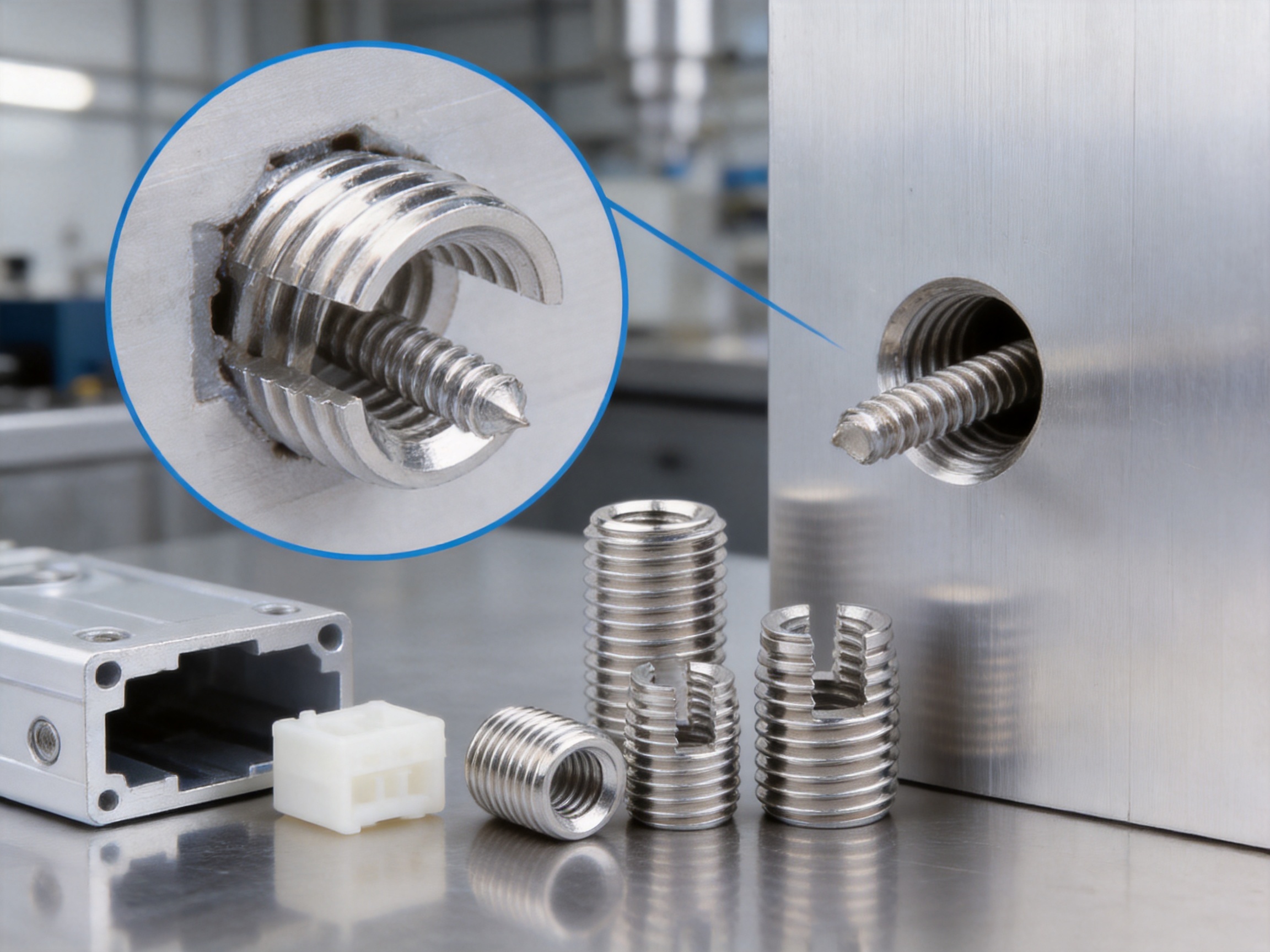
The Type 302 slotted self-inserting screw sleeve is a representative design within this product category. Its screw sleeve body incorporates a cutting groove that enables self-tapping installation. The external thread is designed for engagement with the base material, while the internal thread provides the finished connection for a standard mating fastener.
The cutting groove is important because it allows the insert to remove or displace material as it enters the drilled hole. This reduces the need for a separately tapped external thread. The slot also helps the insert begin its engagement more effectively when the correct installation method and pilot-hole diameter are used.
A slotted insert must be installed with attention to alignment. If the driver is tilted or excessive force is applied, the sleeve may be driven at an angle, causing incomplete engagement or damage to the surrounding material. Correct tool selection, controlled installation speed, and a clean pilot hole are essential for achieving consistent results.
The product is available in multiple metric and inch-related sizes. This allows it to be matched with common screw standards used in mechanical, automotive, electrical, and industrial assemblies. The internal thread specification should always be confirmed before ordering so that the insert is compatible with the intended fastener.
Dimensional Selection Guide
The following table summarizes the listed Type 302 sizes and related installation information. The drilling ranges are reference values supplied for plastic, aluminum alloy, and cast iron. Final pilot-hole dimensions should be validated through engineering trials because actual requirements can vary with material grade, hardness, wall thickness, tooling, and production conditions.
| Internal Thread | Approximate Inch Reference | Insert Length | External Thread | Plastic Pilot Hole | Aluminum Alloy Pilot Hole | Cast Iron Pilot Hole | Minimum Drilling Depth |
|---|---|---|---|---|---|---|---|
| M2-0.4 | — | 6 | M4.5-0.5 | 4.0-4.1 | 4.1-4.2 | 4.2-4.3 | 8 |
| M2.5-0.45 | U#2-56 | 6 | M4.5-0.5 | 4.0-4.1 | 4.1-4.2 | 4.2-4.3 | 8 |
| M3-0.5 | U#4-40 | 6 | M5-0.5 | 4.5-4.6 | 4.6-4.7 | 4.7-4.8 | 8 |
| M4-0.7 | U#8-32 | 8 | M6.5-0.75 | 5.8-5.9 | 6.0-6.1 | 6.1-6.2 | 10 |
| M5-0.8 | U#10-24 | 10 | M8-1.0 | 7.1-7.2 | 7.3-7.5 | 7.5-7.6 | 13 |
| M6a-1.0 | — | 12 | M9-1.0 | 8.1-8.2 | 8.3-8.5 | 8.5-8.6 | 15 |
| M6-1.0 | U/14-20 | 14 | M10-1.5 | 9.0-9.2 | 9.2-9.3 | 9.3-9.4 | 17 |
| M8-1.25 | U5/16-18 | 15 | M12-1.5 | 10.6-10.8 | 11.0-11.2 | 11.2-11.4 | 18 |
| M10-1.5 | U3/8-16 | 18 | M14-1.5 | 12.6-12.8 | 13.0-13.3 | 13.2-13.4 | 22 |
| M12-1.75 | U7/16-14 | 22 | M16-1.5 | 14.6-14.8 | 15.0-15.3 | 15.2-15.4 | 26 |
| M14-2.0 | U1/2-13 | 24 | M18-1.5 | 16.6-16.8 | 17.0-17.3 | 17.2-17.5 | 28 |
| M16-2.0 | U5/8-11 | 22 | M20-1.5 | 18.6-18.8 | 19.0-19.3 | 19.2-19.5 | 27 |
| M18-2.5 | — | 24 | M22-1.5 | 20.6-20.8 | 21.0-21.3 | 21.2-21.5 | 29 |
| M20-2.5 | — | 27 | M26-1.5 | 24.6-24.8 | 25.0-25.3 | 25.2-25.2 | 32 |
Several dimensional details deserve special attention. The listed values distinguish between different parent materials because plastic, aluminum alloy, and cast iron do not behave identically during installation. A softer material may require a different pilot-hole diameter from a harder material to achieve the correct balance between cutting action, insertion torque, and pull-out resistance.
The minimum drilling depth should exceed the insert length. Additional clearance may be required for chips, displaced material, tool travel, and the bottom geometry of the hole. For blind holes, engineers should confirm that the insert can reach its required seating position without bottoming out before the external thread is fully engaged.
Where the table contains an unusual size designation or a dimension that appears inconsistent with the intended thread standard, the purchaser should request a controlled drawing or technical confirmation before mass production. This is a normal and important step in industrial fastener procurement.
Installation Procedure
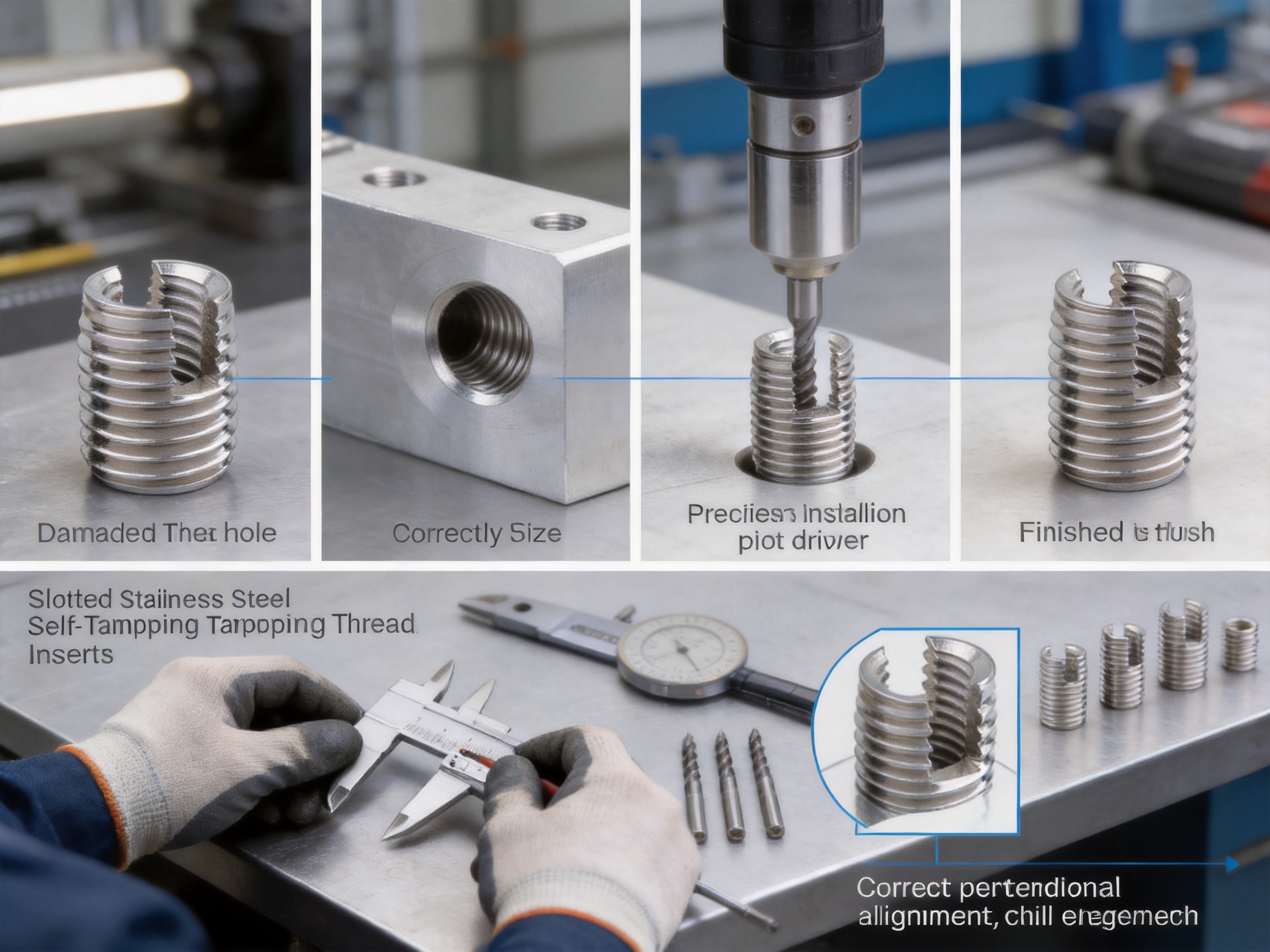
Step One: Inspect the Base Material
Before installation, inspect the component for cracks, distortion, excessive wear, contamination, or insufficient wall thickness. A thread insert can reinforce a threaded hole, but it cannot compensate for a severely fractured or structurally unstable component. The surrounding material must be capable of supporting the external thread.
For repair applications, remove loose fragments and assess whether the original hole can be enlarged to the specified pilot-hole size. If the component has suffered impact damage, confirm that the hole remains perpendicular to the surface. An angled or oval hole may cause poor insert alignment and uneven load distribution.
Step Two: Prepare the Pilot Hole
Drill the pilot hole according to the selected insert size and the recommended range for the parent material. Hole diameter is one of the most important installation variables. If the hole is too small, insertion torque may become excessive and the insert or workpiece may be damaged. If the hole is too large, the external thread may not engage sufficiently, reducing retention strength.
For a blind hole, the drilling depth should be greater than the specified minimum depth. Remove chips and debris using an appropriate cleaning method. The bottom of the hole should not contain compacted material that prevents the insert from reaching its intended position.
Step Three: Align the Installation Tool
Use a suitable mandrel, driver, installation tap, or other compatible tool. The tool must engage the insert securely and maintain the correct axis. Begin the installation perpendicular to the workpiece surface. Alignment is especially important for small inserts and thin-wall components, where a slight angular error can produce a significant deviation in the finished thread.
Depending on the material and production method, the insert may be installed manually, with a hand tool, or using powered equipment with controlled torque and speed. Automated assembly systems can improve repeatability when installation parameters are properly established.
Step Four: Drive the Insert into Position
Apply steady rotational force and allow the cutting groove to form the external thread. Avoid forcing the insert with sudden impact unless the installation system is specifically designed for that method. Excessive speed or torque can generate heat, deform the insert, or damage the parent material.
Drive the insert until it reaches the specified seating depth. The top of the insert should be positioned according to the assembly drawing. It may be flush with the surface, slightly below the surface, or located at a defined depth depending on the application and the mating fastener.
Step Five: Verify the Finished Thread
After installation, inspect the insert for correct seating, visible damage, distortion, and alignment. Use a suitable thread gauge, master screw, or mating fastener to confirm that the internal thread is clean and functional. The fastener should engage smoothly without excessive resistance or cross-threading.
Where the connection is safety-critical or production volume is high, inspection may include insertion-torque testing, pull-out testing, torque-to-failure testing, visual inspection, dimensional verification, and statistical process control. The test method should reflect the material and service conditions of the final product.
Manufacturing Process and Quality Strengths
Specialized Production Capability
Dongtai Jinzhize Metal Products Co., Ltd. is a specialized manufacturer of threaded connection and fastening products. Its product range includes helical wire inserts, self-tapping inserts, key-locking inserts, threaded adapters, oil plugs, installation taps, and related tools. This product concentration allows the company to develop experience across the complete threaded-connection process rather than treating inserts as a general-purpose commodity.
The company was established in 2015 and operates an owned manufacturing facility with an area of approximately 10,000 square meters. The plant is equipped with hundreds of machine tools and automated production systems. This combination of equipment and process specialization supports stable production capacity for customers requiring repeatable dimensions, consistent materials, and regular supply.
Material Preparation and Traceability
Quality begins with the selection and control of stainless-steel raw material. For 304 or 316 products, the material should be identified by grade and controlled through incoming inspection. A professional manufacturing system may use material certificates, batch identification, chemical composition verification, and mechanical-property documentation to maintain traceability.
Traceability is particularly important for applications in automotive, aerospace, rail, and industrial equipment. When a customer purchases repeated production batches, the ability to connect finished inserts with raw-material lots and manufacturing records improves confidence in long-term consistency. It also makes investigation more efficient if a performance concern is reported.
Precision Forming and Thread Production
The cutting groove, external thread, and internal thread must be manufactured with controlled geometry. Variations in pitch, diameter, slot form, or thread crest can influence installation torque and holding strength. Modern machine tools and automated production systems help maintain repeatability across large quantities.
Manufacturing control should cover the complete dimensional chain, including raw-material size, sleeve geometry, thread profile, insert length, cutting-edge condition, surface finish, and final inspection. The purpose is not merely to produce a part that looks correct, but to ensure that the insert performs predictably during installation and service.
Process Inspection
Typical quality checks for stainless steel self-tapping inserts may include visual inspection, dimensional measurement, thread gauging, material verification, surface-condition inspection, and functional testing. Depending on customer requirements, the manufacturer may also assess installation torque, pull-out resistance, stripping torque, corrosion behavior, and temperature-related performance.
Automated equipment can reduce operator variation in repetitive processes. However, automation is most effective when supported by clear process parameters, preventive maintenance, tool-life management, and trained quality personnel. The company describes its manufacturing operation as being supported by a rigorous quality management system and a comprehensive after-sales service mechanism.
Application Engineering Support
Choosing an insert is not only a matter of selecting an internal thread size. The manufacturer must consider the parent material, wall thickness, load direction, installation method, exposure conditions, available drilling depth, and expected maintenance frequency. A supplier with experience in multiple threaded products can help customers compare self-tapping inserts with wire inserts, key-locking inserts, adapters, or other solutions.
Application support may include size selection, pilot-hole guidance, material recommendations, installation-tool matching, and sample testing. For new designs, early testing can identify whether the selected length and external thread provide the required installation torque and pull-out resistance.
Why Manufacturing Scale Matters to Buyers
For industrial customers, product performance and supply reliability are closely connected. A technically suitable insert is of limited value if its dimensions vary from batch to batch or if replenishment is uncertain. A manufacturing facility with substantial equipment, automated systems, and established production teams can be better positioned to support scheduled deliveries and ongoing programs.
Jinzhize reports an annual output value of 153 million RMB in 2024. This figure indicates significant commercial activity and manufacturing capability, although buyers should still evaluate the specific product, quality documentation, and production capacity required for their own project. Manufacturing scale can help support stable supply, but product qualification remains essential for critical assemblies.
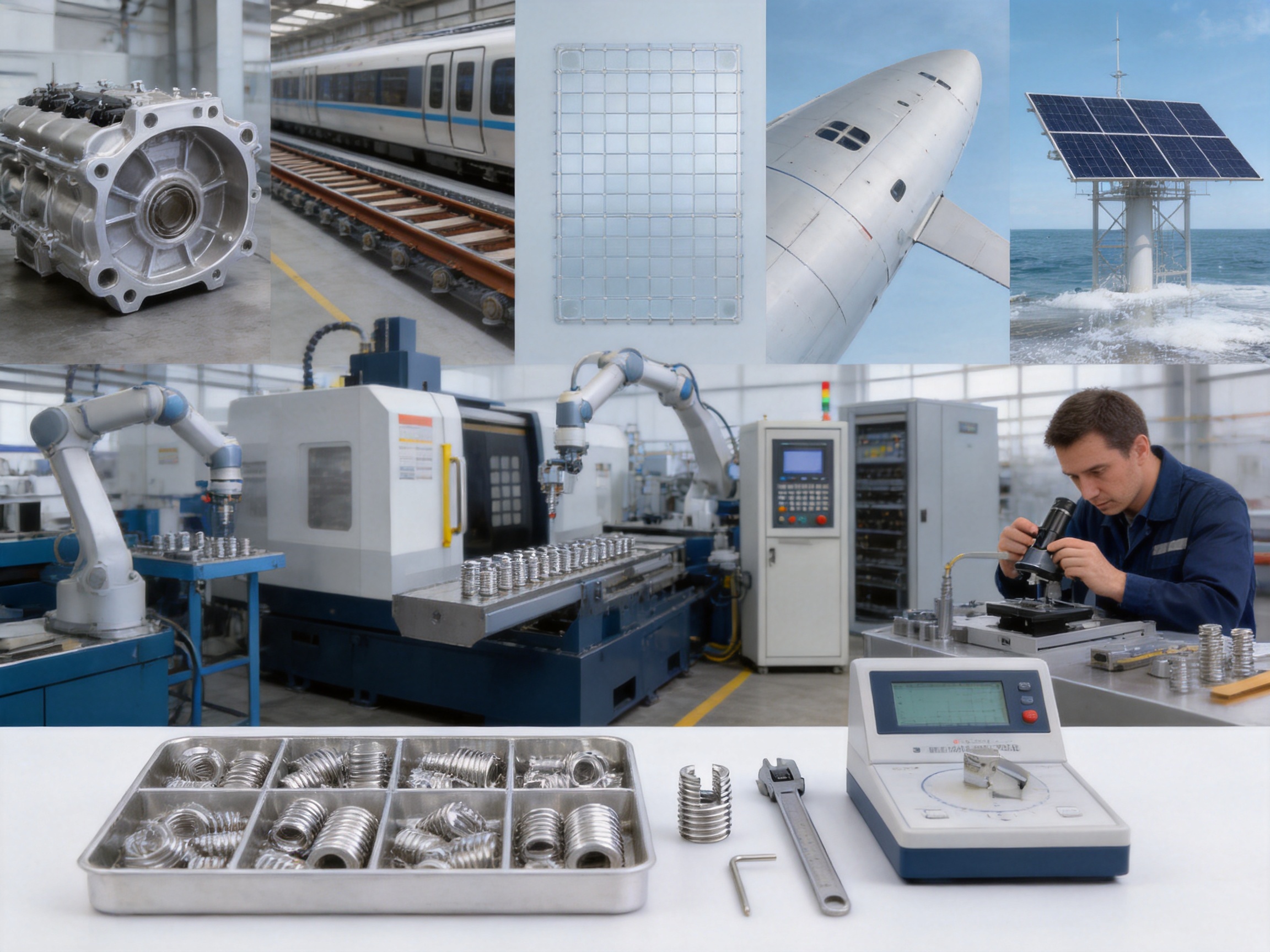
The company supplies products used in automotive engines and transmissions, passenger and commercial vehicles, aerospace-related manufacturing, and rail vehicles. These sectors generally require high consistency because threaded inserts may be installed in assemblies exposed to vibration, thermal cycling, maintenance activity, and demanding operating conditions.
A broad product portfolio also provides practical advantages. A customer sourcing self-tapping inserts may later require installation taps, key-locking inserts, oil plugs, threaded adapters, or wire inserts. Working with a manufacturer that produces related components can simplify supplier management, technical communication, and packaging coordination.
Applications Across Industrial Markets
Automotive Components
Automotive assemblies use aluminum, magnesium alloy, engineering plastic, and thin-wall metal to reduce vehicle weight and improve efficiency. These materials are useful but may not provide sufficient thread durability for every fastening point. Stainless steel self-tapping inserts can reinforce threads in engine-related housings, transmission parts, brackets, covers, interior components, and chassis-related assemblies.
Automotive applications also involve vibration, shock, temperature cycling, fluids, and repeated service operations. A reinforced internal thread can help maintain fastening performance when a component must be opened during maintenance. The insert may also support repair work after a fastener has stripped the original thread.
Aerospace and Rail Equipment
Aerospace and rail manufacturing often emphasizes weight control, structural reliability, maintenance access, and traceable production. Aluminum components are common, and threaded connections may require reinforcement to support repeated assembly without damaging the base material.
For these sectors, insert selection should be tied to the applicable engineering standards and qualification procedures. Material certificates, inspection records, lot traceability, and controlled installation are especially important. Stainless steel provides a strong and corrosion-resistant thread, but the complete fastening system must still be approved for the specific service environment.
Electronics and Electrical Housings
Communication equipment, instruments, control boxes, power equipment, and electronic housings frequently use plastic or aluminum enclosures. A directly tapped plastic thread may be adequate for a lightly loaded cover, but it may fail after repeated service or excessive tightening. An insert produces a more durable thread for screws that secure covers, brackets, terminals, heat sinks, and internal modules.
The compact size range of self-tapping inserts allows designers to reinforce small fastening points without using large nuts or bulky external hardware. Stainless steel is also useful where the housing may be exposed to condensation, outdoor humidity, or temperature changes.
Outdoor Facilities and Renewable-Energy Structures
Outdoor railings, photovoltaic supports, equipment cabinets, signs, lighting structures, and monitoring systems may be exposed to rain, salt, dust, ultraviolet radiation, and temperature variation. Stainless steel self-tapping inserts can provide a corrosion-resistant threaded connection in metal or polymer components.
When used in outdoor structures, designers should consider drainage, galvanic compatibility, surface coatings, and water accumulation around the joint. Grade 316 may be preferred for coastal or salt-exposed locations. The insert should be matched with a compatible fastener and installation method to avoid damaging the thread or reducing corrosion performance.
Industrial Machinery and Machine Housings
Machine housings, guards, covers, control panels, and sheet-metal assemblies often require many serviceable threaded points. Inserts are useful where screws will be removed frequently or where the parent material is too thin for a durable direct thread.
Self-tapping installation can simplify production because the same basic hole-preparation process can be used for a large number of fastening points. When the insert is correctly selected and installed, it provides a repeatable internal thread that supports assembly, maintenance, and component replacement.
Comparison with Alternative Threaded Solutions
Directly Tapped Plastic or Aluminum
Direct tapping is simple and inexpensive when the material is strong enough and the joint will not be frequently serviced. However, the thread may strip under high torque, repeated assembly, vibration, or accidental cross-threading. A stainless steel self-tapping insert adds a hardened and corrosion-resistant thread where direct tapping would be less reliable.
Wire Thread Inserts
Wire thread inserts are lightweight and effective in many applications. They are often selected when a high-strength internal thread is required in aluminum or other soft alloys. However, they generally require a dedicated internal thread to be tapped before installation, along with specialized installation and tang-removal operations.
A self-tapping sleeve can be preferable when the customer wants a solid insert, a simpler installation sequence, or a solution that forms its own external engagement. The best choice depends on load, available space, installation equipment, service conditions, and applicable standards.
Press-Fit or Heat-Installed Inserts
Press-fit and heat-installed inserts are common in thermoplastics. They can provide good retention when the design and installation equipment are suitable. However, they may require controlled heating or pressing, and their performance can be sensitive to molding conditions and local material geometry.
A self-tapping stainless steel insert can offer a practical alternative when the component is already machined, when repair is required, or when the production line does not use thermal insertion equipment.
Key-Locking Inserts
Key-locking inserts use external keys or locking elements to prevent rotation and provide strong thread repair. They are useful in high-load applications and damaged holes that require substantial reinforcement. In comparison, a self-tapping insert may be faster to install and more suitable for applications where external locking keys are unnecessary.
| Solution | Main Strength | Potential Limitation | Typical Selection Reason |
|---|---|---|---|
| Directly tapped thread | Low part cost and simple machining | May strip in soft or thin materials | Suitable for strong materials and low service frequency |
| Stainless steel self-tapping insert | Fast installation and strong corrosion-resistant thread | Requires accurate pilot-hole preparation | Suitable for soft materials, repairs, vibration, and outdoor exposure |
| Wire thread insert | High-strength internal thread with low weight | Usually requires pre-tapping and additional installation steps | Suitable for many high-strength alloy applications |
| Heat-installed insert | Efficient retention in thermoplastics | Requires controlled heat and compatible plastic geometry | Suitable for molded plastic production |
| Key-locking insert | Strong resistance to rotation and pull-out | Installation may require additional locking operations | Suitable for demanding thread repairs and high-load joints |
Design Recommendations for Reliable Performance
Designers should select the insert length based on the load, parent-material strength, available wall thickness, and expected number of assembly cycles. The thread should engage sufficient material without breaking through a thin wall or interfering with internal features.
The pilot hole should be specified by material and insert type. A single universal drilling diameter should not be assumed for plastic, aluminum alloy, and cast iron. Material hardness, elasticity, fiber reinforcement, casting condition, and temperature can all affect the installation result.
Edge distance is another important factor. If the hole is too close to an edge, the external thread may split or distort the surrounding material. Plastic components may require additional edge distance because of their lower resistance to cracking. Aluminum and cast iron may behave differently depending on section thickness and microstructure.
Designers should also consider the relationship between the insert and the mating fastener. The internal thread size, fastener grade, tightening torque, washer arrangement, and clamping load must be compatible. A stronger insert does not automatically make the entire joint stronger if the bolt, component, or surrounding wall is the limiting element.
Where the joint is exposed to corrosive conditions, evaluate the complete material combination. Stainless steel, aluminum, plated carbon steel, and other metals can create galvanic effects in the presence of an electrolyte. Suitable coatings, sealants, washers, drainage features, or material combinations may be required.
For production programs, it is useful to establish a controlled installation specification. This specification can include pilot-hole tolerance, drilling depth, cleaning method, installation tool, insertion speed, torque range, seating depth, inspection method, and rejection criteria. Standardized installation helps maintain consistent performance across operators and production shifts.
Quality Assurance and Customer Support
Reliable thread inserts should be supported by more than a dimensional catalog. Customers may require material certificates, inspection reports, samples, drawings, packaging specifications, and production-lot information. These documents help the buyer verify that the product meets the requirements of the intended assembly.
Jinzhize emphasizes consistent and traceable products supported by a quality management system and after-sales service. For buyers in automotive, aerospace, rail, and other critical industries, this approach can simplify supplier qualification and improve communication when technical questions arise.
Sample testing is recommended before full-scale production. A suitable evaluation can compare installation torque, seating condition, pull-out load, stripping torque, repeated assembly performance, and environmental resistance. Testing should use the actual parent material and representative component geometry rather than relying only on generic test blocks.
Packaging is also relevant to product quality. Inserts should be protected against contamination, impact, mixing of sizes, and unnecessary exposure to moisture during storage and transport. Clear labeling should identify the internal thread, external thread, length, material, quantity, batch, and any required installation information.
Purchasing and Customization Considerations
When requesting a quotation, buyers should provide the internal thread standard, external thread requirement, insert length, stainless-steel grade, parent material, hole type, expected quantity, installation method, and service environment. A drawing or sample component can help avoid misunderstandings, especially when the product uses nonstandard dimensions.
Customers may also need customized lengths, special thread combinations, alternative cutting grooves, modified surface conditions, or packaging formats for automated assembly. The feasibility of customization depends on production tooling, material availability, inspection requirements, and order volume.
For international supply, buyers should clarify labeling, export packaging, documentation, inspection standards, delivery schedule, and acceptance criteria in advance. A clear technical specification helps both parties reduce quality risk and ensures that the supplied insert matches the production process.
Jinzhize’s specialization in threaded connection products allows it to support a range of related requirements from one manufacturing source. This can be useful for companies that need several insert types, installation tools, thread taps, oil plugs, or adapters across the same product family.
Frequently Asked Questions
What materials can receive a stainless steel self-tapping thread insert?
These inserts are commonly used in aluminum, plastic, thin-wall metal, and other materials that require thread reinforcement. The correct insert design and pilot-hole size depend on the hardness, thickness, structure, and strength of the parent material.
Does installation require a pre-tapped external thread?
No. The self-tapping external thread and cutting groove are designed to form engagement directly in the prepared pilot hole. The hole still needs to be drilled to the correct diameter and depth, and the insert must be installed with an appropriate tool.
Are these inserts suitable for repairing stripped threads?
Yes. They can be used to restore damaged or stripped threads when enough surrounding material remains to support the larger pilot hole and external thread. The damaged hole must be properly prepared, aligned, cleaned, and inspected before installation.
Should I choose 304 or 316 stainless steel?
304 stainless steel is suitable for many general industrial, indoor, automotive, and outdoor applications. 316 stainless steel is generally preferred where the insert will experience salt spray, marine exposure, chloride contamination, or more aggressive chemical conditions. The final choice should consider the complete assembly and environment.
Can the inserts be used in high-temperature applications?
The supplied product information identifies reliable operation across approximately -40°C to 600°C. However, the complete joint must be evaluated because the parent material, mating fastener, applied load, thermal expansion, and oxidation environment also affect performance at high temperature.
How do I select the pilot-hole diameter?
Use the recommended reference range for the selected insert and parent material. Plastic, aluminum alloy, and cast iron may require different hole sizes. Always validate the dimension through a trial installation, especially for new materials, thin-wall components, reinforced plastics, or critical assemblies.
What happens if the pilot hole is too small?
A hole that is too small can cause excessive insertion torque, damage the cutting groove, distort the insert, crack the parent material, or prevent the insert from reaching the required depth. It may also make production installation inconsistent.
What happens if the pilot hole is too large?
A hole that is too large may reduce external thread engagement and lower resistance to pull-out or rotation. The insert may also seat loosely or fail to maintain the required clamping performance.
Can the insert be installed manually?
Small quantities can often be installed with a suitable hand tool. For high-volume production, controlled powered equipment or automated installation systems may provide better consistency. The selected equipment must maintain alignment and avoid excessive torque or impact.
Are these inserts resistant to vibration?
The reinforced stainless steel thread and Type 302 slotted self-tapping design are intended to provide strong vibration resistance and anti-loosening performance. Correct seating, proper fastener torque, suitable joint design, and inspection remain essential for vibration-exposed assemblies.
Can a stainless steel insert be used with an aluminum component?
Yes. Aluminum is one of the common parent materials for thread reinforcement. Because stainless steel and aluminum are dissimilar metals, the complete assembly should be reviewed for galvanic corrosion, particularly in wet, coastal, or salt-exposed environments.
How should installed inserts be inspected?
Inspect the seating depth, alignment, visible damage, and thread cleanliness. A suitable gauge or mating fastener can verify the internal thread. High-reliability applications may also require installation-torque, pull-out, stripping, or repeated-assembly testing.
What information should be included in a purchase inquiry?
Include the internal thread, external thread, length, material grade, parent material, hole type, required quantity, operating environment, installation method, packaging requirements, and documentation needs. A technical drawing is recommended for special or nonstandard sizes.
Conclusion
Stainless steel self-tapping thread inserts provide a practical way to create durable internal threads in soft, thin, or damaged materials. Their self-tapping external design simplifies installation, while the stainless steel body improves corrosion resistance, wear resistance, and long-term thread stability. These benefits make them suitable for automotive, aerospace-related, rail, electronic, industrial, marine, and outdoor applications.
Compared with directly tapped threads, the insert offers stronger protection against stripping and repeated wear. Compared with solutions that require pre-tapping or thermal installation, it can reduce process steps and support faster assembly or repair. The Type 302 slotted design further supports efficient insertion by combining a cutting groove with a high-strength external thread.
Product selection must be supported by correct pilot-hole preparation, sufficient wall thickness, proper alignment, controlled installation, and inspection. The dimensional information provides a useful starting point, but application trials and engineering validation remain important for critical joints.
Dongtai Jinzhize Metal Products Co., Ltd. combines specialized threaded-product manufacturing with a large owned facility, extensive machine-tool resources, automated production systems, quality management, traceability, and application support. Its broader range of inserts, adapters, oil plugs, installation taps, and related tools can help customers develop coordinated fastening solutions from a single experienced source.
For manufacturers seeking corrosion-resistant, repeatable, and efficient thread reinforcement, stainless steel self-tapping thread inserts offer a strong balance of installation convenience and mechanical performance. When matched correctly to the base material and service conditions, they can improve assembly reliability, extend component life, reduce repair time, and lower the risk associated with stripped or unstable threaded connections.
References
1. Product information supplied for Stainless Steel Self-Tapping Thread Insert, including Type 302 slotted self-inserting screw sleeve dimensions and installation data.
2. ISO 965, ISO Metric Screw Threads: Tolerances and Limits of Size.
3. ISO 1502, ISO General-Purpose Metric Screw Threads: Gauging.
4. ASTM A240, Standard Specification for Chromium and Chromium-Nickel Stainless Steel Plate, Sheet, and Strip for Pressure Vessels and for General Applications.
5. ASTM A276, Standard Specification for Stainless Steel Bars and Shapes.
6. ASM Handbook, Volume 1, Properties and Selection: Irons, Steels, and High-Performance Alloys.
7. Engineering guidance on threaded fastener joint design, torque control, pilot-hole preparation, and thread-strength evaluation.



