

 Français
 Español
 Deutsch

Content
- 1 Introduction
- 2 What Is a Blue Zinc Plated Self-Tapping Thread Insert?
- 3 Core Product Advantages
- 4 Type 302 Slotted Design
- 5 Technical Dimensions and Selection Data
- 6 Installation Procedure
- 7 Applications Across Multiple Industries
- 8 Advantages Compared with Alternative Thread Solutions
- 9 Manufacturing Strengths and Quality Control
- 10 Customization and Technical Support
- 11 Packaging, Storage, and Handling
- 12 Engineering Considerations and Limitations
- 13 Recommended Inspection Points
- 14 Why Choose a Specialized Threaded Connection Manufacturer?
- 15 Q&A
- 15.1 What materials can receive these self-tapping inserts?
- 15.2 Do I need to tap the hole before installation?
- 15.3 What is the purpose of the blue zinc coating?
- 15.4 Can the insert repair a stripped thread?
- 15.5 Are both metric and inch-related sizes available?
- 15.6 How should I select the insert length?
- 15.7 Can these inserts be used outdoors?
- 15.8 What causes excessive installation torque?
- 15.9 Can the inserts be installed with standard tools?
- 15.10 Does the insert completely prevent fastener loosening?
- 15.11 Are customized inserts available?
- 15.12 What quality information should be requested?
- 16 Conclusion
- 17 References
- 18 Product: Blue Zinc Plated Self-Tapping Thread Insert
Introduction
Threaded joints are essential in mechanical assemblies, furniture, electronic housings, automotive components, architectural hardware, and many other products. However, a conventional tapped hole is not always strong enough for the base material in which it is formed. Aluminum, plastic, magnesium alloys, composite panels, and other relatively soft materials may have insufficient thread engagement, especially when the joint is repeatedly assembled and disassembled. Vibrations, impact loads, thermal cycling, and exposure to humidity can further increase the risk of thread stripping, loosening, and corrosion.
Blue zinc plated self-tapping thread inserts provide a practical solution to these challenges. They are designed to create or reinforce internal threads in soft or relatively low-strength materials without requiring a separately pre-tapped thread. Their external cutting thread forms a secure mechanical engagement with the host material, while the internal thread provides a durable connection for a bolt, screw, or other threaded component. The blue-white zinc coating adds a protective barrier against rust and oxidation, making the insert suitable for applications where both mechanical performance and surface appearance matter.
The Type 302 slotted self-inserting screw sleeve is a representative design. Its cutting groove supports direct installation, and its high-strength internal thread offers improved resistance to wear and repeated fastening. Compared with uncoated inserts, ordinary non-cutting sleeves, or improvised thread-repair methods, this product combines fast installation, thread reinforcement, corrosion resistance, dimensional variety, and clean appearance in one component.
Manufactured by Dongtai Jinzhize Metal Products Co., Ltd., these inserts are part of a broader range of threaded connection and fastening products. The company specializes in helical wire inserts, self-tapping inserts, key-locking inserts, threaded adapters, oil plugs, installation taps, and related tools. Its production capabilities, engineering experience, quality management system, and focus on traceability support stable supply for industrial customers in China and international markets.
What Is a Blue Zinc Plated Self-Tapping Thread Insert?
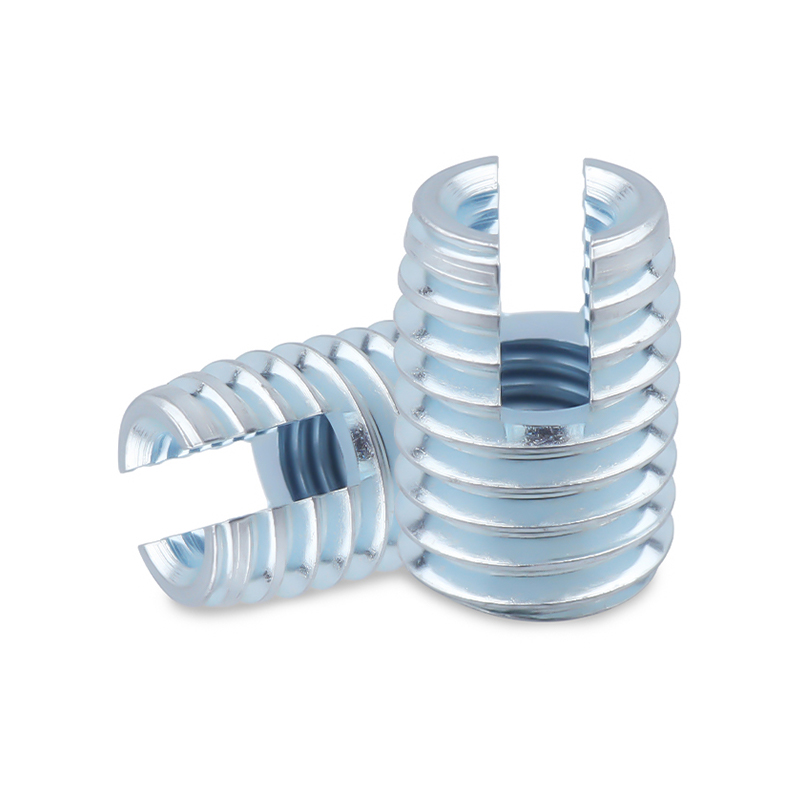
A blue zinc plated self-tapping thread insert is a cylindrical metal sleeve with an internal thread and an external cutting thread. The external thread is designed to enter a prepared hole and cut or form its own mating profile in the base material. Unlike a conventional threaded bushing that may require the workpiece to be tapped in advance, a self-tapping insert can often be installed directly after drilling a correctly sized pilot hole.
The insert usually includes a longitudinal slot, cutting groove, or other thread-forming feature. In the Type 302 slotted design, the groove allows the external thread to engage the base material progressively. During installation, the cutting feature helps remove or displace material, reducing the need for a pre-tapping operation. The insert is driven into the hole using a compatible installation tool, mandrel, driver, or standard shop equipment according to the selected size and application.
The internal thread is manufactured to receive a standard metric or inch fastener. Once installed, the insert distributes the load over a greater area than a thread cut directly into a soft material. This improves resistance to pull-out, stripping, vibration, and repeated assembly. If an existing thread has been damaged, the insert can also be used as a repair component, provided the damaged area can be accurately drilled and prepared.
The blue zinc plated surface is a protective finish applied to the metal insert. Zinc acts as a barrier between the steel substrate and the surrounding environment. It also provides sacrificial protection because zinc tends to corrode preferentially to the underlying steel when the coating is damaged. The resulting blue-white appearance is uniform, clean, and suitable for visible assemblies where an untreated dark or oily surface would be undesirable.
Core Product Advantages
Corrosion Protection from Blue Zinc Plating
The main environmental advantage of the product is its blue zinc coating. Uncoated carbon steel inserts may develop surface rust during storage, transportation, or service in humid conditions. A zinc-plated surface helps delay oxidation and provides improved protection when the product is exposed to moisture, dust, condensation, or intermittent outdoor conditions.
The supplied product information specifies salt spray resistance of approximately 48 to 96 hours, depending on the applicable test conditions and coating quality. Salt spray performance should not be interpreted as a direct prediction of service life in every environment, but it provides a useful comparative indicator for evaluating surface protection. In many general industrial applications, the blue zinc finish offers a practical balance between cost, appearance, and corrosion resistance.
The coating is especially useful for furniture hardware, electrical housings, outdoor fittings, architectural decoration, and automotive interior components. It can also improve warehouse stability by reducing the risk of corrosion before assembly. For more aggressive chemical, marine, or high-temperature environments, users should confirm the required coating system, base material, operating temperature, and corrosion standard before final selection.
Self-Tapping Installation
The external cutting thread is designed to simplify installation. With a properly sized pilot hole, the insert can be screwed into the base material without first creating a complete internal thread using a conventional tap. Eliminating the pre-tapping step can shorten the assembly process, reduce the number of tools required, and lower the chance of mismatched thread dimensions.
Self-tapping installation is particularly beneficial in production environments where many components must be assembled consistently. Operators can drill or mold a suitable hole, align the insert, and drive it into position using an appropriate tool. The process is also useful for maintenance and repair work because it can reduce the time required to restore a damaged threaded hole.
Although the insert is self-tapping, installation still requires attention to hole diameter, hole depth, alignment, driving torque, and material condition. A pilot hole that is too small may cause excessive installation force or damage the insert. A hole that is too large may reduce pull-out resistance. The correct recommended diameter depends on the base material, insert size, thread design, and application load.
Improved Thread Strength in Soft Materials
Soft materials often have threads that are too shallow or weak to withstand repeated fastening. A screw threaded directly into plastic or thin aluminum may strip if excessive torque is applied. The same thread may loosen when exposed to vibration or repeated disassembly. A metal insert creates a more durable internal thread and transfers the load into a larger volume of surrounding material.
The insert also helps separate the function of the internal thread from the strength limitations of the workpiece. The fastener engages the wear-resistant metal insert, while the external thread anchors the insert in the base material. This arrangement can increase serviceability because the joint can be opened and reassembled without repeatedly damaging the original material.
In impact-prone or vibration-prone assemblies, the insert can help maintain thread integrity. However, thread reinforcement does not eliminate the need for correct joint design. Clamping force, fastener grade, joint stiffness, hole geometry, installation torque, and vibration control all influence final performance. The insert should be selected as part of the complete fastening system rather than considered as an isolated component.
Resistance to Thread Stripping and Loosening
The high-strength internal thread provides better wear resistance than a thread formed directly in many plastics or lightweight alloys. By increasing the effective strength of the threaded interface, the insert helps reduce the probability of thread stripping during tightening. It can also reduce damage caused by repeated use of the same threaded hole.
The external thread and cutting groove provide mechanical engagement with the host material. Once the insert has been installed to the correct depth, the surrounding material holds the sleeve in place. The design can resist movement caused by ordinary service vibration, although additional locking methods may be required for severe dynamic applications.
Where loosening is a critical risk, engineers may combine the insert with an appropriate fastener locking method, such as a prevailing-torque nut, thread-locking compound, locking washer, safety wire, or mechanical retention feature. Compatibility with coatings, temperatures, chemicals, and maintenance requirements should be checked before using any additional locking method.
Wide Size Compatibility
The product range supports multiple standard metric and inch-related thread sizes. The supplied specification includes metric sizes from M2 to M20, along with several referenced Unified or English system sizes. This range allows users to select an insert that matches existing fasteners and assembly standards rather than redesigning the entire joint.
Available length options vary by size. Smaller inserts are suitable for compact electronic housings, small brackets, panels, and furniture hardware. Longer sizes provide greater engagement in thicker components and can offer improved load distribution where the base material permits adequate installation depth.
Customers should verify the exact internal thread, external thread, length, coating, tolerance, and packaging requirements before ordering. Special sizes, nonstandard lengths, customized materials, and application-specific specifications may be available subject to engineering review and production capability.
Clean and Attractive Appearance
The blue-white zinc finish creates a smooth and consistent appearance. Compared with untreated steel, the coating gives the component a more finished look and reduces the visibility of early oxidation. This is valuable in furniture, architectural hardware, visible electrical products, and other applications in which the fastener area may be seen by the end user.
A visually uniform coating can also assist incoming inspection. Operators can quickly identify the intended surface treatment and distinguish the insert from untreated or differently plated parts. The absence of obvious burrs and the clean external profile support easier handling and more consistent installation.
Blue Zinc Plated Self-Tapping Thread Insert
Type 302 Slotted Design
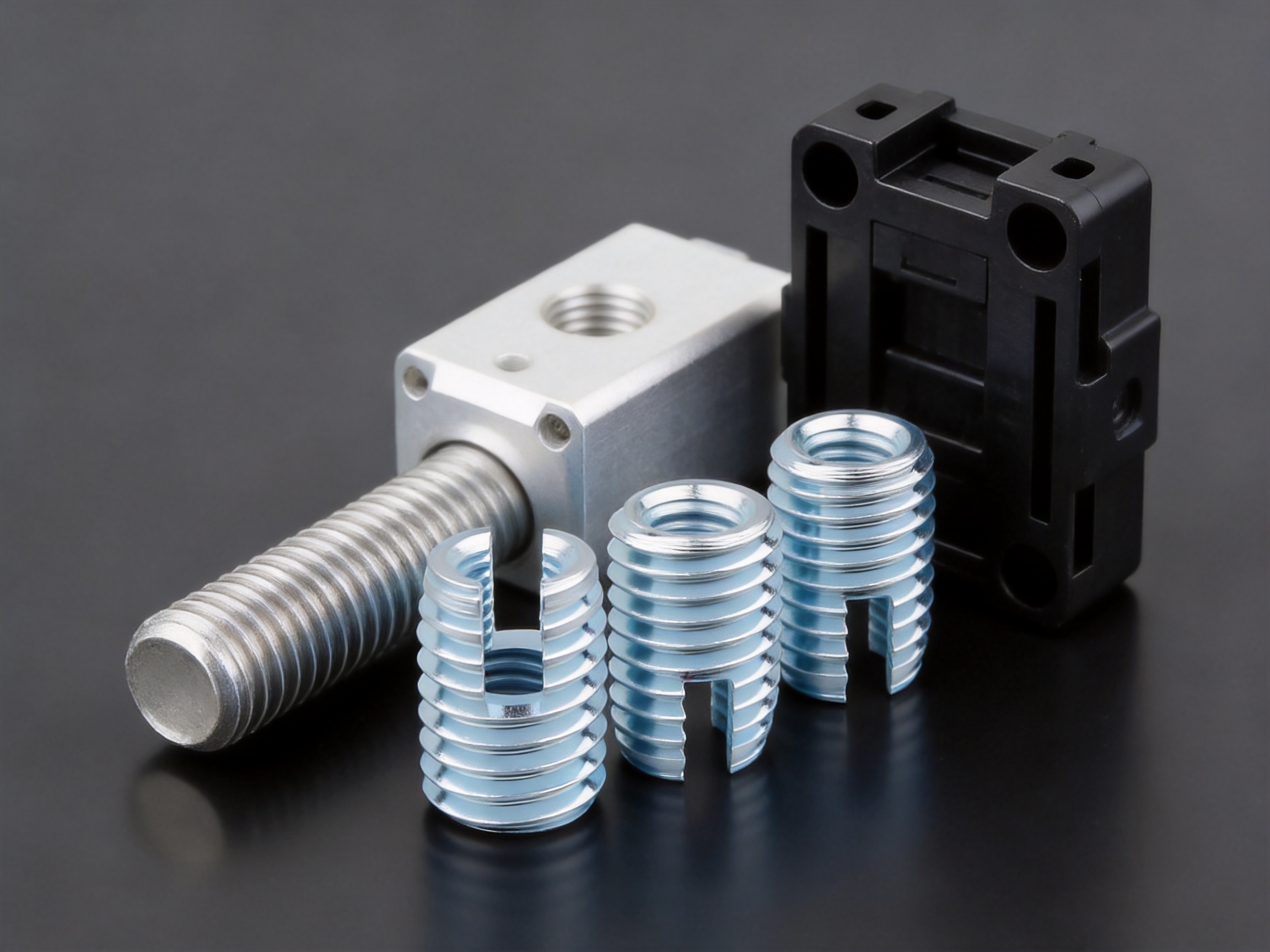
The Type 302 slotted self-inserting screw sleeve uses a practical and widely applicable geometry. The slot functions as a cutting feature that helps the external thread enter the workpiece. As the insert advances, the slot allows the cutting action to begin progressively rather than requiring the entire external thread to displace material at once.
This design helps reduce installation resistance when the pilot hole and base material are properly matched. It is suitable for aluminum alloys, plastics, and other materials in which a self-tapping metal sleeve can form a reliable external thread. The high-strength internal thread is intended to withstand normal fastening loads and provide improved resistance to wear.
Slot geometry, external thread form, internal thread accuracy, and insert hardness all influence performance. A well-controlled cutting groove should provide effective engagement without creating excessive burrs or damaging the workpiece. Dimensional consistency is also important because variations in external diameter or thread pitch can affect installation torque and holding strength.
The insert should be driven straight into the pilot hole. Tilting the tool can damage the first external threads, deform the slot, or produce an insert that is not perpendicular to the surface. In precision assemblies, the final position should be checked using a depth gauge, visual inspection, or an appropriate measurement fixture.
Technical Dimensions and Selection Data
The following table summarizes the supplied Type 302 size information. The metric designation identifies the internal thread. The external thread is listed as the recommended self-tapping thread form. Reference drilling diameters vary according to whether the base material is plastic, aluminum alloy, or cast iron. Minimum drilling depth is also included for blind-hole applications.
| Internal Thread | English Reference | Length | External Thread | Pilot Hole in Plastic | Pilot Hole in Aluminum Alloy | Pilot Hole in Cast Iron | Minimum Drilling Depth |
|---|---|---|---|---|---|---|---|
| M2-0.4 | — | 6 mm | M4.5-0.5 | 4.0–4.1 mm | 4.1–4.2 mm | 4.2–4.3 mm | 8 mm |
| M2.5-0.45 | U#2-56 | 6 mm | M4.5-0.5 | 4.0–4.1 mm | 4.1–4.2 mm | 4.2–4.3 mm | 8 mm |
| M3-0.5 | U#4-40 | 6 mm | M5-0.5 | 4.5–4.6 mm | 4.6–4.7 mm | 4.7–4.8 mm | 8 mm |
| M4-0.7 | U#8-32 | 8 mm | M6.5-0.75 | 5.8–5.9 mm | 6.0–6.1 mm | 6.1–6.2 mm | 10 mm |
| M5-0.8 | U#10-24 | 10 mm | M8-1.0 | 7.1–7.2 mm | 7.3–7.5 mm | 7.5–7.6 mm | 13 mm |
| M6a-1.0 | — | 12 mm | M9-1.0 | 8.1–8.2 mm | 8.3–8.5 mm | 8.5–8.6 mm | 15 mm |
| M6-1.0 | U#14-20 | 14 mm | M10-1.5 | 9.0–9.2 mm | 9.2–9.3 mm | 9.3–9.4 mm | 17 mm |
| M8-1.25 | U5/16-18 | 15 mm | M12-1.5 | 10.6–10.8 mm | 11.0–11.2 mm | 11.2–11.4 mm | 18 mm |
| M10-1.5 | U3/8-16 | 18 mm | M14-1.5 | 12.6–12.8 mm | 13.0–13.3 mm | 13.2–13.4 mm | 22 mm |
| M12-1.75 | U7/16-14 | 22 mm | M16-1.5 | 14.6–14.8 mm | 15.0–15.3 mm | 15.2–15.4 mm | 26 mm |
| M14-2.0 | U1/2-13 | 24 mm | M18-1.5 | 16.6–16.8 mm | 17.0–17.3 mm | 17.2–17.5 mm | 28 mm |
| M16-2.0 | U5/8-11 | 22 mm | M20-1.5 | 18.6–18.8 mm | 19.0–19.3 mm | 19.2–19.5 mm | 27 mm |
| M18-2.5 | — | 24 mm | M22-1.5 | 20.6–20.8 mm | 21.0–21.3 mm | 21.2–21.5 mm | 29 mm |
| M20-2.5 | — | 27 mm | M26-1.5 | 24.6–24.8 mm | 25.0–25.3 mm | 25.2–25.2 mm | 32 mm |
The table is a reference for product selection rather than a substitute for application testing. Actual pilot-hole requirements may change with material hardness, wall thickness, molding conditions, coating thickness, hole quality, and installation equipment. Cast iron, aluminum alloy, and plastic do not respond identically to cutting action, so production users should validate installation torque and pull-out strength on representative samples.
Installation Procedure
1. Confirm the Insert and Fastener Specification
Before preparing the workpiece, confirm the required internal thread size, insert length, external thread, coating, and installation method. The mating fastener should have the correct metric or inch thread. Using a fastener with the wrong pitch can damage the insert and create an unreliable joint.
Insert length should be selected according to the available wall thickness and required thread engagement. The hole must be deep enough to receive the complete insert without bottoming out prematurely. For blind holes, the minimum drilling depth in the reference table should be treated as a starting point, with additional allowance considered for chips, clearance, and installation tolerance.
2. Prepare the Pilot Hole
Drill the workpiece using a tool that produces a round, clean, and accurately sized hole. Remove chips, burrs, oil contamination, and loose particles. In plastics, excessive drilling heat can soften or deform the hole. In aluminum, built-up edge or smeared material can change the effective diameter. Stable cutting conditions and a sharp drill help improve consistency.
Measure the hole where necessary, especially in high-volume production or critical assemblies. A pilot hole that is outside the recommended range can significantly change installation torque and retention. The reference values distinguish among plastic, aluminum alloy, and cast iron because each material offers different resistance to the external cutting thread.
3. Align and Drive the Insert
Place the insert squarely over the hole and engage the installation tool with the internal thread or designated driving feature. Apply steady rotational force while maintaining axial alignment. Do not force the insert at an angle. If resistance becomes unusually high, stop and inspect the hole, tool, insert orientation, and material condition rather than continuing to apply torque.
For production assembly, a controlled electric, pneumatic, or servo-driven installation system can improve repeatability. Torque monitoring may be used to identify abnormal holes or damaged inserts. A depth stop can help ensure that every insert is positioned consistently relative to the component surface.
4. Inspect the Finished Joint
After installation, inspect the insert for correct depth, perpendicularity, surface damage, and thread cleanliness. Run a suitable test fastener through the internal thread by hand or with a controlled tool. The fastener should engage smoothly without cross-threading or excessive resistance.
For qualification or process control, manufacturers may perform pull-out, torque-out, stripping, vibration, cyclic assembly, and corrosion tests. The exact test method should reflect the application. A joint used in a static furniture panel has different requirements from a joint used in an automotive assembly exposed to vibration and temperature changes.
Applications Across Multiple Industries
Furniture Manufacturing
Panel furniture, cabinets, office equipment, adjustable fittings, and hardware assemblies frequently use particleboard, fiberboard, plastic components, or thin metal sections. Directly tapping these materials may provide insufficient durability, particularly when customers are expected to assemble and disassemble the product several times.
A self-tapping insert provides a reinforced internal thread for connecting brackets, hinges, handles, supports, and detachable panels. The blue zinc coating improves the appearance of exposed hardware and helps protect the insert during storage or use in humid indoor environments. The self-tapping feature can also reduce production steps compared with installing a separate nut or pre-tapped metal plate.
Electronics and Electrical Equipment
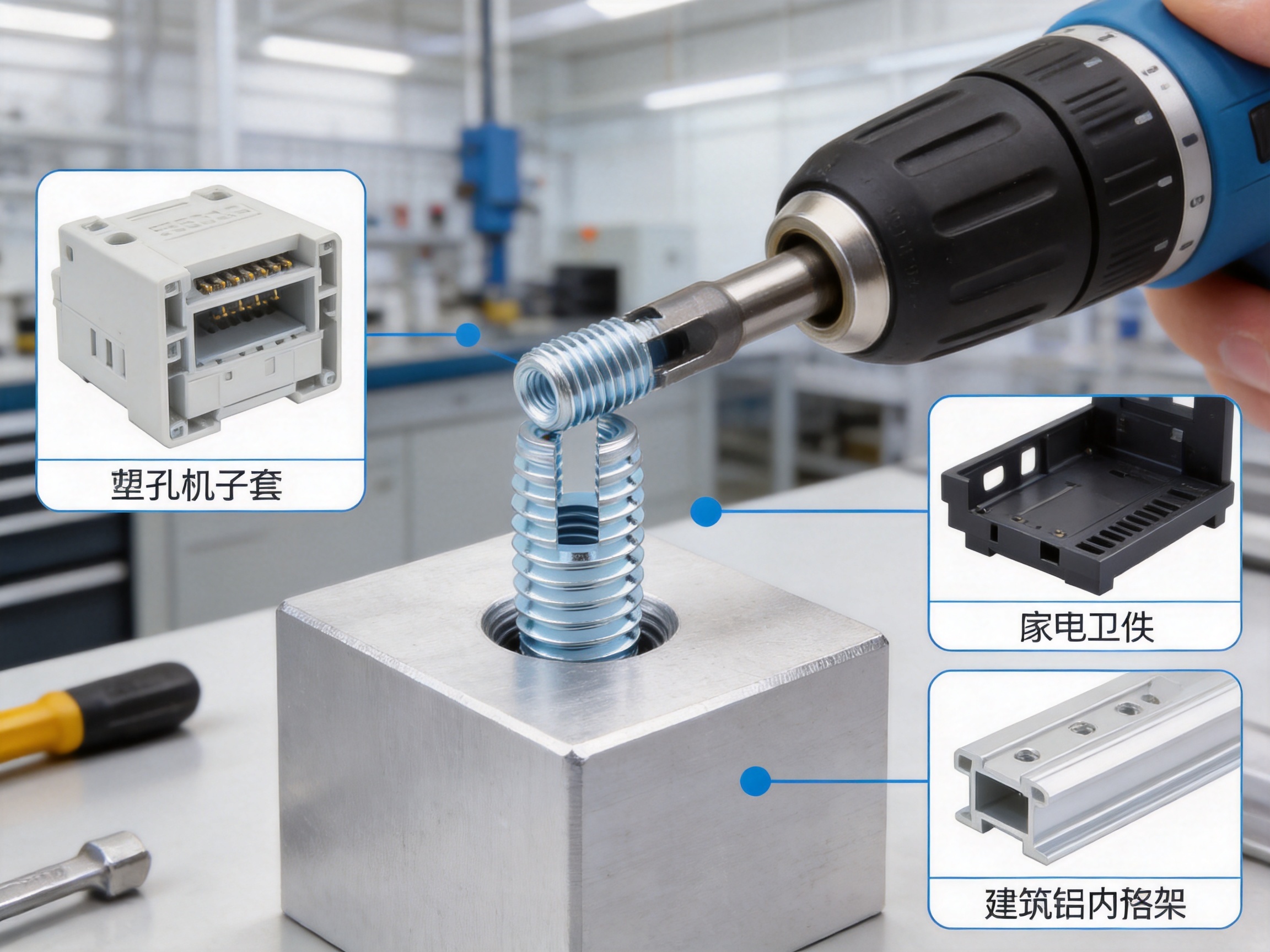
Plastic and aluminum housings for communication equipment, home appliances, control units, lighting products, and electronic instruments often require small, durable mounting threads. A metal insert can improve the reliability of connections for covers, circuit boards, brackets, heat sinks, connectors, and service panels.
The compact sizes in the range are suitable for applications where available wall thickness is limited. The corrosion-resistant surface can reduce the risk of visible rust or contamination around the connection. Engineers should consider electrical isolation, galvanic compatibility, heat exposure, and enclosure material before finalizing the design.
Architectural Decoration and Outdoor Hardware
Doors, windows, railings, decorative panels, and other architectural components may be exposed to rain, condensation, cleaning chemicals, and temperature changes. The zinc coating helps provide a basic corrosion barrier for general outdoor and high-humidity use.
The insert can be installed into aluminum profiles, plastic fittings, and other compatible components to provide a stronger threaded connection. It is useful where a conventional nut would be difficult to position or where a direct thread in the base material would be too weak. For coastal, marine, or heavily polluted environments, additional corrosion evaluation is recommended.
Automotive Components
Automotive interior parts, plastic trim, instrument panels, brackets, housings, and serviceable components may require repeated fastening while remaining lightweight. Thread inserts reduce the need for thick metal sections and help protect threaded connections from damage during assembly and maintenance.
In automotive use, vibration resistance and consistency are important. The insert must be matched to the host material, wall thickness, assembly torque, temperature range, and expected service loads. The blue zinc coating is appropriate for many general applications, but engineers should verify compatibility with fluids, elevated temperatures, cleaning agents, and nearby dissimilar metals.
Industrial Equipment and General Mechanical Assemblies
Industrial machinery often combines steel frames with aluminum covers, plastic guards, control boxes, and cast components. Self-tapping inserts can provide durable service threads in these mixed-material assemblies. They are also useful for repair work when an existing thread has been stripped but the surrounding material remains structurally sound.
The availability of multiple sizes helps maintenance teams standardize repair methods. Instead of replacing an entire housing or fabricating a special nut plate, the damaged area may be restored using a correctly selected insert. The repair should be assessed carefully to confirm that sufficient surrounding material remains after drilling.
Advantages Compared with Alternative Thread Solutions
Compared with Directly Tapped Plastic
Directly tapping plastic is simple, but the resulting thread may have limited wear resistance and low resistance to repeated assembly. The plastic may creep under sustained load, particularly at elevated temperature. A metal insert creates a harder internal thread and usually offers better long-term serviceability.
The insert also allows the designer to use a standard fastener torque more effectively. However, the external engagement still depends on the plastic wall thickness and strength. The design should provide sufficient radial material around the pilot hole to prevent cracking or pull-out.
Compared with Directly Tapped Aluminum
Aluminum is easier to tap than many plastics, but its threads can still strip when engagement is short, when the alloy is soft, or when fasteners are frequently removed. A self-tapping insert increases thread durability without requiring a thick aluminum boss.
It can also simplify repairs. A damaged aluminum thread can often be enlarged to the appropriate pilot-hole size and fitted with an insert, restoring the original internal fastener size. This may be more convenient than redesigning the fastener or replacing a costly component.
Compared with Press-Fit or Heat-Set Inserts
Press-fit inserts depend on interference between the insert and the workpiece. Heat-set inserts require controlled heating to embed the component into thermoplastic material. These systems can perform well, but they may require specialized equipment, molded features, or carefully controlled thermal parameters.
A self-tapping insert uses mechanical installation and can often be applied after the component has been produced. This provides flexibility for repairs, low-volume manufacturing, and components whose geometry was not originally designed for a molded-in insert. The best choice depends on material, production volume, installation access, and required holding force.
Compared with Adhesive Threaded Bushes
Adhesive-bonded bushes depend on surface preparation, adhesive selection, curing time, temperature, and chemical compatibility. They may be unsuitable where immediate installation, clean processing, or easy repair is required.
The self-tapping design achieves retention through external mechanical engagement. It does not require adhesive curing and can reduce process complexity. In applications subject to extreme vibration or unusual loads, adhesive and mechanical retention may be evaluated together, but the combined system must be validated carefully.
Compared with Uncoated Inserts
Uncoated steel inserts may be less expensive in some cases, but they offer less protection against humidity and oxidation. Corrosion can affect appearance, installation torque, thread quality, and long-term joint reliability. Blue zinc plating adds a protective finish without requiring the higher cost of some premium corrosion-resistant alloys.
The blue-white color also provides a more attractive appearance and helps distinguish the product during production and inventory handling. For general industrial, indoor, and moderate outdoor service, this balance of protection and cost can be attractive.
Manufacturing Strengths and Quality Control
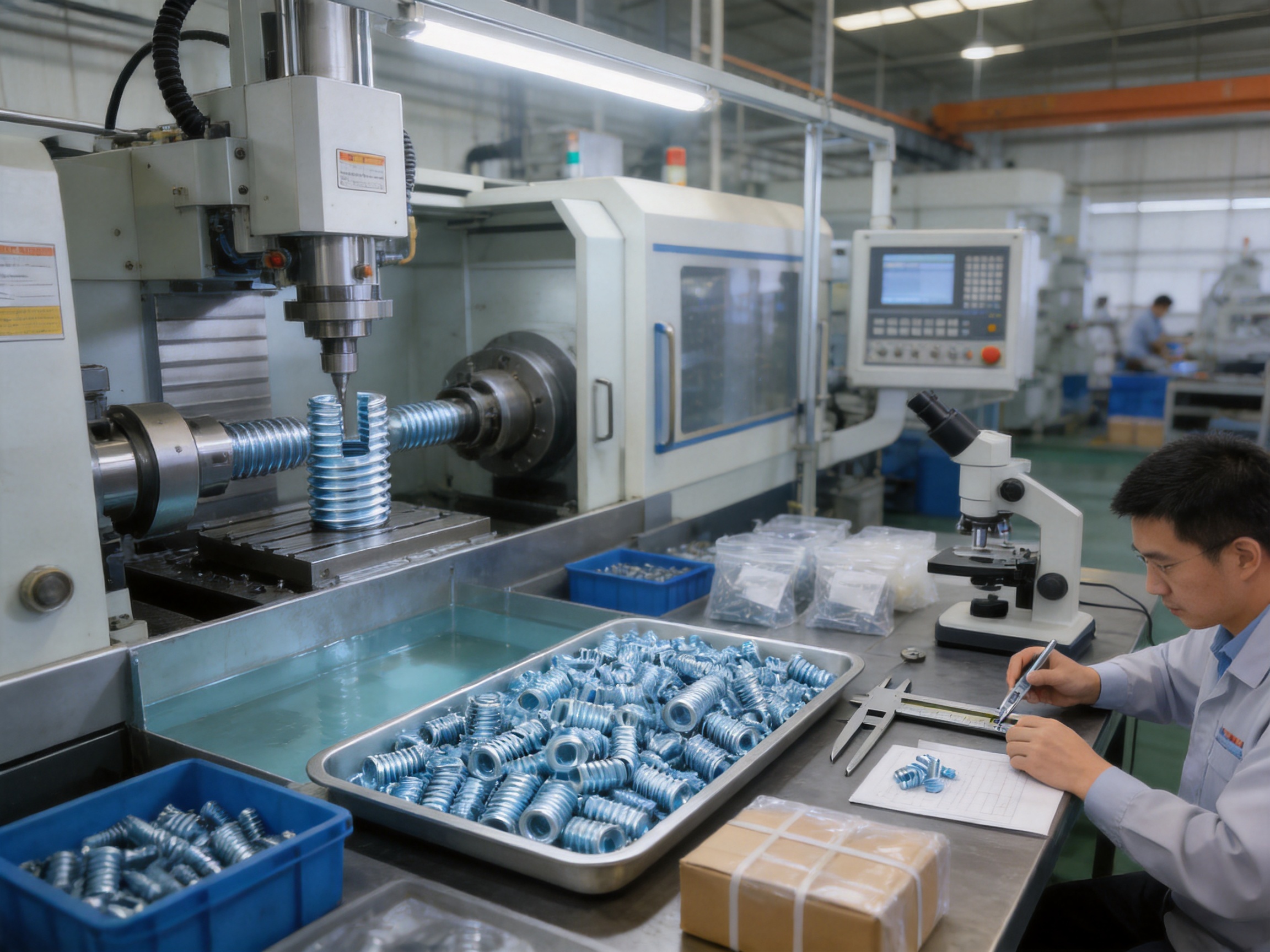
Dongtai Jinzhize Metal Products Co., Ltd. was established in 2015 and operates an owned manufacturing facility with an area of approximately 10,000 square meters. The plant is equipped with hundreds of machine tools and automated production systems. This infrastructure supports the manufacture of threaded connection products in multiple specifications and helps the company respond to both standard and customized requirements.
Manufacturing self-tapping thread inserts requires control at several stages. The raw material must be suitable for forming, machining, heat treatment, and surface finishing. External and internal threads must be produced with accurate pitch, diameter, and profile. The cutting groove must be formed consistently so that the insert can enter the workpiece without excessive damage or unpredictable installation force.
After machining, parts may undergo deburring, cleaning, inspection, and surface treatment. Blue zinc plating should be uniform across the external thread, internal thread, cutting groove, and end surfaces. Coating thickness must be controlled because excessive buildup can interfere with thread fit, while insufficient coverage may reduce corrosion protection.
Automated production systems can improve repeatability by reducing variation between batches. They also support stable output for customers who require regular replenishment. At the same time, experienced technical personnel remain important for process development, tooling adjustment, inspection planning, and problem resolution.
The company reports a rigorous quality management system and a comprehensive after-sales service mechanism. For industrial buyers, quality management is more than final visual inspection. It includes material control, process documentation, batch identification, dimensional verification, surface-treatment monitoring, packaging, and customer feedback. These activities help support product consistency and traceability.
Jinzhize serves automotive, aerospace, rail vehicle, machinery, and other industrial sectors. These industries typically require reliable threaded connections, repeatable assembly, and stable supply. Experience with demanding applications can help a manufacturer understand the importance of thread accuracy, installation behavior, corrosion protection, and documentation.
In 2024, the company achieved an annual output value of approximately 153 million RMB. This figure indicates an established production base and the ability to support relatively large and stable orders. Production scale can benefit customers through improved capacity planning, more efficient procurement of raw materials, and better continuity for recurring projects.
Customization and Technical Support
Standard products are appropriate for many applications, but some assemblies require customized dimensions or specifications. Possible customization areas may include internal thread size, external thread form, length, material, surface treatment, packaging, inspection requirements, and labeling. Customers should provide drawings, sample parts, application materials, load requirements, and expected installation conditions when requesting technical evaluation.
Technical support should begin with the workpiece rather than with the insert alone. Important questions include the type and hardness of the base material, wall thickness, hole depth, available installation access, expected tightening torque, frequency of disassembly, temperature range, chemical exposure, and vibration level. These details help determine whether a self-tapping insert is appropriate and which size is most suitable.
For new product development, the insert can be considered during the initial design stage. Engineers can reserve sufficient wall thickness, define the pilot-hole diameter, provide an installation stop, and select an internal thread that matches existing fasteners. Early integration generally produces better results than attempting to add reinforcement after a component has already been finalized.
For repairs, the remaining material around the damaged hole should be examined carefully. The enlarged pilot hole must not weaken the part excessively. If the original hole is cracked, distorted, or too close to an edge, a larger repair insert, a different retention method, or component replacement may be necessary.
Packaging, Storage, and Handling
Thread inserts should be packaged to prevent impact damage, contamination, and unnecessary exposure to moisture. Small parts can become mixed during handling, so packaging should identify the internal thread, length, surface treatment, quantity, and batch information. Protective packaging also helps preserve the coating and prevents damage to the cutting groove.
Storage should take place in a clean, dry environment with stable conditions. Avoid direct contact with water, corrosive chemicals, and packaging materials that may retain moisture. First-in, first-out inventory control can help reduce prolonged storage. Before use, inspect the inserts for corrosion, dents, damaged threads, plating defects, or contamination.
Operators should handle the components in a way that avoids crushing the external thread or cutting slot. Mixing sizes or coatings can create assembly errors, especially when several similar inserts are used on the same production line. Clearly separated bins and visual identification procedures can improve process control.
Engineering Considerations and Limitations
Although blue zinc plated self-tapping inserts provide important benefits, no threaded insert is universally suitable for every application. The base material must have enough strength and thickness to hold the external thread. Very thin sheets, brittle plastics, highly porous materials, or cracked components may not provide sufficient retention.
Installation torque should be developed through testing. Torque that is too low may leave the insert insufficiently seated. Torque that is too high may damage the cutting groove, enlarge the hole, crack the workpiece, or distort the internal thread. Production settings should account for tool condition, lubrication, temperature, material variation, and operator technique.
Corrosion resistance is also application-dependent. Zinc plating is suitable for many general environments, but continuous immersion, saltwater exposure, strong acids, strong alkalis, or high-temperature service may require stainless steel, specialized coatings, or additional protection. Galvanic corrosion should be considered when zinc-plated steel is installed near aluminum, stainless steel, or other dissimilar metals in the presence of moisture.
Thread locking and vibration performance depend on the complete joint. The insert improves the threaded interface, but it does not automatically prevent a fastener from rotating under severe dynamic loads. Joint design, clamp load, fastener selection, locking features, and maintenance procedures must be evaluated together.
Users should also verify whether the surface treatment is compatible with electrical, cosmetic, or environmental requirements. If the insert is placed inside a sealed electronic enclosure, coating particles or residue must be controlled. If it is used in a visible product, color consistency and surface appearance may need to be included in the inspection specification.
Recommended Inspection Points
Incoming inspection should verify product identification, quantity, internal thread, external thread, length, coating condition, and general appearance. Sampling plans can be established according to order volume and application criticality. For safety-related or high-value assemblies, more extensive inspection and certification may be appropriate.
Dimensional checks may include internal thread gauges, external diameter measurement, overall length, slot geometry, and coating thickness. Functional tests can include installation torque in representative materials, go/no-go fastener testing, pull-out testing, and torque-out testing. Corrosion testing may be performed when environmental exposure is important.
Process inspection during installation should verify pilot-hole diameter, hole depth, perpendicularity, insert position, and final fastener engagement. Recording these parameters helps identify problems before they become widespread. If installation torque changes significantly, the cause may be a worn drill, incorrect hole size, material variation, damaged inserts, or tool misalignment.
Why Choose a Specialized Threaded Connection Manufacturer?
A specialized manufacturer can provide more than a catalog component. Threaded connection products interact closely with material behavior, machining accuracy, coating technology, installation tools, and joint design. A supplier focused on these products is more likely to understand how changes in pitch, length, cutting geometry, or plating affect assembly performance.
Jinzhize produces several related product categories, including helical wire inserts, self-tapping inserts, key-locking inserts, internal-external thread conversion nuts, three-hole threaded inserts, oil plugs, thread taps, and installation tools. This product breadth allows customers to source complementary components from one technical partner and compare different reinforcement methods for different parts of the same assembly.
The company’s automotive and aerospace focus also reflects experience with industries that value consistency, traceability, and reliable supply. Its owned facility, automated equipment, engineering team, and quality system support the production of standard and application-specific products. For overseas buyers, communication regarding drawings, samples, packaging, inspection, and delivery planning is an important part of supplier evaluation.
A long-term manufacturing relationship can help customers reduce procurement risk. Once a validated insert, installation method, and inspection plan have been established, stable production and consistent batch performance become important. A supplier with capacity and after-sales support can help manage design changes, replenishment, quality questions, and future product development.
Q&A
What materials can receive these self-tapping inserts?
They are intended for compatible soft or relatively low-strength materials such as aluminum alloys, plastics, and selected cast materials. The correct pilot-hole diameter depends on the material. Very brittle, thin, porous, or damaged materials may require a different insert style or additional testing.
Do I need to tap the hole before installation?
Normally, no. The external cutting thread and slot allow the insert to form its own mating thread when driven into a correctly sized pilot hole. The hole still needs to be drilled accurately and cleaned before installation.
What is the purpose of the blue zinc coating?
The coating helps protect the steel insert from rust and oxidation. It also creates a smooth blue-white appearance. The supplied specification indicates approximately 48 to 96 hours of salt spray resistance, subject to the applicable test conditions.
Can the insert repair a stripped thread?
Yes, it can be used for certain thread-repair applications. The damaged hole must be enlarged to the correct pilot-hole size, and sufficient surrounding material must remain to support the external thread. Cracked or severely weakened components should be evaluated before repair.
The supplied size information includes multiple metric sizes and several English or Unified thread references. Buyers should confirm the exact internal and external thread specifications before ordering because reference designations do not replace a complete dimensional specification.
How should I select the insert length?
Select a length that provides adequate internal thread engagement while fitting within the available material thickness. For blind holes, include sufficient bottom clearance beyond the minimum drilling depth to accommodate the insert and installation process.
Can these inserts be used outdoors?
They are suitable for many general outdoor and high-humidity applications because the zinc coating provides improved corrosion protection compared with uncoated steel. Severe marine, chemical, immersed, or high-temperature environments require additional material and coating evaluation.
What causes excessive installation torque?
Common causes include an undersized pilot hole, incorrect hole geometry, poor alignment, burrs, contamination, a damaged insert, excessive coating buildup, or a base material that is harder than expected. Stop the operation and investigate rather than forcing the insert into place.
Can the inserts be installed with standard tools?
They can generally be installed using suitable standard or dedicated driving tools, depending on the size and production requirements. For high-volume manufacturing, controlled electric, pneumatic, or servo-driven equipment can improve repeatability.
Does the insert completely prevent fastener loosening?
No threaded insert can replace complete joint design. The insert improves thread strength and can resist ordinary movement, but severe vibration may require an additional fastener-locking method. The complete assembly should be tested under representative service conditions.
Are customized inserts available?
Customized sizes, lengths, materials, coatings, packaging, and inspection requirements may be considered based on drawings, samples, order quantities, and technical feasibility. Customers should submit detailed application information for evaluation.
What quality information should be requested?
Depending on the application, customers may request material information, dimensional inspection records, coating specifications, batch traceability, functional test results, packaging details, and applicable quality documentation. Critical applications may require a formal inspection plan.
Conclusion
Blue zinc plated self-tapping thread inserts offer an efficient way to create strong, serviceable internal threads in aluminum, plastic, and other compatible materials. Their Type 302 slotted design supports direct installation without a separate pre-tapping operation, while the metal internal thread improves resistance to wear, stripping, and repeated assembly. The blue zinc finish adds corrosion protection and a clean appearance for indoor, outdoor, industrial, furniture, electronic, architectural, and automotive applications.
The product provides several advantages over direct tapping, uncoated sleeves, adhesive-bonded bushes, and some press-fit solutions. It can reduce assembly steps, improve thread durability, support repair work, and provide greater design flexibility. Correct pilot-hole preparation, alignment, installation torque, and material selection remain essential to achieving reliable performance.
Dongtai Jinzhize Metal Products Co., Ltd. supports this product category with a specialized manufacturing base, automated production systems, extensive machine-tool resources, engineering personnel, quality management, and related threaded connection products. Its experience serving automotive, aerospace, rail, and industrial customers strengthens its ability to provide consistent products and technical support.
For a successful application, buyers should define the internal thread, external thread, length, base material, hole dimensions, environmental conditions, installation method, and inspection requirements. When these factors are properly controlled, blue zinc plated self-tapping thread inserts can provide a durable and economical foundation for reliable threaded connections.
References
1. Product technical information for Type 302 slotted self-tapping thread inserts, including dimensional and pilot-hole reference data.
2. General engineering principles for threaded joints in aluminum alloys, plastics, cast materials, and other low-strength substrates.
3. General zinc-plating and salt-spray evaluation practices for corrosion-resistant steel fasteners.
4. General guidelines for installation torque, thread engagement, pull-out resistance, and repair of damaged threaded holes.
5. Manufacturer information concerning threaded connection products, production equipment, quality management, and industrial applications.



