Français
 Español
 Deutsch


Content
- 1 Product Overview
- 2 How the Self-Tapping Design Works
- 3 Advantages of Yellow Zinc Plating
- 4 Advantages Compared with Conventional Thread Repair Methods
- 5 Material and Coating Performance
- 6 Dimensional Range and Installation Data
- 7 Installation Procedure
- 8 Applications Across Industrial Sectors
- 9 Manufacturing Capabilities and Quality Strengths
- 10 Why This Product Can Outperform Basic Alternatives
- 11 Design and Purchasing Considerations
- 12 Maintenance and Service Benefits
- 13 Quality Verification Recommendations
- 14 Q&A
- 14.1 What is a yellow zinc plated self-tapping thread insert?
- 14.2 Can the insert be installed without pre-tapping?
- 14.3 Which materials are suitable for this insert?
- 14.4 Does the insert require adhesive?
- 14.5 What corrosion protection does the yellow zinc coating provide?
- 14.6 Is yellow zinc better than blue-white zinc?
- 14.7 Can the insert repair a stripped hole?
- 14.8 What happens if the drilled hole is too small?
- 14.9 What happens if the drilled hole is too large?
- 14.10 Can the insert be used in a blind hole?
- 14.11 What temperature range is listed for the product?
- 14.12 What tools are used to install the insert?
- 14.13 Is the insert suitable for high-vibration applications?
- 14.14 What industries use this product?
- 14.15 Can metric and inch threads be mixed?
- 14.16 How should customers select an insert length?
- 14.17 What quality documents should industrial buyers request?
- 15 Conclusion
- 16 References
- 17 Product: Yellow Zinc Plated Self-Tapping Thread Insert
Reliable threaded connections are essential to the performance, service life, and safety of modern industrial equipment. However, many components are manufactured from materials that do not provide sufficient thread strength on their own. Aluminum, magnesium alloys, plastics, thin sheet materials, and other relatively soft substrates may suffer from stripped threads, premature loosening, vibration damage, or reduced load-bearing capacity. A yellow zinc plated self-tapping thread insert provides an efficient solution by creating a durable internal thread inside a softer base material.
This type of insert combines a self-tapping external thread with a precision internal thread. During installation, the cutting section forms its own mating thread in a prepared hole, eliminating the need for conventional pre-tapping in many applications. Once installed, the insert distributes the load over a stronger, wear-resistant threaded sleeve rather than relying entirely on the original base material. The result is a more consistent and durable connection for machinery, automotive components, electronics housings, building hardware, and other assemblies.
The yellow zinc plated finish adds another important performance advantage. Its metallic zinc layer and passivation treatment help protect the insert from corrosion, while also improving resistance to surface wear during handling, installation, and service. Compared with standard blue-white zinc finishes, color zinc plating generally offers enhanced visual identification and improved protection in humid, oily, or industrial environments. The supplied product is designed for applications where installation efficiency, thread reinforcement, and moderate environmental resistance must be achieved in one component.
Product Overview
A self-tapping thread insert is a hollow, externally threaded sleeve with a finished internal thread. The external thread is designed to cut or form a mating thread in the host material. The internal thread accepts a standard bolt or screw, allowing the insert to convert a weak or damaged hole into a stronger threaded connection.
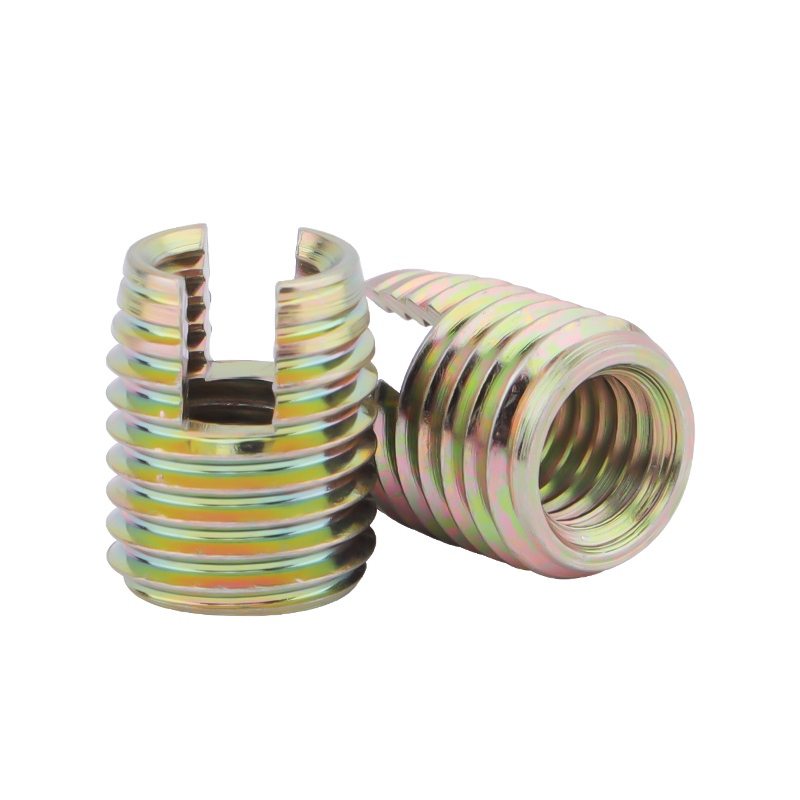
The yellow zinc plated version is based on a Type 302 slotted self-inserting screw sleeve design. Its cutting groove supports self-tapping installation, while the outer thread provides engagement with the surrounding base material. The internal thread is manufactured to accommodate standard metric or compatible inch fasteners, depending on the selected size.
The product is suitable for both new production and thread repair. In new components, it can be specified during design to reinforce a tapped hole from the beginning. In maintenance applications, it can restore a damaged hole without replacing the entire component, provided that sufficient surrounding material remains and the recommended drilling diameter and depth are followed.
Typical host materials include aluminum alloys, magnesium alloys, plastics, die-cast components, and other materials that may not withstand repeated direct fastening. The insert may also be used in cast iron or similar materials when the installation dimensions are correctly selected. The appropriate hole size depends on the insert specification and the base material, because softer materials may require a different drilling diameter from harder materials.
How the Self-Tapping Design Works
Traditional threaded inserts often require several operations. The operator may need to drill a hole, tap an external thread, clean the hole, apply adhesive, and then install the insert. Each additional operation increases cycle time and creates another opportunity for dimensional error, contamination, or assembly inconsistency.
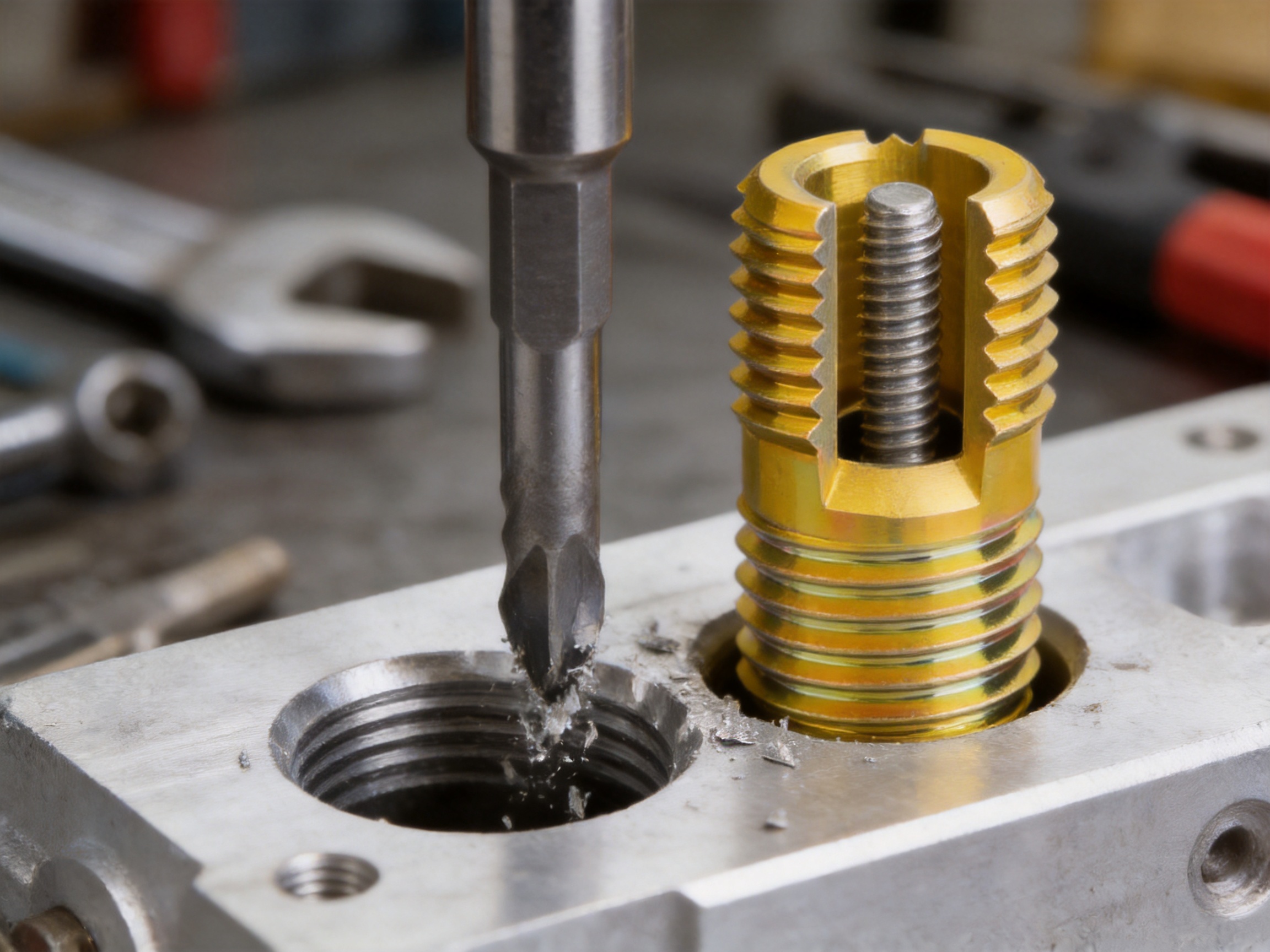
The Type 302 slotted design reduces the number of steps. A correctly sized hole is prepared in the base material, and the insert is driven into the hole using a suitable installation tool. The cutting groove at the lower or leading section engages the material and forms the external mating thread as the insert advances. Because the insert cuts its own path, a separate external tapping operation is usually unnecessary.
The cutting groove must remain clear and properly aligned during installation. Excessive force, incorrect drilling, or an unsuitable driving tool can damage the insert or the host component. For production work, controlled torque and consistent tooling are recommended. The insert should be installed squarely so that its internal thread remains aligned with the component surface.
Once seated, the insert creates a mechanical connection between its external thread and the surrounding material. The internal thread then provides a reusable fastening point. If a bolt is removed during servicing, the reinforced internal thread is better suited to repeated assembly than a directly tapped thread in a soft material.
This design is particularly valuable where a component must be assembled, disassembled, or serviced multiple times. Examples include removable covers, equipment housings, access panels, engine components, transmission assemblies, and electronic enclosures. By strengthening the threaded interface, the insert helps reduce the risk of repair work caused by stripped or deformed threads.
Advantages of Yellow Zinc Plating
Corrosion Protection
The surface of the insert is protected by a color zinc coating combined with a passivation layer. Zinc provides sacrificial protection to the underlying steel. In the presence of moisture, the zinc layer tends to corrode preferentially, helping delay corrosion of the steel substrate. The passivation layer further improves resistance to environmental exposure and supports the stability of the finish.
According to the supplied product information, the finish provides approximately 96 to 120 hours of salt spray resistance under the applicable test conditions. Salt spray performance is a comparative laboratory indicator rather than a direct prediction of field life, but it demonstrates that the coating is intended for environments more demanding than dry indoor assembly areas.
The coating is appropriate for applications exposed to humidity, workshop oils, condensation, intermittent outdoor conditions, and general industrial contamination. It should not be treated as a substitute for a specialized high-performance coating in severe marine, chemical, or continuously immersed environments. However, for many industrial fastening applications, it offers a practical balance of cost, appearance, corrosion protection, and availability.
Wear Resistance During Installation
Thread inserts are exposed to friction during installation. The external thread must engage with the base material, while the driving tool applies torque to the insert. A coating with good adhesion helps reduce premature flaking and surface damage during normal handling and installation.
The metallic zinc layer contributes to surface durability, while the passivation treatment supports coating stability. This is especially useful in production environments where inserts are transported in bulk, fed into assembly stations, or installed using powered tools. A stable finish reduces the likelihood that loose coating particles will contaminate nearby components.
Visual Identification
The yellow or color zinc appearance provides a quick visual distinction from plain steel, stainless steel, black oxide, or blue-white zinc plated fasteners. In a mixed-component production line, this can help operators identify the correct insert type and verify that the intended surface treatment has been supplied.
Visual identification does not replace dimensional inspection or material verification, but it can support receiving inspection, inventory organization, and production control. When several insert finishes are used for different environments or applications, the color difference can help prevent incorrect substitution.
Temperature Considerations
The stated working range is approximately -40°C to 300°C. Actual performance depends on the host material, fastener material, installation conditions, load, thermal cycling, and the environment surrounding the assembly. The temperature range should therefore be used as a design reference rather than a universal guarantee for every application.
At elevated temperatures, coating performance, base-material strength, bolt preload, and thermal expansion should all be reviewed. Aluminum, steel, plastics, and magnesium alloys expand at different rates, and repeated thermal cycling may influence the fit between the insert and the host component. For critical assemblies, engineering validation under representative temperature and loading conditions is recommended.
Yellow Zinc Plated Self-Tapping Thread Insert
Advantages Compared with Conventional Thread Repair Methods
Reduced Installation Time
A self-tapping insert can eliminate the external tapping stage required by many conventional threaded sleeves. This reduces the number of tools and operations needed for installation. In high-volume production, the time saved on every component can create a meaningful improvement in overall assembly efficiency.
Fewer operations also simplify workflow planning. Instead of moving a component between drilling, tapping, cleaning, adhesive application, and insert installation stations, an operator may be able to complete the reinforcement process with a prepared hole and a suitable installation tool.
No Adhesive Requirement for Normal Mechanical Retention
The external thread provides mechanical engagement with the host material. For many applications, no adhesive is required to hold the insert in place. This avoids adhesive curing time, shelf-life management, mixing errors, and contamination concerns.
Adhesive may still be considered when a particular design requires additional sealing, vibration resistance, or retention. However, the basic self-tapping design does not depend on chemical bonding for normal installation. This makes it suitable for production environments that favor clean, repeatable, and immediately usable assemblies.
Repair of Damaged Threads
A stripped hole can make an otherwise serviceable component unusable. Replacing the component may be expensive, particularly when it is part of an engine, gearbox, machine housing, or complex electronic assembly. A self-tapping insert can provide a practical repair method when the original hole can be enlarged to the specified installation diameter.
The repair process should include removal of loose material, accurate drilling, cleaning, and alignment. The remaining wall thickness must be sufficient to support the new external thread. If the component is cracked, excessively thin, or structurally damaged, an insert may not be an adequate repair. The insert is a thread-reinforcement solution, not a replacement for structural restoration.
Improved Load Distribution
Directly tapping a soft material may leave only a limited number of usable threads. A steel insert offers a harder and more wear-resistant internal thread. It can distribute the bolt load through the insert and into a larger external engagement area in the host component.
This arrangement improves resistance to thread stripping and supports more reliable tightening. The actual load capacity depends on insert length, thread size, host-material strength, wall thickness, bolt grade, tightening torque, and the type of applied load. Even so, the insert often provides a major improvement over a short, directly tapped thread in a soft material.
Improved Resistance to Vibration-Related Loosening
The insert itself is mechanically retained by the external thread, and the internal thread provides a stable interface for the fastening bolt. In applications subject to vibration, the reinforced connection may maintain its geometry better than a damaged or weak direct thread.
Thread reinforcement alone does not eliminate the need for appropriate locking methods. Depending on the assembly, designers may use prevailing-torque nuts, thread-locking compounds, lock washers, safety wire, controlled preload, or other anti-loosening methods. The correct solution should be selected according to vibration level, temperature, maintenance requirements, and service regulations.
Material and Coating Performance
The insert is intended to provide a strong threaded interface in relatively soft or easily damaged base materials. The steel substrate supplies the necessary hardness and strength for the internal and external threads, while the zinc coating provides additional environmental protection.
Coating adhesion is important because an insert may experience friction during transportation, installation, and service. A coating that flakes easily can expose the underlying metal and introduce debris into the assembly. The supplied product information emphasizes stable coating adhesion and resistance to flaking across both low- and high-temperature conditions within the stated operating range.
Color zinc plating is generally more protective than a basic untreated surface and offers a practical alternative to more expensive corrosion-resistant materials when the operating environment is moderate. It may also be more economical than manufacturing the entire component from stainless steel or another highly corrosion-resistant alloy.
Compatibility between the insert, bolt, and host component should be evaluated. Dissimilar metals can create galvanic corrosion under certain moisture conditions. The risk depends on the material combination, electrolyte availability, surface area ratio, temperature, and exposure duration. In demanding applications, engineers may consider barrier coatings, sealants, controlled material pairing, or a different insert material.
Dimensional Range and Installation Data
The supplied Type 302 table covers a broad range of metric sizes, with several corresponding inch thread references. The external thread, recommended drilling diameter, and minimum drilling depth vary according to the insert size and the base material. The drilling recommendations distinguish between plastics, aluminum alloys, and cast iron because each material interacts differently with the cutting thread.
| Metric Internal Thread | Approximate Inch Reference | Insert Length | External Thread | Plastic Drill Diameter | Aluminum Alloy Drill Diameter | Cast Iron Drill Diameter | Minimum Drilling Depth |
|---|---|---|---|---|---|---|---|
| M2-0.4 | — | 6 | M4.5-0.5 | 4.0-4.1 mm | 4.1-4.2 mm | 4.2-4.3 mm | 8 mm |
| M2.5-0.45 | U #2-56 | 6 | M4.5-0.5 | 4.0-4.1 mm | 4.1-4.2 mm | 4.2-4.3 mm | 8 mm |
| M3-0.5 | U #4-40 | 6 | M5-0.5 | 4.5-4.6 mm | 4.6-4.7 mm | 4.7-4.8 mm | 8 mm |
| M4-0.7 | U #8-32 | 8 | M6.5-0.75 | 5.8-5.9 mm | 6.0-6.1 mm | 6.1-6.2 mm | 10 mm |
| M5-0.8 | U #10-24 | 10 | M8-1.0 | 7.1-7.2 mm | 7.3-7.5 mm | 7.5-7.6 mm | 13 mm |
| M6-1.0 | U 1/4-20 | 14 | M10-1.5 | 9.0-9.2 mm | 9.2-9.3 mm | 9.3-9.4 mm | 17 mm |
| M8-1.25 | U 5/16-18 | 15 | M12-1.5 | 10.6-10.8 mm | 11.0-11.2 mm | 11.2-11.4 mm | 18 mm |
| M10-1.5 | U 3/8-16 | 18 | M14-1.5 | 12.6-12.8 mm | 13.0-13.3 mm | 13.2-13.4 mm | 22 mm |
| M12-1.75 | U 7/16-14 | 22 | M16-1.5 | 14.6-14.8 mm | 15.0-15.3 mm | 15.2-15.4 mm | 26 mm |
| M14-2.0 | U 1/2-13 | 24 | M18-1.5 | 16.6-16.8 mm | 17.0-17.3 mm | 17.2-17.5 mm | 28 mm |
| M16-2.0 | U 5/8-11 | 22 | M20-1.5 | 18.6-18.8 mm | 19.0-19.3 mm | 19.2-19.5 mm | 27 mm |
| M18-2.5 | — | 24 | M22-1.5 | 20.6-20.8 mm | 21.0-21.3 mm | 21.2-21.5 mm | 29 mm |
| M20-2.5 | — | 27 | M26-1.5 | 24.6-24.8 mm | 25.0-25.3 mm | 25.2-25.2 mm | 32 mm |
The dimensions in the table should be verified against the latest production drawing before manufacturing release. In particular, specifications should be checked for thread pitch notation, tolerances, and any transcription differences. The drilling diameter is not interchangeable between materials or insert sizes. A hole that is too small can cause excessive installation torque or damage the insert, while a hole that is too large may reduce retention and pull-out resistance.
Installation Procedure
1. Confirm the Insert Specification
Before beginning, verify the internal thread size, insert length, external thread, coating, and required drilling diameter. Confirm that the selected insert matches the bolt or screw that will be used in the final assembly. Metric and inch thread forms should not be mixed unless the design specifically permits it.
2. Inspect the Host Component
Check the component for cracks, distortion, insufficient wall thickness, or previous repair damage. The insert requires adequate material around the hole to form a secure external thread. Components that are too thin may require a shorter insert or a different reinforcement method.
3. Drill the Hole
Drill the hole to the recommended diameter and minimum depth. Use a sharp, suitable drill and maintain alignment with the original hole axis. For a blind hole, provide sufficient clearance beyond the insert length to accommodate cutting debris and prevent bottoming out.
When repairing a stripped thread, remove damaged thread fragments and ensure that the new hole is concentric with the original feature. Do not rely on an irregular, partially damaged hole as the final installation surface.
4. Clean the Hole
Remove chips, dust, oil residue, and loose material from the hole. Cleaning is especially important in blind holes because trapped debris can prevent the insert from reaching the required seating depth. Compressed air, vacuum cleaning, or an appropriate mechanical cleaning method may be used according to workplace safety procedures.
5. Install the Insert
Use a suitable mandrel, driver, or installation tool that engages the insert without damaging the internal thread. Keep the tool and insert aligned with the hole. Apply steady rotational force and avoid excessive impact unless the approved installation process specifically calls for it.
The cutting groove should enter the material smoothly. If torque rises sharply before the insert reaches the required position, stop and investigate the hole diameter, material condition, tool alignment, and presence of debris. Forcing the insert can distort the host component or damage the coating.
6. Verify Seating and Thread Function
After installation, confirm that the insert is seated at the specified depth and is not tilted, protruding excessively, or installed below an unsuitable surface position. Run a compatible test bolt through the internal thread by hand before applying final assembly torque.
For controlled production, inspection may include go/no-go thread gauges, visual checks, installation torque monitoring, pull-out testing, or sample destructive testing. The appropriate inspection method depends on the component’s function and quality requirements.
Applications Across Industrial Sectors
Industrial Equipment and Machine Tools
Machine tool housings, protective covers, fixtures, gearboxes, pumps, and engineering equipment frequently use aluminum or cast components. These materials provide weight, cost, and manufacturing advantages, but their directly tapped threads may not withstand repeated service or high tightening loads.
Self-tapping inserts reinforce access covers, inspection panels, mounting points, and brackets. The zinc coating is useful in workshops where the component may encounter cutting fluids, lubricants, condensation, and airborne contaminants. The insert also supports maintenance because a reinforced internal thread can tolerate repeated removal and replacement of fasteners better than a weak direct thread.
Automotive Manufacturing
Automotive components experience vibration, thermal cycling, moisture, road contaminants, and frequent service operations. Inserts may be used in engine housings, transmission components, chassis parts, brackets, sheet metal assemblies, and interior or exterior equipment.
In production, the self-tapping feature can reduce assembly time and simplify line operations. In repair work, the insert can restore a damaged threaded hole without replacing a complete housing or structural component. Engineers should evaluate temperature, vibration, corrosion exposure, torque requirements, and regulatory or manufacturer-specific repair procedures before approving the insert for a critical automotive location.
Hardware and Building Materials
Doors, windows, railings, cabinets, frames, and outdoor hardware often use thin sections or lightweight metal profiles. A self-tapping insert can create a stronger serviceable thread in these materials, allowing hinges, handles, brackets, and fittings to be secured more reliably.
The yellow zinc finish is visually distinctive and provides additional protection for components exposed to intermittent outdoor humidity. For continuously exposed architectural hardware, the complete assembly should be evaluated, including cut edges, adjacent fasteners, drainage, sealants, and contact with dissimilar metals.
Electronics and Communication Equipment
Electronic housings and communication enclosures are frequently manufactured from aluminum or other lightweight materials. Thread inserts can reinforce mounting points for covers, circuit boards, heat sinks, cable brackets, and service panels.
Outdoor communication equipment may face condensation, temperature changes, and harsh weather. The coating helps protect the insert, while the reinforced thread supports repeated service access. Designers should also consider electromagnetic compatibility, grounding requirements, enclosure sealing, and the possibility of coating interference at electrical contact points.
Aerospace and Rail-Related Assemblies
Threaded inserts are widely used in transportation and aerospace-related manufacturing because lightweight structures often require locally reinforced fastening points. The supplied company information identifies automotive, aerospace, and rail vehicle manufacturing among its application areas.
Use in safety-critical or regulated assemblies requires formal qualification, traceability, process approval, and application-specific testing. A general industrial product description cannot replace the design authority’s requirements. Where required, buyers should request material certificates, dimensional inspection reports, coating test documentation, and batch traceability records.
Manufacturing Capabilities and Quality Strengths
Dongtai Jinzhize Metal Products Co., Ltd. is a specialized manufacturer of threaded connection products. Its product range includes helical wire inserts, self-tapping inserts, key-locking inserts, threaded adapters, oil plugs, installation taps, and related installation tools. This product concentration allows the company to develop experience across the full threaded-connection process rather than focusing on a single isolated component.
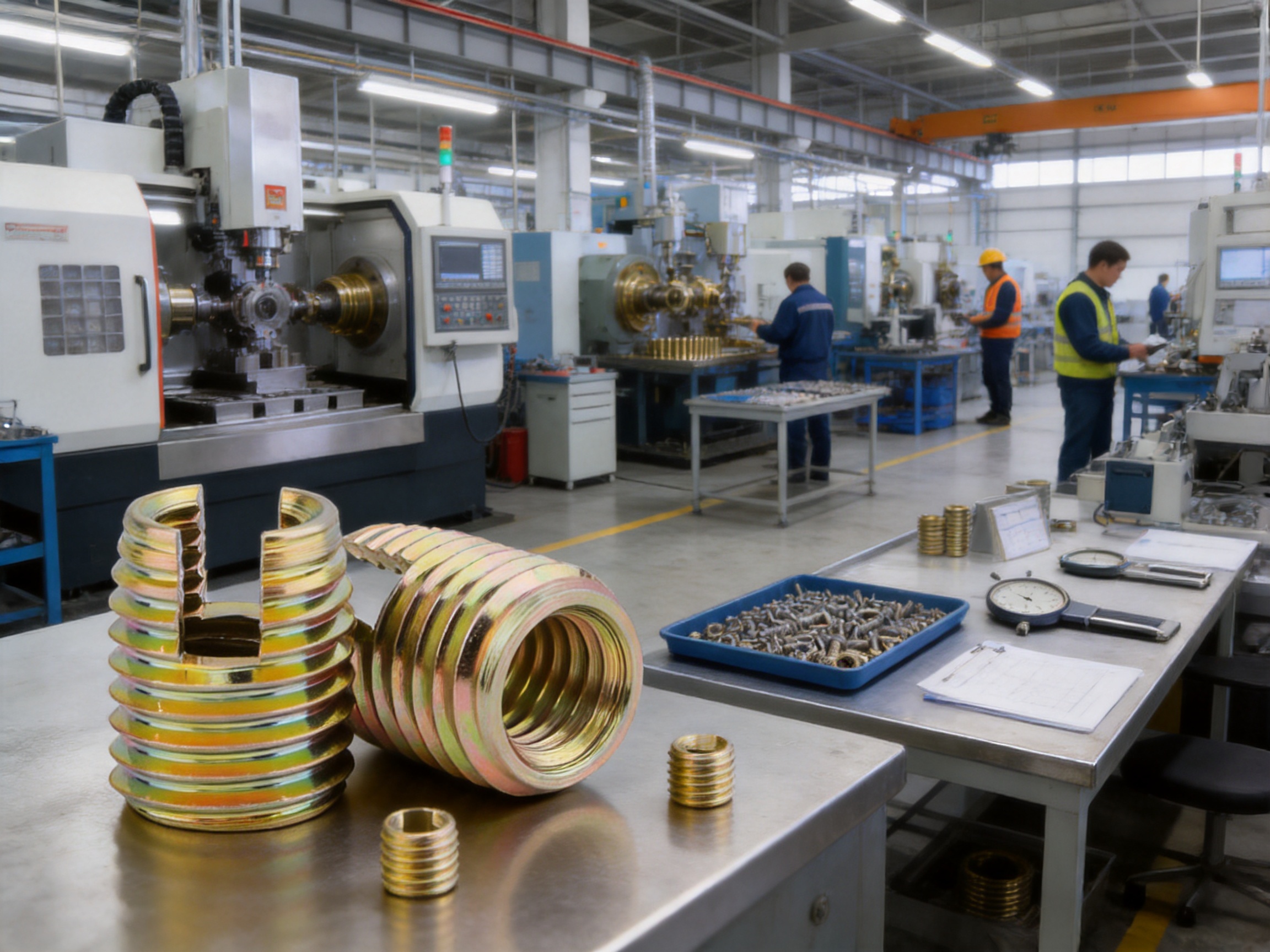
The company was established in 2015 and operates a 10,000-square-meter owned manufacturing facility. According to the supplied company information, the plant contains hundreds of machine tools and automated production systems. This equipment base supports the production of precision threaded components in multiple sizes and configurations.
A broad machine-tool base can provide several manufacturing advantages. It can support dedicated production lines, reduce dependence on a single machine, improve scheduling flexibility, and allow different insert sizes to be processed according to demand. Automation can also improve repeatability in feeding, machining, inspection, and packaging operations when properly controlled.
The manufacturing process for a self-tapping insert typically involves material preparation, forming or machining of the sleeve, external thread production, internal thread production, cutting-groove formation, heat or surface treatment as applicable, plating, inspection, and packaging. Each stage influences final performance. A sharp and correctly positioned cutting groove is essential for installation, while accurate internal thread geometry is necessary for smooth bolt engagement.
Engineering and Development Support
The company maintains an experienced team for product design, development, and production. This is important because threaded inserts are not simply generic sleeves. Their performance depends on the relationship between external thread geometry, internal thread geometry, length, material, coating, host-material characteristics, and installation method.
Design support can help customers select the right size and insert type for a specific base material. It can also support custom packaging, dimensional requirements, thread standards, production quantities, and application-specific inspection plans. For customers transitioning from a conventional repair method, technical support can help evaluate whether a self-tapping insert can reduce production time or improve connection reliability.
Quality Management
The company reports a rigorous quality management system and a comprehensive after-sales service mechanism. For industrial buyers, quality management should cover more than final visual inspection. It should include incoming material control, machine setup, process monitoring, thread gauging, coating verification, batch identification, packaging inspection, and corrective-action procedures.
Traceability is especially important for components used in automotive, aerospace, rail, and other critical assemblies. A traceable production record can connect a shipment to its raw material, machine process, inspection results, coating batch, and packaging information. This helps customers investigate nonconformities and manage inventory with greater confidence.
Stable Supply Capacity
The supplied company profile reports an annual output value of 153 million RMB in 2024. This indicates substantial production activity and supports the company’s position as a large-scale supplier of threaded connection products. Production scale can benefit customers through more stable supply, better capacity planning, and reduced risk when ordering recurring quantities.
Scale alone does not guarantee product quality, so buyers should still confirm the exact product specification, inspection documents, tolerances, packaging method, and delivery requirements. However, a dedicated plant with automated equipment and established production systems provides a strong foundation for repeat orders and long-term supply relationships.
Why This Product Can Outperform Basic Alternatives
The main advantage of the yellow zinc plated self-tapping insert is the combination of several functions in one component. It reinforces the thread, installs without a separate external tapping operation, provides a finished internal thread, and adds moderate corrosion protection through zinc plating and passivation.
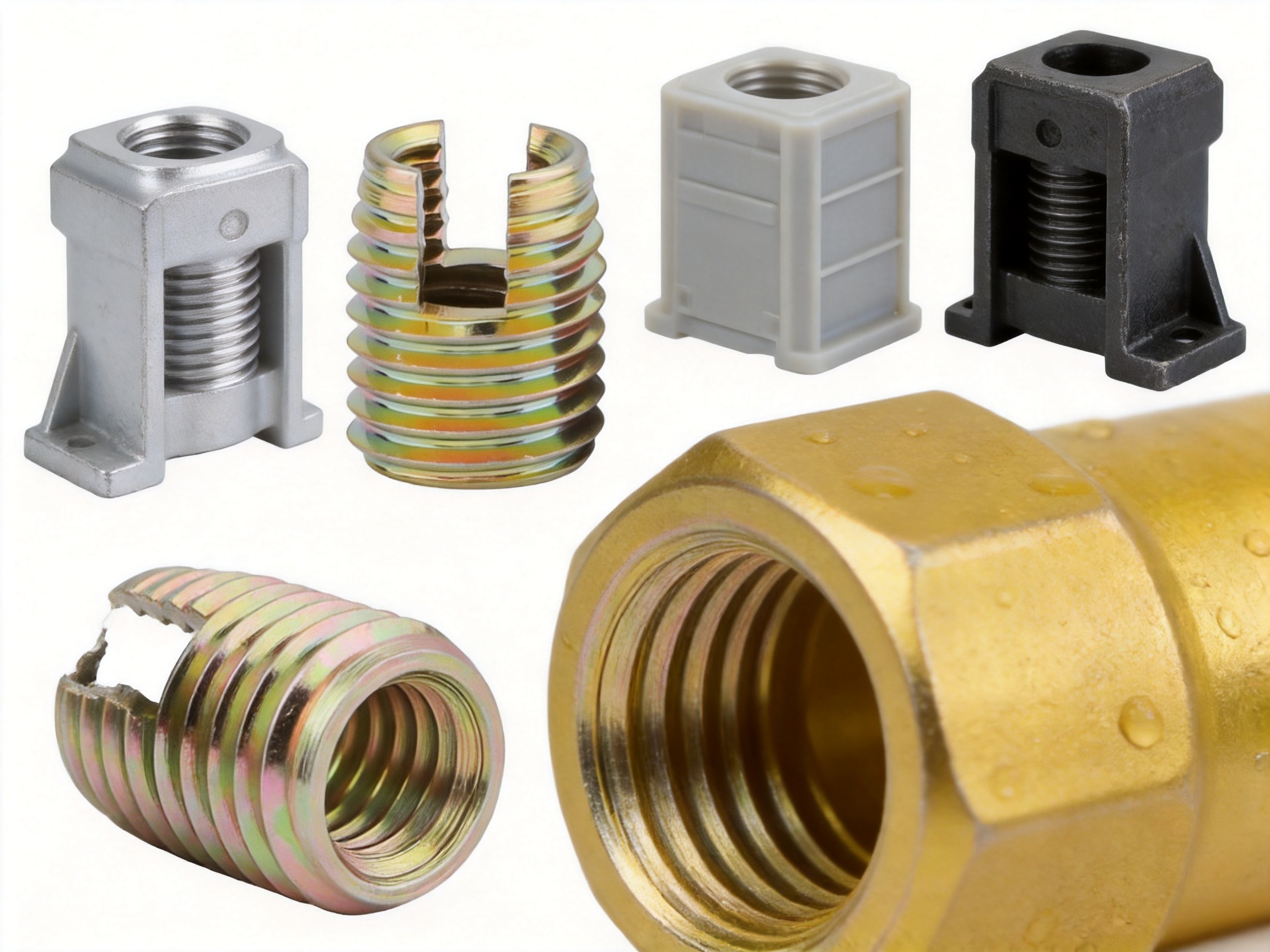
A plain steel sleeve may offer mechanical reinforcement but lack corrosion protection. A direct tapped hole may be inexpensive but provide insufficient durability in a soft material. An adhesive-dependent insert may require additional curing time and process control. A conventional external-thread insert may require a separate tapping operation. The Type 302 self-tapping design addresses these limitations through its cutting groove and mechanically engaging external thread.
The yellow zinc finish also offers a practical middle ground between untreated steel and premium corrosion-resistant alloys. It can reduce the need to upgrade the entire component material when only the threaded connection requires additional strength and protection.
Another competitive advantage is the availability of multiple sizes and both metric and inch-related thread references. Customers can select a suitable insert for common fastener systems while maintaining a consistent product family across machinery, automotive, electronics, and building applications.
Design and Purchasing Considerations
Before specifying the insert, determine the required internal thread, insert length, host material, wall thickness, installation depth, applied load, environmental exposure, and service temperature. The correct insert is selected by considering the complete connection rather than the bolt size alone.
Insert length affects thread engagement and load capacity. A longer insert generally provides more external engagement and more internal bolt engagement, but it may not be suitable for thin sections or blind holes. The insert must not bottom out before it reaches the desired position.
Host-material strength is equally important. Plastic, aluminum alloy, magnesium alloy, and cast iron have different cutting and retention characteristics. Follow the relevant drilling recommendation and validate the installation torque. If the component is unusually soft, brittle, thin, or highly loaded, sample testing should be completed before production approval.
Coating requirements should be discussed when the assembly will be exposed to water, salt, chemicals, high temperature, or electrical contact. The stated salt spray resistance of 96 to 120 hours provides useful comparative information, but the coating may not be sufficient for every outdoor or marine environment.
Buyers should also confirm packaging requirements. Small inserts can be supplied in bulk, but bulk handling may cause size mixing or surface contact if inventory controls are inadequate. Labeled compartments, batch identification, and separate packaging by size can help prevent assembly errors.
Maintenance and Service Benefits
A reinforced threaded hole can simplify service work throughout the life of a machine or vehicle. Technicians can remove and reinstall the fastener without relying on the original soft-material thread. This is valuable for filters, covers, guards, inspection plates, sensors, brackets, and other components that are frequently serviced.
During maintenance, the internal thread should be kept clean and protected from cross-threading. Fasteners should be started by hand whenever possible. If unusual resistance is encountered, the technician should stop rather than force the bolt, because cross-threading can damage both the bolt and insert.
If an insert becomes loose or damaged, the cause should be investigated. Possible causes include an oversized original hole, insufficient wall thickness, excessive installation torque, incorrect drilling, vibration beyond the design assumption, or a bolt that was tightened above the specified value. Corrective action may require a different insert size, a longer insert, a locking method, or replacement of the host component.
Quality Verification Recommendations
Quality verification should be proportionate to the importance of the application. For general hardware, visual inspection and sample thread checks may be sufficient. For automotive, aerospace, rail, or other critical products, a more comprehensive control plan is appropriate.
Dimensional checks may include internal thread size, external thread diameter, insert length, cutting-groove position, and coating appearance. Thread gauges can verify functional fit. Surface inspection can identify scratches, exposed substrate, excessive discoloration, burrs, or plating irregularities.
Installation testing can measure driving torque and seating behavior in representative host materials. Pull-out and torque-out tests can evaluate retention. Repeated installation tests can help assess durability when the application requires frequent servicing.
Environmental testing may include humidity exposure, salt spray, thermal cycling, oil contact, or chemical exposure. Testing should reproduce the actual assembly materials and loading conditions as closely as practical. Results obtained from an isolated insert may not fully represent performance in the complete component.
Q&A
What is a yellow zinc plated self-tapping thread insert?
It is a threaded sleeve with an internal thread for a bolt and a cutting external thread for installation into a prepared hole. The yellow zinc plating and passivation layer provide additional corrosion and wear protection.
Can the insert be installed without pre-tapping?
Yes. The Type 302 slotted design has a cutting groove that allows it to form its external mating thread during installation. A correctly sized and prepared hole is still required.
Which materials are suitable for this insert?
The insert is intended for materials such as aluminum alloys, magnesium alloys, plastics, and other relatively soft substrates. It may also be installed in cast iron or similar materials when the recommended drilling diameter and installation process are followed.
Does the insert require adhesive?
Normal mechanical retention is provided by the external thread, so adhesive is not generally required for standard installation. An engineer may specify adhesive for additional sealing or retention in a particular application.
What corrosion protection does the yellow zinc coating provide?
The coating combines a metallic zinc layer with passivation treatment. The supplied information indicates approximately 96 to 120 hours of salt spray resistance. Actual field performance depends on exposure, assembly design, and maintenance.
Is yellow zinc better than blue-white zinc?
For the supplied product, the color zinc finish is described as providing better corrosion and wear resistance than standard blue-white zinc inserts. The exact difference depends on coating thickness, passivation, test method, and production controls.
Can the insert repair a stripped hole?
It can repair many stripped or damaged holes if sufficient surrounding material remains. The hole must be drilled to the correct diameter and depth, and the component must have adequate wall thickness to support the new external thread.
What happens if the drilled hole is too small?
A hole that is too small may cause excessive installation torque, damage the cutting groove, distort the insert, or crack the host material. The recommended drilling diameter should be followed for the specific material and insert size.
What happens if the drilled hole is too large?
An oversized hole can reduce external thread engagement and lower retention or pull-out resistance. It may also allow the insert to rotate or loosen under load.
Can the insert be used in a blind hole?
Yes, provided that the blind hole is deep enough for the insert length, cutting debris, and installation clearance. The minimum drilling depth in the product table should be treated as a starting reference, and additional clearance may be required for specific installation conditions.
What temperature range is listed for the product?
The stated working range is approximately -40°C to 300°C. Final suitability depends on the complete assembly, including the host material, bolt, load, thermal cycling, and environmental exposure.
What tools are used to install the insert?
A suitable insert driver, mandrel, or installation tool may be used. The tool must engage the insert securely, maintain alignment, and apply controlled rotational force without damaging the internal thread.
Is the insert suitable for high-vibration applications?
The reinforced thread and mechanical external engagement can improve connection stability compared with a weak or damaged direct thread. However, the complete assembly may still require an approved anti-loosening method and application-specific vibration testing.
What industries use this product?
Typical applications include industrial machinery, machine tools, automotive manufacturing, hardware and building materials, electronics, communication equipment, and selected aerospace or rail-related assemblies.
Can metric and inch threads be mixed?
Metric and inch threads should not be mixed unless the design explicitly supports the combination. The insert, installation tool, and final bolt must be selected as a compatible set.
How should customers select an insert length?
Selection should consider the required internal thread engagement, host-material thickness, expected load, available hole depth, and whether the hole is through or blind. A longer insert is not automatically better if it cannot be fully seated or if it weakens a thin section.
What quality documents should industrial buyers request?
Depending on the application, buyers may request material certificates, dimensional inspection records, coating test results, batch traceability, thread gauge records, installation test data, and packaging or labeling specifications.
Conclusion
The yellow zinc plated self-tapping thread insert is a practical solution for creating strong, serviceable internal threads in soft or easily damaged materials. Its Type 302 slotted design supports quick installation without a separate external tapping operation, while the reinforced internal thread improves resistance to stripping and repeated fastening.
The color zinc coating and passivation layer add corrosion and wear protection for humid, oily, and industrial environments. With a stated salt spray resistance of approximately 96 to 120 hours and a working temperature reference of -40°C to 300°C, the product is suited to a broad range of general industrial applications, subject to application-specific validation.
Its advantages are supported by a wide dimensional range, compatibility with metric and inch-related fastener systems, and suitability for both new production and thread repair. Correct drilling, alignment, cleaning, installation torque, and inspection remain essential to achieving the expected performance.
Dongtai Jinzhize Metal Products Co., Ltd. strengthens this product offering through specialized threaded-product manufacturing, a 10,000-square-meter facility, extensive machine-tool and automation resources, engineering and production experience, quality management, traceability, and after-sales support. These capabilities make the company a suitable manufacturing partner for customers seeking consistent threaded connection products and long-term fastening solutions.
References
1. Product specification information for Type 302 slotted self-tapping thread inserts, including metric and inch-related dimensions, drilling recommendations, and minimum drilling depths.
2. Product coating information describing color zinc plating, passivation, salt spray resistance, wear resistance, and the stated temperature range.
3. General engineering principles for threaded inserts, mechanical thread reinforcement, installation torque, and thread repair in soft materials.
4. General corrosion-control principles for zinc coatings and passivation treatments on steel components.
5. Company manufacturing profile describing threaded connection products, production facilities, automated equipment, quality management, traceability, and application industries.
6. General industrial practice for inspection, installation validation, torque control, and maintenance of threaded insert assemblies.