Français
 Español
 Deutsch

Content
- 1 Understanding the DIN 7965 Screwed Insert
- 2 Why DIN 7965 Inserts Are Used in Soft Materials
- 3 Key Advantages of DIN 7965 Screwed Inserts
- 4 Comparison with Conventional Directly Tapped Holes
- 5 Applications Across Industrial Sectors
- 6 Manufacturing Process for DIN 7965 Screwed Inserts
- 7 Manufacturing Strengths of a Specialized Supplier
- 8 Installation Principles and Best Practices
- 9 How to Select the Appropriate Insert
- 10 Advantages Compared with Generic or Uncontrolled Alternatives
- 11 Quality, Consistency, and Supply Reliability
- 12 Custom and OEM/ODM Support
- 13 Frequently Asked Questions
- 13.1 What is a DIN 7965 screwed insert?
- 13.2 What materials are suitable for this insert?
- 13.3 Does the insert require a pre-tapped hole?
- 13.4 Can the insert be used in a blind hole?
- 13.5 Can a damaged insert be replaced?
- 13.6 Which material should be selected: carbon steel or stainless steel?
- 13.7 Are DIN 7965 inserts suitable for automotive and aerospace applications?
- 13.8 What information should be provided when requesting a quotation?
- 13.9 Can the supplier provide installation tools?
- 13.10 How can installation quality be improved?
- 14 Why Choose a Dedicated Threaded Connection Manufacturer
- 15 Conclusion
- 16 References
- 17 Product: DIN 7965 Screwed Insert
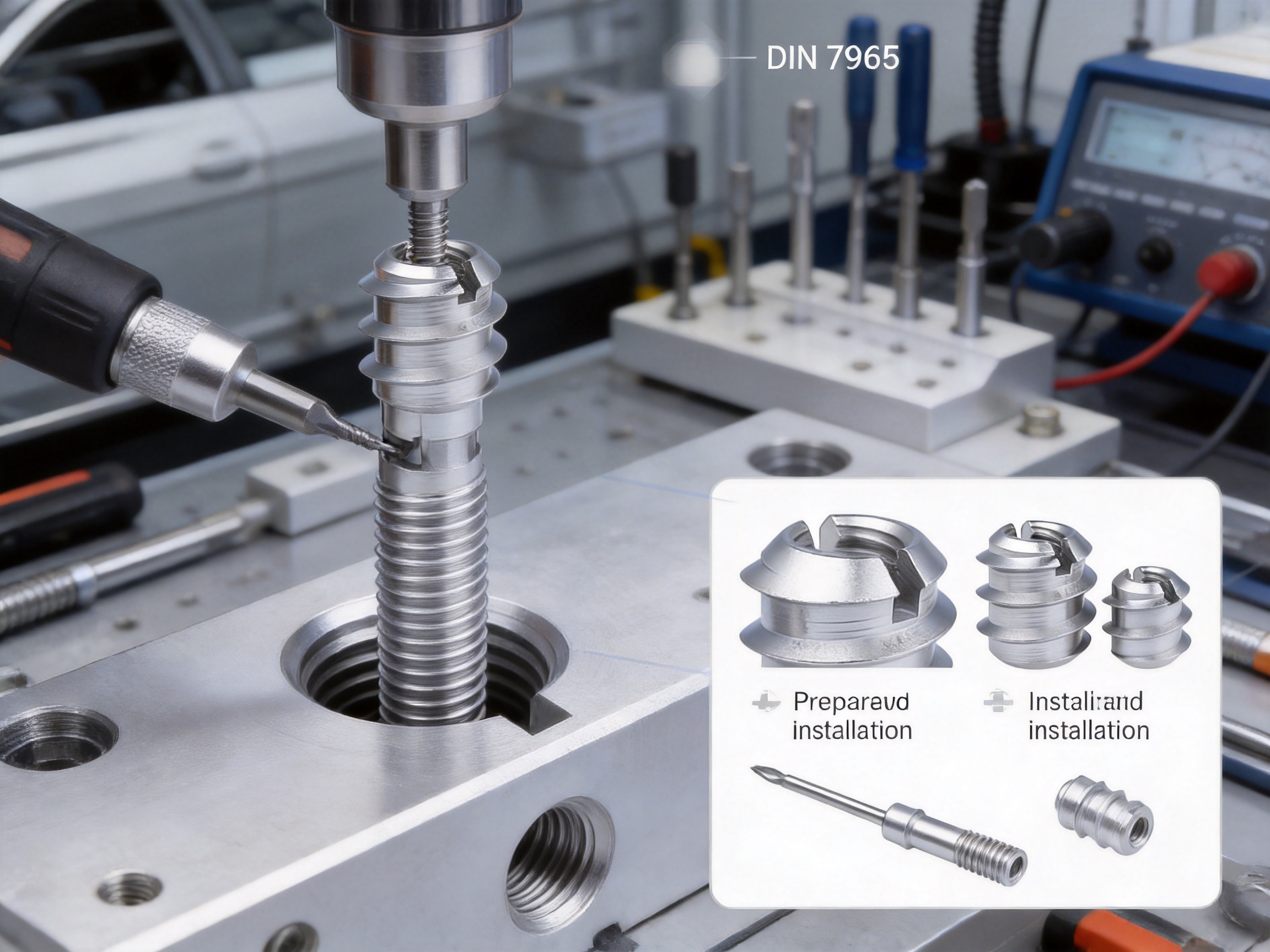
Reliable threaded connections are essential in automotive, aerospace, industrial equipment, precision instruments, and many other engineering applications. When a threaded hole is machined directly into a soft or relatively low-strength base material, the connection may not provide sufficient resistance to stripping, vibration, repeated assembly, or impact loading. DIN 7965 screwed inserts address this challenge by creating a strong, standardized internal thread inside materials such as aluminum, magnesium alloys, plastics, and other substrates that require thread reinforcement.
A DIN 7965 screwed insert is a self-tapping threaded insert designed for installation into a prepared hole. Its external thread engages with the base material, while its internal thread accepts a standard screw or bolt. This internal-external thread conversion allows designers to obtain a durable fastening point without replacing the original component with a larger or heavier part. The result is a compact, repairable, and production-friendly threaded connection.
Manufactured according to the DIN 7965 standard, these inserts offer controlled dimensions, consistent thread geometry, and improved interchangeability. For manufacturers, distributors, and engineering buyers, standardization is especially important because it simplifies part selection, supports repeatable assembly, and reduces the risk of compatibility problems between components from different production batches or suppliers.
Dongtai Jinzhize Metal Products Co., Ltd. specializes in threaded connection and fastening products, including self-tapping inserts, helical wire inserts, key-locking inserts, threaded adapters, oil plugs, installation taps, and related tools. With a dedicated manufacturing facility, automated production systems, extensive machine capacity, and experience serving automotive and aerospace applications, the company provides DIN 7965 screwed inserts for customers requiring stable quality and dependable supply.
Understanding the DIN 7965 Screwed Insert
The DIN 7965 screwed insert is a metallic threaded component with an external self-tapping thread and an internal machine thread. The external profile is designed to cut or form its own engagement in a correctly prepared base hole. After installation, the insert becomes a reinforced threaded interface between the base material and the fastener.
Unlike a conventional nut installed behind a panel or inside a structure, a screwed insert can be placed directly into a blind or through hole. This is valuable when the rear side of the workpiece is inaccessible or when the design requires a flush, compact, or integrated fastening point. It also provides a practical method for introducing strong threads into lightweight components.
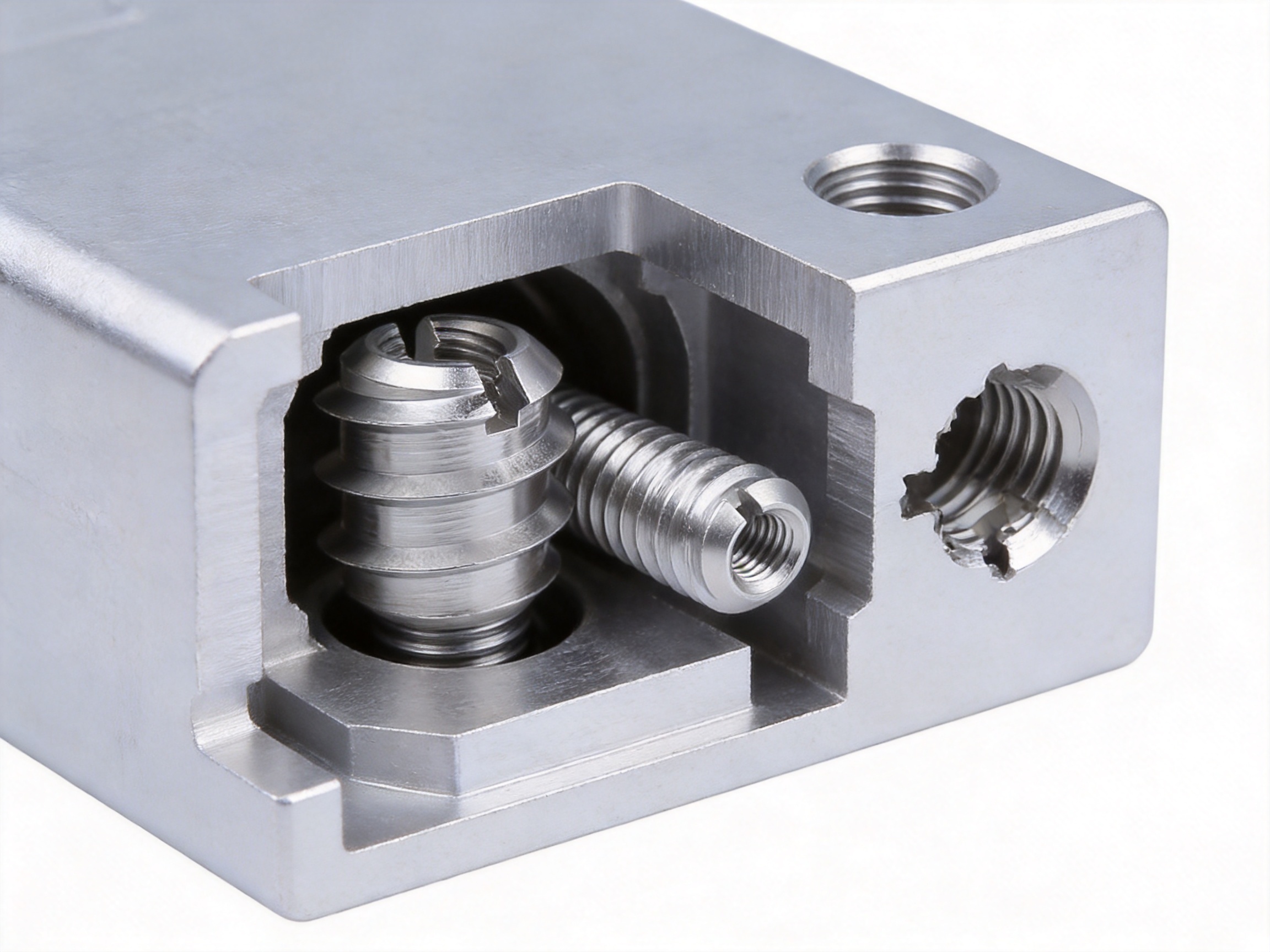
The insert transfers the load through two separate threaded systems. The internal thread transfers tensile, shear, and clamping forces to the fastener. The external thread distributes those forces into the surrounding base material. Because the load is spread over a larger engagement area than a basic tapped hole in soft material, the connection can provide improved resistance to thread stripping and loosening.
DIN 7965 provides a standardized basis for the insert’s dimensional and technical characteristics. Standardization helps ensure that specified nominal sizes, thread forms, external diameters, lengths, and installation requirements remain consistent. This is important for equipment manufacturers that need to source replacement parts, maintain production tooling, or qualify components across multiple facilities.
How the Internal and External Threads Work Together
The internal thread is normally matched to a standard screw or bolt. It provides the fastening interface used during final assembly and maintenance. The external thread is adapted to the base material and the prepared installation hole. During installation, the insert cuts or forms its own external thread, creating mechanical engagement with the surrounding material.
This dual-thread arrangement creates several engineering benefits. First, it allows a lightweight housing to use a standard high-strength fastener. Second, it can increase the service life of the threaded hole when compared with directly tapping a soft alloy. Third, it enables damaged threads to be repaired by removing the failed insert and installing a replacement, often without discarding the entire component.
The effectiveness of the connection depends on more than the insert alone. Correct hole diameter, hole depth, material compatibility, installation torque, thread cleanliness, and alignment all affect performance. For this reason, a professional supplier should provide suitable dimensional information, installation recommendations, and technical support for the intended application.
Why DIN 7965 Inserts Are Used in Soft Materials
Aluminum and magnesium alloys are widely used because they offer low weight, good machinability, and useful corrosion characteristics. However, their relatively low hardness and lower thread shear strength can limit the durability of directly tapped holes. Repeated tightening, vibration, thermal cycling, and accidental over-torque may damage the threads.
A DIN 7965 screwed insert provides a harder and more wear-resistant threaded interface. The fastener is tightened against the insert rather than directly against the softer base material. This can reduce local thread deformation and improve resistance to stripping during assembly and service.
The insert is also suitable for designs where weight reduction is a priority. Engineers can retain an aluminum or magnesium housing while adding a steel or stainless-steel threaded element only where additional strength is needed. This approach avoids the weight and cost of manufacturing the entire component from a heavier material.
In many cases, the use of an insert also improves repairability. If a directly tapped aluminum hole becomes damaged, the complete housing may otherwise need to be replaced, reworked, or enlarged. A suitable insert can restore the original fastener size and preserve the surrounding component, reducing downtime and maintenance expense.
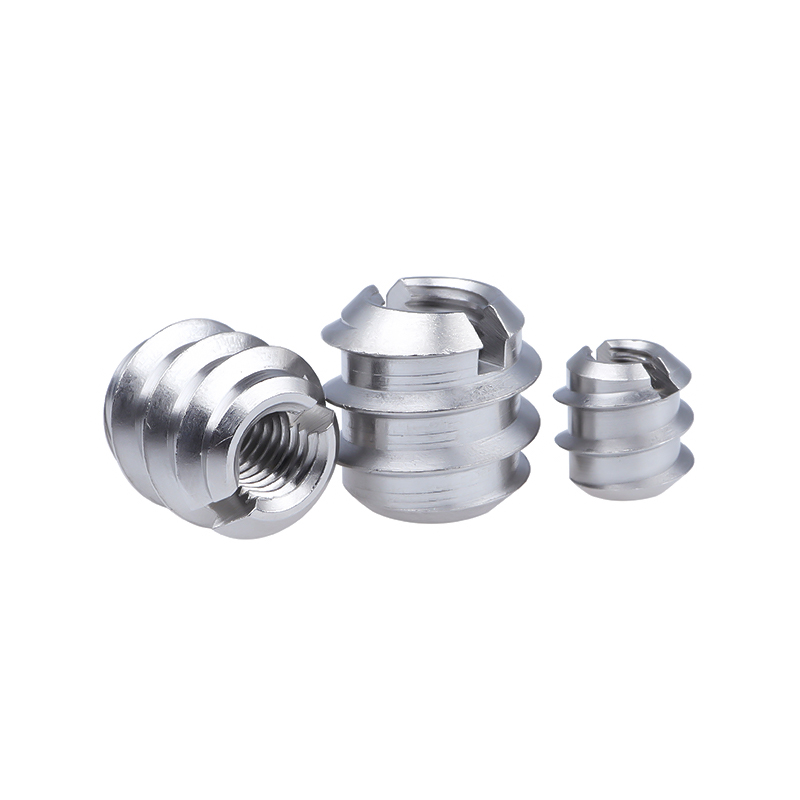
DIN 7965 Screwed Insert
Key Advantages of DIN 7965 Screwed Inserts
Standardized Dimensions and Interchangeability
One of the main advantages of a DIN 7965 screwed insert is its standardized design. Industrial buyers can specify a recognized standard instead of relying on an undocumented or proprietary geometry. This supports consistent purchasing, quality inspection, replacement planning, and production control.
Standardization is especially valuable in global supply chains. Equipment may be designed in one country, manufactured in another, and serviced in multiple regions. When the insert conforms to a recognized German standard, engineering teams have a clearer reference for dimensional expectations and compatibility. This reduces dependence on a single source and helps simplify qualification of alternative suppliers.
High Connection Strength in Lightweight Components
The external thread increases the load-bearing area within the base material. Instead of relying only on a short set of threads cut into aluminum or another soft substrate, the connection uses a dedicated insert with controlled thread geometry and stronger material characteristics.
This can improve resistance to tensile loading, shear loading, vibration, and repeated fastening. The actual performance depends on insert material, installation depth, base material, hole preparation, and fastener selection, but the design principle remains consistent: a reinforced threaded interface can provide a more reliable connection than an unreinforced hole in a soft component.
Resistance to Thread Stripping and Loosening
Thread stripping is a common failure mode when a fastener is installed in a material with limited thread strength. The external thread of the insert distributes forces into the surrounding material, while the internal thread is designed to withstand normal fastener engagement. This separation of functions helps protect the base component.
Once properly installed, the insert engages tightly with the prepared hole. The resulting mechanical connection can remain stable under vibration and repeated service conditions. For assemblies exposed to movement or shock, the insert may be used together with an appropriate locking method, fastener coating, adhesive, prevailing torque feature, or other anti-loosening strategy when required by the design.
Efficient Installation
DIN 7965 screwed inserts are designed for installation into pre-tapped or suitably prepared holes. They do not require a separate nut, rear-side access, or complex structural modification. This is beneficial in compact assemblies, enclosed housings, cast components, and thin-wall structures.
With the correct installation tap, driver, and process settings, inserts can be integrated into manual, semi-automatic, or automated assembly operations. Consistent installation procedures help control insertion depth, torque, alignment, and production cycle time.
Repairability and Maintenance Value
Thread repair is a major practical advantage. A damaged threaded hole does not necessarily require replacement of the complete component. The failed insert can be removed, the hole can be inspected or reconditioned, and a new insert can be installed where the surrounding material remains suitable.
This capability is useful in engines, transmissions, machine housings, fixtures, tooling, and serviceable industrial equipment. It can reduce spare-part requirements and help restore equipment more quickly. For high-value castings and lightweight structural components, repairability can produce substantial economic benefits over the service life of the product.
Material and Coating Flexibility
DIN 7965 inserts can be supplied in different material options according to application requirements. Carbon steel is often selected for general industrial use because it combines strength, machinability, and cost efficiency. Stainless steel may be selected for improved corrosion resistance or for applications involving moisture, chemicals, or demanding environmental conditions.
Surface treatments and coatings can also be considered. The appropriate finish depends on corrosion exposure, galvanic compatibility, operating temperature, installation method, and customer requirements. Material and coating selection should be evaluated together with the base material and the fastener to avoid unwanted corrosion or installation problems.
Comparison with Conventional Directly Tapped Holes
Directly tapping a hole is simple and economical when the base material has sufficient strength, thickness, and thread engagement. However, it may be less suitable for soft alloys, thin-wall parts, or assemblies that require repeated maintenance. A DIN 7965 insert is a specialized solution for situations where the basic tapped hole is vulnerable.
| Evaluation Factor | Directly Tapped Soft Material | DIN 7965 Screwed Insert |
|---|---|---|
| Thread strength | Limited by the strength and thickness of the base material | Improved through a reinforced internal thread and external load distribution |
| Repeated assembly | May experience wear or stripping after repeated tightening | Better suited to repeated fastening when correctly installed |
| Vibration resistance | Depends heavily on base material and thread engagement | Provides a stable reinforced connection when correctly installed |
| Repairability | Damage may require oversize tapping or component replacement | Damaged insert can often be replaced while preserving the component |
| Rear-side access | May require a nut or additional structure | Can be installed in blind or through holes without a separate nut |
| Supply consistency | Dependent on the tapped component design | Supported by a recognized standard and controlled insert dimensions |
| Material suitability | Best for materials with adequate thread strength | Well suited to aluminum, magnesium alloys, and other soft substrates |
The insert is not intended to replace every direct tapping operation. For strong steel components with sufficient wall thickness and low maintenance demands, direct tapping may remain appropriate. The advantage of DIN 7965 lies in providing a reliable reinforcement method where the base material, design geometry, or service conditions create additional risk.
Applications Across Industrial Sectors
Automotive Manufacturing
Automotive components are exposed to vibration, thermal cycling, shock, contamination, and repeated service operations. Aluminum housings, engine components, transmission cases, chassis structures, and accessory brackets often require durable threaded connections without excessive weight.
DIN 7965 screwed inserts can be used to reinforce mounting points in engine-related components, transmission housings, suspension structures, and other assemblies. They support the use of standardized bolts while helping protect softer cast or machined materials from stripping during assembly and maintenance.
Automotive production also requires highly repeatable processes. A standardized insert allows the manufacturer to define a controlled hole, installation tool, torque range, and inspection method. This supports consistent assembly quality across production lines and vehicle platforms.
Aerospace and Lightweight Structures
Aerospace designs place strong emphasis on weight reduction, dimensional accuracy, fatigue resistance, and traceability. Aluminum-based components are common, but their directly tapped threads may require reinforcement in areas exposed to high loads or repeated service.
DIN 7965 inserts can help create durable fastening points in lightweight panels, housings, brackets, equipment supports, and precision structural components. The selected material, coating, dimensions, and installation method must be carefully matched to aerospace specifications and environmental requirements.
In high-reliability applications, the value of a threaded insert extends beyond initial strength. Consistent geometry, documented production controls, inspection records, and stable batch performance are also important. A qualified manufacturer should be able to support customer requirements for traceability and process consistency.
Industrial Equipment and Machine Tools
Machine tools, automated production systems, pumps, robotics, and industrial housings frequently use aluminum or other lightweight materials. Access panels, sensor mounts, protective covers, actuator brackets, and internal mechanisms may require threaded points that can withstand regular adjustment and maintenance.
Using a reinforced insert can extend the service life of these fastening points. It can also simplify repairs when equipment is operated in demanding production environments. A damaged thread can often be restored without replacing a complete housing or interrupting a larger machine assembly.
Precision Instruments and Medical Equipment
Precision instruments require stable connections that do not compromise alignment or operation. Threaded inserts can be used in measurement equipment, control housings, laboratory devices, and other assemblies where compact, accurate fastening points are necessary.
For medical or laboratory equipment, material selection and surface treatment must take into account cleaning procedures, corrosion resistance, biocompatibility requirements where applicable, and any relevant customer specifications. The insert should be selected as part of the complete fastening system rather than as an isolated component.
Rail Vehicles and Transportation Equipment
Rail vehicles and other transportation systems experience continuous vibration, acceleration, braking forces, and environmental exposure. Lightweight metal structures may require reinforced threaded connections for interior equipment, control systems, covers, brackets, and serviceable modules.
A standardized insert can support maintenance across different vehicle fleets by enabling the use of familiar fastener sizes and replacement procedures. Its repairability is also valuable when equipment must remain in service and component replacement would be costly or time-consuming.
Manufacturing Process for DIN 7965 Screwed Inserts
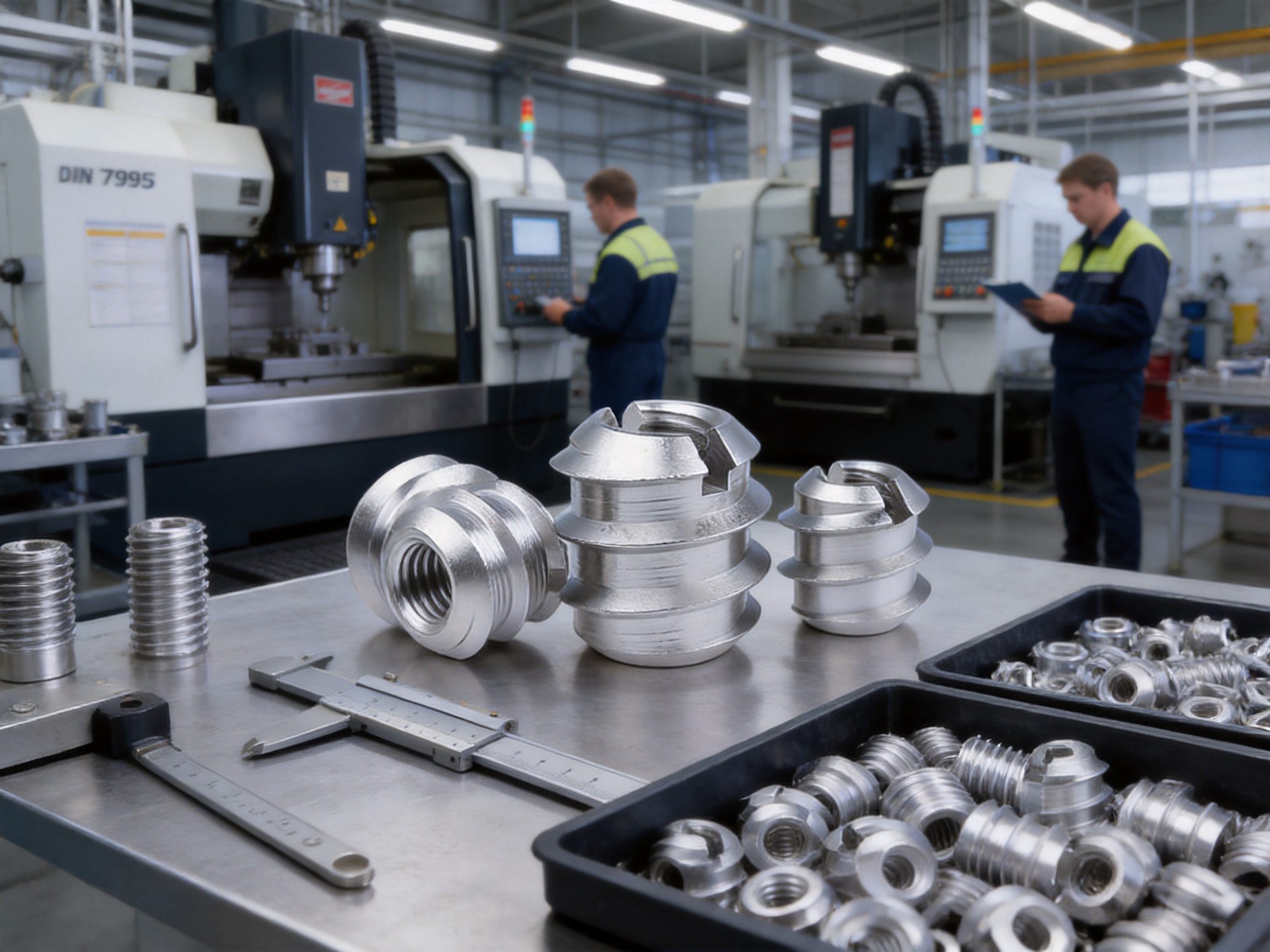
The quality of a screwed insert depends on the full manufacturing process, not only on the final dimensional inspection. Material control, forming or machining, thread production, heat treatment when applicable, surface finishing, cleaning, inspection, and packaging all contribute to final performance.
Material Selection and Incoming Inspection
Production begins with the selection of suitable raw material. Carbon steel and stainless steel are common choices, but the exact grade should be determined by strength, corrosion resistance, operating temperature, application environment, and customer requirements.
Incoming material is checked against purchasing and technical specifications. Typical controls may include dimensional verification, material identification, surface condition inspection, and review of supplier documentation. Maintaining clear material records supports traceability throughout the production process.
Precision Forming and Machining
Depending on the insert design, production may involve cold forming, turning, thread rolling, tapping, grinding, or a combination of these operations. The objective is to create accurate external and internal thread profiles while maintaining the required wall thickness, length, concentricity, and end geometry.
Modern machine tools and automated production systems help improve repeatability and reduce variation between batches. Controlled tooling, stable machine settings, and preventive maintenance are important for maintaining consistent thread dimensions during extended production runs.
For self-tapping inserts, the external thread must be formed with a profile that can engage the prepared hole effectively. The cutting or forming action should produce secure mechanical engagement without excessive installation force or unnecessary damage to the base material.
Internal Thread Production
The internal thread is manufactured to accept the specified screw or bolt. Thread accuracy is important because excessive interference, roughness, or dimensional variation can increase assembly torque and reduce fastening reliability. Conversely, an oversized or damaged internal thread may reduce the effective engagement between the insert and fastener.
Thread tools are monitored and replaced according to production requirements. Inspection may include thread gauges, optical measurement, dimensional measurement, and functional testing with corresponding mating fasteners. The exact inspection plan depends on the insert size, material, application, and customer quality requirements.
Heat Treatment and Surface Finishing
Some applications may require heat treatment to obtain a desired balance of hardness, strength, and toughness. Heat treatment parameters must be controlled to prevent distortion, cracking, excessive brittleness, or undesirable changes in thread dimensions.
Surface finishing may include cleaning, passivation, plating, coating, or other treatments. The selected finish should be compatible with the base material, installation process, service environment, and fastener. A professional production process considers both corrosion protection and functional performance.
Inspection and Quality Control
Quality control is applied at multiple stages rather than only at the end of production. In-process inspection can identify tool wear, dimensional drift, surface defects, and thread problems before a large quantity of parts is completed.
Final inspection may cover external diameter, internal diameter, length, thread condition, surface appearance, material characteristics, coating condition, and packaging quantity. Where required, functional tests can evaluate installation behavior, torque, pull-out resistance, or other application-specific characteristics.
Jinzhize operates with a rigorous quality management approach supported by experienced production and technical personnel. The company’s manufacturing facility contains hundreds of machine tools and automated production systems, enabling it to support both regular production and customer-specific requirements while maintaining attention to product consistency.
Manufacturing Strengths of a Specialized Supplier
A specialized threaded-product manufacturer offers advantages over a general fastener trader or a supplier that only performs final packaging. Threaded inserts require control of thread geometry, material behavior, installation performance, and application compatibility. Production experience in related products helps the manufacturer understand how inserts interact with taps, fasteners, base materials, and assembly equipment.
Dongtai Jinzhize Metal Products Co., Ltd. was established in 2015 and operates from an owned manufacturing plant covering approximately 10,000 square meters. The facility is equipped with hundreds of machine tools and automated production systems. This infrastructure supports stable production capacity and allows the company to manage a broad range of threaded connection products.
The company’s product range includes helical wire inserts, self-tapping inserts, key-locking inserts, threaded adapters, oil plugs, installation taps, and related tools. This product scope is useful to customers seeking a coordinated fastening solution rather than isolated components from multiple suppliers.
In addition to production equipment, the company has an experienced team covering design, development, manufacturing, quality control, and customer support. This technical foundation helps customers select suitable insert types, prepare installation holes, define assembly procedures, and address application-specific challenges.
The company serves automotive, aerospace, rail vehicle, industrial equipment, and other sectors where supply stability and product consistency are important. In 2024, it achieved an annual output value of 153 million RMB, demonstrating substantial manufacturing activity and the ability to support larger-volume supply programs.
For international buyers, manufacturing strength should be evaluated through several factors: production capacity, quality systems, process control, delivery planning, technical communication, packaging, and after-sales support. A supplier that combines these capabilities can help reduce procurement risk over the complete product life cycle.
Installation Principles and Best Practices
Prepare the Correct Hole
The installation hole must be prepared according to the insert’s technical requirements. Hole diameter, depth, roundness, surface condition, and thread profile all affect installation quality. A hole that is too small may cause excessive insertion torque or damage the insert. A hole that is too large may reduce external thread engagement and pull-out resistance.
For blind holes, the hole depth should provide enough space for the insert and any chips or displaced material generated during installation. The bottom of the hole should not prevent the insert from reaching the intended depth. For through holes, the surrounding wall thickness and exit condition should be checked to ensure adequate support.
Use the Correct Installation Tool
Installation should be performed with a suitable driver, mandrel, installation tap, or automated tool matched to the insert design. The tool should hold the insert securely and maintain alignment with the hole. Misalignment can damage the external thread, create uneven engagement, or cause the insert to sit at an angle.
Jinzhize also manufactures installation taps and related tools, allowing customers to coordinate the insert and installation equipment. Using compatible tooling can improve process stability and simplify production validation.
Control Installation Torque and Depth
Installation torque should be controlled according to the insert size, material, hole condition, lubrication, and base material. Excessive torque may damage the insert or deform the surrounding component. Insufficient torque may prevent full engagement and reduce connection strength.
Installation depth is equally important. The insert should be positioned at the specified depth without excessive projection or excessive penetration. A consistent depth ensures that the internal thread is correctly aligned with the component and that the mating fastener can engage the intended length.
Inspect the Finished Connection
After installation, the insert should be checked for alignment, depth, thread cleanliness, visible damage, and secure engagement. A suitable screw or thread gauge may be used to confirm internal thread functionality. Where the application is safety-critical, additional inspection methods and documented process approval may be required.
Assembly operators should also verify that chips, burrs, oil, and foreign material have not entered the internal thread. Clean and controlled installation improves the reliability of the final fastened joint.
How to Select the Appropriate Insert
Choosing a DIN 7965 screwed insert requires consideration of the complete application rather than only the nominal screw size. The following factors should be reviewed during product selection.
Base Material
Identify whether the component is made from aluminum, magnesium alloy, plastic, cast metal, or another substrate. Base-material hardness, tensile strength, wall thickness, and thermal expansion affect external thread engagement and installation behavior.
Fastener Size and Thread Type
The internal thread must match the mating screw or bolt. Thread diameter, pitch, tolerance class, and fastener material should be confirmed before ordering. If the application uses a special thread, the supplier should verify whether a suitable insert configuration is available.
Required Insert Length
Insert length determines the amount of internal and external thread engagement. A longer insert may increase load distribution, but the available component thickness and hole depth must be considered. The selected length should provide adequate strength without interfering with internal features or creating assembly problems.
Operating Environment
Temperature, humidity, salt exposure, chemicals, vibration, electrical contact, and maintenance conditions may affect material and coating selection. Carbon steel can be suitable for many controlled environments, while stainless steel or a special surface treatment may be preferred for corrosive conditions.
Production Volume and Installation Method
Manual installation may be adequate for prototypes, repair work, and low-volume production. High-volume manufacturing may require pneumatic, electric, or automated installation equipment. The insert design, tooling, and inspection procedure should be selected as a complete production system.
Traceability and Documentation
Automotive and aerospace customers may require batch identification, material documentation, inspection reports, process records, or special packaging. These requirements should be defined before production begins. Clear documentation helps the buyer manage incoming inspection and maintain product traceability.
Advantages Compared with Generic or Uncontrolled Alternatives
Not all self-tapping inserts provide the same level of dimensional control or application support. Generic components may have inconsistent external diameters, internal thread quality, surface treatment, or installation behavior. These variations can create problems during automated assembly or when the buyer needs reliable replacement parts.
A DIN 7965 insert provides a recognized dimensional reference. This does not eliminate the need for application testing, but it gives engineers a stronger starting point for product qualification. Standardized design also makes it easier to compare samples, evaluate alternative batches, and establish inspection criteria.
A specialized manufacturer can provide further advantages through controlled production, technical consultation, and coordinated tooling. Customers may obtain not only the insert but also installation taps and related products from one source. This can reduce compatibility issues and simplify communication about hole preparation and assembly methods.
Production scale is another important factor. A supplier with a dedicated plant and automated equipment can often provide more stable output than a trading company dependent on unrelated subcontractors. Stable manufacturing capacity supports delivery planning, recurring orders, and long-term platform supply.
Finally, after-sales support has practical value. When an installation problem occurs, the supplier should be able to help analyze hole dimensions, tool selection, torque, material compatibility, and process conditions. This type of technical response can prevent repeated production interruptions and support faster corrective action.
Quality, Consistency, and Supply Reliability
For threaded inserts used in critical assemblies, quality is not limited to whether the part looks correct. The insert must perform consistently during installation and service. Variation in thread geometry, hardness, surface finish, or material composition can affect torque, engagement, pull-out resistance, and long-term durability.
Reliable production therefore requires controlled raw materials, stable machines, capable operators, inspection equipment, and documented procedures. Batch management and traceability are also important for identifying the source of any nonconformance and supporting corrective action.
Jinzhize’s stated mission is to provide stable and reliable threaded connection and fastening products for critical assemblies. Its quality management and after-sales service mechanisms are intended to support consistent products and dependable customer cooperation. For buyers, this approach can help reduce procurement and usage risks throughout the product life cycle.
Packaging should also be considered. Inserts must be protected from contamination, corrosion, impact, and mixing of different sizes. Clear labels, batch information, quantity control, and suitable protective packaging help customers receive and identify the correct parts efficiently.
Custom and OEM/ODM Support
Although DIN 7965 is a standardized product, customers may still require customized packaging, material options, coatings, labeling, inspection plans, or delivery schedules. Some applications may also require a related insert or threaded connection product with different dimensions or installation features.
As an OEM and ODM manufacturing partner, Jinzhize can support customers with product selection and threaded connection solutions for global markets. Its manufacturing capabilities cover multiple product categories, allowing the company to respond to project requirements involving self-tapping inserts, wire thread inserts, key-locking inserts, adapters, oil plugs, taps, and installation tools.
Before mass production, customers should provide drawings, standards, material requirements, expected order quantity, application environment, packaging requirements, and inspection criteria. Sample evaluation is recommended for new applications, particularly where the insert will be installed into an unfamiliar material or used under severe loading.
A structured development process may include technical review, sample production, dimensional inspection, installation testing, customer approval, pilot production, and full-scale manufacturing. This approach helps identify potential issues early and creates a clear transition from prototype to regular supply.
Frequently Asked Questions
What is a DIN 7965 screwed insert?
A DIN 7965 screwed insert is a standardized threaded insert with an external self-tapping thread and an internal machine thread. It is installed into a prepared hole to create a stronger threaded connection in soft or lightweight materials.
What materials are suitable for this insert?
Typical applications include aluminum alloys, magnesium alloys, and other substrates where a directly tapped thread may not provide sufficient strength or durability. The final material choice should consider the base material, operating environment, fastener, corrosion exposure, and required load.
Does the insert require a pre-tapped hole?
DIN 7965 screwed inserts are designed for installation into a suitably prepared hole, normally with the required hole size and thread preparation defined by the product specification. The exact preparation method depends on the insert design and should be confirmed with the supplier.
Can the insert be used in a blind hole?
Yes, it can be suitable for blind-hole applications when the hole depth and installation method are correctly designed. The hole must provide sufficient space for the insert and any material displaced during installation.
Can a damaged insert be replaced?
In many applications, a damaged insert can be removed and replaced if the surrounding base material remains in suitable condition. The hole should be inspected before repair, and the replacement insert should match the required dimensions and installation specifications.
Which material should be selected: carbon steel or stainless steel?
Carbon steel is often selected for general industrial applications because of its strength and cost efficiency. Stainless steel may be more suitable where corrosion resistance is important. Selection should also consider galvanic compatibility, temperature, coating, fastener material, and the surrounding environment.
Are DIN 7965 inserts suitable for automotive and aerospace applications?
They can be used in automotive, aerospace, rail, and industrial applications when the insert specification, material, coating, installation procedure, and inspection requirements are properly validated for the intended use. Critical applications may require additional customer qualification and documentation.
What information should be provided when requesting a quotation?
Customers should provide the required standard, internal thread size, insert length, material, surface treatment, order quantity, base-material information, application environment, packaging requirements, and any inspection or certification needs. Drawings or samples are helpful for confirming technical details.
Can the supplier provide installation tools?
Yes. In addition to threaded inserts, Jinzhize produces installation taps and related tools. Coordinating the insert and tooling through one supplier can simplify process development and improve compatibility.
How can installation quality be improved?
Use the correct hole dimensions, suitable installation equipment, controlled torque, accurate alignment, and a defined insertion depth. Clean the hole and internal thread, inspect the installed insert, and validate the process using the actual base material and production conditions.
Why Choose a Dedicated Threaded Connection Manufacturer
Threaded inserts are small components, but their effect on assembly reliability can be significant. A supplier with specialized experience understands the relationship between insert geometry, base materials, installation tools, fasteners, and service conditions. This knowledge is useful when a customer needs more than a basic catalog part.
Dongtai Jinzhize Metal Products Co., Ltd. focuses on threaded connection and fastening products rather than treating inserts as an incidental product line. Its manufacturing scope, production equipment, engineering team, quality management approach, and customer service structure are aligned with the requirements of industrial buyers.
The company’s owned 10,000-square-meter facility and extensive machine-tool resources support production scale and process integration. Its experience since 2015 provides a foundation for serving recurring orders, development projects, and customers requiring stable long-term supply.
For global customers, the combination of standardized DIN 7965 products, material flexibility, coordinated installation tools, OEM/ODM support, and application-oriented service can provide a practical alternative to less specialized suppliers. The objective is not simply to deliver a metal insert, but to help create a reliable threaded connection system.
Conclusion
DIN 7965 screwed inserts provide an effective method for reinforcing threaded holes in aluminum, magnesium alloys, and other soft or lightweight materials. Their internal-external thread design improves load distribution, supports standard fasteners, reduces the risk of thread stripping, and offers a practical repair solution for damaged holes.
The standardized DIN 7965 design provides dimensional consistency and interchangeability, while material and coating options allow the insert to be adapted to different industrial environments. Proper hole preparation, compatible tooling, controlled installation, and appropriate inspection remain essential for achieving the expected performance.
Compared with uncontrolled generic alternatives, a DIN 7965 insert from a specialized manufacturer can offer better consistency, clearer technical reference points, coordinated tools, and more reliable supply support. These advantages are particularly valuable in automotive, aerospace, industrial equipment, precision instrument, and rail applications.
Dongtai Jinzhize Metal Products Co., Ltd. combines dedicated threaded-product manufacturing, automated production systems, extensive machine capacity, experienced technical personnel, and quality-focused processes. Its DIN 7965 screwed inserts and related fastening products are intended to help customers improve assembly consistency, reduce maintenance risks, and establish dependable threaded connections for demanding applications.
References
1. Deutsches Institut für Normung. DIN 7965, Screwed Inserts and Related Dimensional Requirements.
2. Deutsches Institut für Normung. Standards and guidance for mechanical fasteners, threaded components, and dimensional tolerances.
3. International Organization for Standardization. General principles for ISO metric screw threads and threaded fastener inspection.
4. ASM International. Engineering principles for threaded joints, fastener loading, and material selection.
5. Fastener engineering references covering thread stripping, pull-out resistance, torque control, and installation practices.
6. Manufacturer technical information for self-tapping threaded inserts, installation taps, and threaded connection products.
7. Industrial assembly guidelines for reinforced threads in aluminum, magnesium, and other lightweight engineering materials.