Français
 Español
 Deutsch

Content
- 1 What Is a Stainless Steel Self-Tapping Thread Insert?
- 2 Material Selection and Stainless Steel Performance
- 3 How the Self-Tapping Design Works
- 4 Advantages Over Directly Tapped Threads
- 5 Advantages Over Conventional Non-Stainless Inserts
- 6 Product Structure: Type 302 Slotted Self-Inserting Screw Sleeve
- 7 Size Range and Drilling Guidance
- 8 Installation Procedure
- 9 Manufacturing Process and Quality Control
- 10 Manufacturing Strengths and Supply Capability
- 11 Applications Across Multiple Industries
- 12 Temperature and Environmental Considerations
- 13 Repairing Damaged Threads
- 14 Design Recommendations for Engineers
- 15 Why Quality and Traceability Matter
- 16 Q&A
- 16.1 What is the main purpose of a stainless steel self-tapping thread insert?
- 16.2 Does the insert require a pre-tapped external hole?
- 16.3 Which materials are suitable for these inserts?
- 16.4 Should I choose 304 or 316 stainless steel?
- 16.5 Can the insert repair an existing stripped thread?
- 16.6 Can the insert be removed and replaced?
- 16.7 How important is the drilling diameter?
- 16.8 Is the insert suitable for repeated maintenance?
- 16.9 Does the insert prevent all loosening caused by vibration?
- 16.10 What installation tools are required?
- 16.11 Can these inserts be customized?
- 16.12 What industries use stainless steel self-tapping inserts?
- 17 Conclusion
- 18 References
- 19 Product: Stainless Steel Self-Tapping Thread Insert
Reliable threaded connections are essential in modern mechanical assemblies. They determine whether components remain securely fastened during vibration, impact, thermal cycling, repeated maintenance, and exposure to moisture or corrosive substances. When the parent material is soft, thin, lightweight, or easily damaged, a conventional tapped hole may not provide sufficient strength or service life. Stainless steel self-tapping thread inserts offer an efficient solution by creating strong internal threads inside materials that cannot reliably support a direct threaded connection.
A stainless steel self-tapping thread insert is a precision-engineered sleeve with external cutting threads and an internal thread designed to receive a screw or bolt. During installation, the insert cuts or forms its own external thread in the prepared base material. This eliminates the need for a separately tapped external hole in many applications and simplifies assembly. Once installed, the insert provides a durable internal thread that distributes load over a larger area than a thread cut directly into aluminum, plastic, or other relatively soft materials.
Compared with ordinary carbon steel inserts, stainless steel versions offer stronger protection against rust, oxidation, humidity, salt spray, and chemical exposure. They are particularly suitable for outdoor structures, marine equipment, electrical housings, transportation systems, automotive components, and industrial machinery. Their combination of corrosion resistance, mechanical stability, easy installation, and long service life makes them a practical choice for both original equipment production and thread repair.
What Is a Stainless Steel Self-Tapping Thread Insert?
A self-tapping thread insert is a threaded sleeve that contains two functional thread systems. The inner thread is used to accept a fastener, while the outer thread engages with the parent material. Unlike a standard threaded bushing that may require a pre-tapped hole, the external thread of a self-tapping insert is designed to cut into the base material during installation.
The insert supplied in this product range uses a slotted self-inserting configuration. A cutting groove is incorporated into the insert body so that the leading section can penetrate the prepared hole and form the external thread. This design allows the installer to use a suitable standard tool, installation mandrel, or compatible driver rather than relying on a complex special process.
After installation, the insert becomes a permanent reinforced threaded connection. The load from the installed screw is transferred through the internal thread, across the insert body, and into the surrounding base material. Because the insert has a larger external diameter than the original fastener, it spreads the load over a greater area. This helps reduce local stress concentration and lowers the risk of thread stripping, cracking, or loosening.
Stainless steel self-tapping inserts are especially valuable when the parent material is aluminum alloy, plastic, magnesium-based material, composite material, or a thin metal section. These materials may be lightweight and economical, but their direct threads can wear quickly under repeated assembly. An insert provides a stronger and more durable interface without requiring the entire component to be manufactured from a harder or heavier material.
Material Selection and Stainless Steel Performance
The inserts are available in 304 or 316 stainless steel, depending on application requirements. Both grades provide useful corrosion resistance and stable mechanical performance, while 316 stainless steel generally offers improved resistance in chloride-containing and marine environments.
304 stainless steel is widely used for general industrial assemblies, indoor equipment, automotive components, electrical housings, machinery, and outdoor products with moderate environmental exposure. It provides a practical balance between corrosion resistance, strength, availability, and cost.
316 stainless steel is suitable for more aggressive conditions, including coastal installations, marine equipment, chemical processing areas, salt-exposed structures, and applications where higher resistance to pitting and corrosion is required. Selecting the correct grade helps extend service life and reduces the need for frequent inspection or replacement.
The stainless steel construction also provides stable dimensional performance over long periods. A properly produced insert maintains its shape and thread geometry during normal use, helping preserve consistent engagement between the insert and the mating screw. This is important for applications that require repeated disassembly, controlled fastening torque, or long-term vibration resistance.
In addition to corrosion resistance, stainless steel provides good resistance to wear and environmental aging. It does not depend on a temporary surface coating for its primary corrosion protection. If a coated carbon steel insert is scratched during handling or installation, the exposed substrate may become a corrosion initiation point. Stainless steel provides a more uniform material-based defense against rust, although the final selection should always consider galvanic compatibility, temperature, chemical concentration, and installation conditions.
How the Self-Tapping Design Works
The main functional advantage of this insert is its external self-tapping thread. A conventional insert may require the base material to be drilled and tapped before the insert can be installed. In contrast, a self-tapping insert uses its cutting section to engage with the prepared hole and form the external thread during insertion.
The installation process normally begins with selecting the correct insert size and identifying the recommended drilling diameter for the base material. The hole is then drilled to the specified diameter and depth. The recommended diameter varies according to the material because plastic, aluminum alloy, and cast iron have different cutting and holding characteristics. The insert is aligned with the hole and driven into position using an appropriate installation tool.
As the insert advances, the cutting groove removes or displaces material and the external thread becomes embedded in the hole wall. The installer should apply controlled force and maintain alignment to prevent cross-threading, tilting, or damage to the insert. When the insert reaches the specified depth, the internal thread is ready to accept the mating fastener.
This process reduces the number of operations required during assembly. It can also lower labor time and simplify field repairs because the installer does not need to perform a separate tapping operation for the external insert thread. For high-volume production, the reduced process sequence may improve throughput and simplify tooling management.
Although self-tapping inserts are designed for efficient installation, the hole diameter remains critical. A hole that is too small may create excessive installation torque, distort the insert, or damage the surrounding material. A hole that is too large may reduce pull-out resistance and compromise connection stability. The recommended drilling range should therefore be treated as an important part of the installation specification.
Advantages Over Directly Tapped Threads
Directly tapping a hole in soft material can be economical for low-load applications, but it has limitations. The thread depth may be insufficient, the thread crest may deform under load, and repeated tightening can gradually wear the material. A stainless steel insert addresses these problems by providing a hard, wear-resistant internal thread inside the softer component.
The insert increases the effective thread engagement area. Instead of relying on a few delicate threads cut directly into plastic or aluminum, the fastener engages with a robust stainless steel thread. This improves resistance to stripping and allows the same component to be serviced multiple times without destroying the thread.
The insert can also improve assembly consistency. A direct thread in plastic may vary significantly depending on molding conditions, material batch, tool wear, or operator technique. A precision insert provides a more stable mating surface and helps maintain more consistent torque behavior.
Another advantage is design flexibility. Engineers can use a lightweight aluminum or plastic housing while still obtaining a durable connection for a steel bolt. This supports weight reduction, electrical insulation, corrosion-resistant design, and cost control without sacrificing the reliability of the fastening point.
Advantages Over Conventional Non-Stainless Inserts
Self-tapping inserts made from ordinary steel may provide satisfactory strength in dry indoor environments, but they may require plating, coating, or other surface treatment for corrosion protection. These treatments can be effective, but their performance depends on coating integrity, thickness, handling, and environmental exposure.
Stainless steel provides inherent corrosion resistance throughout the body of the insert. This is valuable in applications where the insert may be exposed to condensation, cleaning chemicals, humidity, salt, or outdoor weather. It also reduces concerns about coating damage during installation.
Compared with some lower-grade alternatives, stainless steel inserts maintain a more stable appearance and functional surface over time. This is important for visible assemblies, laboratory equipment, medical-related equipment, food-processing support structures, and architectural hardware where corrosion stains or surface deterioration are undesirable.
The material also supports long-term reliability in assemblies where maintenance access is limited. Replacing a corroded insert inside a sealed housing or structural component can be expensive and disruptive. Choosing stainless steel at the design stage may help reduce lifecycle costs and unplanned maintenance.
| Feature | Stainless Steel Self-Tapping Insert | Direct Thread in Soft Material | Conventional Coated Steel Insert |
| Corrosion resistance | High, depending on stainless steel grade and environment | Depends on parent material | Depends on coating condition and exposure |
| Thread wear resistance | High | Low to moderate in soft materials | High when coating remains intact |
| Installation method | Drill and self-tap with suitable tool | Drill and tap directly | Varies by insert design |
| Repeated assembly | Well suited | May cause stripping or deformation | Generally suitable |
| Outdoor and marine suitability | Strong option with correct grade | Depends on base material and environment | Requires appropriate protective coating |
| Use in plastic and aluminum | Highly suitable | Limited by material strength | Suitable when corrosion protection is adequate |
| Maintenance value | Long service life and reliable repair capability | May require oversized repair or component replacement | Good, subject to coating durability |
Product Structure: Type 302 Slotted Self-Inserting Screw Sleeve
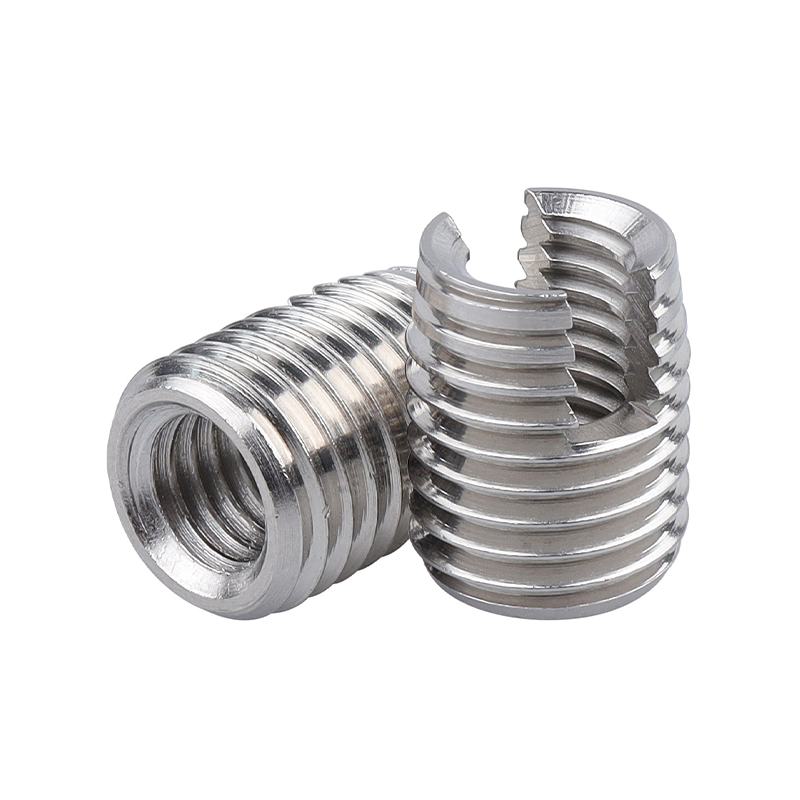
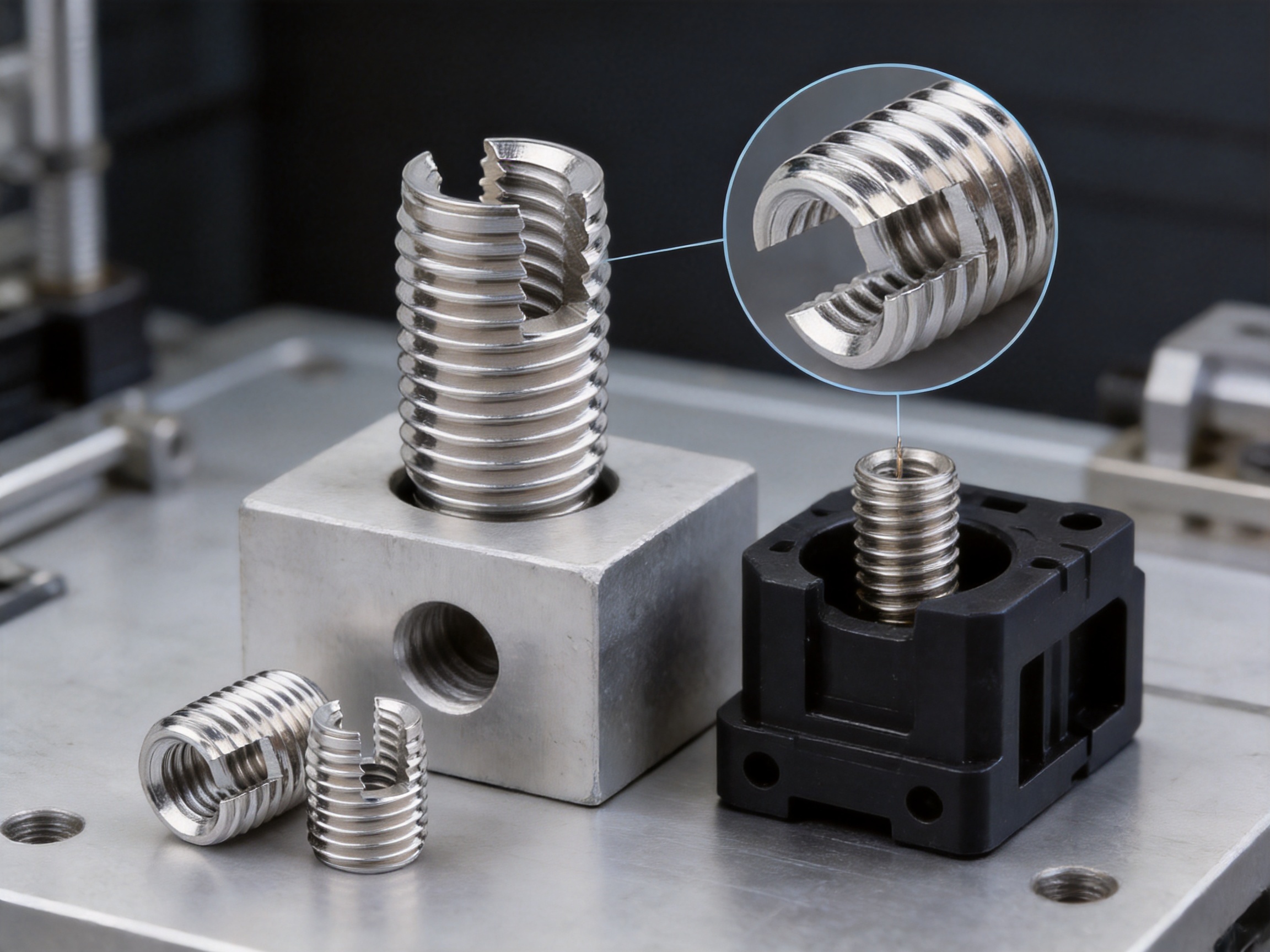
The Type 302 slotted configuration incorporates a cutting groove and a high-strength external thread. The groove supports self-tapping action, while the external thread creates mechanical engagement with the base material. The internal thread is manufactured to receive the selected metric or inch fastener.
The slotted design is intended to simplify installation. During insertion, the cutting section can remove or displace material and reduce the amount of effort required to establish the external thread. The design also supports efficient assembly in production environments where installation time and repeatability are important.
Once installed, the sleeve provides a strong internal thread and helps resist vibration-related loosening. The insert does not replace the need for correct fastener torque, suitable screw selection, or proper joint design, but it creates a more reliable threaded foundation than many unreinforced soft-material holes.
The insert body is available in multiple sizes. The metric range described for the Type 302 product includes internal thread sizes from M2 to M20, with corresponding external thread dimensions, drilling guidance, and minimum drilling depths. Inch equivalents are also available for several sizes, allowing the product to support international equipment designs and mixed-standard maintenance requirements.
Stainless Steel Self-Tapping Thread Insert
Size Range and Drilling Guidance
Correct sizing is one of the most important factors in insert performance. The selected insert must match the required internal fastener size, the available wall thickness, the expected load, and the characteristics of the parent material. The hole diameter must also fall within the recommended range for the specific material.
For example, a smaller M2 or M2.5 insert is appropriate for compact electronic assemblies, instrument housings, small mechanisms, and miniature brackets. These sizes require relatively small drilling diameters and are useful where space is limited.
M3 and M4 inserts are frequently used in electrical equipment, small machinery, control panels, automotive interior parts, and general mechanical assemblies. They offer a balance between compact dimensions and useful fastening capacity.
Larger sizes such as M6, M8, M10, M12, M16, M18, and M20 are intended for heavier components, structural housings, automotive systems, industrial machinery, and assemblies requiring greater fastener capacity. The required hole diameter and minimum drilling depth increase with insert size.
The following summarized specifications are based on the supplied Type 302 dimensional information. Final production drawings should confirm the applicable tolerance, material grade, installation method, and application-specific requirements.
| Internal thread | Typical external thread | Recommended drilling range for plastic | Recommended drilling range for aluminum alloy | Minimum drilling depth |
| M2-0.4 | M4.5-0.5 | 4.0–4.1 mm | 4.1–4.2 mm | 8 mm |
| M3-0.5 | M5-0.5 | 4.5–4.6 mm | 4.6–4.7 mm | 8 mm |
| M4-0.7 | M6.5-0.75 | 5.8–5.9 mm | 6.0–6.1 mm | 10 mm |
| M5-0.8 | M8-1.0 | 7.1–7.2 mm | 7.3–7.5 mm | 13 mm |
| M6-1.0 | M10-1.5 | 9.0–9.2 mm | 9.2–9.3 mm | 17 mm |
| M8-1.25 | M12-1.5 | 10.6–10.8 mm | 11.0–11.2 mm | 18 mm |
| M10-1.5 | M14-1.5 | 12.6–12.8 mm | 13.0–13.3 mm | 22 mm |
| M12-1.75 | M16-1.5 | 14.6–14.8 mm | 15.0–15.3 mm | 26 mm |
| M16-2.0 | M20-1.5 | 18.6–18.8 mm | 19.0–19.3 mm | 27 mm |
| M20-2.5 | M26-1.5 | 24.6–24.8 mm | 25.0–25.3 mm | 32 mm |
The drilling figures are reference values and should be validated through production trials, especially when the base material contains glass fiber, mineral filler, recycled content, heat treatment, or unusual hardness. Material thickness should also be considered. Blind holes need sufficient depth for the complete insert and installation tool, while through-holes may require attention to the opposite surface and possible protrusion.
Installation Procedure
Step One: Confirm the Application
Before installation, identify the required internal thread, insert length, parent material, expected load, operating temperature, and environmental exposure. Confirm whether 304 or 316 stainless steel is more appropriate. For coastal, marine, or chloride-rich environments, 316 stainless steel may provide additional protection.
Step Two: Prepare the Hole
Drill the hole using the recommended diameter for the specific material. The drill should be sharp and properly aligned. Remove chips, burrs, dust, and contamination from the hole. In a blind hole, verify that the hole depth exceeds the minimum required depth and provides adequate clearance for the cutting material generated during installation.
Step Three: Align the Insert
Place the insert squarely over the hole. Misalignment at the beginning of installation can cause the sleeve to enter at an angle. An angled insert may reduce thread engagement, affect screw alignment, or produce uneven stress in the base material.
Step Four: Drive the Insert
Use a compatible installation tool and apply steady, controlled force. The insert should advance progressively as the external cutting thread engages the hole. Avoid excessive impact that could deform the insert or damage the parent material. For powered installation, control rotational speed and torque to ensure repeatable results.
Step Five: Check the Finished Thread
After installation, inspect the insert position and verify that the internal thread is clean. A matching screw or thread gauge can be used to check engagement. The insert should be seated at the specified depth, and the surrounding material should not show cracking, excessive distortion, or abnormal damage.
For production applications, manufacturers should establish a documented installation procedure. This may include drilling parameters, tool specifications, installation torque, inspection frequency, allowable variation, and operator training. Standardization is especially important when multiple insert sizes or base materials are used on the same production line.
Manufacturing Process and Quality Control
The performance of a self-tapping insert depends on more than the stainless steel grade. Thread geometry, dimensional accuracy, cutting groove design, surface condition, concentricity, heat treatment where applicable, and final inspection all influence product reliability.
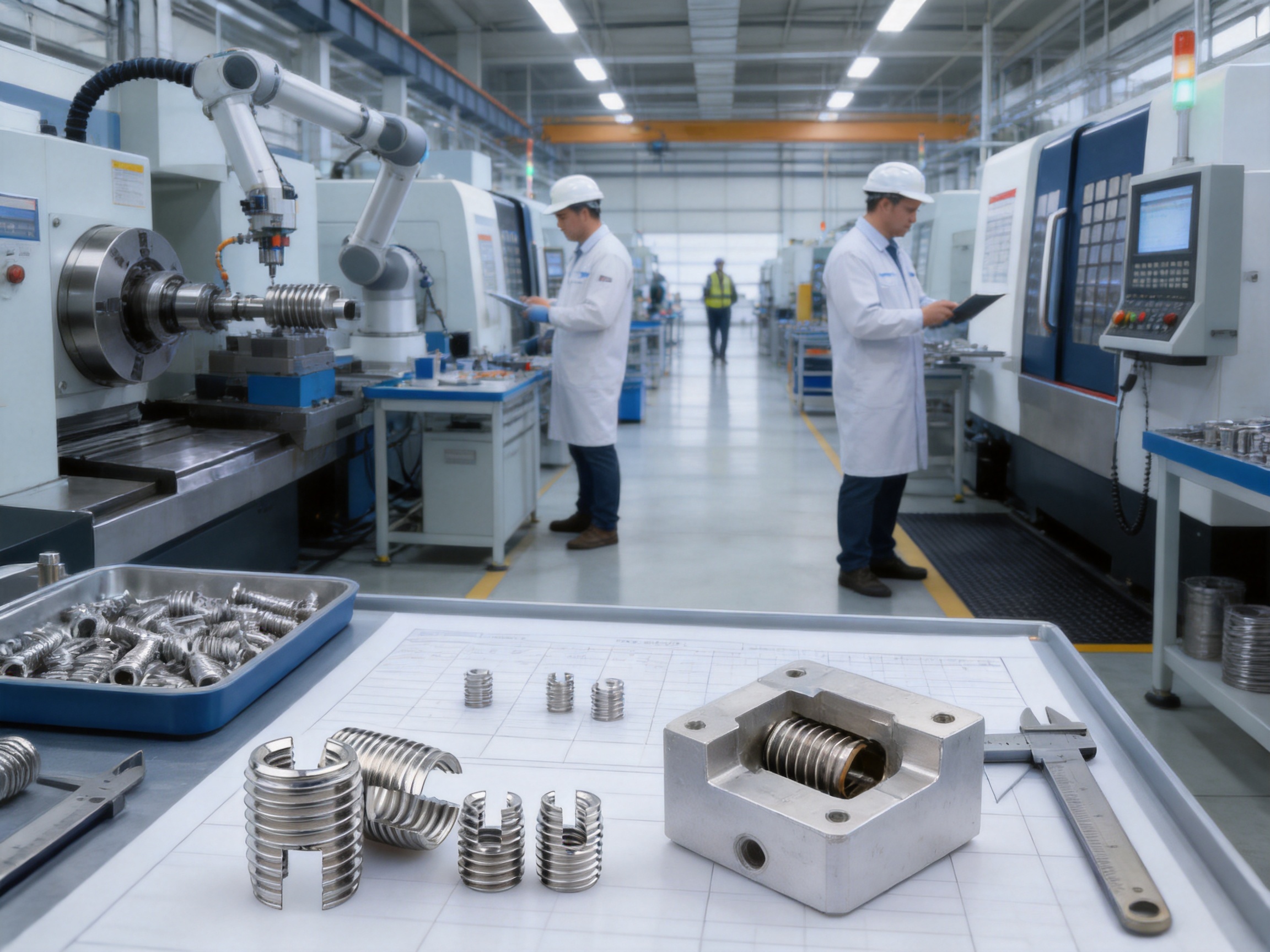
Jinzhize operates a specialized manufacturing facility focused on threaded connection products. Established in 2015, the company operates a 10,000-square-meter owned plant equipped with hundreds of machine tools and automated production systems. This production infrastructure supports stable output and allows multiple product categories to be manufactured under coordinated quality procedures.
The manufacturing process begins with controlled material selection. Stainless steel wire, bar, or tube stock must meet the required grade and dimensional requirements. Material identification and traceability are important because the insert’s corrosion resistance and mechanical behavior depend on the actual alloy composition. Proper material control also helps prevent mixing between 304, 316, and other stainless steel grades.
Precision forming and machining create the insert’s basic geometry. The external thread must be formed with accurate pitch and diameter so that it can cut into the prepared hole without excessive resistance. The internal thread must be dimensionally consistent so that mating screws engage smoothly and achieve the intended load transfer.
The cutting groove is another critical feature. Its location, width, depth, and edge condition influence how efficiently the insert starts and cuts the external thread. A properly controlled groove supports self-tapping action while maintaining enough material in the sleeve body for strength and wear resistance.
Automated production systems can improve repeatability by reducing variation between batches. They can also support faster production, consistent machine settings, and more effective process monitoring. Automation does not eliminate the need for skilled personnel; instead, it allows experienced engineering and quality teams to focus on process development, inspection, tool management, and continuous improvement.
Inspection may include dimensional measurement of internal and external threads, overall length, groove geometry, concentricity, surface condition, and material verification. Depending on customer requirements, production control can also include sampling tests for installation torque, pull-out resistance, strip resistance, vibration behavior, and corrosion performance.
A comprehensive quality management system helps ensure that manufacturing results are consistent from order to order. Product identification, production records, inspection data, and corrective-action procedures support traceability and provide customers with greater confidence in critical applications.
Manufacturing Strengths and Supply Capability
The company’s specialization in threaded connection products is a significant advantage for customers seeking more than a standard catalog component. Its product portfolio includes helical wire inserts, self-tapping inserts, key-locking inserts, threaded adapters, oil plugs, installation taps, and related tools. This breadth allows customers to source complementary products from one experienced supplier.
A focused product portfolio supports technical depth. Engineers who work continuously with threaded inserts understand the relationship between material hardness, thread geometry, installation torque, drilling diameter, pull-out resistance, and service conditions. This knowledge can be applied when customers need assistance selecting a product for an unusual material or a demanding connection.
The 10,000-square-meter facility and large equipment base provide production flexibility. Multiple machines and automated systems can support different insert sizes, materials, configurations, and order volumes. This is valuable for customers who need prototype quantities, recurring production supply, or high-volume orders for automotive and industrial programs.
Annual output value reached 153 million RMB in 2024, indicating substantial commercial and manufacturing activity. Large-scale production capability can help support stable delivery, capacity planning, and continuity of supply. For customers managing long-term programs, a supplier with established infrastructure may reduce the risks associated with inconsistent production capacity.
The company also maintains an experienced team for design, development, and production. This is important when an application requires a nonstandard length, special thread combination, customized packaging, material confirmation, or installation guidance. While standard sizes provide efficient purchasing, engineering support adds value when the product must fit a specific assembly or production process.
Automotive, aerospace, and rail vehicle manufacturing demand reliable components because threaded connections may be exposed to vibration, shock, temperature changes, and repeated maintenance. Experience serving these sectors helps strengthen process discipline and encourages attention to consistency, traceability, and customer documentation.
Quality assurance continues after shipment through after-sales service and technical support. Questions about drilling, installation tooling, material compatibility, or product selection can be addressed as part of the supply relationship. This reduces the chance that a technically suitable insert will be used incorrectly because of an incomplete installation process.
Applications Across Multiple Industries
Industrial Machinery
Machine housings, guards, brackets, covers, gearboxes, pump bodies, and equipment frames often use aluminum or other lightweight materials. Stainless steel self-tapping inserts reinforce fastening points that may be opened repeatedly during maintenance. They also help maintain reliable connections in environments exposed to oil, moisture, vibration, and cleaning operations.
Automotive Components
Automotive assemblies contain numerous threaded fastening points in engine systems, transmissions, interior components, brackets, chassis-related parts, and electronic modules. The insert can reinforce threads in aluminum housings and plastic components while resisting vibration and repeated service operations.
Automotive applications may also involve temperature changes, road moisture, salt, oil, and cleaning chemicals. The stainless steel option provides a durable material for connection points where corrosion protection and stable thread performance are important.
Aerospace and Rail Equipment
Transportation equipment frequently combines lightweight structures with high reliability requirements. Inserts can allow designers to use lightweight materials while maintaining stronger fastening interfaces. In aerospace and rail applications, careful qualification is required, but the basic value of a durable reinforced thread remains clear: the connection can withstand repeated maintenance and mechanical stress more effectively than an unreinforced soft-material thread.
Electronics and Electrical Equipment
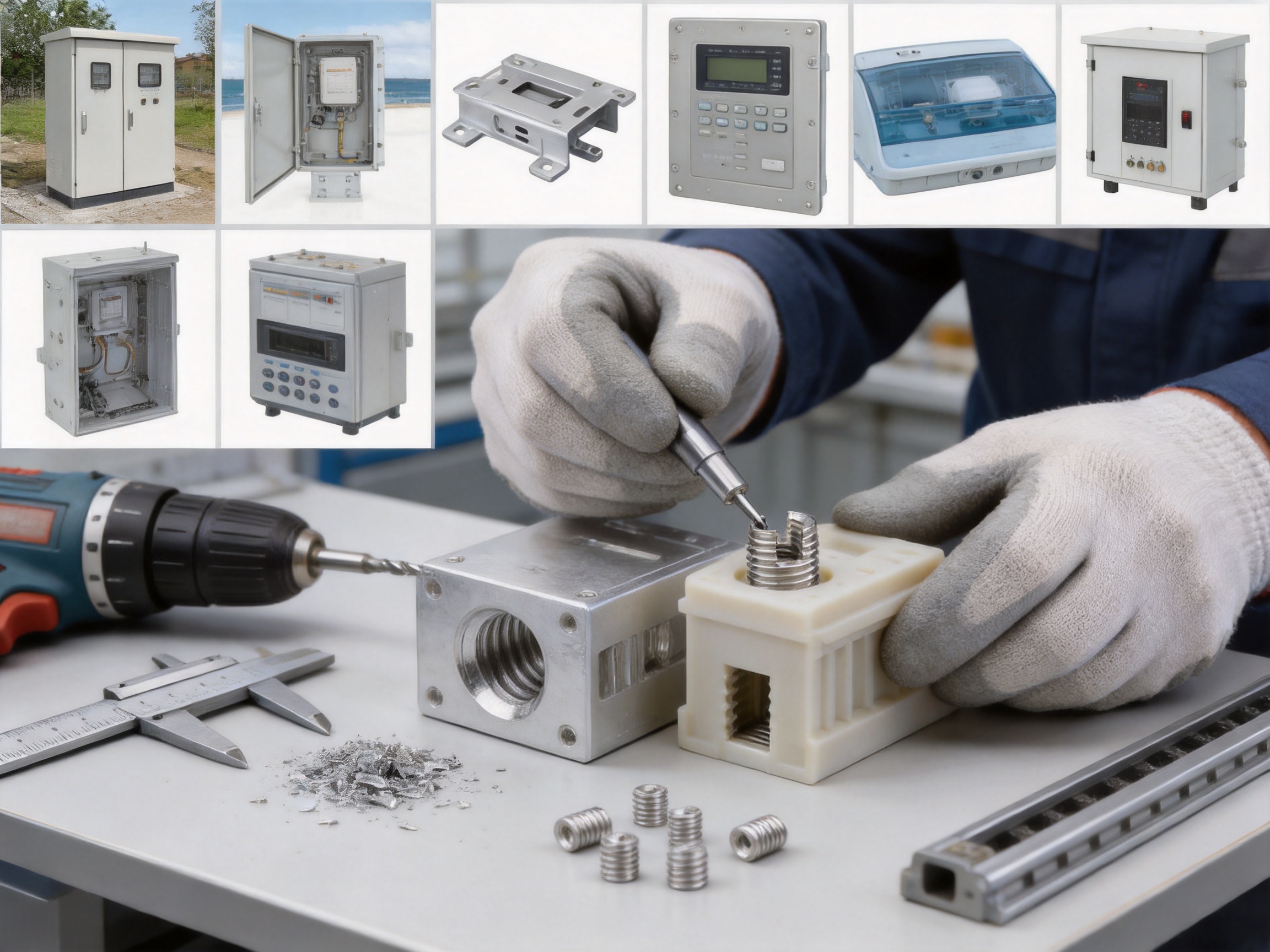
Communication devices, control instruments, electrical cabinets, sensors, and electronic housings commonly use plastic or aluminum enclosures. Small stainless steel inserts provide a dependable thread for covers, mounting brackets, grounding components, and service panels. They are particularly useful where the enclosure must be opened and closed repeatedly without damaging the thread.
Outdoor Structures
Railings, photovoltaic supports, outdoor cabinets, lighting equipment, agricultural machinery, and structural accessories may be exposed to rain, condensation, ultraviolet radiation, dust, and salt-laden air. A corrosion-resistant insert supports longer service life and helps maintain a clean, stable threaded connection.
Chemical and Processing Equipment
Processing environments may contain acidic, alkaline, or cleaning agents. Material selection must be based on the actual chemical concentration and temperature, but 304 or 316 stainless steel can provide a useful level of resistance for many applications. The insert is suitable where a protected and durable internal thread is needed in a plastic, aluminum, or other compatible component.
Temperature and Environmental Considerations
The supplied product information identifies an operating range from approximately -40°C to 600°C. Actual performance at either limit depends on the stainless steel grade, load, exposure time, mating fastener, parent material, lubrication, and joint design. The stated range should therefore be used as a reference for product selection rather than as a substitute for application testing.
At low temperatures, the parent material may become less flexible, particularly when it is a polymer. At high temperatures, plastics may soften or lose strength even though the stainless steel insert remains dimensionally stable. For this reason, the complete connection must be evaluated as a system rather than judging the insert material alone.
Environmental compatibility also includes galvanic interaction. Stainless steel in contact with aluminum can create galvanic effects in the presence of an electrolyte. Designers should consider surface treatments, sealants, washers, drainage, joint geometry, and the relative area of the metals. In many assemblies, appropriate design controls can minimize this risk.
In humid or salty environments, correct installation is equally important. Contamination, trapped moisture, damaged surrounding material, or incompatible fasteners can reduce the life of the connection. A corrosion-resistant insert performs best when the entire joint is designed to manage water, debris, and dissimilar-metal contact.
Repairing Damaged Threads
Thread damage is common in equipment that is frequently serviced. Over-tightening, cross-threading, corrosion, impact, and repeated assembly can strip a hole and prevent the original fastener from achieving proper engagement. Replacing the entire component may be expensive or impossible, especially when the damaged part is a large housing or a complex machined assembly.
A self-tapping insert can restore the connection by allowing the damaged hole to be drilled to the required diameter and then reinforced with a new stainless steel internal thread. The repair process should remove loose material and establish a clean, correctly aligned hole. The insert must be selected according to the original fastener size and the available surrounding material.
Thread repair should be performed only when sufficient wall thickness remains around the enlarged hole. If the damaged area contains cracks, severe deformation, or insufficient material, a larger repair design or replacement component may be necessary. Inspection after repair is important, particularly in safety-related equipment.
Design Recommendations for Engineers
Engineers should plan the insert during the initial component design whenever possible. Pre-planning allows the designer to provide adequate wall thickness, hole depth, edge distance, and access for installation tools. It also prevents the need for a difficult repair after a direct thread has failed.
The insert length should provide sufficient internal thread engagement without extending into a clearance area, moving component, fluid passage, or electrical space. Blind-hole applications should include enough depth for the insert, tool, and any displaced material. The hole should not terminate so close to a thin wall that installation causes cracking or deformation.
Fastener selection must match the insert thread. The screw should have compatible pitch, diameter, strength, and corrosion characteristics. The use of a substantially harder fastener may improve joint strength but can also affect galling risk in stainless steel combinations. Appropriate lubrication or anti-seize practices may be considered where permitted by the application.
Load direction also matters. Pull-out, shear, torque, vibration, and impact place different demands on the connection. If the joint carries a high structural load, the insert and parent material should be tested under representative conditions. The insert improves the thread interface, but it does not automatically compensate for inadequate base material thickness or poor joint design.
Why Quality and Traceability Matter
A threaded insert is a small component, but its dimensions directly affect the safety and durability of the larger assembly. Slight variation in external diameter can change installation torque and holding strength. Variation in internal thread geometry can affect screw engagement, torque-tension behavior, and resistance to stripping.
Traceability helps identify the material grade, production batch, inspection status, and applicable specifications. It is especially valuable for automotive, aerospace, rail, and industrial customers who must document component sources and investigate any production issue.
Consistent packaging is also important. Inserts should be protected from contamination, mixed sizes, mechanical damage, and moisture during transportation and storage. Clear labeling supports correct identification at the assembly station and reduces the risk of installing an incorrect insert.
Q&A
What is the main purpose of a stainless steel self-tapping thread insert?
Its main purpose is to create or restore a strong internal thread in a softer or weaker base material. The insert’s external cutting thread engages the prepared hole, while its internal thread receives the final screw or bolt.
Does the insert require a pre-tapped external hole?
No. The self-tapping design is intended to cut or form the external thread during installation. The base material still requires a correctly sized and properly aligned drilled hole.
Which materials are suitable for these inserts?
They are particularly suitable for aluminum alloy, plastic, and other materials that may strip or wear when threaded directly. They may also be used in cast iron, sheet metal, and selected composite materials when the hole size and installation method are appropriate.
Should I choose 304 or 316 stainless steel?
304 stainless steel is suitable for many general industrial, indoor, automotive, and outdoor applications. 316 stainless steel is generally preferred for marine, coastal, chloride-rich, and more aggressive chemical environments. The final selection should consider the complete environmental and mechanical requirements.
Can the insert repair an existing stripped thread?
Yes, it can be used for many thread repair applications. The damaged hole must be enlarged and prepared according to the insert specifications, and adequate surrounding material must remain to support the new external thread.
Can the insert be removed and replaced?
Removal depends on the installation condition, parent material, and degree of thread engagement. In many cases, removal is possible with suitable tools, but the repair hole may need to be inspected and possibly resized before a replacement insert is installed.
How important is the drilling diameter?
It is extremely important. A hole that is too small can cause excessive installation force and damage, while a hole that is too large can reduce holding strength. The recommended drilling range should be selected according to both insert size and base material.
Is the insert suitable for repeated maintenance?
Yes. One of its principal advantages is that it provides a durable internal stainless steel thread for repeated screw removal and installation. This is generally more reliable than repeatedly fastening directly into plastic or soft aluminum.
Does the insert prevent all loosening caused by vibration?
No threaded insert can replace proper joint design, correct tightening torque, or an appropriate locking method. The insert strengthens the threaded interface and can improve resistance to thread damage and loosening, but the complete assembly still requires suitable vibration-control practices.
What installation tools are required?
A suitable drill, alignment equipment, and installation tool are normally required. The exact tool depends on the insert size, production volume, access conditions, and whether installation is manual or automated. Related installation taps and tools can be selected for specific product configurations.
Can these inserts be customized?
Customers may request support for different sizes, lengths, thread standards, materials, packaging, or application requirements. Customization should be reviewed with the manufacturer to confirm production feasibility, tooling, inspection methods, and minimum order conditions.
What industries use stainless steel self-tapping inserts?
Common industries include automotive, aerospace, rail transportation, industrial machinery, electronics, electrical equipment, outdoor structures, photovoltaic systems, chemical equipment, and general mechanical manufacturing.
Conclusion
Stainless steel self-tapping thread inserts provide an effective way to create durable threaded connections in aluminum, plastic, cast iron, sheet metal, and other materials. Their self-tapping external thread simplifies installation, while the stainless steel internal thread improves resistance to stripping, wear, corrosion, vibration, and repeated maintenance.
The Type 302 slotted self-inserting design combines a cutting groove with a strong external thread, supporting efficient installation with standard or specialized tools. A broad size range accommodates metric and inch-based equipment, and reference drilling data helps engineers establish suitable installation procedures for different parent materials.
The use of 304 or 316 stainless steel makes these inserts more suitable than many ordinary alternatives for humid, outdoor, marine, and chemically demanding conditions. Their value is especially clear when a lightweight or soft component must contain a reliable fastening point without increasing the size or weight of the entire assembly.
Product performance also depends on manufacturing quality. A specialized facility with extensive machinery, automated production systems, experienced technical personnel, quality management, traceability, and after-sales support can provide more than a basic fastener. It can deliver a consistent threaded connection solution backed by application guidance and stable supply capability.
For engineers, manufacturers, and maintenance teams, selecting the correct stainless steel self-tapping insert means considering material grade, insert size, drilling diameter, installation depth, fastener compatibility, environmental exposure, and expected load. When these factors are properly controlled, the insert becomes a dependable component for strengthening new designs and restoring damaged threads across a wide range of industries.
References
1. Stainless steel material information for austenitic grades 304 and 316, including general corrosion-resistance characteristics.
2. General engineering practices for threaded fasteners, insert installation, torque control, and joint design.
3. Manufacturer-provided Type 302 slotted self-inserting screw sleeve dimensional information and drilling recommendations.
4. General principles of thread repair in aluminum, plastic, cast iron, sheet metal, and other engineering materials.
5. Industrial quality-control practices for precision machined components, material traceability, dimensional inspection, and production-process monitoring.