Français
 Español
 Deutsch

Content
- 1 Why Stainless Steel Oil Plugs Matter in Industrial Equipment
- 2 Material Options: 303, 304, and 316 Stainless Steel
- 3 Core Advantages of Stainless Steel Oil Plugs
- 4 Advantages Compared with Conventional Alternatives
- 5 Precision Manufacturing Process
- 6 Quality Control and Production Strengths
- 7 Applications in Demanding Industries
- 8 Design and Specification Considerations
- 9 Installation, Maintenance, and Service Recommendations
- 10 Customization and OEM Support
- 11 Why Choose an Integrated Threaded-Product Manufacturer
- 12 Procurement Checklist for Stainless Steel Oil Plugs
- 13 Quality, Value, and Total Cost of Ownership
- 14 Q&A: Stainless Steel Oil Plug Selection and Use
- 14.1 What is the main purpose of a stainless steel oil plug?
- 14.2 When should I choose 316 stainless steel instead of 304 stainless steel?
- 14.3 Is 303 stainless steel suitable for oil plugs?
- 14.4 Can stainless steel oil plugs be used in high-temperature equipment?
- 14.5 Do stainless steel oil plugs prevent all leakage?
- 14.6 Can these oil plugs be customized?
- 14.7 How can I avoid cross-threading during installation?
- 14.8 Can stainless steel plugs be installed into aluminum housings?
- 14.9 What information should be included in an inquiry?
- 14.10 Why is supplier traceability important?
- 15 Company Manufacturing Capability
- 16 Conclusion
- 17 References
- 18 Product: 303 / 304 / 316 Stainless Steel Oil Plug
Stainless steel oil plugs are small components with a major influence on equipment reliability. They close threaded openings, retain lubricants and process fluids, protect internal assemblies from contamination, and help maintain the integrity of sealed systems. When an oil plug is installed in equipment exposed to chemicals, seawater, heat, pressure, repeated maintenance, or demanding hygiene requirements, material selection and manufacturing accuracy become critical.
303, 304, and 316 stainless steel oil plugs are developed for applications that require dependable corrosion resistance, stable mechanical performance, and consistent sealing. These grades provide practical solutions for equipment manufacturers and maintenance teams working in chemical processing, food production, pharmaceutical machinery, marine equipment, oil drilling, automotive systems, industrial machinery, and other harsh operating environments.
Unlike ordinary carbon steel plugs or low-grade replacements, stainless steel oil plugs can provide improved resistance to oxidation, moisture, acids, alkalis, and long-term environmental exposure. Their performance is supported not only by the stainless steel material but also by accurate threading, controlled dimensions, reliable surface quality, and strict manufacturing management.
Dongtai Jinzhize Metal Products Co., Ltd. manufactures threaded connection and fastening products for demanding industrial applications. Its product range includes oil plugs, helical wire thread inserts, self-tapping thread inserts, key-locking inserts, threaded adapters, installation taps, and related installation tools. With an owned manufacturing plant, extensive production equipment, automated systems, experienced engineering personnel, and a structured quality management approach, the company is positioned to supply stable and traceable threaded products for global customers.
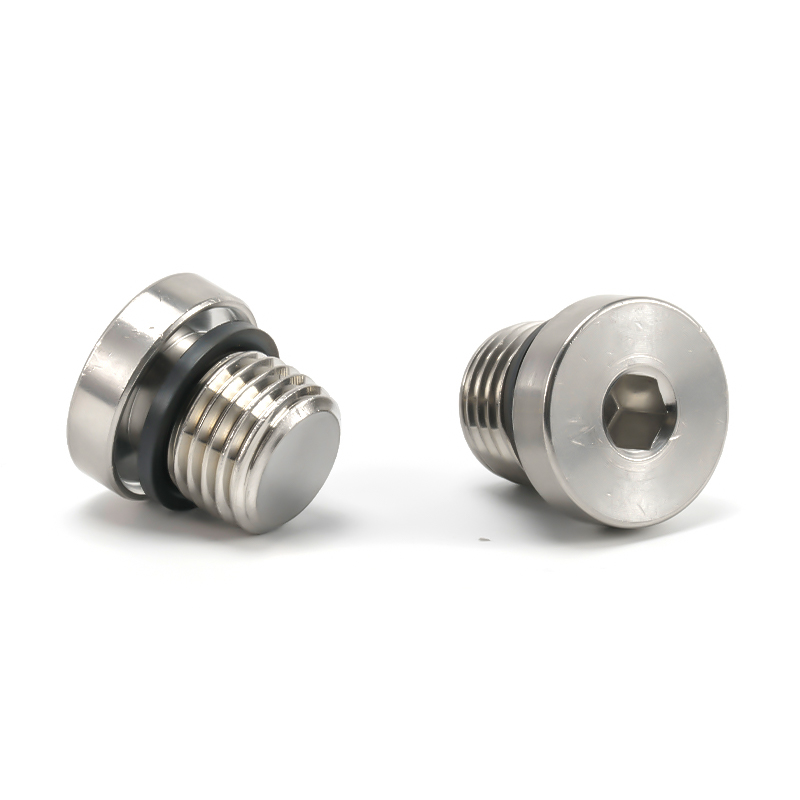
303 / 304 / 316 Stainless Steel Oil Plug
Why Stainless Steel Oil Plugs Matter in Industrial Equipment
An oil plug may appear simple, but it performs several essential functions. It closes a threaded port after fluid filling, draining, inspection, or maintenance. It can protect an internal cavity from dust and moisture. It may also serve as a service access point for lubrication systems, gearboxes, engines, hydraulic equipment, pumps, compressors, and process machinery.
The plug must fit the mating thread accurately. If the external thread is poorly formed, the plug may be difficult to install, may damage the internal thread, or may fail to create a dependable seal. If the sealing face is uneven, fluid can escape even when the thread itself is correctly engaged. If the material is not suitable for the environment, corrosion can weaken the component, contaminate the fluid, or make future removal difficult.
Stainless steel oil plugs address these risks through a combination of corrosion-resistant material and precision production. The result is a component capable of supporting long-term operation where ordinary steel may rust, wear, or require frequent replacement.
In equipment exposed to water, condensation, cleaning agents, chemical vapors, or marine atmospheres, corrosion resistance is particularly important. In high-temperature machinery, the plug must preserve its structural integrity while remaining compatible with the surrounding housing and fluid. In food and pharmaceutical equipment, material cleanliness and resistance to corrosion support hygienic operation and easier maintenance.
The correct oil plug also contributes to total equipment efficiency. A reliable plug reduces unplanned fluid loss, minimizes maintenance interruptions, lowers the possibility of thread repair, and helps keep service procedures consistent. These benefits are especially valuable in engines, transmissions, marine systems, chemical equipment, and other assemblies where a small leak can create a substantial operational problem.
Material Options: 303, 304, and 316 Stainless Steel
The three stainless steel grades used for these oil plugs offer different combinations of machinability, corrosion resistance, and application suitability. Selection should be based on the actual environment, fluid type, temperature, pressure, cleaning method, and maintenance requirements.
303 Stainless Steel Oil Plugs
303 stainless steel is widely recognized for its good machinability. It is suitable for precision-turned components where efficient cutting, stable dimensions, and repeatable thread production are important. This makes 303 stainless steel useful for oil plugs that require accurate external threads, controlled sealing surfaces, and economical production in multiple sizes.
303 stainless steel provides useful resistance to atmospheric moisture and general industrial conditions. It is often considered when the application requires stainless construction and efficient machining but does not involve the most aggressive chemical or marine exposure.
For equipment used indoors, in general machinery, or in moderately corrosive environments, 303 stainless steel can provide a balanced solution. Its machinability can also support consistent production of detailed geometries, recessed features, wrenching sections, and other design elements used in service plugs.
304 Stainless Steel Oil Plugs
304 stainless steel is a versatile material used across industrial, food, chemical, and general engineering applications. It offers stronger corrosion resistance than ordinary carbon steel and is suitable for a broad range of moisture-related and moderately corrosive conditions.
304 stainless steel oil plugs are often selected for equipment requiring a combination of durability, cleanliness, appearance, and corrosion resistance. They can be used in food processing machinery, packaging equipment, chemical handling systems, pumps, storage equipment, industrial assemblies, and general-purpose machinery.
The broad applicability of 304 stainless steel is one of its main advantages. It provides a practical middle ground for customers who need more corrosion protection than standard steel but may not require the additional corrosion resistance associated with 316 stainless steel. It is also suitable for many applications where repeated cleaning and exposure to humid environments are part of normal operation.
316 Stainless Steel Oil Plugs
316 stainless steel is selected for more demanding environments where corrosion resistance is a priority. It is suitable for marine equipment, seawater exposure, chemical processing, pharmaceutical machinery, oil drilling equipment, and systems that may encounter aggressive fluids or corrosive atmospheres.
316 stainless steel oil plugs are especially valuable when the cost of corrosion-related failure is high. A plug installed in a marine or chemical environment may be exposed to salt, moisture, chemical vapors, or repeated cleaning. In these conditions, the additional corrosion resistance of 316 stainless steel can support longer service life and more dependable maintenance performance.
316 stainless steel also supports applications requiring high cleanliness and reliable resistance to contamination. It is therefore widely considered for pharmaceutical, food, marine, and chemical equipment where the surrounding environment places greater demands on material stability.
Choosing the Correct Grade
Material selection should not be based on grade name alone. The application engineer should consider the concentration and temperature of chemicals, the presence of chlorides, contact with seawater, cleaning agents, pressure conditions, expected service life, and the possibility of galvanic interaction with the mating component.
303 stainless steel may be suitable for general industrial service and precision-machined applications. 304 stainless steel can support broader corrosion-resistant use, including many hygienic and wet environments. 316 stainless steel is often preferred for marine, chemical, and highly corrosive applications.
When the operating environment is uncertain, customers should provide application details to the manufacturer. This allows the oil plug material, thread specification, sealing method, surface finish, dimensions, and inspection requirements to be matched to the equipment.
| Material | Primary Strength | Typical Application Direction | Selection Consideration |
|---|---|---|---|
| 303 stainless steel | Good machinability and stable precision production | General machinery, moderate environments, precision-turned parts | Suitable when efficient machining and practical corrosion resistance are required |
| 304 stainless steel | Balanced corrosion resistance and versatility | Food processing, industrial machinery, chemical equipment, humid environments | A broad-purpose option for many wet and moderately corrosive conditions |
| 316 stainless steel | Enhanced corrosion resistance for demanding environments | Marine equipment, seawater, chemical, pharmaceutical, and oil drilling applications | Preferred when corrosive exposure and long-term reliability are major concerns |
Core Advantages of Stainless Steel Oil Plugs
Excellent Corrosion Resistance
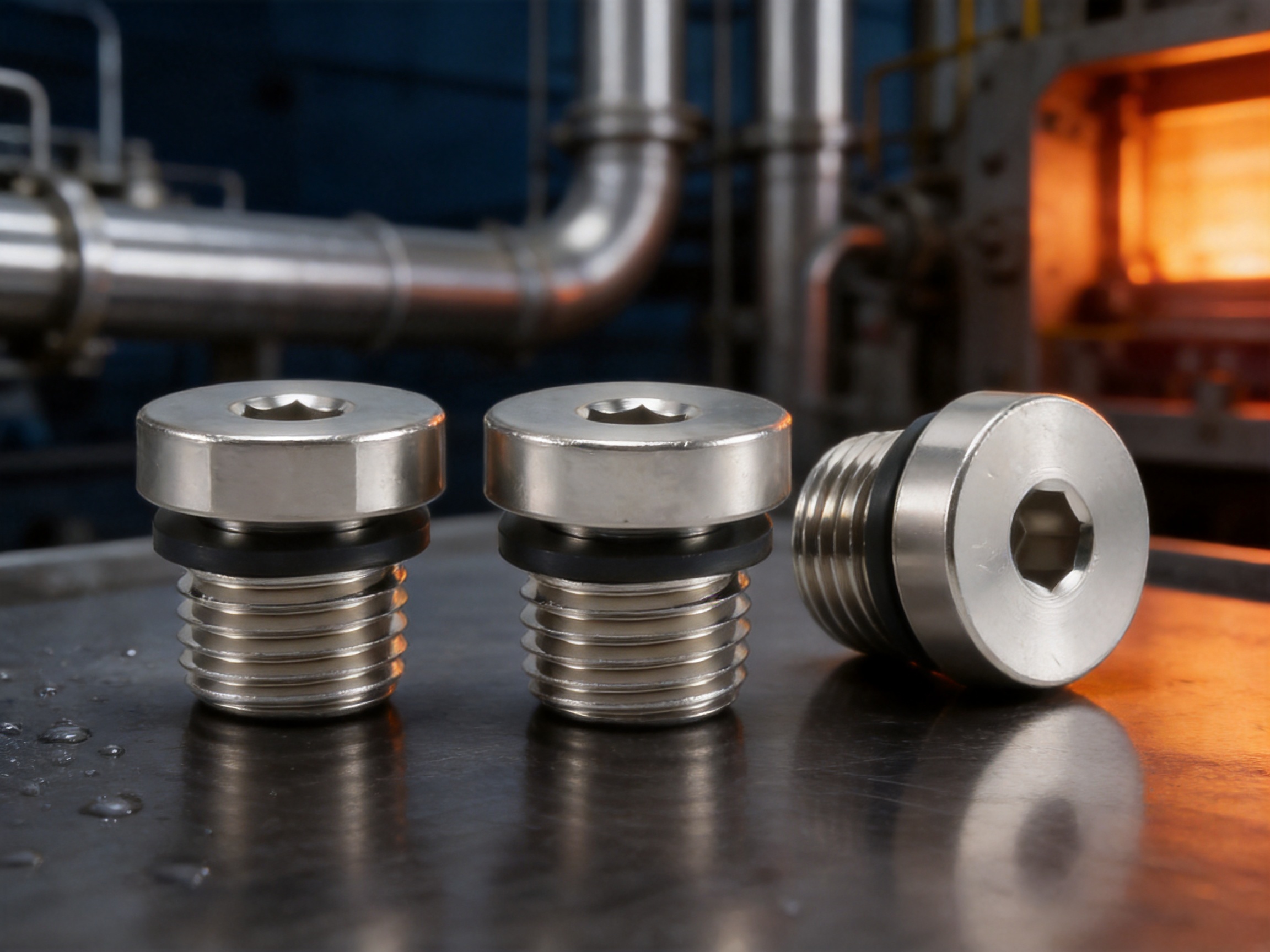
The most important advantage of stainless steel oil plugs is their resistance to corrosion. Corrosion can attack exposed metal surfaces, threaded connections, and sealing areas. It may cause pitting, discoloration, thread damage, leakage, or seizure during removal. Stainless steel construction helps reduce these risks in environments where moisture, chemicals, or salt are present.
304 and 316 stainless steel are particularly suitable for applications requiring reliable resistance to corrosion. 316 stainless steel is commonly selected for more severe exposure, including seawater and chemical environments. By choosing a suitable grade, equipment manufacturers can reduce the likelihood that the plug will become a weak point in the assembly.
Reliable Sealing Performance
A plug is effective only when it closes the port reliably. Precision manufacturing helps ensure that the external thread, sealing face, and other functional dimensions are produced consistently. A correctly manufactured plug can engage the mating thread smoothly and support the use of an appropriate sealing method.
Reliable sealing reduces the risk of oil, lubricant, coolant, hydraulic fluid, or process fluid leakage. It also helps prevent contaminants from entering the equipment. In systems operating under pressure or at elevated temperatures, sealing consistency becomes even more important.
The sealing design may vary according to the equipment. Some oil plugs use a sealing face, while others may be used with a gasket, sealing washer, thread sealant, or an integrated sealing feature. The correct design should be confirmed according to the port specification and service requirements.
High-Temperature Performance
Stainless steel oil plugs can maintain structural stability in high-temperature applications. This makes them suitable for engines, transmissions, industrial machinery, chemical processing systems, and other equipment where heat is generated during operation.
Temperature affects both the plug and the mating housing. Thermal expansion can influence thread engagement, sealing pressure, and removal torque. A properly selected stainless steel plug, manufactured to controlled dimensions, supports more predictable performance across changes in operating temperature.
Actual temperature capability depends on the complete system, including the stainless steel grade, geometry, pressure, fluid, sealing method, mating material, and duration of exposure. Customers should verify the operating range for each application rather than relying on a general material description.
Long-Term Reliability
Long-term reliability is particularly important when an oil plug is installed in equipment that is difficult to access or costly to shut down. Stainless steel resists wear, oxidation, and many forms of chemical attack. This can reduce the need for frequent replacement and help maintain stable service intervals.
A durable plug also supports repeatable maintenance. During a service operation, the plug may be removed and reinstalled. A well-made stainless steel plug with an accurate thread and suitable wrenching feature is less likely to suffer premature damage when handled correctly.
Long service life can produce savings beyond the purchase price. Fewer replacements may reduce labor, downtime, spare-parts inventory, and the risk of damage to the mating housing.
Wide Industrial Applicability
Stainless steel oil plugs can be used in a wide range of equipment and industries. Their combination of corrosion resistance, mechanical stability, and precise thread engagement makes them adaptable to many threaded closure requirements.
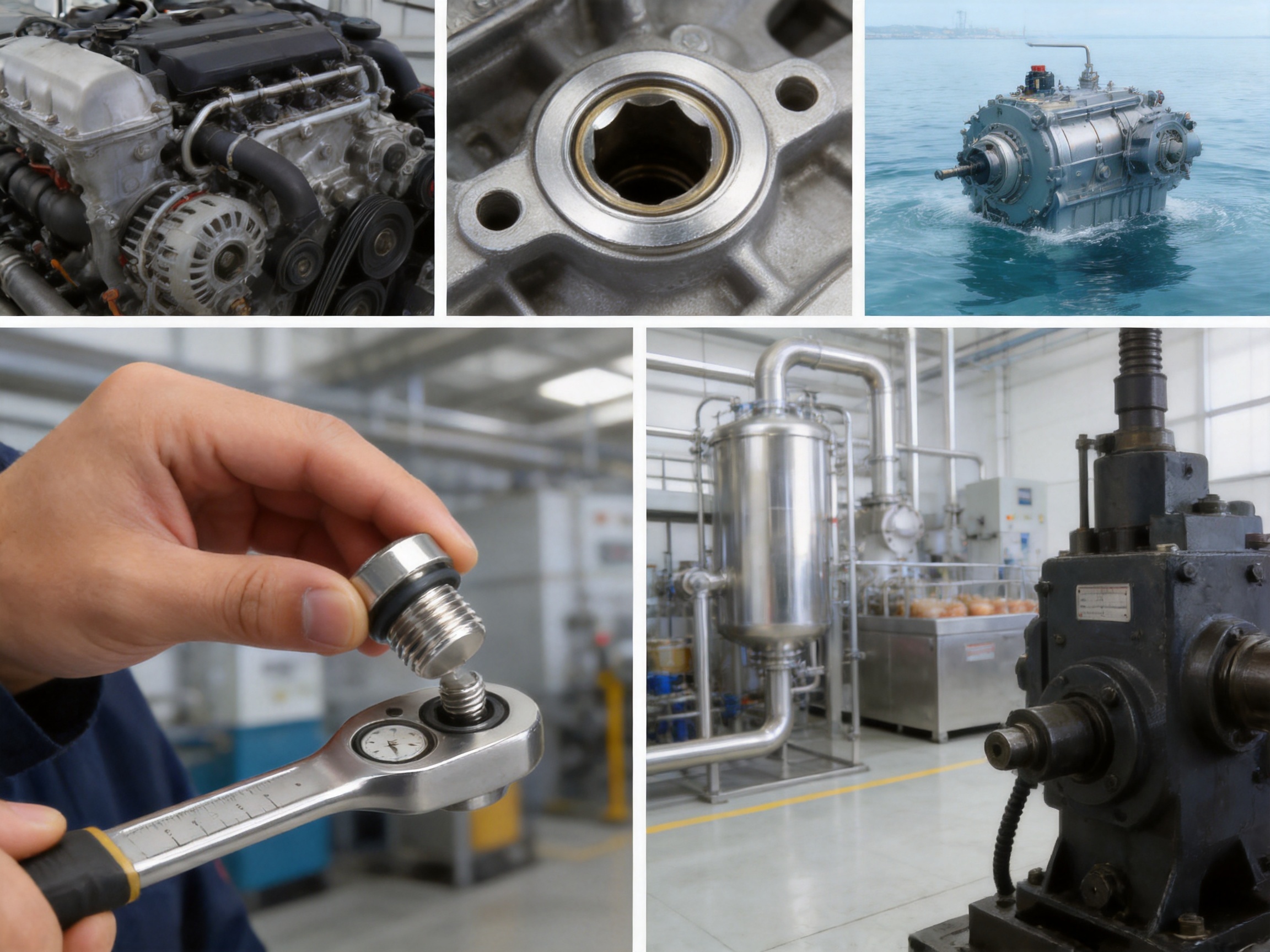
Typical application areas include automotive engines and transmissions, commercial vehicles, rail vehicles, marine equipment, ships, oil drilling systems, chemical processing equipment, food processing machinery, pharmaceutical machinery, pumps, compressors, hydraulic systems, gearboxes, and industrial production equipment.
Advantages Compared with Conventional Alternatives
Customers often compare stainless steel oil plugs with carbon steel plugs, plated steel plugs, aluminum plugs, or low-cost general-purpose components. Each material may be suitable in a particular application, but stainless steel provides several advantages in harsh environments.
Compared with Carbon Steel
Carbon steel can provide good mechanical strength and may be economical in dry, protected environments. However, unprotected carbon steel is vulnerable to rust when exposed to moisture, oxygen, chemicals, or salt. Coatings can provide temporary protection, but damage to the coating may expose the underlying metal.
Stainless steel provides corrosion resistance through the material itself rather than relying solely on an external coating. This is useful on threads and sealing faces, where coating damage, wear, or dimensional variation may create problems.
Compared with Plated Components
Plated components can offer an attractive initial price and may perform well in moderate environments. However, plating thickness and uniformity must be controlled, particularly on threads. Wear during installation or removal can expose the base metal. In corrosive service, this may lead to localized attack.
Stainless steel oil plugs avoid dependence on a thin surface layer for their basic corrosion resistance. The material remains corrosion-resistant throughout the component, although surface condition, contamination, chemical compatibility, and installation practice still influence performance.
Compared with Aluminum
Aluminum plugs are lightweight and can be valuable where weight reduction is a major design priority. However, the correct choice depends on strength, wear, temperature, chemical compatibility, and galvanic considerations. Stainless steel may provide a more suitable solution where the assembly requires greater resistance to mechanical damage, repeated servicing, or aggressive environments.
Compared with Low-Quality Imported Replacements
Low-cost replacements may not provide consistent thread dimensions, material traceability, surface quality, or sealing geometry. Even when the nominal size appears correct, deviations can lead to difficult installation, leakage, premature corrosion, or damage to the mating port.
A professionally manufactured stainless steel oil plug offers greater confidence when dimensional control, production consistency, inspection, and documentation are important. The advantage is not simply the stainless steel grade; it is the integration of suitable material, controlled processing, and reliable quality management.
| Comparison Factor | Stainless Steel Oil Plug | Ordinary Carbon Steel Plug | Plated or Low-Grade Replacement |
|---|---|---|---|
| Corrosion resistance | Strong inherent resistance, depending on grade and environment | Often requires coating or protection | Depends heavily on coating quality and condition |
| Performance in wet environments | Suitable for many wet and corrosive applications | Higher risk of rust without effective protection | May deteriorate if plating is damaged |
| High-temperature stability | Suitable for many elevated-temperature applications | Can be suitable but may require surface protection | Coating performance must be evaluated |
| Maintenance life | Supports long-term use and repeated service | May require more frequent replacement in corrosive conditions | Varies with manufacturing quality |
| Material selection | Available in 303, 304, and 316 stainless steel | Generally limited to carbon steel grades | May have unclear or inconsistent material information |
| Traceability potential | Can be supported by controlled manufacturing and inspection | Depends on supplier management | May be limited or unavailable |
Precision Manufacturing Process
The performance of an oil plug depends on more than the raw material. A reliable manufacturing process must control material preparation, machining, thread formation, sealing surfaces, cleaning, inspection, packaging, and delivery. Every stage influences whether the final component will fit, seal, and remain serviceable.
Material Preparation and Identification
Production begins with the selection of suitable stainless steel bar, forging stock, or other approved raw material. Material identification is important because 303, 304, and 316 stainless steel have different performance characteristics. Correct identification helps prevent material substitution and supports product traceability.
Material preparation may include cutting stock to a controlled length, checking dimensions, and organizing batches for efficient production. Where customer requirements call for documentation, material records can support quality verification and production traceability.
CNC Turning and Forming
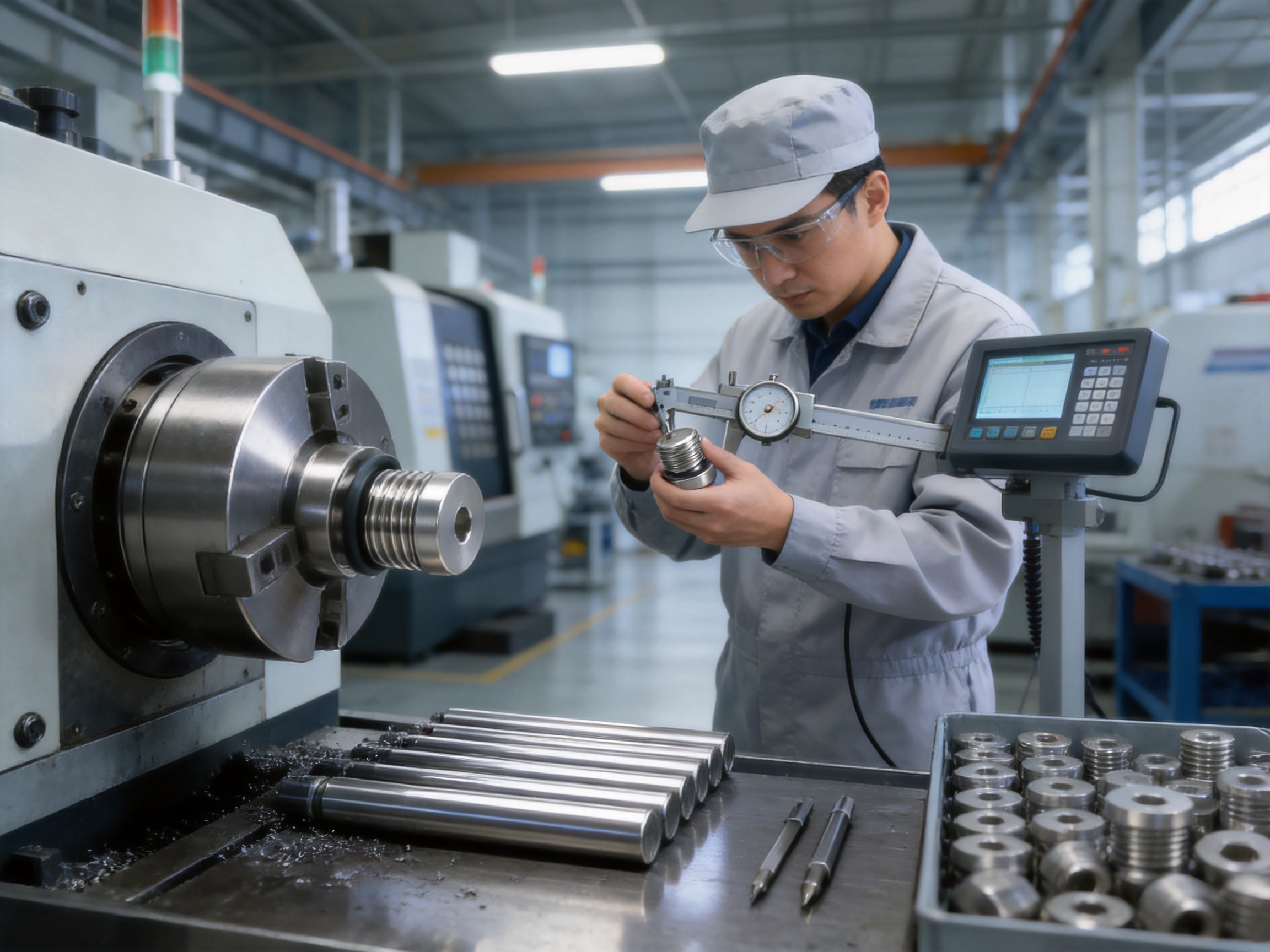
Oil plugs are commonly produced through turning, forming, or a combination of machining processes. CNC equipment can produce the main body diameter, head shape, wrenching section, recess, sealing shoulder, and other features with repeatable accuracy.
Automated and semi-automated production systems help improve consistency across large quantities. Machine settings, tooling conditions, workholding, and cutting parameters must be managed carefully because stainless steel can generate heat and work-harden under unsuitable machining conditions.
Controlled machining also helps maintain the concentricity of the thread and sealing face. This is important because an offset or irregular sealing surface may create uneven contact and increase the possibility of leakage.
Thread Production
The external thread is one of the most important functional features of an oil plug. It must correspond to the specified thread standard, nominal diameter, pitch, tolerance, and engagement length. Depending on the design and production volume, threads may be formed by cutting, rolling, or other approved methods.
Thread production requires attention to crest condition, root geometry, flank accuracy, pitch consistency, and burr control. The plug should engage smoothly with the mating internal thread without excessive looseness or damaging interference.
Thread inspection may include gauges, optical measurement, dimensional inspection, and functional fit testing. The exact inspection method depends on the product specification and customer requirements.
Sealing Surface Processing
The sealing face must be machined or formed to support the selected sealing method. Flatness, perpendicularity, surface finish, and edge condition may affect sealing performance. If a gasket or washer is used, the contact area must be suitable for that component.
Some designs may use an integrated sealing feature, while others depend on an external sealing material. The manufacturer should confirm the intended installation method before finalizing the geometry.
Deburring and Surface Treatment
Machining can leave burrs on thread entrances, wrenching sections, holes, or edges. Deburring is necessary to improve handling safety, protect the mating thread, and support proper installation. Sharp fragments can interfere with sealing or enter the equipment during assembly.
Surface cleaning removes chips, oils, and residues from the production process. The treatment must be compatible with the stainless steel grade and the final application. For hygiene-sensitive applications, customers may require additional cleaning, controlled packaging, or specific surface-finish criteria.
Quality Control and Production Strengths
Consistent oil plug performance requires a quality system that controls both individual operations and the complete production flow. Dongtai Jinzhize Metal Products Co., Ltd. has developed its production capability around threaded connection products and related fastening components.
Established in 2015, the company operates an owned manufacturing plant covering approximately 10,000 square meters. The facility is equipped with hundreds of machine tools and automated production systems. This production base supports large-scale manufacturing, product diversification, and stable supply for customers requiring repeated orders.
Experienced Engineering and Production Team
Experienced personnel are essential for products involving threads, sealing interfaces, inserts, and precision-machined components. Engineering staff can assist with product development, drawing review, material selection, manufacturing feasibility, and application-specific requirements.
A capable production team also helps maintain stable processes as order volumes change. This is important for customers that require both prototype quantities and regular production batches. Manufacturing flexibility can help support standard products, customized dimensions, and products developed according to customer drawings.
Automated Production Capability
Automation can improve repeatability by reducing variation in loading, machining, inspection, and material handling. It can also support higher productivity and more stable delivery schedules. For oil plugs, automated or controlled machining is useful when a customer requires consistent thread dimensions and repeatable sealing geometry across large quantities.
Automation does not replace quality management. It must be supported by correct programming, tool management, equipment maintenance, first-piece verification, in-process checks, and final inspection. The combination of equipment and process discipline is what creates reliable production results.
Quality Management
A rigorous quality management system helps define manufacturing standards, inspection points, nonconformance procedures, corrective actions, and customer-service responsibilities. Quality control should cover incoming materials, production parameters, dimensional accuracy, thread condition, surface quality, cleanliness, packaging, and shipment identification.
For industrial customers, consistent quality is often more valuable than a low initial purchase price. A repeatable supply helps reduce assembly interruptions, field failures, emergency replacements, and uncertainty during incoming inspection.
Traceability and Stable Supply
Traceability can connect the finished oil plug to its production batch, material information, inspection records, and shipment details. This is especially important in automotive, aerospace-related, rail, chemical, pharmaceutical, and other industries where component history may need to be reviewed.
Stable supply also depends on production capacity, equipment availability, workforce experience, and internal coordination. The company’s large manufacturing base and broad product range support an integrated approach to threaded connection products.
Large-Scale Manufacturing Experience
In 2024, the company achieved an annual output value of 153 million RMB. This figure reflects its ability to support substantial production activity and serve customers requiring dependable supply. The experience gained from producing a wide range of threaded products can also support better understanding of thread interfaces, installation conditions, and customer assembly requirements.
Applications in Demanding Industries
Automotive Engines and Transmissions
Automotive engines and transmissions contain lubricants and service ports that must remain closed during operation. Oil plugs may be exposed to vibration, temperature changes, oil contact, repeated servicing, and contamination from the surrounding environment.
Stainless steel oil plugs can support dependable closure of service openings when their dimensions and sealing method are matched to the housing. In maintenance operations, the plug must be easy to remove with the correct tool and capable of being reinstalled without thread damage.
For passenger vehicles and commercial vehicles, consistent production is important because even a small component may be installed in high quantities. Stable dimensions and batch-to-batch uniformity help improve assembly efficiency and reduce inspection complexity.
Rail Vehicles
Rail vehicles operate under vibration, weather exposure, temperature variation, and demanding service schedules. Stainless steel oil plugs can be used in gearboxes, lubrication systems, hydraulic equipment, and other assemblies where corrosion resistance and service reliability are important.
Rail maintenance often requires predictable replacement parts over an extended product life. A supplier capable of maintaining product specifications and traceability can help support fleet maintenance and reduce uncertainty in procurement.
Marine Equipment and Ships
Marine equipment is exposed to seawater, salt spray, humidity, condensation, and fluctuating temperatures. These conditions can accelerate corrosion in ordinary steel components. 316 stainless steel oil plugs are particularly suitable for marine applications where corrosion resistance is a primary concern.
Applications may include ship engines, marine gearboxes, pumps, hydraulic systems, deck machinery, and oil-handling equipment. The plug material, sealing arrangement, and mating housing should be evaluated together, especially where dissimilar metals could create galvanic corrosion.
Chemical Processing Equipment
Chemical equipment may be exposed to acids, alkalis, solvents, process liquids, vapor, and cleaning chemicals. Stainless steel oil plugs can help close service openings while resisting many forms of chemical attack. However, chemical compatibility must always be confirmed for the specific substance, concentration, temperature, and exposure time.
304 stainless steel may support many general chemical applications, while 316 stainless steel is often preferred for more aggressive or chloride-containing environments. The complete assembly should be designed to avoid leakage and to allow safe maintenance.
Food Processing Machinery
Food processing equipment requires materials and designs that support cleanliness, corrosion resistance, and routine sanitation. Stainless steel oil plugs are suitable for equipment where moisture, cleaning agents, and frequent washdown are present.
The plug should have a surface condition that does not create unnecessary contamination traps. Proper cleaning, burr removal, packaging, and installation procedures are also important. The selected stainless steel grade should be compatible with the food contact or surrounding equipment requirements defined by the application.
Pharmaceutical Equipment
Pharmaceutical manufacturing machinery operates under strict cleanliness and process-control expectations. Stainless steel components are widely used because they can provide corrosion resistance and a suitable base for controlled cleaning procedures.
Oil plugs may be used in auxiliary equipment, mechanical drives, pumps, gearboxes, and service systems. The required finish, cleaning procedure, documentation, and packaging should be established according to the customer’s quality system.
Oil Drilling and Heavy Industrial Equipment
Oil drilling and heavy industrial systems may encounter vibration, pressure, temperature variation, abrasive contamination, and corrosive fluids. Stainless steel oil plugs can provide a robust closure solution for service ports and lubrication systems when designed for the applicable conditions.
In such applications, selection should consider mechanical loading, installation torque, sealing performance, chemical exposure, and accessibility for maintenance. The plug should not be treated as an isolated component; its performance depends on the threaded housing, seal, operating fluid, and installation procedure.
Design and Specification Considerations
Before ordering stainless steel oil plugs, customers should define the complete specification. Important information includes material grade, thread standard, nominal size, pitch, thread length, overall length, head style, wrenching dimension, sealing design, surface finish, temperature range, pressure conditions, and packaging requirements.
Thread Standard and Size
The plug must match the internal thread of the equipment. Possible requirements may include metric, Unified, pipe, or another recognized thread system. Nominal size alone is not sufficient because different standards can have similar diameters but different pitches and profiles.
Customers should provide a drawing, sample, or complete thread specification. If the mating port is already installed, a qualified technician may need to verify the internal thread using appropriate gauges or measurement equipment.
Sealing Method
The sealing method should be defined before production. Options may include a flat sealing face, gasket, sealing washer, O-ring arrangement, tapered thread, thread sealant, or another design. The correct choice depends on pressure, temperature, fluid, service frequency, and the design of the equipment.
Using the wrong seal can result in leakage, excessive installation torque, damage to the plug, or difficulty during maintenance. The plug supplier can assist with selecting a suitable configuration when the application information is available.
Installation Torque
Installation torque should be appropriate for the thread size, material combination, lubrication condition, seal design, and required sealing load. Excessive torque may stretch or damage the plug, deform the sealing surface, or strip the mating thread. Insufficient torque may cause leakage or loosening.
Torque values should be established through engineering evaluation or customer specifications. Technicians should use the correct wrenching feature and avoid impact tools unless the procedure specifically permits them.
Mating Materials
The plug may be installed into stainless steel, carbon steel, cast iron, aluminum, or another material. Differences in hardness, thermal expansion, corrosion behavior, and galling tendency should be considered.
Stainless steel threads can be susceptible to galling under unsuitable conditions, especially when similar stainless steel surfaces are assembled dry with excessive force. Clean threads, proper alignment, suitable lubrication where permitted, controlled torque, and correct installation speed can help reduce this risk.
Operating Environment
Customers should communicate whether the plug will contact seawater, cleaning chemicals, acids, alkalis, oils, fuels, hydraulic fluids, food products, pharmaceutical materials, or other substances. Temperature, pressure, vibration, and exposure duration should also be considered.
These factors affect material grade, surface finish, sealing design, inspection, packaging, and maintenance procedures. A carefully defined specification helps prevent a mismatch between the plug and the actual operating conditions.
Installation, Maintenance, and Service Recommendations
Correct installation is essential to achieving the expected performance of stainless steel oil plugs. Before installation, the mating port should be inspected for damage, contamination, burrs, cross-threading, or corrosion. The plug should also be checked for clean threads, a sound sealing surface, and any visible damage.
The plug should be aligned with the port by hand before applying a wrench. It should turn smoothly for several threads. Resistance at the beginning of engagement may indicate cross-threading, incorrect thread specification, contamination, or damage. Forcing the plug can permanently damage both the plug and the equipment housing.
If a sealing washer, gasket, O-ring, or approved thread sealant is specified, it should be installed correctly. Sealing materials must be compatible with the operating fluid and temperature. Excessive sealant should be avoided because loose material may enter the equipment or affect thread engagement.
The final tightening operation should use the specified torque or an approved installation procedure. Tools should engage the intended wrenching surfaces fully. Pliers, hammers, or tools that damage the head should not be used for normal installation.
During maintenance, the plug should be inspected for corrosion, thread wear, deformation, galling, damaged sealing surfaces, and contamination. A plug that has been damaged or permanently deformed should be replaced rather than reused. The mating port should be checked at the same time.
In high-temperature systems, maintenance personnel should allow the equipment to cool to a safe level before removing the plug. In pressurized systems, all pressure must be released according to the equipment procedure. Fluid may remain hot, hazardous, or under trapped pressure even when the equipment appears inactive.
For food, pharmaceutical, and chemical applications, cleaning and handling procedures should follow the facility’s established safety and hygiene requirements. Components should be stored in clean, dry packaging and protected from contamination before installation.
Customization and OEM Support
Industrial customers may require oil plugs that differ from standard catalog dimensions. Customization may involve thread size, thread length, head configuration, sealing face, overall length, recess, wrenching dimension, surface finish, marking, packaging, or material grade.
A capable manufacturer can review customer drawings and recommend a production method that balances performance, cost, and delivery requirements. Prototype development may be used to verify fit and sealing before larger production quantities are released.
OEM support is particularly important when the plug is part of a new engine, transmission, pump, gearbox, marine system, or process machine. The manufacturer may assist with design review, material selection, production feasibility, inspection planning, and repeat-order management.
Because the company also manufactures self-tapping inserts, helical wire inserts, key-locking inserts, threaded adapters, installation taps, and related tools, it can provide broader support for threaded connection systems. This product knowledge can be useful when a customer needs to repair a damaged port, convert a thread, strengthen a weak base material, or develop a complete threaded assembly solution.
Why Choose an Integrated Threaded-Product Manufacturer
Working with a specialized threaded-product manufacturer can provide advantages over purchasing disconnected components from multiple sources. An integrated supplier understands the relationship between the external thread of an oil plug, the internal thread of the housing, installation tools, thread inserts, sealing features, and repair requirements.
This knowledge can simplify technical communication. Instead of explaining thread issues separately to several suppliers, customers can discuss the complete application with one experienced production partner. Integrated support may also reduce compatibility risks between the plug, mating components, inserts, and tools.
A specialized manufacturer can also maintain a focused production system. Equipment, inspection methods, engineering experience, and quality procedures are developed around threaded connection products rather than unrelated commodity parts. This specialization supports greater familiarity with thread standards, tolerances, machining behavior, and assembly requirements.
For international customers, stable communication and after-sales support are also important. Product drawings, specifications, inspection questions, delivery planning, and improvement requests should be managed through a clear process. A reliable supplier should respond to technical issues with practical information and documented follow-up.
Procurement Checklist for Stainless Steel Oil Plugs
Before placing an order, purchasing and engineering teams can use the following checklist:
1. Confirm the required stainless steel grade: 303, 304, or 316.
2. Confirm the thread standard, nominal diameter, pitch, tolerance, and thread length.
3. Define the sealing method, including gasket, washer, O-ring, sealant, or sealing face.
4. Provide the operating temperature, pressure, fluid, chemical exposure, and environmental conditions.
5. Specify the head shape, wrenching dimension, recess, overall length, and any special features.
6. Identify the mating housing material and assess possible galvanic or galling concerns.
7. Define required surface finish, cleanliness, marking, packaging, and storage conditions.
8. Request inspection requirements, material documentation, dimensional reports, or traceability records where necessary.
9. Confirm sample approval or first-article requirements for customized products.
10. Establish expected annual quantity, batch size, delivery schedule, and after-sales communication process.
Providing complete information at the beginning allows the manufacturer to recommend a more suitable product and reduces the risk of delays caused by incomplete specifications.
Quality, Value, and Total Cost of Ownership
The purchase price of an oil plug is only one part of its total cost. A low-priced plug that leaks, corrodes, damages the mating thread, or requires early replacement can become more expensive over the equipment’s service life.
Stainless steel oil plugs can provide value through longer service, reduced replacement frequency, improved resistance to corrosion, and more dependable sealing. These advantages may reduce maintenance labor and downtime, especially when the plug is installed in equipment that is difficult to access or critical to production.
Consistent quality also reduces hidden costs. When all plugs in a batch have stable dimensions, assembly personnel spend less time adjusting installation procedures. Incoming inspection can be more efficient, and the risk of production stoppages caused by dimensional variation may be lower.
For large-scale manufacturers, supplier stability is another cost factor. A supplier with substantial equipment, an owned production facility, trained personnel, and established quality procedures is better positioned to support repeat orders and long-term product availability.
Q&A: Stainless Steel Oil Plug Selection and Use
What is the main purpose of a stainless steel oil plug?
A stainless steel oil plug closes a threaded opening in equipment and helps retain oil, lubricant, coolant, hydraulic fluid, or another process fluid. It can also prevent dust, moisture, and other contaminants from entering an internal cavity.
When should I choose 316 stainless steel instead of 304 stainless steel?
316 stainless steel is generally considered when the plug will face more severe corrosion, including seawater, marine atmospheres, chloride exposure, aggressive chemicals, or demanding pharmaceutical and chemical processing conditions. 304 stainless steel is suitable for many general industrial, food processing, humid, and moderately corrosive environments. The final choice should be based on the actual fluid, temperature, concentration, and exposure conditions.
Is 303 stainless steel suitable for oil plugs?
Yes. 303 stainless steel is suitable for many precision-machined oil plugs, especially where good machinability and stable dimensional production are important. It is often considered for general machinery and moderate environments. It may not be the first choice for highly corrosive marine or chemical exposure.
Can stainless steel oil plugs be used in high-temperature equipment?
They can be used in many high-temperature applications because stainless steel maintains useful structural stability at elevated temperatures. However, the complete design must be evaluated, including grade, pressure, fluid, sealing material, thread fit, mating housing, and length of exposure.
Do stainless steel oil plugs prevent all leakage?
No component can guarantee leak prevention if the thread, sealing method, installation torque, mating port, or equipment design is unsuitable. A precision-manufactured plug supports reliable sealing, but correct specification, compatible sealing materials, clean threads, proper alignment, and controlled installation are also required.
Can these oil plugs be customized?
Customization may be available for thread size, thread length, head shape, sealing face, wrenching dimensions, overall length, surface finish, marking, packaging, and material grade. Customers should provide drawings, samples, or detailed specifications for technical review.
How can I avoid cross-threading during installation?
Clean the mating port, align the plug carefully, and turn it by hand before using a wrench. The plug should engage smoothly for several threads. If strong resistance occurs immediately, stop and inspect the thread specification, alignment, and condition rather than forcing the component.
Can stainless steel plugs be installed into aluminum housings?
They can be used in some aluminum assemblies, but the material combination should be evaluated for thread wear, galvanic corrosion, thermal expansion, and galling. Correct torque, suitable lubrication where permitted, and proper sealing practices are important.
What information should be included in an inquiry?
An inquiry should include the material grade, thread standard and size, dimensions, sealing method, operating environment, quantity, drawing or sample, inspection requirements, packaging needs, and delivery expectations. The more complete the information, the more accurately the supplier can recommend or manufacture the product.
Why is supplier traceability important?
Traceability helps connect the finished product with its material, production batch, inspection information, and shipment details. It is valuable for quality investigations, regulated industries, long-term maintenance, and customers that require consistent documentation.
Company Manufacturing Capability
Dongtai Jinzhize Metal Products Co., Ltd. is a specialized manufacturer of threaded connection and fastening products. The company serves automotive, aerospace-related, rail, industrial, and other sectors requiring dependable threaded components.
Its product portfolio includes helical wire inserts, self-tapping inserts, key-locking inserts, threaded adapters, oil plugs, installation taps, and related tools. This range allows the company to support both new equipment production and repair applications involving damaged, worn, converted, or reinforced threads.
The company was established in 2015 and operates from an approximately 10,000-square-meter owned manufacturing plant. Hundreds of machine tools and automated production systems provide the equipment foundation for stable and scalable production. An experienced team supports design, development, machining, inspection, production planning, and customer service.
The company’s quality management and after-sales service systems are designed to support product consistency and long-term cooperation. Its mission is to provide stable and reliable threaded connection and fastening products for critical assemblies, helping customers improve assembly consistency and reduce procurement and usage risks.
For stainless steel oil plugs, this manufacturing background supports more than basic component production. It provides customers with access to material selection, thread expertise, customized development, production coordination, and complementary threaded-product solutions.
Conclusion
303, 304, and 316 stainless steel oil plugs provide dependable solutions for closing threaded ports in equipment exposed to moisture, chemicals, heat, pressure, vibration, and frequent maintenance. Their key advantages include corrosion resistance, reliable sealing potential, high-temperature stability, long-term serviceability, and broad industrial applicability.
303 stainless steel is a practical choice for many precision-machined and moderately corrosive applications. 304 stainless steel offers a versatile balance for industrial, food processing, humid, and general chemical environments. 316 stainless steel is well suited to more demanding marine, seawater, chemical, pharmaceutical, and oil drilling applications.
The performance of the finished oil plug depends on both material and manufacturing quality. Accurate turning, controlled thread production, consistent sealing surfaces, effective deburring, suitable cleaning, inspection, and traceability all contribute to dependable service. Automated production systems, extensive machine capacity, engineering experience, and a rigorous quality approach further support stable supply.
When selecting an oil plug, customers should evaluate the complete application rather than choosing only by nominal size or purchase price. Thread standard, sealing design, temperature, pressure, fluid, corrosion exposure, mating material, installation torque, and maintenance conditions must all be considered.
With its specialized threaded-product portfolio, owned manufacturing facility, extensive equipment base, and experience serving critical industrial assemblies, Dongtai Jinzhize Metal Products Co., Ltd. can support standard and customized stainless steel oil plug requirements. A properly specified and precisely manufactured oil plug can help protect equipment, reduce leakage risk, improve maintenance consistency, and deliver dependable value throughout the service life of the assembly.
References
1. General engineering principles for stainless steel material selection in corrosive industrial environments.
2. Industrial guidance on threaded fastener design, thread tolerances, and dimensional inspection.
3. Manufacturing practice references for CNC turning, thread production, deburring, cleaning, and quality control.
4. Engineering guidance for sealing threaded ports in pressure, temperature, and fluid-handling applications.
5. Industrial maintenance principles for installation torque, thread protection, corrosion prevention, and component traceability.
6. Product and company information supplied by Dongtai Jinzhize Metal Products Co., Ltd.