Français
 Español
 Deutsch

Content
- 1 Introduction to Hexagon Socket Screw Plugs
- 2 Product Structure and Operating Principle
- 3 Advantages Compared with Conventional Plug Designs
- 4 Materials and Surface Treatments
- 5 Manufacturing Process and Production Capabilities
- 6 Quality Control and Inspection
- 7 Application Areas
- 8 Flanged and Reinforced Plug Configurations
- 9 Installation Recommendations
- 10 Customization and OEM Support
- 11 Why Manufacturing Experience Matters
- 12 Purchasing and Supplier Evaluation Guide
- 13 Maintenance, Storage, and Service Life
- 14 Q&A About Hexagon Socket Screw Plugs
- 14.1 What is a hexagon socket screw plug used for?
- 14.2 How is a hexagon socket plug installed?
- 14.3 What is the main advantage of the internal hexagon?
- 14.4 Can the plug be removed for maintenance?
- 14.5 Should a gasket or O-ring always be used?
- 14.6 Can hexagon socket screw plugs be customized?
- 14.7 Are these plugs suitable for high-pressure systems?
- 14.8 What information should be included in an inquiry?
- 14.9 How does a flanged plug differ from a socket screw plug?
- 14.10 Why is traceability important?
- 15 Conclusion
- 16 References
- 17 Product: Hexagon Socket Screw Plug

Introduction to Hexagon Socket Screw Plugs
Hexagon socket screw plugs are compact threaded components used to close, isolate, protect, or maintain access to threaded holes in industrial equipment and fluid systems. Although small in size, a properly engineered plug can have a significant effect on the safety, reliability, serviceability, and operating life of an assembly. It may be installed in an oil passage, hydraulic manifold, gearbox housing, engine component, transmission casing, pipeline connection, pressure-testing port, or other machined opening that requires secure closure.
The hexagon socket screw plug combines an external threaded section with an internal hexagonal drive. This configuration allows the plug to be installed or removed with a hex key, socket driver, or compatible internal-hex tool. Compared with plugs that require an exposed external head, the internal socket design reduces the space required around the component and provides a clean, low-profile finish. It is particularly suitable for applications where surrounding structures, housings, covers, or protective guards limit tool access.
In demanding applications, the performance of a screw plug depends on much more than its visible shape. Thread accuracy, material quality, sealing geometry, surface finish, heat treatment, dimensional consistency, and inspection procedures all contribute to final performance. The plug must fit the mating thread correctly, withstand assembly torque, resist loosening, maintain sealing pressure, and remain serviceable during future maintenance.
Dongtai Jinzhize Metal Products Co., Ltd. specializes in threaded connection and fastening products for automotive, aerospace, rail vehicle, machinery, and other industrial applications. Its product range includes oil plugs, helical wire inserts, self-tapping thread inserts, key-locking inserts, threaded adapters, installation taps, and related installation tools. This product experience provides a strong technical foundation for manufacturing hexagon socket screw plugs and other precision threaded components.
The following article explains the structure, advantages, manufacturing process, quality control, applications, customization options, and purchasing considerations associated with hexagon socket screw plugs.
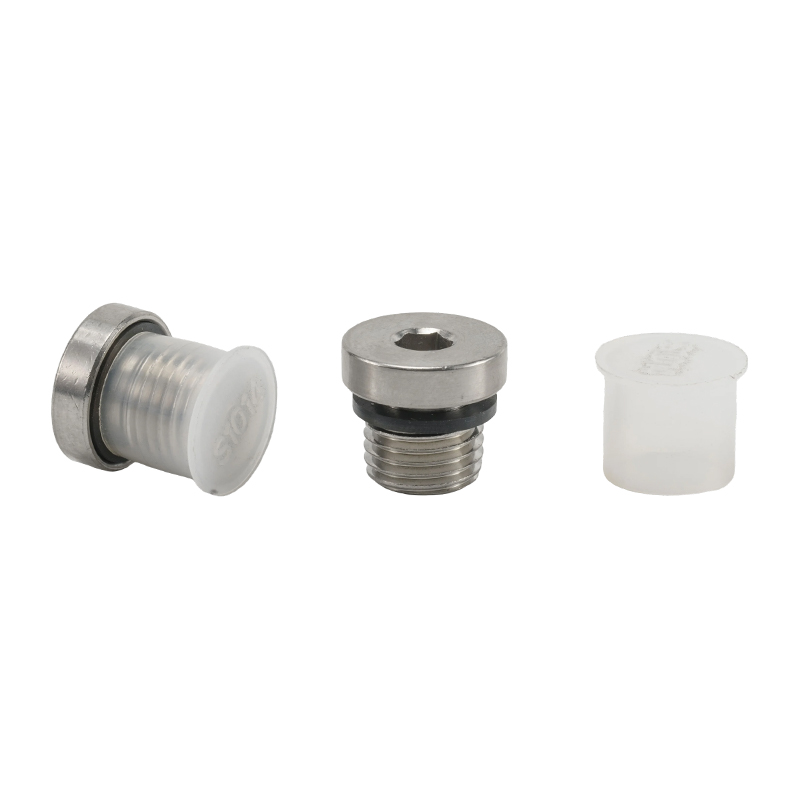
Hexagon Socket Screw Plug
Product Structure and Operating Principle
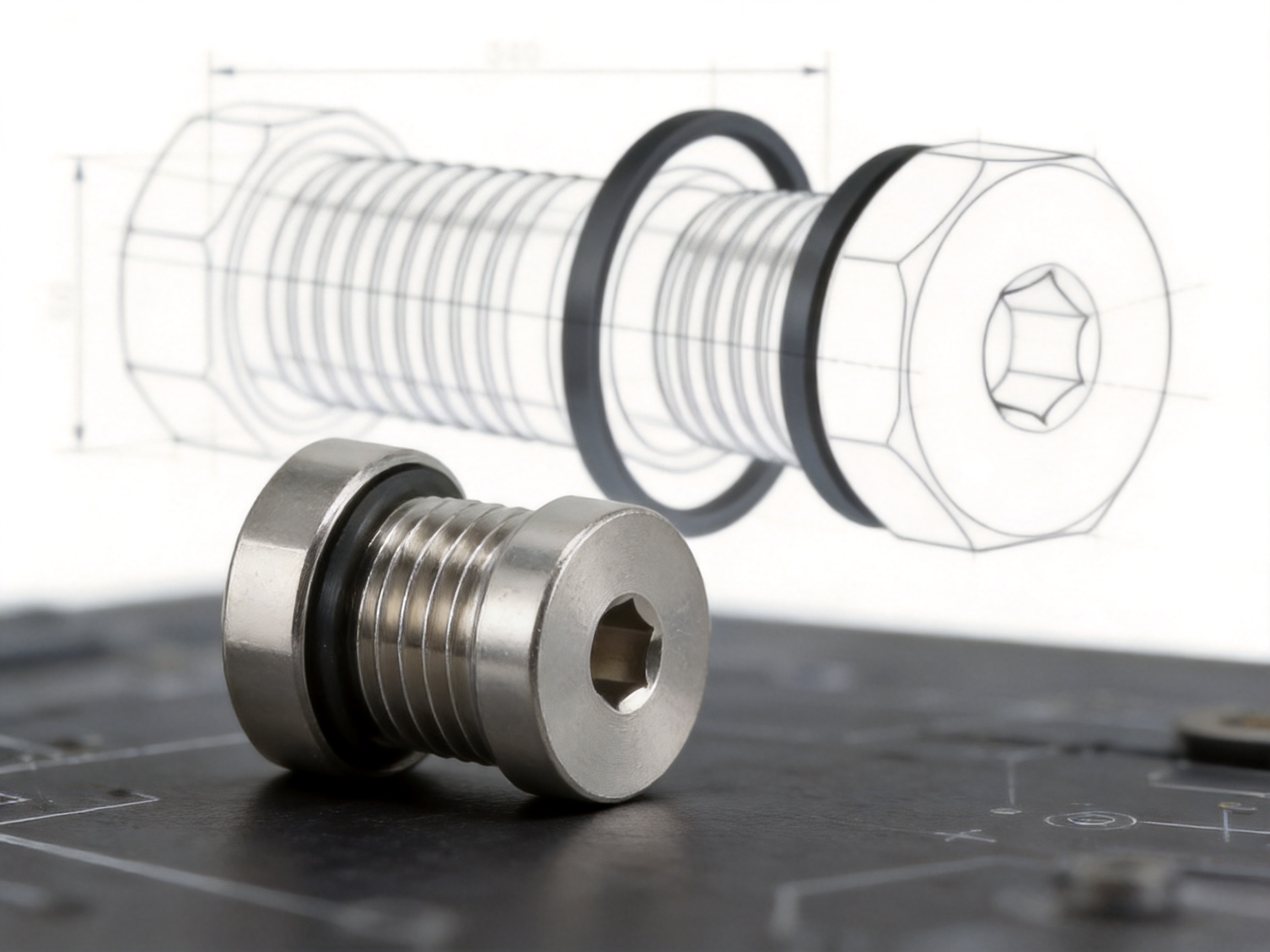
A hexagon socket screw plug generally consists of several functional areas: the threaded body, the sealing surface or sealing feature, the internal hexagonal socket, and the end face or shoulder. Depending on the intended application, the plug may also include a gasket seat, tapered thread, a flat sealing face, a counterbore, a magnetic element, or a special coating.
Threaded Body
The threaded body creates the mechanical connection between the plug and the mating component. The thread may be designed as a straight parallel thread or a tapered thread, depending on the sealing method and system requirements. Straight threads are commonly used with a gasket, sealing washer, O-ring, or machined sealing shoulder. Tapered threads can create an interference fit as the plug advances into the port, although correct thread selection and controlled installation are essential to avoid damage or excessive stress.
Thread geometry must be controlled carefully. Important factors include major diameter, minor diameter, pitch, flank angle, thread length, crest condition, root radius, and concentricity. A plug with poor thread accuracy may be difficult to install, may require excessive torque, or may fail to achieve uniform sealing pressure. In contrast, a precisely manufactured thread supports smooth engagement and predictable assembly performance.
Internal Hexagonal Socket
The internal hexagonal socket is the defining installation feature of this plug type. It accepts a standard hex key or internal-hex driver and transfers torque to the plug without requiring an external wrenching surface. This design is particularly valuable in compact assemblies, where an external head could interfere with neighboring parts or increase the overall envelope of the product.
The socket must have sufficient depth and accurate across-flat dimensions to ensure reliable engagement with the installation tool. The socket corners should be formed cleanly, and the internal surfaces should be free of excessive burrs, cracks, folding, or deformation. Proper socket geometry reduces the risk of tool slipping or rounding during installation and removal.
Sealing Area
The sealing method varies according to the plug design and application. A plug may seal through a gasket under a flange or shoulder, an O-ring located in a machined groove, a metal-to-metal contact surface, or the interference created by a tapered thread. The sealing surface must be smooth, flat, and correctly positioned relative to the thread.
When a gasket is used, the plug should apply uniform compression across the gasket surface. Uneven contact can create leak paths, especially in systems exposed to pressure fluctuations, vibration, thermal cycling, or repeated maintenance. The sealing area should therefore be manufactured and inspected as a functional part of the complete assembly rather than as an isolated cosmetic feature.
End Face and Profile
The end face may be flat, recessed, domed, or otherwise customized. A low-profile end is useful where the plug must remain within the contour of a housing or plate. A raised or reinforced profile may be selected where additional structural rigidity is required. For larger closures and flange-related applications, a reinforced center design can help distribute pressure and reduce deformation.
Although the hexagon socket screw plug is generally more compact than a flanged closure, the same engineering principle applies: the closing element must resist pressure, maintain alignment, and preserve sealing performance throughout its service life.
Advantages Compared with Conventional Plug Designs
Hexagon socket screw plugs are selected not only because they close a hole, but also because they offer practical advantages in design, assembly, maintenance, and space utilization. Their benefits become especially clear when compared with external-head plugs, improvised threaded closures, welded closures, and less precisely manufactured alternatives.
Compact Installation Envelope
The internal socket eliminates the need for a large external wrenching head. This allows the plug to occupy less radial space and makes it suitable for housings, manifolds, engine components, and other assemblies with restricted clearance. A compact plug can also reduce interference with adjacent components, wiring, hoses, covers, and protective structures.
For equipment designers, this low-profile format can provide greater freedom when arranging internal passages and external components. It may also help reduce the size of access panels or simplify the shape of a finished housing.
Reliable Torque Transfer
When the socket and tool are correctly matched, the internal hexagon transfers installation torque directly to the plug body. This provides a controlled installation method and avoids the need to grip a small external surface with pliers or adjustable tools. Reliable torque transfer is important for achieving the intended thread engagement and sealing pressure.
For production assembly, the internal socket is compatible with manual hex keys, torque-controlled drivers, and automated or semi-automated equipment. This flexibility supports consistent installation across different production environments.
Improved Accessibility in Confined Areas
A conventional external-head plug may require a wrench to approach from the side. In a narrow space, the wrench may not have enough swing clearance. A hexagon socket plug can often be installed from above or along the axis of the threaded opening, which is useful in deep bores, recessed ports, and tightly packaged equipment.
This accessibility can reduce assembly time and lower the risk of damaging adjacent surfaces. It may also make field maintenance easier because technicians can use a compact tool instead of carrying several open-ended or specialty wrenches.
Clean Appearance and Reduced Interference
The flush or recessed profile of an internal socket plug gives the finished product a clean appearance. More importantly, it minimizes protruding edges that could catch on protective covers, moving equipment, clothing, packaging, or handling tools. The reduced profile is valuable in automotive and aerospace assemblies, where packaging efficiency and surface protection are important design considerations.
Repeatable Removal and Maintenance
Unlike welded closures or permanent caps, a threaded plug can be removed when the system requires inspection, draining, cleaning, pressure testing, or component replacement. A correctly manufactured hex socket supports repeated service operations when the appropriate tool and torque procedure are used.
Maintenance personnel can remove the plug without cutting, grinding, or applying destructive force. This reduces downtime and helps preserve the surrounding component. It also makes the threaded port available for future inspection or system expansion.
Flexible Sealing Options
The plug can be configured for different sealing methods, including flat gaskets, sealing washers, O-rings, thread sealants, and metal-to-metal contact. This flexibility enables the product to be adapted to oil, coolant, hydraulic fluid, compressed air, process media, and other operating conditions.
A suitable sealing design can also reduce the dependence on excessive thread sealant. Excess material may contaminate fluid passages or interfere with assembly. A precisely designed sealing surface and correctly selected gasket can provide a cleaner and more predictable solution.
Better Consistency than Improvised Closures
Inconsistent plugs, modified bolts, or non-standard closures may appear economical but can create hidden risks. Their thread dimensions, hardness, socket strength, and sealing surfaces may not be controlled for the intended application. A purpose-manufactured hexagon socket screw plug is produced according to defined drawings, specifications, and inspection requirements.
This consistency helps manufacturers standardize assembly procedures, simplify inventory, reduce variation between production batches, and improve traceability in critical applications.
Materials and Surface Treatments
Material selection should be based on operating temperature, pressure, fluid compatibility, corrosion exposure, required strength, installation torque, and service life. The correct material also depends on the material of the mating component. For example, a plug used in an aluminum housing may require a different balance of strength, corrosion resistance, and galvanic compatibility than a plug installed in a steel manifold.
Carbon and Alloy Steel
Carbon steel and alloy steel are widely used when high mechanical strength, wear resistance, and controlled hardness are required. Alloy steel can provide improved resistance to deformation and socket damage during repeated installation. Heat treatment may be applied to achieve a suitable balance between strength and toughness.
Steel plugs can be protected with zinc-based coatings, black oxide, phosphate treatments, or other specified finishes. The selected finish should be evaluated for corrosion protection, dimensional impact, fluid compatibility, and environmental requirements.
Stainless Steel
Stainless steel is suitable for applications requiring enhanced corrosion resistance, clean surfaces, or exposure to moisture and selected chemical environments. It may be used in fluid systems, processing equipment, marine-related applications, and assemblies where appearance and long-term surface stability are important.
Different stainless steel grades offer different levels of corrosion resistance, strength, machinability, and temperature performance. The grade should therefore be selected according to the actual service conditions rather than by general preference alone.
Aluminum and Other Lightweight Materials
Lightweight alloys may be used where mass reduction is important. However, a lightweight plug must still withstand the installation torque and pressure requirements of the application. Thread wear, galling, and galvanic interaction should be considered when aluminum or other softer materials are used.
Surface Finishing
Surface treatment can improve corrosion resistance, reduce friction, support lubrication, and provide a consistent appearance. It may also influence the torque-to-tension relationship during assembly. For this reason, the finish should be included in torque validation and not treated as an unrelated cosmetic step.
Typical finishing decisions include the required coating thickness, color, salt spray performance, friction behavior, fluid compatibility, and restricted-substance requirements. For high-precision plugs, the effect of coating thickness on thread fit and sealing dimensions must be controlled.
Manufacturing Process and Production Capabilities
The performance of a hexagon socket screw plug begins with a stable manufacturing process. Dongtai Jinzhize Metal Products Co., Ltd. operates an owned manufacturing facility of approximately 10,000 square meters and uses hundreds of machine tools and automated production systems. This production infrastructure supports repeatable processing, scalable supply, and coordinated control over multiple stages of manufacturing.
Engineering Review and Drawing Confirmation
Before production begins, the product drawing and technical requirements should be reviewed in detail. The review normally covers thread standard, thread size, thread length, socket dimensions, sealing method, material, hardness, surface treatment, tolerances, inspection criteria, packaging, and identification requirements.
This stage is essential when a plug is used in an automotive or aerospace assembly. A seemingly minor difference in thread pitch, sealing shoulder location, or socket depth can affect assembly compatibility. Early engineering communication helps prevent errors and supports an efficient transition from prototype to mass production.
Material Preparation
Raw material is prepared in bar, blank, or other suitable form according to the production method. Material identification and batch control support traceability throughout the manufacturing process. Consistent material preparation also contributes to stable machining behavior and predictable mechanical properties.
Where required, incoming material can be checked for dimensions, surface condition, chemical composition, and relevant mechanical characteristics. Maintaining clear material records helps manufacturers identify the source of any later quality issue and supports customer documentation requirements.
Precision Turning
CNC turning or related precision machining processes are used to form the external diameter, thread blank, shoulder, sealing face, end profile, and other rotational features. Automated equipment can maintain consistent dimensions over large production quantities while reducing manual variation.
Machining parameters must be selected according to the material, geometry, tolerance, and surface finish requirements. Stable tooling, correct workholding, and regular tool-life management are important for maintaining concentricity and dimensional consistency.
Internal Socket Machining
The internal hexagonal socket may be formed by broaching, shaping, cold forming, milling, drilling followed by broaching, or another suitable process. The chosen method depends on material, socket size, production quantity, required accuracy, and part geometry.
Socket depth and across-flat dimensions must be controlled because insufficient engagement can lead to tool slipping or corner damage. The transition between the socket and the surrounding end face should also be inspected for burrs, cracks, or deformation.
Thread Formation
Threads may be produced by cutting, rolling, or other controlled processes. Thread rolling can provide strong thread surfaces and favorable material flow when the material and geometry are suitable. Thread cutting may be preferred for certain materials, sizes, internal features, or low-volume customized products.
Regardless of the process, the finished thread should be checked using appropriate gauges and dimensional equipment. Visual inspection alone is not sufficient to confirm thread function. Gauge control, flank inspection, pitch verification, and evaluation of runout or incomplete thread areas all contribute to reliable performance.
Heat Treatment
Heat treatment may be applied when the selected material and application require increased strength, hardness, wear resistance, or resistance to socket deformation. The heat-treatment cycle must be controlled to minimize distortion and preserve the dimensional accuracy of the threaded body.
After heat treatment, parts may require cleaning, straightening, additional machining, or inspection. Hardness testing and sampling of mechanical properties can help verify that the process achieved the intended result.
Deburring and Cleaning
Deburring removes sharp edges and loose particles that could interfere with assembly, sealing, fluid cleanliness, or operator safety. Internal socket corners, thread runouts, sealing faces, and drilled openings require particular attention.
Cleaning is also important for oil plugs and plugs used in hydraulic, pneumatic, or precision mechanical systems. Machining chips, abrasive residue, and coating particles must be removed before packaging. Clean parts reduce the risk of contaminating oil passages, valves, pumps, bearings, or other sensitive components.
Surface Treatment and Final Processing
After machining and heat treatment, the plugs may receive the specified surface finish. The treatment process should be managed to prevent excessive buildup on threads or sealing faces. Depending on the product requirements, selected surfaces may need masking, polishing, passivation, coating, or controlled lubrication.
Final processing can also include marking, sorting, protective oil application, and packaging. Every added operation should support the intended function and should be verified for compatibility with the customer's assembly and storage conditions.
Automated and Batch Production
The combination of machine tools and automated production systems supports both repeat orders and larger-volume programs. Automation can improve feeding, positioning, inspection, sorting, and production data collection. It also helps reduce operator-dependent variation in repetitive operations.
For customers in the automotive and aerospace sectors, stable batch-to-batch performance is often as important as nominal dimensional accuracy. A supplier must be able to maintain process discipline across repeated production cycles, preserve records, and respond efficiently when technical changes are introduced.
Quality Control and Inspection
A reliable hexagon socket screw plug requires a quality system that evaluates both individual characteristics and the interaction of the complete product. Inspection should be planned around the failure risks of the application rather than limited to basic visual checks.
Dimensional Inspection
Dimensional checks may include external diameter, overall length, thread length, shoulder height, sealing face dimensions, socket depth, across-flat size, and concentricity. Measuring equipment should be selected according to the tolerance level and product geometry.
Statistical process monitoring can help identify gradual tool wear or process drift before nonconforming parts become widespread. In high-volume production, in-process checks are especially valuable because they provide faster feedback than relying only on final inspection.
Thread Inspection
Thread gauges are used to verify functional fit with the corresponding mating thread. Depending on the specification, inspection may also include pitch diameter measurement, thread profile evaluation, surface condition, and examination of the first and last engaged threads.
Correct gauge maintenance is important. Worn or damaged gauges can produce misleading results. Gauge calibration and traceable inspection records support confidence in the final product.
Socket Inspection
The socket should be inspected for across-flat dimension, depth, angular form, corner condition, and tool engagement. A socket that is too shallow may not transfer the required torque. A socket that is oversized or irregular may allow excessive tool movement and increase the chance of rounding.
For high-strength plugs, socket integrity is particularly important because installation torque can be significant. The socket must be strong enough to withstand assembly and removal without cracking, collapsing, or losing its functional shape.
Sealing Performance
Where the plug is used in a fluid or pressure system, sealing performance should be evaluated using a method appropriate to the design. Testing may involve pressure retention, leakage inspection, dimensional verification of the sealing face, or validation with the intended gasket or O-ring.
A plug should not be evaluated independently from the sealing system. The mating port, gasket, installation torque, surface finish, and pressure medium can all affect the result. A complete application test provides more meaningful information than a theoretical evaluation of the plug alone.
Material and Hardness Verification
Material certificates, chemical analysis, hardness testing, and heat-treatment records may be used to verify conformity. The level of documentation depends on customer requirements and the criticality of the application.
In industries with strict traceability requirements, batch identification should be maintained from raw material through machining, heat treatment, surface finishing, final inspection, and shipment. This approach supports effective investigation and controlled corrective action if a problem is ever discovered.
Visual and Cleanliness Inspection
Finished plugs should be checked for burrs, dents, cracks, incomplete threads, surface defects, corrosion, coating irregularities, and contamination. For oil plugs and components installed inside fluid passages, cleanliness should receive special attention.
Packaging materials must also be selected carefully. Poor packaging can allow parts to rub against each other, damage the sealing faces, or collect moisture during transportation and storage.
Application Areas
Hexagon socket screw plugs are used across many industries because threaded access points are common in mechanical and fluid-handling systems. Their compact installation format makes them suitable for both new equipment and replacement maintenance.
Automotive Engines and Transmissions
Automotive engines and transmissions contain oil passages, drain points, inspection openings, casting ports, and machined bores that require secure closure. An oil plug must resist vibration, temperature changes, contact with lubricants, and repeated service operations.
The internal hexagon allows installation in compact housings and can simplify draining or inspection procedures. A suitable sealing arrangement helps prevent lubricant loss and protects the assembly from the entry of dust, water, or other contaminants.
Hydraulic and Pneumatic Equipment
Hydraulic manifolds, valve blocks, pumps, cylinders, and pneumatic control systems frequently use threaded plugs to close unused ports or isolate internal passages. These components may be exposed to high pressure and rapid pressure changes, making thread accuracy and sealing reliability essential.
Plugs can also be used during pressure testing, assembly, commissioning, and maintenance. A removable closure allows technicians to access a passage without replacing the complete manifold or cutting into the system.
Industrial Machinery
Industrial machinery may use plugs in gearboxes, lubrication systems, machine bases, coolant circuits, and protective housings. The low-profile design can reduce interference with moving parts and external guards.
For equipment manufacturers, standardized plug dimensions can simplify spare-part management. For maintenance teams, a recognizable internal-hex drive makes removal tools easy to identify and use.
Pipeline and Equipment Maintenance
Threaded plugs may close auxiliary ports, drain openings, sampling points, and temporary test interfaces. They are useful where a connection must be opened and closed repeatedly during installation or maintenance.
For larger pipeline terminations and flange-based closures, a reinforced flanged plug may be selected instead of a compact screw plug. A T-shaped or center-reinforced profile can improve rigidity, while a full-face sealing surface can work with a standard flange gasket. Such products are intended for applications including pipeline termination, pressure testing, maintenance isolation, and future port provision.
Aerospace and Rail Applications
Aerospace and rail vehicle assemblies require careful control of weight, reliability, traceability, and installation consistency. Threaded plugs may be used in fluid systems, structural components, gear units, thermal systems, and maintenance access points.
In these applications, product selection should consider vibration, temperature, corrosion exposure, fluid compatibility, inspection requirements, and the consequences of leakage or component failure. A manufacturing partner with experience in precision threaded products can help support these requirements through controlled production and documentation.

Flanged and Reinforced Plug Configurations
Not every sealing application can be served by a small socket plug. Some pipeline, pressure-testing, and equipment-maintenance situations require a larger closure that matches a standard flange. A flanged plug, sometimes identified by a T-shaped or reinforced profile, provides a different solution while following the same fundamental principles of controlled sealing and serviceability.
Reinforced Center Design
The raised center section increases structural rigidity and helps the closure resist pressure-related deformation. It can also distribute stress more effectively than a thin flat plate, especially when the closure is subjected to internal pressure or transient water hammer effects.
Full-Face Sealing Surface
A precision-machined full-face sealing area works with the appropriate flange gasket to create uniform compression. Correct contact across the sealing surface helps reduce potential leak paths and supports reliable operation during pressure fluctuations.
Standard Flange Compatibility
Flanged plugs can be manufactured to match common flange profiles and bolt-hole arrangements, including major ANSI, DIN, and JIS systems where specified. Compatibility with standard dimensions supports interchangeability and simplifies installation in existing piping systems.
| Plug Configuration | Typical Installation Method | Main Advantage | Common Use |
|---|---|---|---|
| Hexagon socket screw plug | Threaded installation with an internal-hex tool | Compact profile and convenient access | Oil passages, housings, manifolds, and inspection ports |
| Gasketed shoulder plug | Threaded installation with a sealing washer or gasket | Controlled axial sealing compression | Fluid systems and maintenance openings |
| Tapered threaded plug | Threaded interference fit with suitable sealant where required | Simple closure for compatible threaded ports | General piping and low-to-moderate service applications |
| Flanged reinforced plug | Bolted installation to a matching flange | High rigidity and broad sealing area | Pipeline termination and pressure testing |
The most appropriate configuration depends on pressure, size, access, sealing method, maintenance frequency, and applicable standards. A technical review should be completed before replacing one design with another.
Installation Recommendations
Correct installation is necessary to achieve the designed performance of a hexagon socket screw plug. Even a precisely manufactured part can leak or become damaged if the mating thread is contaminated, the sealing element is incorrect, or the plug is tightened with unsuitable force.
Confirm Compatibility
Before installation, verify the thread standard, size, pitch, plug material, sealing method, and required installation direction. The mating port should be checked for damage, cross-threading, excessive wear, or contamination.
Clean the Mating Port
Remove chips, old sealant, oil sludge, corrosion products, and other debris from the threaded opening. Contamination can prevent full thread engagement and may create a leak path beneath a gasket or O-ring.
Inspect the Plug
Check the threaded body, sealing area, and internal socket for damage. Do not install a plug with flattened threads, deep scratches on the sealing face, visible cracks, or a deformed socket. Reusing a damaged plug can create greater costs than replacing it at the start of the maintenance operation.
Use the Correct Sealing Method
Install the specified gasket, washer, O-ring, or thread sealant. The sealing method should be compatible with the fluid, pressure, temperature, and thread design. Excessive sealant should be avoided because it may enter oil or hydraulic passages.
Engage Threads Carefully
Start the plug by hand whenever possible. It should engage smoothly without cross-threading. If the plug binds immediately, remove it and inspect both the plug and port. Forcing a misaligned plug can permanently damage the mating component.
Apply Controlled Torque
Use the recommended torque for the specific material, thread, sealing arrangement, lubrication condition, and application. Torque should be applied through a properly sized internal-hex tool that fully engages the socket. An undersized or worn tool can damage the socket and make future removal difficult.
Verify the Completed Assembly
After installation, inspect the seating area and confirm that the plug is correctly positioned. Where applicable, perform a pressure or leakage test. During initial operation, check for fluid loss, abnormal movement, or signs of loosening.
Customization and OEM Support
Industrial customers often require more than a standard catalog dimension. Customization may involve thread size, thread standard, body length, socket dimension, sealing groove, material, heat treatment, surface finish, marking, packaging, or inspection documentation.
Dimensional Customization
Custom dimensions can be developed to match a specific housing, casting, manifold, flange, or assembly clearance. The plug may be designed with a short engagement length for thin-wall components or a longer thread for deeper ports. The sealing shoulder can also be positioned according to the available counterbore or gasket seat.
Application-Specific Materials
Material selection can be adjusted for corrosion resistance, temperature, strength, weight, or compatibility with the mating part. Customers should provide information about the operating medium, pressure range, temperature range, vibration, and expected service environment so that the material and finish can be evaluated properly.
Special Sealing Features
O-ring grooves, gasket seats, recessed sealing faces, retaining features, and other sealing details can be incorporated into the design. These features should be validated against the selected sealing material and the actual port geometry.
Identification and Packaging
Laser marking, batch identification, color coding, counted packaging, individual packaging, and customer-specific labels can assist with inventory control and traceability. Packaging can be adjusted to prevent scratching, moisture exposure, part mixing, and damage during transportation.
Prototype to Production
A reliable OEM process normally begins with drawing review and prototype evaluation. Sample parts can be inspected for fit, sealing performance, tool engagement, and installation behavior. After approval, the process can be transferred to controlled batch production with documented inspection points and agreed acceptance criteria.
Why Manufacturing Experience Matters
Threaded components are often integrated into critical assemblies, so supplier capability should be assessed beyond nominal price. Manufacturing experience influences process stability, response speed, engineering communication, inspection quality, and long-term supply reliability.
Dongtai Jinzhize Metal Products Co., Ltd. was established in 2015 and has developed an experienced team covering product design, development, manufacturing, quality management, and after-sales support. Its specialization in threaded connection products allows it to understand the relationship between inserts, plugs, taps, adapters, and installation tools.
The company operates from an owned manufacturing facility equipped with hundreds of machine tools and automated production systems. This equipment base supports the production of repeated, consistent threaded components and provides capacity for both standard and customized requirements.
Its products are used in automotive applications such as engines and transmissions for passenger and commercial vehicles, as well as aerospace and rail vehicle manufacturing. These fields require stable dimensions, repeatable production, controlled materials, and dependable documentation.
In 2024, the company reported an annual output value of 153 million RMB. This production scale indicates experience in organized manufacturing and the ability to support stable supply for customers with ongoing demand. Capacity alone does not guarantee quality, but when combined with process control and technical experience, it can reduce supply interruptions and improve production planning.
The company's stated mission is to provide stable and reliable threaded connection and fastening products for critical assemblies. Its approach emphasizes consistency, traceability, service support, and reduced procurement and usage risks. These priorities are directly relevant to customers sourcing hexagon socket screw plugs for repeat production or maintenance programs.
Purchasing and Supplier Evaluation Guide
When purchasing hexagon socket screw plugs, customers should define the application clearly. A supplier can provide a more suitable recommendation when the inquiry includes the thread standard, nominal size, material, sealing method, temperature, pressure, fluid, quantity, surface treatment, and inspection requirements.
| Evaluation Item | Questions to Confirm | Why It Matters |
|---|---|---|
| Thread | What standard, size, pitch, tolerance, and engagement length are required? | Ensures compatibility and prevents cross-threading or poor fit. |
| Sealing | Will the plug use a gasket, O-ring, sealant, or metal-to-metal contact? | Determines the sealing geometry and installation procedure. |
| Material | What are the pressure, temperature, fluid, corrosion, and strength requirements? | Supports correct material and heat-treatment selection. |
| Socket | What tool size, socket depth, and torque level are required? | Prevents tool slipping and installation damage. |
| Finish | Is corrosion protection, lubrication, passivation, or a special coating required? | Controls service life, friction, and environmental resistance. |
| Quality documents | Are inspection reports, material certificates, batch records, or samples required? | Supports traceability and customer approval procedures. |
| Packaging | How should parts be separated, labeled, counted, and protected? | Reduces damage, mixing, and handling errors. |
Customers should also evaluate whether the supplier can support technical changes, forecast-based production, emergency replenishment, and after-sales communication. A supplier that manufactures related threaded products may offer additional value because it can coordinate plugs with installation tools, threaded inserts, taps, or adapters used in the same assembly.
Maintenance, Storage, and Service Life
Proper storage helps preserve the condition of threaded plugs before installation. Parts should be protected from excessive humidity, corrosive atmospheres, dust, impact, and uncontrolled temperature changes. Original packaging should be retained when it provides suitable separation and identification.
During maintenance, removed plugs should be inspected before reuse. Threads should be checked for galling, deformation, corrosion, and contamination. The internal socket should be examined for rounding or cracking. Sealing washers and O-rings should generally be replaced when required by the application or manufacturer instructions.
Service life depends on the operating environment and installation practice. Vibration, thermal cycling, pressure pulsation, chemical exposure, repeated removal, and incorrect torque can shorten the life of both the plug and the mating port. Periodic inspection should therefore focus on the complete joint rather than the plug alone.
If leakage occurs, the assembly should be depressurized and inspected safely. Increasing torque without identifying the cause may damage the socket, stretch the thread, crush the gasket, or deform the mating component. A controlled troubleshooting procedure is more effective than repeated tightening.
Q&A About Hexagon Socket Screw Plugs
What is a hexagon socket screw plug used for?
It is used to close a threaded opening in equipment, housings, manifolds, engines, transmissions, pipelines, and other systems. Depending on the design, it may seal an oil passage, isolate a pressure port, protect an unused opening, or provide removable access for inspection and maintenance.
How is a hexagon socket plug installed?
The plug is normally inserted into a compatible threaded port and tightened with a correctly sized hex key or internal-hex driver. The specified gasket, O-ring, or thread sealant should be used, and the final tightening torque should follow the approved technical requirement.
What is the main advantage of the internal hexagon?
The internal hexagon provides torque access without a large external head. This creates a compact profile, reduces interference with surrounding parts, and makes installation possible in areas with limited side clearance.
Can the plug be removed for maintenance?
Yes. A threaded plug is designed to be removable when the correct tool and procedure are used. The plug and mating port should be inspected after removal, and damaged sealing elements should be replaced before reinstallation.
Should a gasket or O-ring always be used?
Not always. The correct sealing method depends on the plug design and application. Some plugs use a gasket or O-ring, while others rely on a tapered thread or a specified metal-to-metal sealing surface. The sealing method should be confirmed from the product drawing or technical specification.
Can hexagon socket screw plugs be customized?
Yes. Customization may include thread size, thread standard, body length, socket dimensions, material, hardness, sealing groove, surface treatment, marking, packaging, and inspection documentation. A technical drawing and application details are normally required for accurate quotation and development.
Are these plugs suitable for high-pressure systems?
They can be suitable when the plug design, material, thread engagement, sealing method, mating port, and installation procedure are all rated for the required pressure. High-pressure applications should be validated through engineering review and appropriate pressure or leakage testing.
What information should be included in an inquiry?
An inquiry should include a drawing or sample, thread standard and size, material, sealing method, operating pressure, temperature, medium, surface treatment, order quantity, packaging requirements, and inspection documentation. These details help the manufacturer recommend or produce the correct configuration.
How does a flanged plug differ from a socket screw plug?
A socket screw plug is generally installed directly into a threaded opening and is valued for compactness. A flanged plug is bolted to a matching flange and provides a larger sealing surface and greater structural support for larger pipeline or equipment openings.
Why is traceability important?
Traceability connects the finished plug to its raw material, production batch, heat treatment, surface treatment, inspection results, and shipment records. It helps customers manage quality investigations, production control, and replacement requirements, especially in automotive, aerospace, and other critical applications.
Conclusion
Hexagon socket screw plugs provide a practical and reliable method for closing threaded openings in compact and demanding industrial assemblies. Their internal-hex drive supports efficient torque transfer, their low-profile shape reduces interference, and their removable threaded design simplifies maintenance, inspection, pressure testing, and future servicing.
Performance depends on precise thread production, durable material, correct socket geometry, suitable sealing design, controlled surface treatment, and consistent inspection. For more substantial pipeline closures, reinforced flanged plugs provide an alternative with a broad gasket contact area, standard flange compatibility, and improved structural rigidity.
Dongtai Jinzhize Metal Products Co., Ltd. combines specialization in threaded connection products with an owned manufacturing facility, extensive machining resources, automated production systems, experienced technical personnel, and quality-management procedures. Its experience in automotive, aerospace, and rail-related applications supports the production of stable, traceable, and application-focused threaded components.
For standard replacement requirements, OEM programs, and customized industrial applications, selecting the correct plug configuration and working with a capable manufacturer can improve assembly consistency, reduce leakage risk, simplify maintenance, and support dependable long-term supply.
References
ISO 965, ISO Metric Screw Threads: Tolerances and Limits of Size.
ISO 1179, Connections for General Purpose and Fluid Power: Ports and Stud Ends with ISO 228-1 Threads.
ISO 724, ISO General Purpose Metric Screw Threads: Basic Dimensions.
ASME B16.5, Pipe Flanges and Flanged Fittings.
DIN 910, Hexagon Socket Screw Plugs with Cylindrical Head.
DIN 908, Hexagon Socket Screw Plugs with Collar.
JIS B 1173, Hexagon Socket Set Screws and Related Fastener Specifications.
ASM Handbook, Volume 4: Heat Treating.
ASM Handbook, Volume 18: Friction, Lubrication, and Wear Technology.
General engineering principles for threaded joint design, sealing interfaces, torque control, corrosion protection, and industrial component traceability.