Français
 Español
 Deutsch


Content
- 1 1. The Role of Thread Inserts in Modern Manufacturing
- 2 2. Product Overview
- 3 3. Three-Hole Anti-Rotation Design
- 4 4. Carbon Steel Material Advantages
- 5 5. Comparison with Conventional Threaded Inserts
- 6 6. Product Types and Dimensional Range
- 7 7. Installation Principles
- 8 8. Manufacturing Process and Quality Strengths
- 9 9. Industrial Applications
- 10 10. Design Considerations for Engineers
- 11 11. Performance and Reliability Benefits
- 12 12. Procurement and Customization Support
- 13 13. Recommended Quality-Control Program
- 14 14. Frequently Asked Questions
- 14.1 Q1: What is a carbon steel three-hole thread insert?
- 14.2 Q2: What is the difference between a 307 and a 308 insert?
- 14.3 Q3: Which materials are suitable for this product?
- 14.4 Q4: Why are the three holes important?
- 14.5 Q5: Can the insert be installed without adhesive?
- 14.6 Q6: Can the insert be used in a blind hole?
- 14.7 Q7: How should the drilling diameter be selected?
- 14.8 Q8: Is the product suitable for vibration environments?
- 14.9 Q9: Are coatings available?
- 14.10 Q10: Can customized specifications be supplied?
- 14.11 Q11: What inspection should be completed after installation?
- 14.12 Q12: Why work with a specialized threaded-product manufacturer?
- 15 15. Conclusion
- 16 References
- 17 Product: Carbon Steel 3-Hole Thread Insert
Reliable threaded connections are essential in machinery, transportation equipment, sheet metal assemblies, industrial furniture, and many other products. When a component is made from aluminum, cast iron, soft steel, plastic, or another relatively soft material, directly tapping a thread into the base material may not provide sufficient wear resistance, pull-out strength, or resistance to vibration. A threaded insert creates a stronger and more durable internal thread while allowing the original material to remain lightweight and economical.
The carbon steel three-hole thread insert is designed for applications that require both thread reinforcement and anti-rotation performance. Also known as a 307 or 308 type three-hole self-tapping insert, it has an external self-tapping profile and three evenly distributed circular grooves or positioning holes. During installation, the surrounding base material flows or deforms into these features. This mechanical interlock helps prevent the insert from rotating, loosening, or shifting under repeated loading.
This article examines the design, performance, installation, material characteristics, size range, application value, and manufacturing strengths associated with carbon steel three-hole thread inserts. It also explains why the product can be a practical alternative to conventional non-holed self-tapping inserts, oversized fasteners, adhesive locking methods, and other thread-repair solutions.
1. The Role of Thread Inserts in Modern Manufacturing
Many components are manufactured from materials selected for low weight, corrosion resistance, machinability, thermal performance, or cost. Aluminum alloys are widely used in automotive housings, equipment frames, cabinets, and structural parts because they are lightweight and easy to machine. Plastics are used in electrical enclosures, consumer equipment, control systems, and industrial products because they offer design flexibility and insulation. Cast iron and soft steel may also require reinforcement when a thread must withstand frequent assembly and disassembly.
Although these materials offer important advantages, their directly tapped threads may have limited load-bearing capacity. The thread may strip when a fastener is tightened, especially where the available wall thickness is small. Repeated removal and installation can wear the thread. Vibration, impact, thermal cycling, and fluctuating loads may also cause a conventional connection to lose its original clamping performance.
A thread insert addresses these limitations by transferring the internal thread function to a separate metal component. The insert is installed into a prepared hole, and the internal thread then accepts a standard bolt or screw. This arrangement provides several benefits:
• It increases the effective strength of the internal thread.
• It improves resistance to wear during repeated fastening cycles.
• It allows lightweight or softer materials to support stronger threaded connections.
• It can help repair damaged or stripped threads.
• It makes it possible to standardize fasteners across different assemblies.
• It may reduce the need to redesign a component with thicker walls or larger bosses.
Conventional self-tapping inserts rely primarily on external thread interference and friction. The three-hole design adds a further locking mechanism. Its external grooves and holes are positioned to encourage the base material to engage with the insert during installation. This is particularly useful in assemblies where vibration or torque could otherwise cause the insert to rotate with the fastener.
2. Product Overview
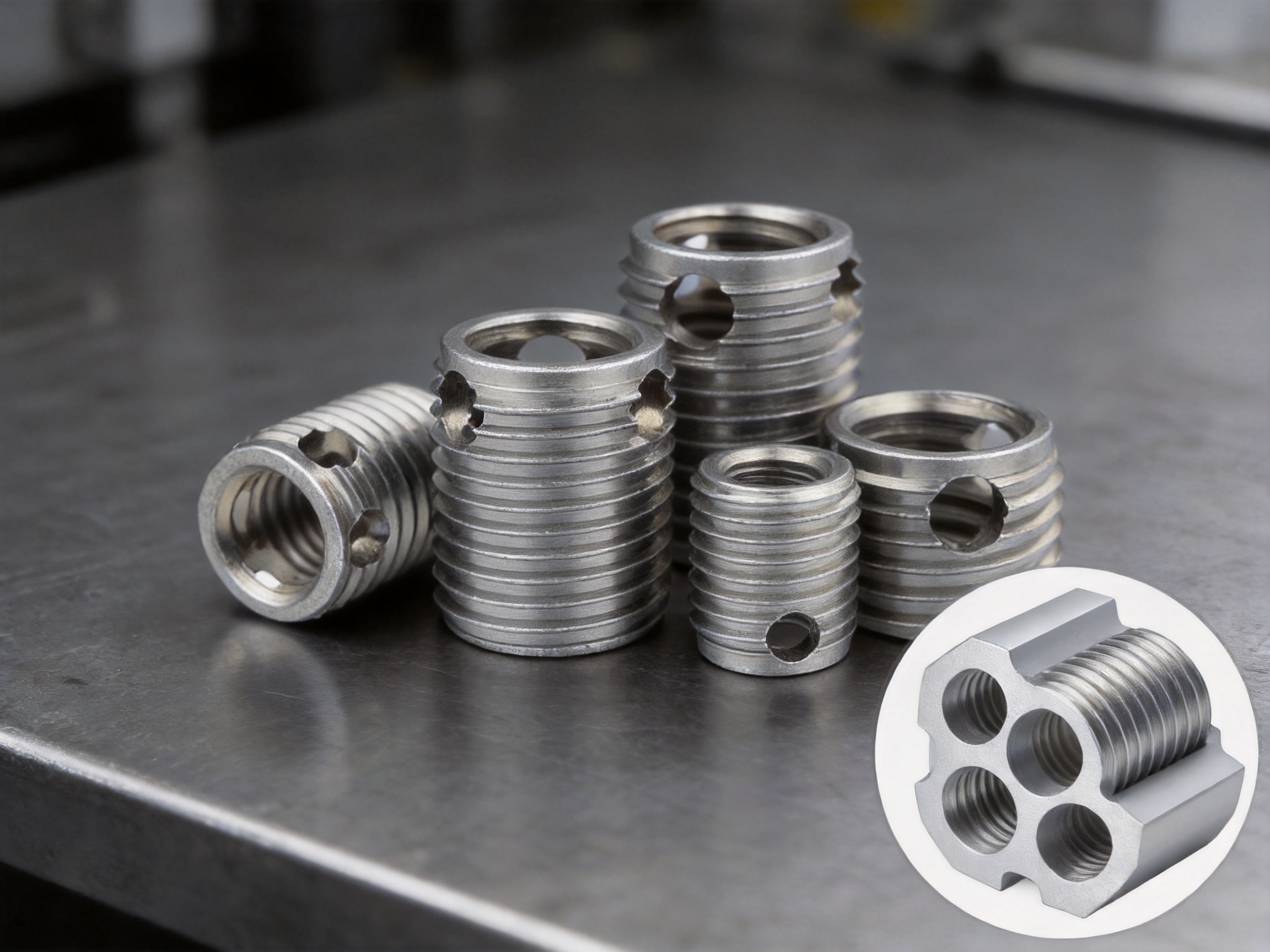
The carbon steel three-hole thread insert is a self-tapping threaded sleeve with an internal machine thread and an external cutting or forming thread. Its main structural characteristic is the presence of three evenly distributed holes or circular grooves along the external wall. These features are not merely visual details. They are part of the anti-rotation design and help the parent material form a localized mechanical lock around the insert.
The product is available in two principal versions: the 307 type and the 308 type. The 308 type is a reinforced version of the 307 type and is generally offered in longer lengths. The two types use the same basic three-hole concept but provide different levels of engagement according to the selected length and application requirements.
When installed into a correctly prepared hole, the external thread cuts or forms a path in the base material. At the same time, the surrounding material is displaced toward the external grooves and positioning holes. Once the insert is fully seated, the material captured in these areas helps resist rotational movement and axial displacement.
The internal thread is manufactured to accept a corresponding metric or unified fastener. This allows the insert to create a durable internal connection without requiring the base material itself to provide the complete thread strength.
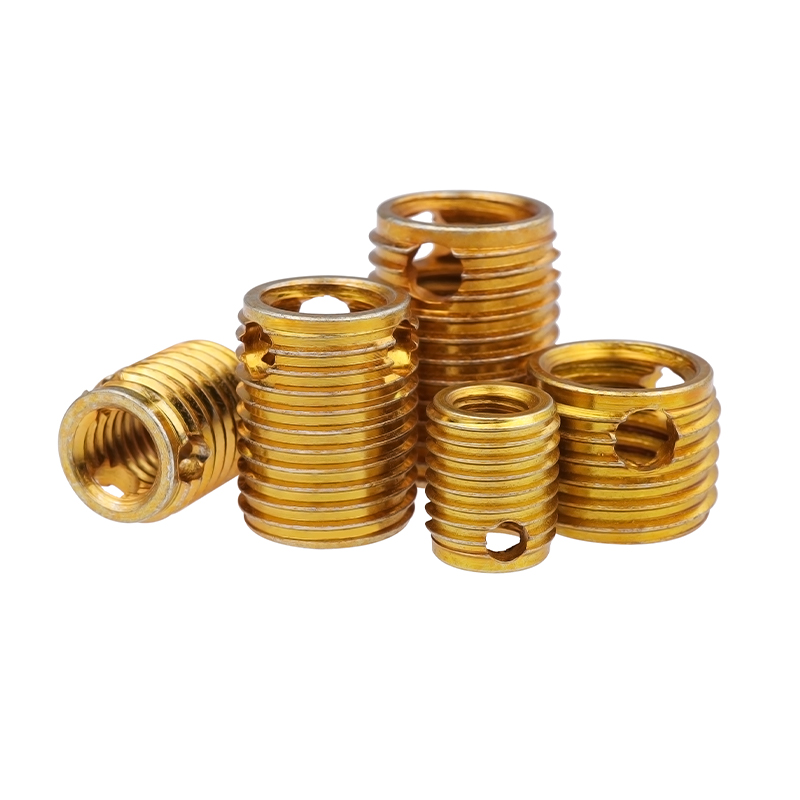
Carbon Steel 3-Hole Thread Insert
3. Three-Hole Anti-Rotation Design
3.1 Mechanical Interlocking Rather Than Friction Alone
The most important advantage of the three-hole design is its additional mechanical interlocking effect. A standard non-holed insert may depend largely on the interference between its external thread and the drilled hole. This can be effective in many applications, but its resistance to rotation may decrease when the assembly experiences repeated torque, vibration, impact, or temperature-related expansion and contraction.
The three positioning holes create localized areas where the parent material can deform and enter the insert structure. This produces a more positive engagement between the insert and the base material. Instead of relying only on radial pressure and friction, the connection benefits from material capture at multiple points around the circumference.
Because the three holes are evenly distributed, the locking effect is balanced. The insert is less likely to experience one-sided loading caused by an irregular locking feature. Balanced engagement also supports more consistent installation behavior and helps maintain alignment between the insert and the original drilled hole.
3.2 Resistance to Vibration and Torque
In machinery, the fastener may be exposed to vibration generated by motors, gear systems, pumps, fans, or reciprocating mechanisms. When a bolt is tightened into an ordinary insert, friction between the bolt and the internal thread can transmit torque to the insert. If the insert is not sufficiently locked to the parent material, it may rotate during bolt removal or gradually loosen during service.
The three-hole structure is designed to reduce this risk. The base material engages with the positioning features and resists the rotational force transferred through the internal thread. This makes the insert suitable for industrial assemblies where vibration resistance and stable positioning are important.
The product does not replace correct bolt tightening, joint design, or other required locking methods where the application demands them. However, it provides an additional structural defense against insert movement and can improve the reliability of the threaded connection when correctly selected and installed.
3.3 Protection Against Shifting
An insert may be exposed not only to rotation but also to axial or lateral movement. For example, repeated loading can cause an insert to creep inside a soft plastic housing or a thin aluminum wall. Engagement between the parent material and the three external holes helps limit this movement. The result is a more stable internal thread position and improved consistency during maintenance or repeated assembly.
4. Carbon Steel Material Advantages
Carbon steel is selected for this product because it offers a practical balance of strength, machinability, impact resistance, and cost. Compared with softer materials, carbon steel can maintain a more stable internal thread under high tightening loads. It also provides greater resistance to deformation when a fastener is installed or removed multiple times.
High-quality carbon steel is especially suitable for inserts used in aluminum alloys, cast iron, soft steel, and other materials where the insert must carry loads that the parent material cannot safely support on its own. The insert acts as a stronger threaded interface between the assembly and the fastener.
Carbon steel also supports efficient precision machining. The external self-tapping profile, internal thread, three-hole structure, chamfered entry area, and length dimensions can be produced with controlled tooling and repeatable production methods. This contributes to consistent installation and predictable thread engagement.
For environments where corrosion protection is required, optional coatings such as zinc or color zinc can be applied according to the application. Coating selection should consider the surrounding environment, contact with dissimilar metals, operating temperature, required appearance, and any applicable industry specifications.
In comparison with some stainless steel alternatives, carbon steel can offer a more economical solution when the application does not require maximum corrosion resistance. It may also provide a useful combination of hardness and strength for industrial thread reinforcement. The correct choice depends on the complete service environment rather than material strength alone.
5. Comparison with Conventional Threaded Inserts
5.1 Advantages over Non-Holed Self-Tapping Inserts
A conventional non-holed self-tapping insert may be suitable for low- to medium-load applications where the parent material provides sufficient resistance to rotation. However, applications with frequent vibration or repeated tightening may benefit from the three-hole configuration.
The three-hole product offers a dedicated anti-rotation structure, while a conventional insert generally depends more heavily on external thread friction. The three-hole structure can also help distribute the locking effect around the insert instead of concentrating resistance in a single area.
5.2 Advantages over Oversized Bolts or Directly Tapped Threads
Increasing bolt size or tapping a larger thread directly into the base material may appear to be a simple way to increase strength, but this approach can require additional wall thickness, larger bosses, and more material. It may also force changes to mating components, tool access, product dimensions, or assembly standards.
A thread insert allows the designer to retain a practical external hole size while providing a standardized and stronger internal thread. It can also make repair or redesign more manageable because the base component does not necessarily need to be replaced when its original thread is damaged.
5.3 Advantages over Adhesive Retention Alone
Adhesives can be used to secure threaded inserts in selected applications, but their effectiveness depends on surface preparation, curing conditions, chemical compatibility, operating temperature, and long-term aging. The three-hole insert creates a mechanical lock through deformation of the base material, reducing dependence on adhesive performance.
Adhesive may still be used in certain designs when required by the engineering specification, but the three-hole structure provides a mechanical retention mechanism that can function independently of adhesive curing.
5.4 Advantages over Keyed or Flanged Designs in Restricted Spaces
Some anti-rotation inserts use external keys, flanges, or large shoulders. These features can provide strong locking, but they may require additional clearance, counterbores, or special component geometry. The three-hole insert is comparatively compact and is installed into a prepared cylindrical hole. This can make it easier to use in enclosed housings, thin sections, and assemblies where external keys or flanges would interfere with adjacent parts.
6. Product Types and Dimensional Range
The available size range covers common metric and unified thread requirements. Metric internal thread sizes include M3, M4, M5, M6, M8, M10, M12, M14, and M16. Corresponding unified thread references include U#4-40, U#8-32, U#10-24, U1/4-20, U5/16-18, U3/8-16, U7/16-14, U1/2-13, and U5/8-11.
External thread sizes are selected according to the insert’s internal thread and are used to determine the required drilling diameter. The drilling requirement can vary according to the parent material. For example, the recommended hole range for aluminum alloy may differ slightly from the recommended range for cast iron because the two materials respond differently to cutting, forming, and deformation.
The 307 type and 308 type are differentiated primarily by length within the listed range. The 308 version provides a longer engagement length and is described as the reinforced version. Longer engagement may be appropriate when the application involves higher loads, greater wall thickness, or a need for increased contact area.
| Metric Internal Thread | Unified Thread Reference | 307 Length | 308 Length | External Thread | Recommended Drilling Diameter for Aluminum Alloy | Recommended Drilling Diameter for Cast Iron | Minimum Drilling Depth, 307 | Minimum Drilling Depth, 308 |
| M3-0.5 | U#4-40 | 4 mm | 6 mm | M5-0.6 | 4.6–4.7 mm | 4.7–4.8 mm | 6 mm | 8 mm |
| M4-0.7 | U#8-32 | 6 mm | 8 mm | M6.5-0.8 | 6.0–6.1 mm | 6.1–6.2 mm | 8 mm | 10 mm |
| M5-0.8 | U#10-24 | 7 mm | 10 mm | M8-1.0 | 7.4–7.5 mm | 7.6–7.7 mm | 9 mm | 13 mm |
| M6-1.0 | U1/4-20 | 8 mm | 12 mm | M10-1.25 | 9.3–9.4 mm | 9.5–9.6 mm | 10 mm | 15 mm |
| M8-1.25 | U5/16-18 | 9 mm | 14 mm | M12-1.5 | 11.1–11.3 mm | 11.3–11.5 mm | 11 mm | 17 mm |
| M10-1.5 | U3/8-16 | 10 mm | 18 mm | M14-1.5 | 13.1–13.3 mm | 13.3–13.5 mm | 13 mm | 22 mm |
| M12-1.75 | U7/16-14 | 12 mm | 22 mm | M16-1.75 | 15.0–16.2 mm | 15.3–15.5 mm | 15 mm | 26 mm |
| M14-2.0 | U1/2-13 | 14 mm | 24 mm | M18-2.0 | 17.0–17.2 mm | 17.3–17.5 mm | 17 mm | 28 mm |
| M16-2.0 | U5/8-11 | 14 mm | 24 mm | M20-2.0 | 19.0–19.2 mm | 19.3–19.5 mm | 17 mm | 28 mm |
The dimensions in the table should be treated as selection references. Final hole size and depth should be confirmed against the current product drawing, actual parent material, production method, and installation tooling. The use of a calibrated gauge or trial installation is recommended before full-scale production.
7. Installation Principles
7.1 Preparing the Parent Material
Installation begins with the preparation of a hole that matches the selected insert. The hole diameter must be controlled carefully. If it is too small, installation torque may become excessive and the insert may be damaged. If it is too large, the external thread may not develop adequate engagement and the anti-rotation performance may be reduced.
The hole should be drilled perpendicular to the surface unless the design specifically allows another orientation. Misalignment can cause uneven loading, incomplete seating, or difficulty during bolt installation. The hole depth must also be sufficient to accommodate the complete insert length and any required tool clearance.
After drilling, chips, oil, burrs, and loose material should be removed. A clean hole improves engagement between the external thread and the base material. Excessive burrs at the entrance may prevent the insert from seating properly or may cause local distortion around the opening.
7.2 Using Dedicated Installation Tools
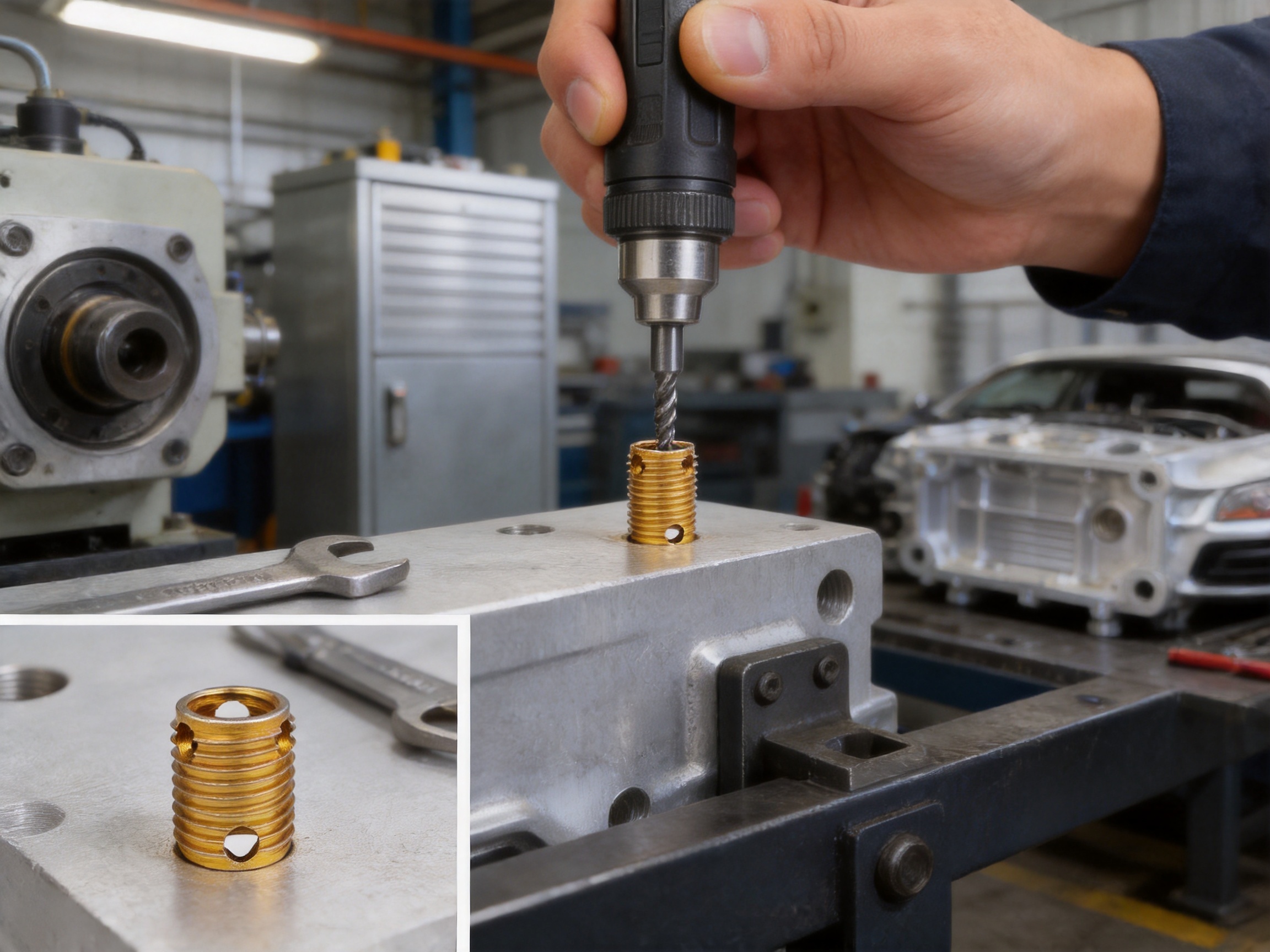
The insert should be installed with suitable dedicated tools. The tool must align with the insert and transmit the required installation torque without damaging the internal thread or the external locking features. Depending on the production process, manual, pneumatic, electric, or automated installation equipment may be used.
A controlled installation process provides several advantages. It helps maintain consistent depth, reduces variation between operators, limits the risk of cross-threading, and supports reliable engagement of the three-hole structure. For high-volume manufacturing, automated or semi-automated installation can improve productivity and process repeatability.
7.3 Seating Depth and Alignment
The insert should be installed to the specified depth. It should not protrude beyond the working surface unless the design intentionally requires a projecting configuration. It should also not be driven excessively deep if doing so could reduce the effective internal thread length or interfere with a blind-hole bottom.
Correct alignment is equally important. A bolt inserted into a misaligned thread can create side loading and uneven stress. The insert should remain concentric with the prepared hole so that the internal thread aligns with the mating fastener.
7.4 Post-Installation Inspection
Inspection may include checking the installation depth, internal thread condition, surface position, and rotational stability. A suitable test fastener or thread gauge can be used to confirm that the internal thread is free from damage and accepts the specified bolt smoothly.
For critical applications, manufacturers may define additional checks such as installation torque, removal torque, pull-out force, torque-out resistance, or dimensional inspection. These tests should be established according to the load requirements and applicable quality standards.
8. Manufacturing Process and Quality Strengths
The performance of a three-hole insert depends on more than the raw material. Consistent geometry, stable heat treatment where applicable, controlled thread dimensions, accurate hole positioning, surface quality, and reliable inspection are all important. A manufacturer with dedicated production capability can control these factors more effectively than a general trading supplier.
8.1 Integrated Product Manufacturing
Dongtai Jinzhize Metal Products Co., Ltd. specializes in threaded connection and fastening products, including helical wire inserts, self-tapping inserts, key-locking inserts, threaded adapters, oil plugs, installation taps, and related tools. This product focus provides practical manufacturing experience across the complete threaded connection system rather than only one individual component.
Experience with inserts and installation tools is valuable because the performance of an insert is closely related to the tool, hole preparation, and assembly method. A supplier that understands the entire installation process can provide more useful technical coordination than a supplier that only produces the insert body.
8.2 Production Equipment and Automation
The company operates a 10,000-square-meter owned manufacturing plant equipped with hundreds of machine tools and automated production systems. This equipment base supports stable production capacity, repeatable machining, and the ability to handle multiple product specifications.
Automation can improve consistency in operations such as material feeding, turning, thread forming or cutting, hole processing, inspection, sorting, and packaging. Automated systems also reduce variation caused by manual handling and can help maintain production records for traceability.
8.3 Engineering and Process Development
Three-hole inserts require careful coordination between internal thread geometry, external self-tapping profile, positioning holes, material properties, and installation conditions. An experienced engineering and development team can optimize these factors for different parent materials and application requirements.
Process development may include tool selection, cutting parameter control, surface treatment compatibility, dimensional tolerance management, and production testing. These activities help ensure that the finished product is not only dimensionally correct but also suitable for its intended installation environment.
8.4 Quality Management and Traceability
Threaded connection products are often used in assemblies where inconsistent fastening can result in rework, field failure, or safety concerns. A rigorous quality management system therefore plays an important role. Material identification, batch control, dimensional inspection, thread gauging, appearance inspection, and packaging verification can all contribute to stable product quality.
Traceability is especially useful for large industrial customers. When production batches, raw materials, inspection results, and shipment records can be connected, quality concerns can be investigated more efficiently. Traceable supply also supports controlled procurement programs and repeat orders.
8.5 Stable Supply Capability
The company reported an annual output value of 153 million RMB in 2024, demonstrating established production scale and supply capability. A stable manufacturing base is important for customers that require continuous supply, multiple sizes, custom specifications, or coordinated deliveries for high-volume assembly programs.
Production scale can also support better scheduling of standard sizes and more efficient organization of customized orders. For customers, this may reduce procurement uncertainty and simplify the management of threaded insert inventories.
9. Industrial Applications
9.1 General Industrial Equipment
Machine tools, printing equipment, pumps, automation systems, and other indoor industrial machinery often contain aluminum housings, steel frames, and polymer covers. Three-hole inserts can reinforce threaded holes used for covers, brackets, inspection panels, sensors, actuators, and service components.
Where maintenance requires repeated removal of a fastener, the insert can protect the base material from thread wear. Its anti-rotation characteristics are beneficial when the equipment is exposed to vibration during operation.
9.2 Sheet Metal Processing
Enclosures, control cabinets, electrical boxes, and sheet metal structures frequently have limited material thickness. Directly tapping a thin sheet may result in insufficient thread engagement. A self-tapping insert can create a stronger internal thread without requiring a large welded nut or additional external hardware.
The compact cylindrical form of the three-hole insert may be useful where the outside surface must remain relatively unobstructed. It can also support more consistent fastening in cabinet panels and equipment housings.
9.3 Heavy-Duty Furniture Assembly
Industrial racks, storage systems, workstations, equipment stands, and heavy office furniture may experience repeated assembly, movement, and vibration. A reinforced internal thread can improve durability at connection points that are serviced or reassembled over the life of the product.
Compared with a directly tapped soft metal section, a carbon steel insert can provide greater resistance to thread damage. The three-hole structure also helps reduce the possibility of insert rotation during tightening and loosening.
9.4 Automotive Parts Manufacturing
Automotive components may include aluminum housings, interior structures, brackets, control modules, chassis-related components, and transmission or engine assemblies. These parts often require strong, consistent fasteners while maintaining low weight and efficient manufacturing.
In applications exposed to vibration, thermal cycling, and repeated service operations, the anti-rotation design can offer an additional level of connection stability. Final suitability should be verified through application-specific testing, including temperature, corrosion, vibration, torque, and fatigue evaluation where required.
9.5 Construction Machinery Components
Small construction machinery and auxiliary equipment may contain structural components made from aluminum alloy, cast iron, or soft steel. These machines can experience impact, vibration, and fluctuating loads. The carbon steel insert can reinforce threaded holes in guards, brackets, panels, covers, and other components where a secure connection is required.
10. Design Considerations for Engineers
10.1 Selecting the Correct Internal Thread
The internal thread must match the fastener used in the final assembly. Engineers should confirm the thread standard, nominal diameter, pitch, thread class, bolt strength, and required engagement length. Metric and unified thread systems should not be mixed unless specifically designed and verified.
10.2 Selecting 307 or 308 Type
The 307 type may be suitable for compact applications with moderate engagement requirements. The 308 type, being the reinforced and longer version, may be preferred where a greater thread length or increased contact area is needed.
Selection should consider the available wall thickness, load direction, fastener size, installation depth, edge distance, and parent material. A longer insert is not automatically better if the blind hole is too shallow or if it interferes with an internal component.
10.3 Parent Material and Hole Tolerance
Aluminum alloy, cast iron, and soft steel do not respond identically during installation. The recommended drilling diameter may vary because material hardness, ductility, chip formation, and deformation behavior are different. Engineers should use the relevant drilling recommendation and validate it under actual production conditions.
Hole tolerance is one of the most important factors affecting installation performance. A production drawing should define the required diameter, depth, perpendicularity, surface condition, and deburring requirements. If the hole is produced by casting, molding, punching, or another process rather than drilling, additional validation may be necessary.
10.4 Edge Distance and Wall Thickness
The parent material around the insert must be strong enough to resist expansion, cracking, and pull-out. Adequate edge distance helps prevent the hole from breaking through or splitting during installation. Thin sections may require a shorter insert, a larger surrounding boss, or a redesigned component geometry.
10.5 Environmental Conditions
Product selection should account for moisture, salt spray, chemicals, temperature, outdoor exposure, and contact with dissimilar metals. Zinc or color zinc coatings may improve corrosion resistance, but the specific coating system should be confirmed for the environment. In severe conditions, additional corrosion testing or a different material may be required.
11. Performance and Reliability Benefits
The primary performance benefit of the carbon steel three-hole insert is the combination of a strong internal thread and anti-rotation retention. These two functions address different failure modes. The carbon steel body supports the fastener thread, while the external three-hole structure helps secure the insert within the parent material.
This combination can improve assembly reliability in several ways:
• It reduces the likelihood of thread stripping in soft base materials.
• It supports repeated fastening and unfastening cycles.
• It resists insert rotation caused by tightening or removal torque.
• It helps reduce shifting under vibration and fluctuating loads.
• It can improve the consistency of threaded connections across production batches.
• It can reduce the need for additional anti-rotation accessories.
• It provides a compact alternative to some welded or mechanically retained nuts.
These benefits are strongest when the insert is correctly matched to the parent material, accurately installed, and used within the designed load and environmental limits. No insert should be selected solely by nominal thread size. The complete connection system must be evaluated.
12. Procurement and Customization Support
Industrial customers often need more than a standard catalog item. They may require a particular thread standard, length, coating, packaging method, inspection report, or installation tool. A specialized manufacturer can support these requirements through coordinated product and process development.
Dongtai Jinzhize Metal Products Co., Ltd. supplies a broad range of threaded connection and fastening products for automotive, aerospace, rail vehicle, machinery, and related industries. Its product portfolio includes self-tapping inserts and complementary installation products, allowing customers to coordinate component sourcing with tooling and technical support.
For a new application, customers should provide the following information:
• Parent material and hardness or grade.
• Required internal thread standard and size.
• Available wall thickness and hole depth.
• Expected tensile, shear, torque, and vibration loads.
• Required assembly and disassembly frequency.
• Operating temperature and corrosion conditions.
• Desired coating or surface treatment.
• Annual volume and delivery requirements.
• Applicable drawings, standards, and inspection criteria.
With this information, the manufacturer can recommend the appropriate size, length, type, coating, and installation method. Sample testing before mass production is strongly recommended, especially for safety-related or highly dynamic applications.
13. Recommended Quality-Control Program
A quality-control program for three-hole inserts should cover incoming material, in-process production, final inspection, and packaging. Raw material verification helps confirm that the carbon steel meets the intended mechanical and manufacturing requirements. In-process checks can verify the external thread, internal thread, hole location, length, chamfer, and surface condition.
Thread gauges are useful for confirming internal and external thread conformity. Dimensional inspection equipment can verify critical diameters and lengths. Visual inspection can identify burrs, cracks, incomplete grooves, coating defects, or contamination.
Performance testing should be selected according to the application. Possible tests include:
• Installation torque testing.
• Torque-out or rotational resistance testing.
• Pull-out testing.
• Internal thread stripping testing.
• Repeated assembly and disassembly testing.
• Vibration testing.
• Salt spray or corrosion testing for coated products.
• Temperature cycling and environmental exposure testing.
Not every application requires every test. However, the testing plan should reproduce the actual parent material, hole size, installation tool, fastener, torque, and service conditions as closely as possible.
14. Frequently Asked Questions
Q1: What is a carbon steel three-hole thread insert?
It is a self-tapping threaded sleeve made from carbon steel. It has an internal machine thread, an external self-tapping thread, and three evenly distributed external holes or grooves. These holes allow the parent material to engage with the insert and improve resistance to rotation and shifting.
Q2: What is the difference between a 307 and a 308 insert?
The 308 type is the reinforced version and is generally supplied in a longer length than the 307 type. The correct choice depends on the required thread engagement, available wall thickness, load, and installation depth.
Q3: Which materials are suitable for this product?
The product is intended for use in materials such as aluminum alloy, cast iron, soft steel, and other relatively soft base materials. Plastic applications may also be possible when the material and design provide sufficient strength for installation and service. Testing should be performed for non-metallic materials because their deformation behavior varies significantly.
Q4: Why are the three holes important?
The three holes provide localized areas where the parent material can deform and interlock with the insert. This creates an anti-rotation effect that supplements the friction and interference generated by the external thread.
Q5: Can the insert be installed without adhesive?
The design is intended to provide mechanical retention through its external thread and three-hole structure, so additional anti-rotation accessories or adhesive may not be necessary in many applications. Whether adhesive is appropriate depends on the engineering specification and operating environment.
Q6: Can the insert be used in a blind hole?
Yes, provided that the blind hole has sufficient diameter and depth for the selected insert and installation tool. The minimum drilling depth must account for insert length, tool engagement, chips, and any required clearance at the bottom of the hole.
Q7: How should the drilling diameter be selected?
The drilling diameter should be selected according to the external thread, the parent material, and the manufacturer’s technical recommendation. Aluminum alloy and cast iron may require slightly different hole sizes. The specified hole should be validated through sample installation before production release.
Q8: Is the product suitable for vibration environments?
The three-hole structure is specifically intended to improve resistance to loosening and shifting under vibration. However, the complete joint must still be designed correctly, including bolt preload, joint stiffness, fastener selection, and any required secondary locking measures.
Q9: Are coatings available?
Optional coatings such as zinc and color zinc are available according to application requirements. Coating selection should consider corrosion exposure, temperature, appearance, dimensional effects, and compatibility with mating materials.
Q10: Can customized specifications be supplied?
Customized support may be available for thread size, length, coating, packaging, tooling, and related fastening requirements. Customers should submit drawings and application details so that the manufacturer can evaluate feasibility and define the required inspection criteria.
Q11: What inspection should be completed after installation?
At minimum, the installation depth, internal thread condition, alignment, and surface position should be checked. For critical assemblies, additional torque-out, pull-out, vibration, or repeated-cycle tests may be required.
Q12: Why work with a specialized threaded-product manufacturer?
A specialized manufacturer understands the interaction between insert geometry, parent material, hole preparation, tooling, coating, and final assembly. This integrated knowledge can help reduce installation problems, improve supply consistency, and support more reliable production results.
15. Conclusion
The carbon steel three-hole thread insert is a practical solution for creating strong and stable internal threads in aluminum alloy, cast iron, soft steel, plastic, and other materials that may not provide sufficient direct-thread performance. Its carbon steel body improves thread strength and durability, while the three evenly distributed holes provide a mechanical anti-rotation effect through engagement with the parent material.
Compared with standard non-holed inserts, the design offers additional resistance to rotation and shifting. Compared with oversized bolts, welded nuts, or adhesive-only retention, it can provide a compact and efficient approach to thread reinforcement. The 307 and 308 versions support different engagement requirements, and metric and unified thread options allow the product to serve a broad range of industrial assemblies.
Successful application depends on correct product selection, accurate drilling, proper installation tooling, controlled seating depth, and appropriate inspection. When these factors are managed systematically, the insert can improve assembly consistency, protect soft base materials, support repeated service operations, and reduce the risk of threaded connection failure.
Dongtai Jinzhize Metal Products Co., Ltd. combines dedicated threaded-product manufacturing, extensive machining resources, automated production systems, engineering experience, quality management, and supply capability. Its product range and manufacturing strengths make it positioned to support standard and customized threaded connection requirements for industrial, automotive, aerospace, rail, machinery, and related applications.
References
1. Product technical information for 307 and 308 type three-hole self-tapping screw sleeves, including thread sizes, lengths, drilling diameters, and minimum drilling depths.
2. Manufacturer-provided material and application information for carbon steel three-hole thread inserts.
3. General engineering principles for self-tapping threaded inserts and mechanical anti-rotation retention.
4. General guidelines for threaded-hole design in aluminum alloy, cast iron, soft steel, and plastic components.
5. General quality-control practices for internal and external thread inspection, insert installation, torque testing, and pull-out testing.
6. Manufacturer information concerning threaded connection products, production equipment, automation systems, quality management, and industrial supply capability.