Français
 Español
 Deutsch


Content
- 1 What Is an Internal-External Thread Conversion Nut?
- 2 Why Carbon Steel Is a Practical Material Choice
- 3 Advantages Over Alternative Thread Conversion Methods
- 4 Thread Standards and Compatibility
- 5 Applications Across Industrial Sectors
- 6 Manufacturing Process and Quality Control
- 7 Production Strengths of the Manufacturer
- 8 Design Considerations for Selecting the Correct Adapter
- 9 Installation and Use Recommendations
- 10 Customization and Procurement Support
- 11 Quality, Reliability, and Total Cost of Ownership
- 12 Q&A: Carbon Steel Internal-External Thread Conversion Nuts
- 12.1 What is the main function of this product?
- 12.2 Why is carbon steel used for the adapter?
- 12.3 Can the adapter connect metric and imperial threads?
- 12.4 Is the product suitable for high-load applications?
- 12.5 Can the internal and external threads have different sizes?
- 12.6 Can custom dimensions be produced?
- 12.7 Does carbon steel require surface treatment?
- 12.8 How should the correct size be selected?
- 12.9 Can the adapter be removed after installation?
- 12.10 What industries use this product?
- 12.11 How does this product differ from a wire thread insert?
- 12.12 What information should be included in a quotation request?
- 12.13 What manufacturing capabilities support this product?
- 13 Conclusion
- 14 References
- 15 Product: Carbon Steel Internal-external Thread Conversion Nut
Thread compatibility is a basic requirement in modern manufacturing, yet it is also one of the most common sources of assembly difficulty. Machinery, vehicles, construction equipment, industrial systems, and maintenance projects frequently combine components designed to different thread standards, sizes, or connection arrangements. When a component has an internal thread but the mating part requires an external thread, or when two systems use different thread specifications, a dependable conversion solution is essential.
The carbon steel internal-external thread conversion nut is designed for this purpose. It combines an external male thread and an internal female thread in one compact adapter. This configuration allows a threaded component, stud, bolt, fitting, or shaft to connect with another component that would otherwise be incompatible. By converting the thread interface without replacing the original parts, the adapter can simplify assembly, shorten maintenance time, and reduce the cost of redesigning equipment.
Manufactured by Dongtai Jinzhize Metal Products Co., Ltd., this product is intended for industrial users that require stable thread conversion, repeatable production quality, and cost-effective supply. The company specializes in threaded connection and fastening products for automotive, aerospace, rail vehicle, machinery, and other demanding applications. Its product range includes helical wire inserts, self-tapping inserts, key-locking inserts, threaded adapters, oil plugs, installation taps, and related installation tools.
Carbon steel is selected for this internal-external thread conversion nut because it provides a practical balance of strength, machinability, wear resistance, and production economy. Compared with more expensive specialty alloys, carbon steel can offer excellent value for large-volume applications while still delivering the mechanical performance needed for dependable threaded connections. With suitable surface treatment and correct application selection, the adapter can support long-term use in a wide range of industrial environments.
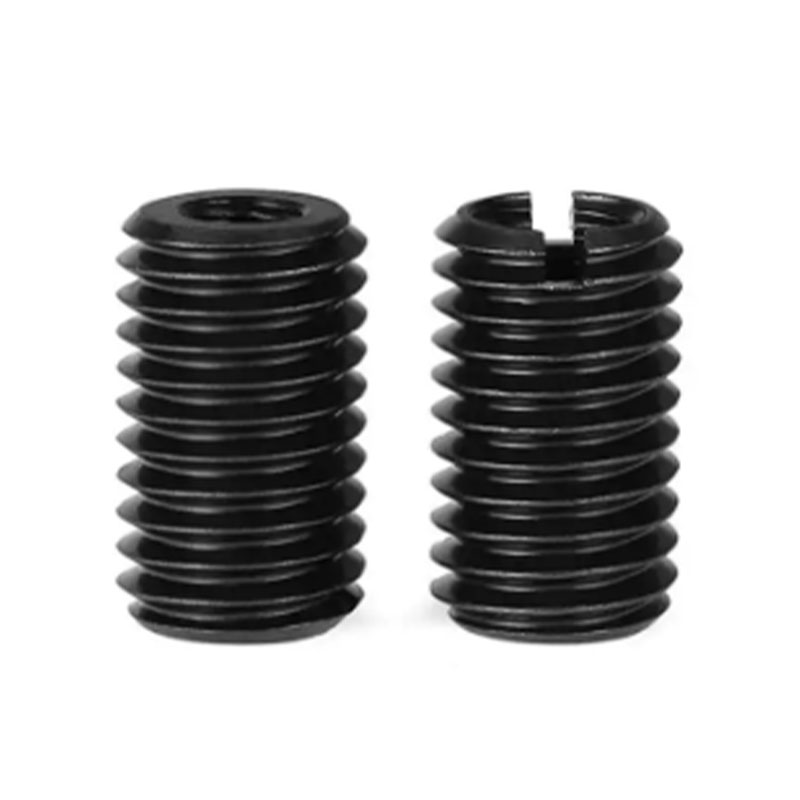
Carbon Steel Internal-external Thread Conversion Nut
What Is an Internal-External Thread Conversion Nut?
An internal-external thread conversion nut is a threaded adapter with two different thread interfaces. The outside of the adapter carries a male thread, while the central bore contains a female thread. Depending on the design, the two thread systems may have different nominal diameters, pitches, profiles, or standards. This makes the component useful for connecting parts that cannot be joined directly.
The product may also be described as a male-to-female thread adapter, threaded conversion bushing, reducer adapter, or thread conversion nut. Although terminology varies between industries and regions, the basic operating principle is the same: the external thread engages with a female threaded hole, while the internal thread receives a male threaded component.
For example, an adapter may be installed into a larger threaded hole, allowing a smaller bolt or stud to be used inside it. In another application, it may convert between a metric external thread and an imperial internal thread. It can also help connect components with different thread pitches, provided that the selected adapter has been designed and manufactured for the required specifications.
The conversion nut is not merely a spacer. Its threads must be accurately formed and aligned so that load is transferred evenly across the mating parts. The outside diameter, internal bore, pitch, thread length, concentricity, surface finish, and end geometry all influence performance. A properly manufactured adapter provides a stable connection while minimizing the risk of cross-threading, looseness, uneven loading, or premature wear.
Typical Operating Arrangement
During installation, the external male thread is screwed into a prepared female threaded hole or component. Once the adapter reaches the required seating position, the internal female thread receives the corresponding bolt, stud, shaft, or fitting. The connection can then be tightened according to the application’s torque requirements.
In some designs, the adapter is installed with a tool, hexagonal feature, slot, or other driving structure. In other designs, installation is performed by applying torque to the outer surface or by using a dedicated mandrel. The appropriate method depends on the product geometry, material, thread size, installation depth, and production requirements.
For industrial use, the adapter must be matched to the base material and operating load. The strength of the connection depends not only on the carbon steel adapter but also on the parent material, thread engagement length, installation accuracy, tightening method, and service environment.
Why Carbon Steel Is a Practical Material Choice
Carbon steel is widely used for threaded components because it offers a favorable combination of mechanical strength, manufacturing efficiency, and cost control. For an internal-external thread conversion nut, these characteristics are especially important because the component must withstand repeated tightening, contact pressure, vibration, and load transfer through two separate thread interfaces.
Mechanical Strength
Carbon steel provides a strong metallic structure suitable for many industrial fastening and connection tasks. It can withstand the compressive and shear forces generated during tightening and service. When the correct grade and heat-treatment condition are selected, the adapter can offer reliable resistance to deformation and thread damage.
Mechanical performance should always be considered in relation to the complete assembly. The adapter is often stronger than a soft base material, but the surrounding threaded hole may still determine the maximum allowable load. Engineering teams should consider thread engagement, material compatibility, tensile loading, shear loading, vibration, temperature, and expected tightening torque when selecting a conversion nut.
Efficient Machining and Thread Formation
Carbon steel is suitable for turning, drilling, tapping, threading, chamfering, and other precision machining operations. Its machinability supports stable production of both the external and internal thread features. Efficient machining is particularly valuable for custom adapters, small batches, and high-volume orders with repeated dimensions.
The material can be processed using automated equipment and controlled production procedures. This makes it possible to maintain consistent dimensions across large quantities while keeping the cost per piece competitive. Compared with difficult-to-machine specialty materials, carbon steel can reduce tool wear and production time when the product is correctly specified.
Wear Resistance
Threaded interfaces are exposed to friction during assembly and may experience micro-movement during operation. Carbon steel has good resistance to ordinary mechanical wear, especially when the thread surfaces are properly finished and lubricated. This helps preserve the thread profile during repeated installation and removal.
Wear resistance is influenced by several factors, including hardness, surface finish, lubrication, tightening force, contamination, and the material of the mating component. In applications involving high cycles, abrasive particles, or severe movement, a suitable surface treatment may further improve service performance.
Cost Efficiency for Large-Scale Production
One of the strongest advantages of carbon steel is its economic value. Many industrial users need thousands or millions of threaded components for equipment production, maintenance, or aftermarket service. A carbon steel adapter can provide the required functional performance without imposing the higher raw-material cost associated with stainless steel, nickel alloys, or other premium materials.
Cost efficiency does not mean sacrificing quality. When supported by controlled material purchasing, precision equipment, inspection procedures, and traceable production records, carbon steel can be an excellent choice for dependable industrial thread conversion. The balance between performance and price is especially attractive in automotive manufacturing, general machinery, construction equipment, and high-volume assembly.
Compatibility with Surface Treatments
Uncoated carbon steel may be vulnerable to oxidation in humid or corrosive environments. For this reason, surface protection may be selected according to the application. Possible treatments can include oil protection, plating, black oxide, phosphate coating, zinc-based coating, or other customer-specified finishes, subject to the product design and technical requirements.
Surface treatment can improve corrosion resistance, appearance, lubricity, or storage stability. However, coatings also affect thread dimensions and friction characteristics. The coating specification should therefore be considered during design rather than treated as an afterthought. The supplier and customer should confirm the required finish, thickness, salt-spray expectations, operating environment, and dimensional tolerances before production.
Advantages Over Alternative Thread Conversion Methods
Industrial users can choose from several methods when connecting incompatible threads. These may include replacing the original component, machining a new part, using a welded adapter, installing a wire insert, or selecting a different threaded bushing. The carbon steel internal-external thread conversion nut offers several advantages when the application requires a compact, straightforward, and economical solution.
Compared with Replacing the Original Component
Replacing a component to achieve thread compatibility can be expensive and disruptive. A new component may require design changes, new tooling, revised inventory, additional testing, or extended equipment downtime. A conversion nut can preserve the original component while adapting the connection interface.
This is particularly useful for repair and maintenance work. If a machine contains a serviceable part with an uncommon thread, an adapter may allow the use of a readily available bolt, stud, fitting, or fastener. The approach can reduce maintenance complexity and help users avoid unnecessary replacement of otherwise functional components.
Compared with Custom-Machined One-Off Parts
A custom-machined adapter may be appropriate for a unique prototype or an unusual high-load application, but it can involve substantial engineering and machining cost. A standardized or semi-custom internal-external conversion nut can shorten the procurement cycle and provide more predictable pricing.
Where the required thread sizes and lengths are within the manufacturer’s production range, the customer can benefit from established process parameters, existing inspection methods, and repeatable tooling. For nonstandard requirements, the same manufacturing capability can be adapted to produce custom dimensions after technical review.
Compared with Welding or Permanent Modification
Welding a threaded component or permanently modifying a housing may introduce heat distortion, residual stress, alignment problems, and difficulties during future maintenance. A mechanical adapter provides a removable connection and avoids many of the risks associated with permanent alteration.
A removable adapter is also useful when equipment must be serviced periodically. If the connection needs to be disassembled, the adapter can be removed or replaced without cutting, grinding, or rewelding the surrounding structure.
Compared with Wire Thread Inserts
Wire thread inserts are highly useful when a damaged or weak internal thread must be restored, particularly in lightweight materials such as aluminum. However, they do not always provide the required male-to-female thread conversion. A carbon steel internal-external adapter is more suitable when the design requires a physical change from one threaded interface to another.
These two products can also be used in complementary ways. A wire insert may reinforce a damaged internal thread, while a conversion nut may adapt the thread size or standard of the connected component. The correct choice depends on whether the primary need is thread repair, reinforcement, or thread conversion.
Compact Geometry and Efficient Assembly
The adapter integrates two thread functions into one small component. This can save space compared with a combination of separate nuts, couplings, spacers, and fastening parts. A compact adapter may also reduce the number of interfaces in an assembly, which can simplify installation and inventory management.
Its compact form is valuable in confined areas such as engine compartments, transmission housings, machinery frames, hydraulic assemblies, and equipment panels. The final design must still provide sufficient tool access and thread engagement, but the integrated construction can help engineers optimize available space.
Thread Standards and Compatibility
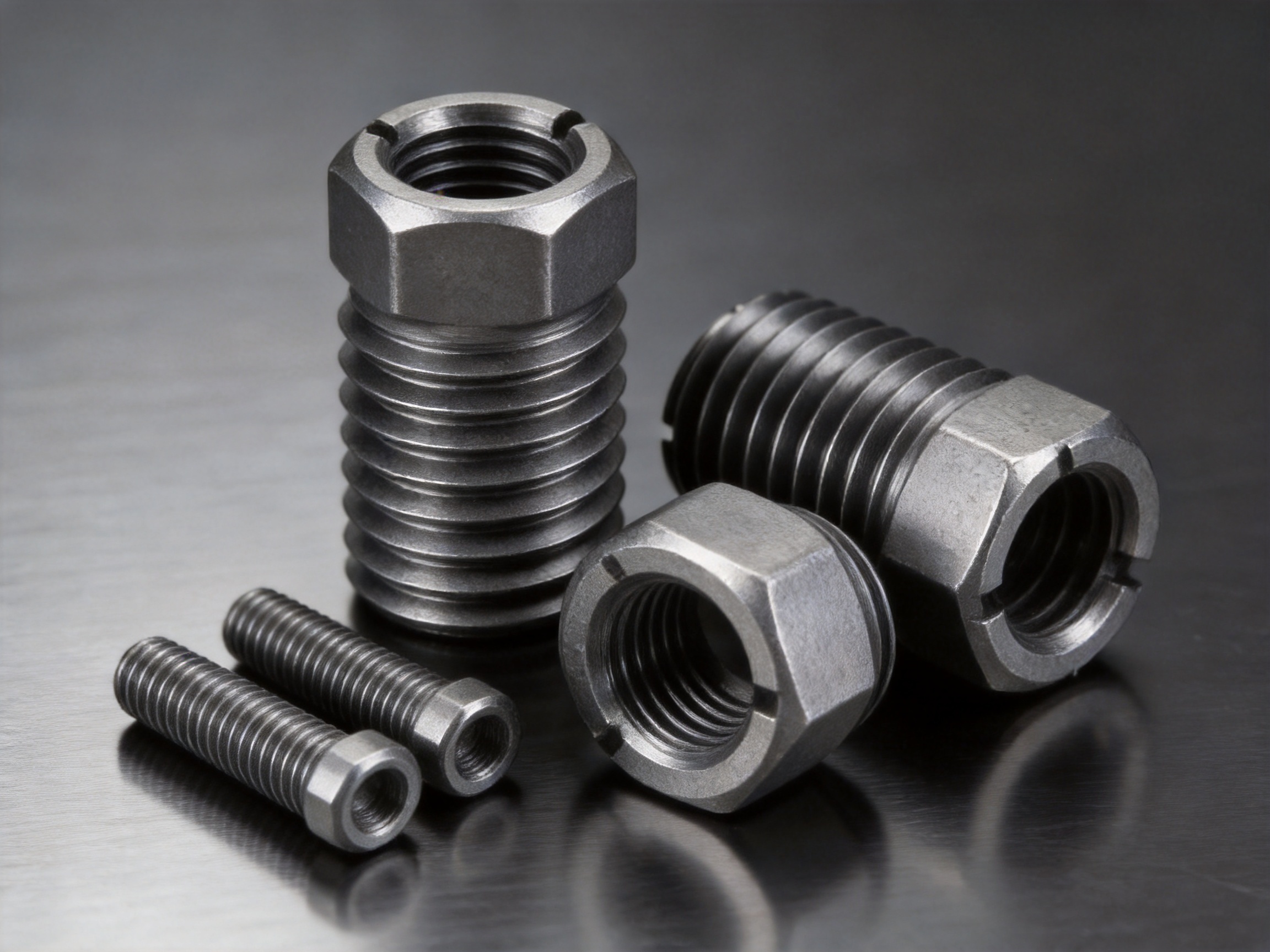
Thread conversion is only reliable when the specifications of both sides are clearly defined. The external and internal threads may differ, but each must accurately match its mating component. Important specifications include nominal diameter, pitch, thread angle, tolerance class, handedness, thread length, effective engagement, and standard designation.
The product can be manufactured for a broad range of standard metric, imperial, and unified thread requirements, subject to technical confirmation. Metric threads are commonly identified by nominal diameter and pitch, while inch-based systems may use threads per inch, nominal diameter, and thread series. Unified thread systems can include coarse and fine series, each with different application characteristics.
Metric Applications
Metric thread conversion nuts may be used to connect different metric sizes or to adapt a metric component to another thread pitch. For example, an external thread may be specified with one nominal diameter while the internal thread uses a smaller diameter. Fine-pitch and coarse-pitch requirements must be identified precisely because they are not interchangeable.
Metric applications are common in automotive manufacturing, industrial machinery, construction equipment, rail vehicles, and general engineering. In production environments, the use of a clearly documented metric specification helps prevent assembly errors and supports automated or semi-automated installation.
Imperial and Unified Thread Applications
Imperial and unified threads remain common in equipment designed in North America, the United Kingdom, and other markets. A conversion nut can connect an imperial fastener to a different imperial size or help integrate an imperial component into a system containing unified or metric parts.
Because several inch-based thread series may have similar nominal dimensions but different pitches, the thread designation should be confirmed from the engineering drawing, sample component, or measurement report. Visual similarity is not sufficient for safe selection.
Right-Hand and Special Thread Requirements
Most industrial threaded connections use right-hand threads, but some applications may require left-hand threads to resist loosening or to accommodate rotational movement. If a special thread direction is required, it should be identified before quotation and production.
Other possible requirements include extended thread lengths, reduced head or shoulder dimensions, special end chamfers, locking features, lubrication grooves, or a specific installation interface. Customization is most successful when the customer supplies a clear drawing or complete technical specification.
Applications Across Industrial Sectors
Machinery Manufacturing
Machinery manufacturers use threaded adapters to connect subassemblies, install replacement parts, and manage differences between legacy and newly designed components. A conversion nut may be installed in a machine frame, housing, bracket, cover, or support structure where the existing thread does not match the selected fastener.
For original equipment production, the adapter can help engineers use standardized fasteners across multiple models. It may also reduce the number of specially manufactured bolts or studs required in the bill of materials. For service departments, a conversion solution can increase the availability of replacement hardware and simplify field repairs.
Automotive Manufacturing
Automotive systems contain numerous threaded connections exposed to vibration, thermal cycling, oil, moisture, and repeated service operations. Internal-external thread conversion nuts may be used in engine-related assemblies, transmissions, brackets, fixtures, tooling, body structures, and other components where thread compatibility is required.
Automotive production places strong emphasis on repeatability and traceability. An adapter used in a production line must be dimensionally consistent, supplied in stable quantities, and compatible with specified tightening procedures. The carbon steel construction provides a practical solution for many applications where high strength and controlled cost are required.
For safety-related or highly loaded automotive assemblies, the adapter must be validated according to the customer’s engineering standards. Material grade, heat treatment, coating, torque requirements, fatigue performance, and inspection documentation should be confirmed before approval.
Aerospace and Rail Vehicle Manufacturing
Aerospace and rail vehicle applications require careful control of materials, dimensions, process records, and configuration. Thread conversion products may be used in tooling, fixtures, maintenance equipment, interior structures, equipment mounts, and non-flight-critical or suitably qualified assemblies.
Where the component is intended for a critical aerospace application, the customer may require specific material certification, special process approvals, non-destructive testing, batch traceability, or qualification testing. A supplier with an established quality system and documented manufacturing process is better positioned to support these requirements.
Construction and Building Equipment
Construction machinery and building systems often involve components from different suppliers. A thread adapter can help connect hydraulic, mechanical, structural, or maintenance-related parts when the original thread arrangements do not match. Its use can reduce downtime at construction sites and simplify replacement of worn or damaged hardware.
Construction equipment may be exposed to dust, rain, mud, vibration, and outdoor storage. In these conditions, the selected carbon steel grade and surface treatment are important. Protective packaging and corrosion-control measures may also be necessary during transportation and storage.
Oil and Gas Equipment
Threaded connections in oil and gas equipment must be selected with particular care because pressure, temperature, fluid compatibility, corrosion, and safety requirements can be severe. A carbon steel conversion nut may be suitable for certain support, maintenance, tooling, or non-pressure-critical applications, provided that it meets the relevant engineering requirements.
For pressure-containing or hazardous-service systems, the adapter must not be selected solely on general appearance or nominal size. Pressure rating, sealing method, material compatibility, corrosion resistance, temperature range, applicable industry standards, and qualification requirements must be verified in advance.
Maintenance, Repair, and Retrofit Projects
Maintenance teams frequently encounter equipment with obsolete, imported, damaged, or nonstandard threads. A conversion nut can provide a practical bridge between the existing equipment and currently available replacement parts. This is especially valuable when the original manufacturer’s fastener is difficult to source or when a machine has been modified over many years.
Retrofit projects also benefit from threaded adapters. When a new sensor, bracket, fitting, or actuator must be installed on an existing machine, a conversion nut can avoid extensive rework. The result may be a faster installation with less disruption to the original structure.
Manufacturing Process and Quality Control
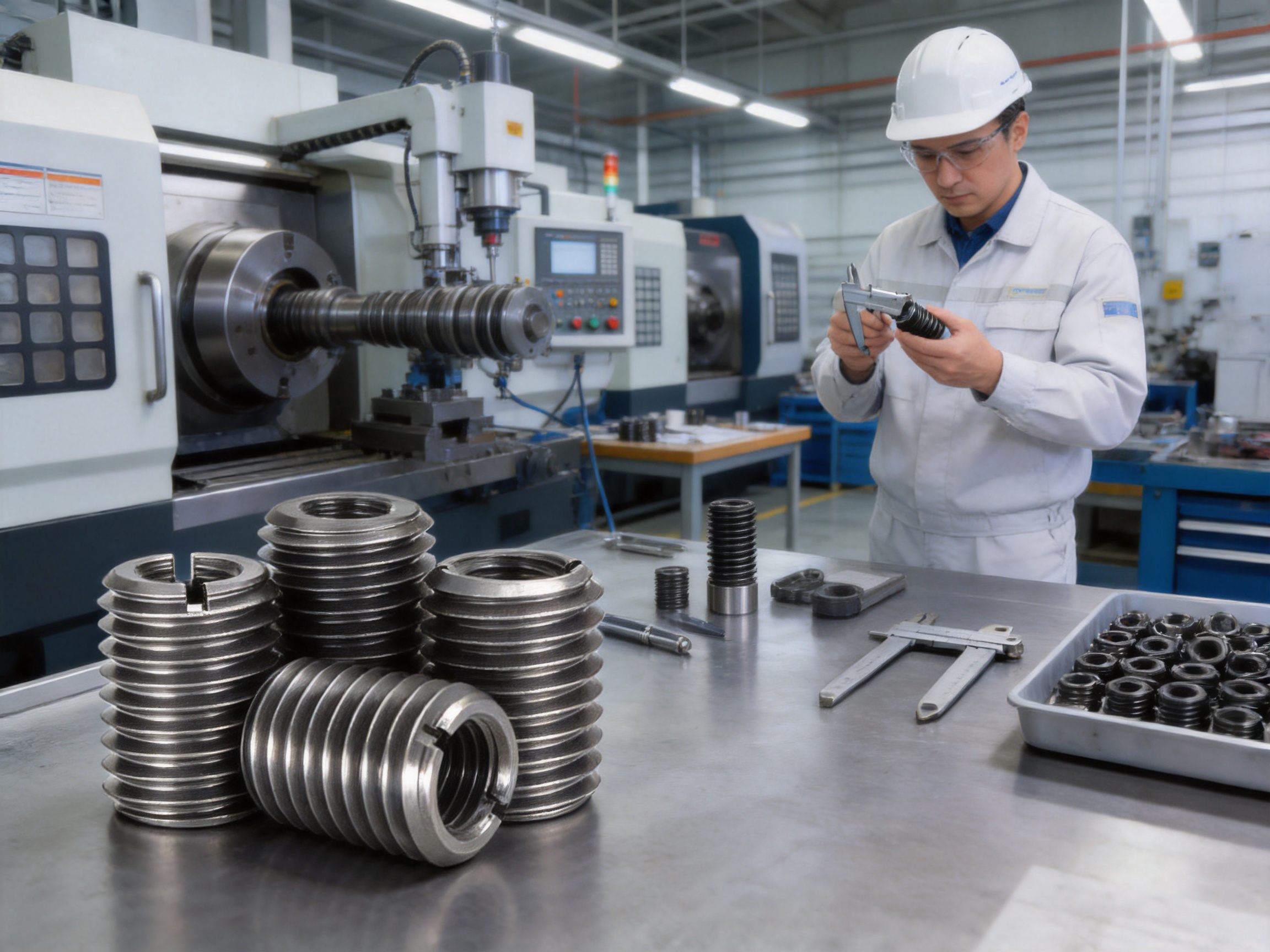
The performance of an internal-external thread conversion nut depends on controlled manufacturing from raw material selection through final inspection. Dongtai Jinzhize Metal Products Co., Ltd. operates a manufacturing facility dedicated to threaded connection products. Established in 2015, the company has developed production experience in wire inserts, self-tapping inserts, key-locking inserts, threaded adapters, oil plugs, installation taps, and related products.
The company operates from an owned manufacturing plant of approximately 10,000 square meters. Its equipment base includes hundreds of machine tools and automated production systems. This combination of production space, equipment capacity, and specialized product knowledge supports both repeat orders and larger-volume industrial supply.
Material Selection and Incoming Control
Production begins with the selection of suitable carbon steel according to the required mechanical and dimensional performance. The material specification may include grade, chemical composition, hardness condition, heat-treatment requirement, and surface-treatment compatibility.
Incoming material control helps ensure that the supplied steel corresponds to the approved specification. Depending on the customer’s requirements, material documentation may include mill certificates, batch identification, chemical analysis, mechanical test results, or other traceability information.
Precision Turning and Forming
The initial blank is shaped to establish the outside diameter, internal bore, overall length, shoulders, chamfers, and other functional features. CNC turning and related machining processes can provide repeatable control over the adapter’s basic geometry.
Dimensional stability at this stage is important because thread accuracy depends on the underlying cylindrical surfaces. An incorrect outside diameter can affect the fit of the external thread, while an incorrectly prepared bore can influence internal thread depth, pitch diameter, and engagement.
External Thread Production
The male thread on the outer surface may be produced through precision cutting, rolling, or another approved process depending on the product design, material condition, size, and performance requirements. The selected method affects thread surface quality, dimensional consistency, production efficiency, and material flow.
Thread production must control major diameter, pitch diameter, minor diameter, pitch, flank angle, crest condition, root condition, and thread length. Proper chamfering at the thread entry can also help reduce the risk of cross-threading during installation.
Internal Thread Production
The female thread is produced in the central bore using suitable taps or precision machining methods. Internal thread quality is affected by pilot-hole size, tool condition, alignment, cutting speed, lubrication, chip evacuation, and inspection frequency.
Because the adapter contains both internal and external threads, concentricity is especially important. If the two threads are misaligned, the connected components may not run correctly or may experience uneven loading. Controlled setups and appropriate inspection help reduce this risk.
Deburring, Cleaning, and Surface Preparation
After machining, burrs and loose chips must be removed. Deburring improves assembly safety, protects mating threads, and helps ensure that the adapter seats correctly. Cleaning removes machining residue, oil contamination, and particles that could interfere with installation or final surface treatment.
Surface preparation is selected according to the required finish. If a coating or conversion treatment is applied, process control is needed to ensure uniform coverage without obstructing the thread profile. The finished product should be checked for coating buildup, damaged areas, discoloration, and other conditions that could affect use.
Inspection and Testing
Inspection may include dimensional measurement, thread gauging, visual examination, hardness testing, surface-finish evaluation, and sampling-based mechanical verification. Go and no-go thread gauges are commonly used to confirm that the product will mate correctly with the specified thread standard.
For customized or critical applications, additional checks may include concentricity measurement, coating thickness, torque testing, proof-load testing, pull-out testing, fatigue evaluation, or corrosion testing. The exact inspection plan should be based on the customer’s drawing, quality agreement, and intended application.
Traceability and Production Records
Industrial customers increasingly require traceable products. Traceability connects the finished adapter with its material batch, production process, inspection results, and shipment information. This supports quality investigations, production control, and long-term supplier management.
Jinzhize’s focus on consistent and traceable threaded connection products supports customers that need repeatable supply rather than one-time purchasing. A stable production record also helps the supplier reproduce approved dimensions and finishes for future orders.
Production Strengths of the Manufacturer
The manufacturer’s specialization is an important advantage when sourcing carbon steel internal-external thread conversion nuts. A company focused on threaded connection products is familiar with thread geometry, insertion methods, tooling, material behavior, and the practical problems that can occur during assembly.
Dongtai Jinzhize Metal Products Co., Ltd. serves the automotive and aerospace sectors while also supplying products for machinery, rail vehicles, construction, and other industries. This cross-sector experience supports a broader understanding of different technical requirements, including high-volume production, custom dimensions, repair applications, and demanding quality documentation.
Integrated Product Knowledge
The company’s product range covers both threaded components and installation-related products. Its portfolio includes helical wire inserts, self-tapping inserts, key-locking inserts, threaded adapters, oil plugs, thread taps, installation tools, and other complementary products.
This integrated knowledge can help customers select the correct solution for a specific problem. For example, a customer with a damaged thread may need an insert rather than an adapter. Another customer may need a thread tap and installation tool along with the conversion nut. A supplier familiar with the entire product family can provide more practical technical guidance.
Equipment Capacity
The company’s manufacturing plant contains hundreds of machine tools and automated production systems. Equipment capacity is valuable for customers that require stable output, repeat orders, or multiple product sizes. It can also support production scheduling that separates different materials, finishes, and specifications to reduce the risk of mix-ups.
Automation helps improve repeatability in operations such as turning, threading, inspection, sorting, and packaging. However, automation is most effective when combined with qualified processes, trained personnel, preventative maintenance, and clear quality procedures.
High-Volume Supply Capability
In 2024, the company achieved an annual output value of 153 million RMB. This figure reflects the scale of its manufacturing and commercial operations and demonstrates the ability to support substantial customer demand. For procurement teams, production scale can reduce concerns about supply interruption and improve confidence in long-term cooperation.
High-volume capability is particularly important for automotive and industrial customers that need consistent parts over extended production cycles. The supplier must be able to maintain the same dimensions, materials, finishes, packaging, and inspection requirements across repeated batches.
Quality and After-Sales Support
Consistent quality is supported by a rigorous quality management approach and a structured after-sales service mechanism. When a customer encounters an installation issue, dimensional concern, or application question, responsive technical communication can help identify the cause and prevent recurrence.
After-sales support may involve reviewing drawings, photographs, samples, inspection records, installation conditions, and operating data. This collaborative approach is useful when the adapter is being introduced into a new assembly or when a customer is changing from one supplier to another.
Design Considerations for Selecting the Correct Adapter
Choosing a conversion nut requires more than matching the nominal thread size. The following factors should be confirmed before ordering.
Thread Specification
Define the external and internal thread standards separately. Specify nominal diameter, pitch or threads per inch, tolerance class, thread direction, and effective length. If one side is metric and the other is imperial, clearly identify both systems.
Load and Engagement
Determine the expected tensile, compressive, shear, and torsional loads. Thread engagement should be sufficient for the materials and forces involved. A short adapter may be appropriate for light-duty use, while a highly loaded assembly may require a longer engagement length or a different connection design.
Base Material
Consider the material into which the adapter will be installed. Aluminum, cast iron, steel, plastic, and composite materials have different thread-strength characteristics. In a soft parent material, the surrounding thread may fail before the carbon steel adapter reaches its own strength limit.
Environment
Identify exposure to water, salt, chemicals, oils, fuels, dust, temperature changes, vibration, and outdoor storage. The finish and packaging should be selected to suit these conditions. If the environment is highly corrosive, stainless steel or a specialized alloy may be more appropriate than standard carbon steel.
Installation Method
Confirm how the adapter will be installed and removed. Production lines may require a specific driving feature, installation mandrel, or torque-control method. Maintenance teams may need an adapter that can be installed with common tools in a confined space.
Dimensional Restrictions
Available space, shoulder location, overall length, outer diameter, and tool clearance should be included in the design review. A technically correct thread adapter may still be unsuitable if it interferes with nearby components or cannot be tightened safely.
Surface Finish
State whether the adapter should be supplied plain, oiled, plated, blackened, phosphated, or with another finish. The required corrosion resistance, friction coefficient, appearance, and storage period should be discussed with the manufacturer.
Installation and Use Recommendations
Before installation, inspect the mating threads and remove dirt, burrs, chips, rust, and damaged material. The female thread receiving the adapter should be clean and properly aligned. The internal mating component should also be checked to confirm that its thread specification matches the adapter.
Start the adapter by hand whenever possible. It should engage smoothly for several turns without excessive resistance. If the adapter binds immediately, stop and verify the thread specification and alignment. Forcing a mismatched component can damage both the adapter and the parent part.
Use the recommended installation tool and apply the appropriate torque. Excessive torque can stretch, deform, or strip the threads, while insufficient torque can allow loosening under vibration. If a locking compound, lubricant, or sealant is required, confirm that it is compatible with the material, coating, temperature, and service environment.
After installation, verify seating depth, alignment, thread engagement, and the position of the connected component. In production environments, a documented inspection method can help ensure that operators install the part consistently.
During maintenance, inspect for thread wear, galling, corrosion, loosening, deformation, or damage caused by over-tightening. Replace the adapter if its thread profile is no longer capable of maintaining a secure connection.

Customization and Procurement Support
Standard sizes are often the most economical choice, but industrial applications may require customized dimensions. The manufacturer can evaluate requirements such as nonstandard external and internal thread combinations, special lengths, reduced diameters, unique shoulders, altered chamfers, special tolerances, different materials, or specified surface treatments.
A complete inquiry should include a drawing or technical data sheet whenever possible. It should identify both thread systems, dimensions, quantities, material requirements, finish, inspection standards, packaging, and intended application. Samples or photographs of the mating components can be useful when the original specifications are unavailable.
For large-volume orders, customers may also discuss production capacity, approval samples, first-article inspection, batch traceability, packaging configuration, delivery schedule, and change-control procedures. These details help establish a stable supply arrangement rather than treating every order as an isolated transaction.
Dongtai Jinzhize Metal Products Co., Ltd. supports international customers from its facility in Dongtai City, China. Its technical and sales team can be contacted for product selection, custom thread conversion requirements, quotation, production coordination, and after-sales support.
Quality, Reliability, and Total Cost of Ownership
The purchase price of a threaded adapter is only one part of its total cost. Poor thread accuracy can create assembly delays, rejected products, equipment downtime, damaged mating components, and field-service problems. A slightly lower unit price may become expensive if the part is inconsistent or difficult to install.
A reliable carbon steel conversion nut contributes to lower total cost by supporting repeatable assembly and reducing replacement frequency. Stable dimensions help automated lines operate smoothly. Correct thread profiles reduce the likelihood of cross-threading. Appropriate surface protection improves storage and service performance. Traceable batches make quality management more efficient.
The manufacturer’s combination of specialized product experience, substantial equipment capacity, automated production systems, and quality control provides a foundation for consistent supply. These advantages are especially relevant to customers that value long-term procurement stability over short-term price comparisons.
Carbon steel also supports cost control at the material level. When the service environment does not require a premium corrosion-resistant alloy, carbon steel can meet the mechanical needs of the application at a more competitive cost. This makes it attractive for large production runs and broad equipment platforms with many threaded connection points.
Q&A: Carbon Steel Internal-External Thread Conversion Nuts
What is the main function of this product?
The product converts one threaded connection into another by combining an external male thread with an internal female thread. It allows components with different thread sizes, standards, or connection arrangements to be joined without replacing the original parts.
Why is carbon steel used for the adapter?
Carbon steel offers good mechanical strength, wear resistance, machinability, and cost efficiency. It is suitable for many industrial applications and is particularly attractive for high-volume production. Surface treatment can be selected when additional corrosion protection is required.
Can the adapter connect metric and imperial threads?
It can be manufactured for compatible metric, imperial, or unified thread combinations, subject to technical confirmation. The exact nominal sizes, pitch, tolerance, and thread standard must be specified before production.
Is the product suitable for high-load applications?
It may be suitable for high-load applications when the material grade, dimensions, thread engagement, heat treatment, surface finish, and installation method are properly designed and validated. The strength of the parent material and the complete assembly must also be considered.
Can the internal and external threads have different sizes?
Yes. Thread conversion commonly involves different nominal diameters or pitches. The adapter should be designed so that both thread interfaces provide sufficient engagement and load capacity for the intended application.
Can custom dimensions be produced?
Custom dimensions may be available, including special thread combinations, lengths, diameters, chamfers, tolerances, materials, and surface treatments. Customers should provide a drawing or detailed specification for evaluation.
Does carbon steel require surface treatment?
Not every application requires the same treatment. Plain or lightly protected carbon steel may be suitable for controlled indoor environments, while humid, outdoor, or corrosive conditions may require plating, black oxide, phosphate, oil protection, or another finish. The choice should be made according to the service environment.
How should the correct size be selected?
Confirm the specification of both mating components, including nominal diameter, pitch, thread standard, direction, tolerance, and required engagement length. Also check available space, installation tooling, operating loads, temperature, vibration, and corrosion conditions.
Can the adapter be removed after installation?
In most applications, it is designed as a removable mechanical component. Removal depends on the installation method, tightening torque, locking compound, corrosion, and condition of the threads. A suitable driving feature or installation tool should be considered if frequent removal is expected.
What industries use this product?
Typical sectors include machinery manufacturing, automotive production, construction equipment, rail vehicles, aerospace-related manufacturing, oil and gas support equipment, maintenance, repair, and industrial retrofits. Application suitability should be evaluated for each specific service condition.
How does this product differ from a wire thread insert?
A wire thread insert primarily reinforces or repairs an internal thread, often in a softer base material. An internal-external thread conversion nut changes the connection interface by providing both an external and an internal thread. The two products solve different problems and may be used separately or together.
What information should be included in a quotation request?
Provide the external thread specification, internal thread specification, dimensions, material, surface treatment, quantity, drawing, application, quality requirements, packaging requirements, and delivery expectations. Samples or photographs can supplement the technical information.
What manufacturing capabilities support this product?
The manufacturer operates an approximately 10,000-square-meter facility with hundreds of machine tools and automated production systems. Its experience includes threaded adapters and multiple related insert and fastening products, supporting both standard and customized industrial requirements.
Conclusion
The carbon steel internal-external thread conversion nut is a practical solution for adapting incompatible threaded components. Its integrated male and female thread arrangement can simplify assembly, support maintenance, preserve existing parts, and reduce the need for costly redesign or permanent modification.
Its carbon steel construction provides a useful balance of strength, wear resistance, machinability, and cost efficiency. When paired with the correct surface treatment, dimensional control, installation method, and service evaluation, it can perform reliably across machinery, automotive, construction, rail, aerospace-related, oil and gas support, and general industrial applications.
The product’s value is strengthened by the manufacturing capabilities of Dongtai Jinzhize Metal Products Co., Ltd. The company brings specialized threaded-product knowledge, a substantial production facility, hundreds of machine tools, automated systems, quality management procedures, traceable production, and after-sales support. Its experience across inserts, adapters, oil plugs, taps, and installation tools allows it to address both individual components and broader threaded connection requirements.
For procurement teams and engineers, the most effective approach is to define the complete technical requirement before ordering. Thread standards, material, loads, engagement, environment, finish, tooling, tolerances, and inspection requirements should all be reviewed. With the correct specification and a qualified manufacturing partner, the carbon steel internal-external thread conversion nut can provide a dependable, economical, and flexible connection solution for modern industrial assemblies.
References
ISO 68-1, ISO General Purpose Screw Threads—Basic Profile, Metric Screw Threads.
ISO 965, ISO General Purpose Metric Screw Threads—Tolerances.
ASME B1.1, Unified Inch Screw Threads—UN and UNR Thread Form.
ASME B1.13M, Metric Screw Threads—M Profile.
ISO 898-1, Mechanical Properties of Fasteners Made of Carbon Steel and Alloy Steel.
ISO 2320, Prevailing Torque Type Steel Nuts—Mechanical and Performance Properties.
ASTM A29/A29M, General Requirements for Steel Bars, Carbon and Alloy, Hot-Wrought.
ASM Handbook, Volume 1, Properties and Selection: Irons, Steels, and High-Performance Alloys.
ASM Handbook, Volume 16, Machining.
Industrial Fastener Engineering Guides, Thread Engagement, Torque, and Joint Design Principles.
Manufacturer-provided product information for carbon steel internal-external thread conversion nuts and related threaded connection products.