

 Français
 Español
 Deutsch

Content
- 1 What Is a Yellow Zinc Plated Self-Tapping Thread Insert?
- 2 Operating Principle and Structural Design
- 3 Key Advantages Compared with Conventional Thread Repair Methods
- 4 Yellow Zinc Coating Performance
- 5 Material Compatibility and Application Selection
- 6 Type 302 Size and Drilling Reference
- 7 Installation Procedure
- 8 Applications Across Major Industries
- 9 Manufacturing Strengths and Process Control
- 10 Quality Evaluation for Purchasing Teams
- 11 Engineering Considerations for Better Results
- 12 Comparison with Alternative Thread Reinforcement Solutions
- 13 Service and Maintenance Benefits
- 14 Frequently Asked Questions
- 14.1 What is the main purpose of this insert?
- 14.2 Can it be installed without tapping the hole first?
- 14.3 Which materials are suitable?
- 14.4 Does the yellow zinc coating prevent all corrosion?
- 14.5 What is the general temperature range?
- 14.6 Can the insert repair a stripped hole?
- 14.7 Is an adhesive necessary?
- 14.8 How should the hole depth be selected?
- 14.9 Can standard tools be used?
- 14.10 What should be inspected after installation?
- 14.11 Are metric and inch sizes available?
- 14.12 Why is supplier manufacturing capability important?
- 15 Why Choose a Specialized Threaded Connection Manufacturer?
- 16 Conclusion
- 17 References
- 18 Product: Yellow Zinc Plated Self-Tapping Thread Insert
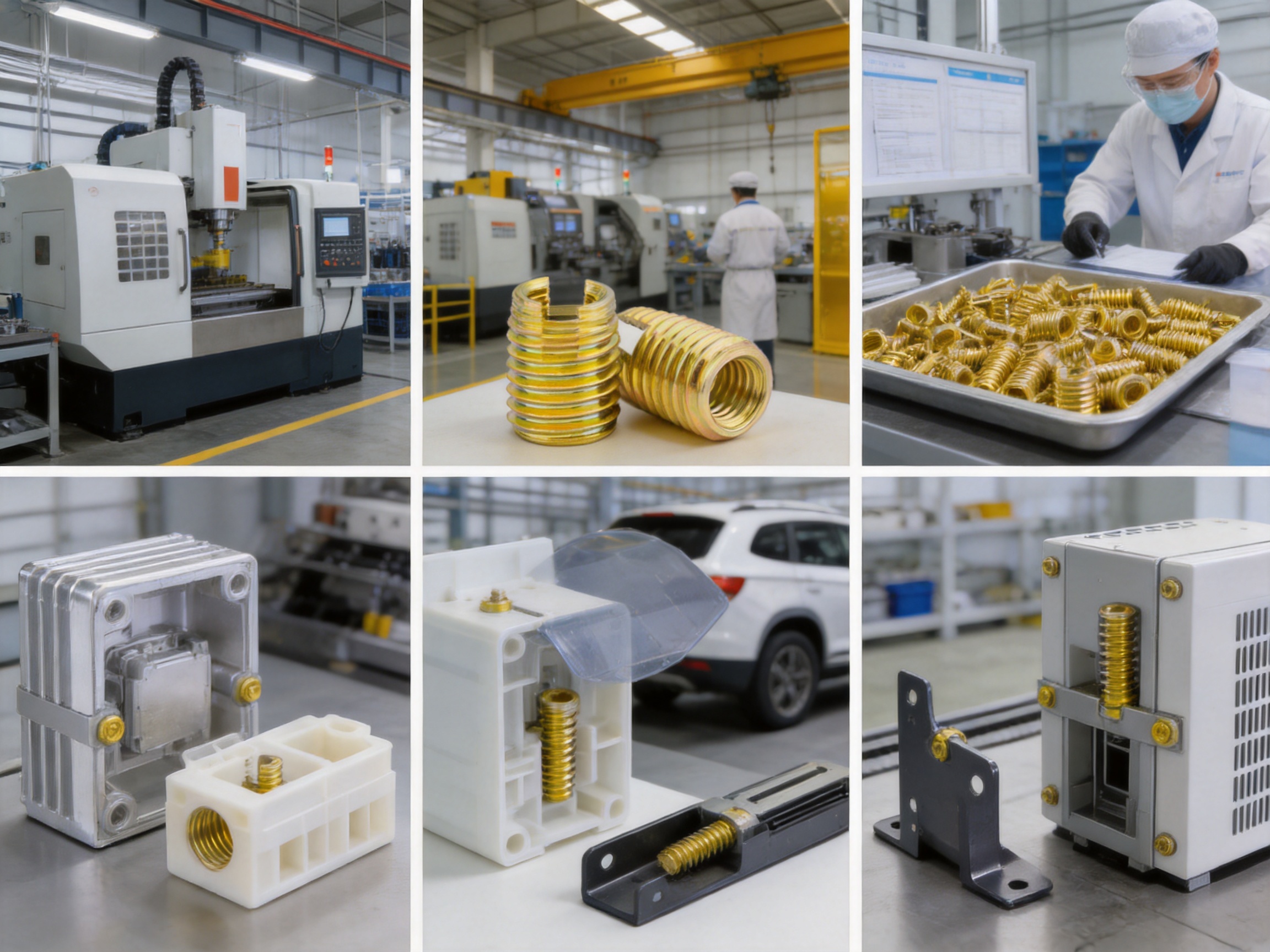
Reliable threaded connections are essential in machinery, automotive systems, aerospace structures, electronics housings, communication equipment, and many other engineered products. When a component is made from a soft or relatively low-strength material such as aluminum, magnesium alloy, plastic, or a thin sheet-metal section, the native thread may not provide sufficient load-bearing capacity. Repeated assembly, vibration, impact, moisture, oil, and temperature changes can gradually damage the thread, resulting in loosening, stripping, or complete connection failure.
Yellow zinc plated self-tapping thread inserts offer a practical solution to these problems. They are designed to create a durable internal thread in a prepared hole without requiring conventional pre-tapping. Their external cutting thread allows the insert to form its own engagement in the base material, while the internal thread provides a stronger and more stable connection for a bolt or screw. The yellow zinc coating adds a protective surface system intended for environments where corrosion resistance and wear resistance are important.
Unlike ordinary threaded sleeves that depend entirely on a previously tapped hole, this type of insert combines installation efficiency, thread reinforcement, and surface protection in one component. It can be used to repair damaged threads or to reinforce a new threaded connection during initial assembly. The result is a repeatable connection that can improve product service life, reduce maintenance costs, and simplify production processes.
Jinzhize Metal Products is a specialized manufacturer of threaded connection and fastening products. Its product range includes self-tapping inserts, helical wire inserts, key-locking inserts, threaded adapters, oil plugs, installation taps, and related installation tools. With an owned manufacturing facility, automated production systems, extensive machine-tool capacity, and a quality management system designed for consistent output, the company supports customers seeking stable supply and dependable thread reinforcement solutions.
What Is a Yellow Zinc Plated Self-Tapping Thread Insert?
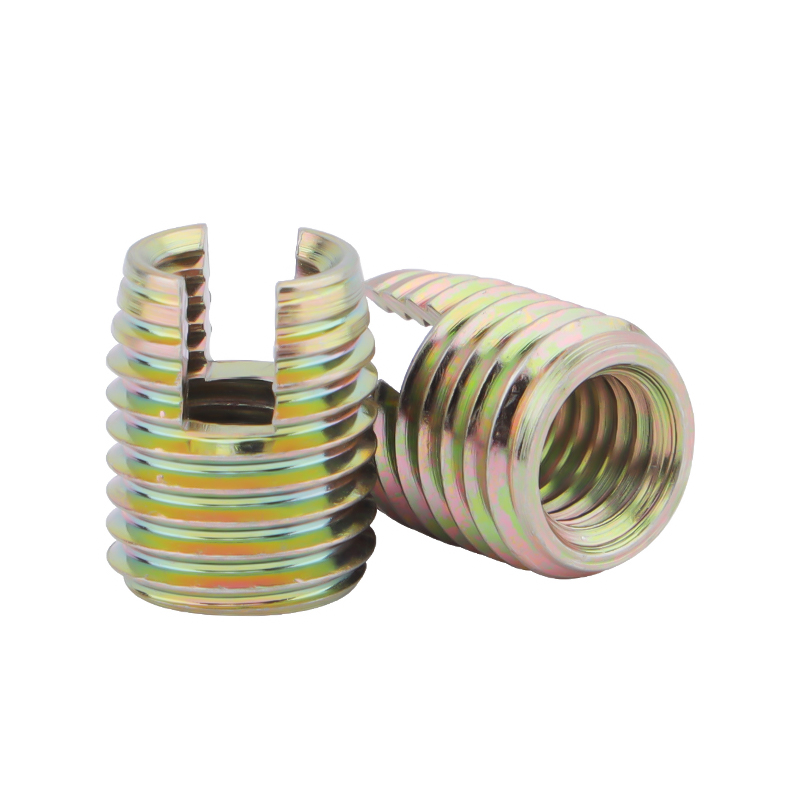
A yellow zinc plated self-tapping thread insert is a metal sleeve with an internal thread and a cutting-style external thread. The external thread is designed to engage directly with a hole in a softer base material. During installation, the cutting geometry removes or displaces a controlled amount of material and forms a strong external engagement. Once installed, the internal thread accepts a standard matching fastener.
The insert is commonly used when the base material cannot reliably support repeated tightening and loosening. Aluminum and magnesium alloys are lightweight and useful in transportation and equipment design, but their lower thread strength can become a limitation. Plastics can also suffer from creep, deformation, and thread wear under load. An insert transfers the load through a larger external engagement area and provides a durable internal steel thread for the mating fastener.
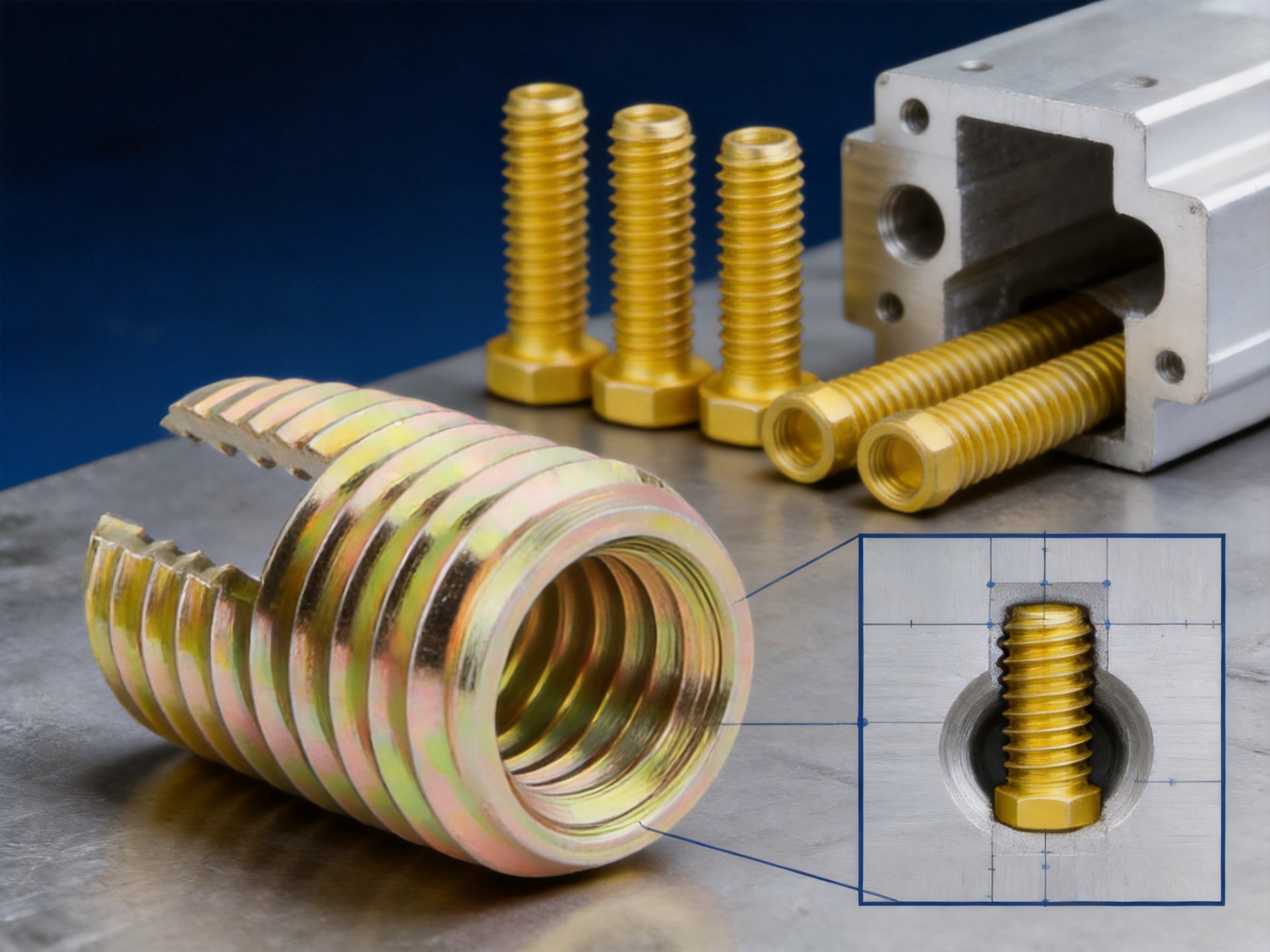
The yellow zinc finish is a protective coating system. It typically includes a zinc metallic layer and a passivation layer that helps improve resistance to oxidation and corrosion. The coating also improves the insert’s resistance to surface wear during handling and installation. According to the supplied product specifications, the color zinc coating provides approximately 96 to 120 hours of salt spray resistance, depending on the applicable testing conditions and coating process.
This surface treatment makes the insert more suitable for humid workshops, oily machinery environments, outdoor hardware, vehicle assemblies, and other applications where standard uncoated or basic blue-white zinc finishes may offer less protection. The coating is not a substitute for application-specific corrosion testing, but it provides an important additional protective barrier for general industrial use.
Operating Principle and Structural Design
The insert performs two different mechanical functions. Its outer thread must engage securely with the parent material, while its inner thread must provide a precise and durable connection for the installed screw or bolt. The two thread systems are designed for different purposes and therefore have different dimensions and geometries.
External Self-Tapping Thread
The external thread includes a cutting or slotted section that enables the insert to enter the prepared hole without conventional tapping. This feature reduces the number of production steps and can eliminate the need for a separate internal thread-forming operation in the base component. The slotted design also helps the insert bite into softer materials and resist rotation after installation.
During assembly, the insert is aligned with the drilled hole and driven using a suitable installation tool. As the external thread advances, the cutting section forms the engagement in the base material. The required hole diameter depends on the material. Plastic, aluminum alloy, and cast iron may require different drilling dimensions because each material has a different resistance to cutting, deformation, and thread formation.
Internal Precision Thread
The internal thread is manufactured to accept a compatible metric or inch fastener. Because the internal thread is carried by the insert rather than formed directly in the soft base material, the connection can offer improved wear resistance and greater resistance to stripping. This is particularly valuable where a fastener must be removed and reinstalled during maintenance.
A stable internal thread also helps control assembly torque and clamping force. In a direct thread formed in plastic or soft aluminum, repeated tightening may gradually damage the thread profile. The insert reduces this risk by providing a harder threaded interface between the insert and the fastener.
Cutting Groove and Anti-Rotation Performance
Type 302, or the slotted type, uses a cutting groove near the screw head. The groove assists self-tapping installation and enables the sleeve to penetrate the parent material efficiently. Once fully installed, the external thread and surrounding base material create resistance against pull-out and rotation.
The insert’s high-strength thread and close engagement can also improve vibration resistance. In vehicle, machine, and industrial applications, vibration is a major cause of gradual fastener loosening. A properly selected and correctly installed insert does not replace the need for appropriate fastener locking practices, but it creates a more stable threaded foundation for the final connection.
Yellow Zinc Plated Self-Tapping Thread Insert
Key Advantages Compared with Conventional Thread Repair Methods
No Conventional Pre-Tapping Required
One of the most important advantages is the self-tapping installation method. Traditional thread inserts often require a sequence of drilling, tapping, cleaning, insert installation, and sometimes locking or staking. A self-tapping insert can reduce this sequence by forming its external engagement during installation.
Fewer operations can provide several production benefits. Assembly time is reduced, fewer tools are needed, and the risk of mismatching the tapped hole and insert is lowered. The simplified process is especially useful for repair work, field maintenance, and high-volume production where every additional operation affects labor cost and throughput.
Stronger Threads in Soft Materials
Directly tapping a thread into aluminum, magnesium alloy, or plastic may produce insufficient thread engagement. A steel or similarly strong metal insert distributes the load over a larger external surface and provides a more durable internal thread. This helps improve resistance to stripping, pull-out, impact, and repeated tightening.
Compared with an ordinary bolt installed directly into a soft material, the insert can create a stronger and more serviceable joint. It is also useful where a lightweight component must retain a high-strength fastening point without adding a bulky solid-metal boss.
Corrosion and Wear Protection
The yellow zinc coating combines a metallic protective layer with passivation. This dual-protection approach helps resist corrosion in humid, oily, and industrial environments. It can also reduce surface damage caused by handling, installation tools, and contact with adjacent metal parts.
Compared with standard blue-white zinc finishes, the color zinc coating is specified to provide improved corrosion and wear resistance, with a salt spray resistance range of approximately 96 to 120 hours. The actual result depends on coating thickness, substrate preparation, handling, storage, and the test method used. For demanding applications, customers should confirm the required corrosion test and coating specification before production approval.
Improved Repairability
A stripped hole does not always require replacement of the entire component. A self-tapping thread insert can restore the functional thread and allow the original assembly to return to service. This is particularly useful for expensive housings, machine parts, engine components, fixtures, and equipment that would be uneconomical to discard because of one damaged thread.
Thread repair can also reduce downtime. Maintenance personnel can prepare the damaged hole, install the insert, and reinstall the fastener using standard procedures. The repaired connection can provide a more durable thread than the original soft-material thread.
Broad Size Compatibility
The Type 302 range includes multiple metric sizes and several corresponding inch-system options. The listed range covers small fasteners such as M2 and M2.5 as well as larger sizes including M20. This allows the same general insert concept to be applied across electronics, small machinery, automotive assemblies, industrial equipment, and structural hardware.
Availability across multiple sizes also helps standardize purchasing and assembly processes. Engineering teams can select an insert based on the required internal thread, external thread, insert length, base-material type, and drilling diameter.
Yellow Zinc Coating Performance
Surface treatment is an important part of insert performance. An insert may have an excellent thread design, but inadequate surface protection can lead to corrosion, installation damage, or reduced service life. The yellow zinc coating used on this product is intended to provide both corrosion resistance and practical wear protection.
Passivation Layer
The passivation layer reduces the tendency of the zinc surface to react with moisture and atmospheric contaminants. It helps stabilize the protective surface and contributes to the color appearance. The passivation layer is especially important because zinc coatings gradually sacrifice themselves to protect the underlying steel. A stable passivated surface can extend the useful protection of the coating.
Metallic Zinc Layer
The metallic zinc layer provides a barrier between the steel insert and the surrounding environment. It also offers sacrificial protection if the surface is scratched or locally damaged. The performance of this layer depends on coating thickness, substrate cleanliness, process control, and post-treatment quality.
Resistance to Humid and Oily Environments
Machine tools, engines, transmissions, agricultural equipment, and industrial workshops may expose threaded components to oil, water vapor, condensation, and contaminants. The color zinc coating is intended to maintain protective performance under these general industrial conditions. It can help reduce surface rust during storage, transportation, and service.
Nevertheless, product designers should evaluate the complete assembly. Contact with dissimilar metals, trapped moisture, chemical cleaners, saltwater, and high concentrations of acids or alkalis can affect corrosion behavior. Where the assembly will be exposed to severe marine, chemical, or high-salt conditions, additional validation may be necessary.
Temperature Range
The supplied technical information identifies a working range of approximately -40°C to 300°C for stable coating performance. This range supports many automotive, machinery, electronics, and outdoor applications. Temperature cycling can cause expansion and contraction between the insert and the parent material, so designers should still consider the thermal expansion characteristics of the complete assembly.
For applications near the upper or lower limits, installation torque, material compatibility, fastener grade, coating behavior, and long-term vibration should be verified through testing. The stated range should be treated as a general product guideline rather than a substitute for application qualification.
Material Compatibility and Application Selection
Aluminum Alloys
Aluminum alloy housings and structural parts are common in automotive, aerospace, electronics, robotics, and industrial equipment because they combine low weight with useful strength. However, aluminum threads can be vulnerable to stripping, galling, and wear, especially when fasteners are repeatedly removed.
A self-tapping insert provides a stronger internal thread and can increase the serviceability of the aluminum component. The appropriate drilling diameter must be selected carefully to ensure adequate external thread engagement without excessive installation force or cracking of the surrounding material.
Magnesium Alloys
Magnesium alloys are even lighter than aluminum and are used in selected housings and vehicle components. Their mechanical and chemical characteristics require careful control during machining and assembly. Thread inserts can reinforce connection points and help protect the internal thread from repeated fastener use.
Before installation, the engineer should confirm that the selected insert, coating, drilling size, installation torque, and assembly environment are compatible with the magnesium alloy. Proper cleaning is also important because chips and residue can interfere with full seating.
Engineering Plastics
Plastics can deform under sustained load, a behavior commonly known as creep. A direct plastic thread may lose clamping force over time, particularly under heat or vibration. A metal insert provides a more stable internal thread and can improve resistance to repeated assembly.
Plastic components vary widely in hardness, elasticity, glass-fiber content, temperature resistance, and chemical behavior. The drilling diameter listed for plastics should therefore be treated as a starting reference. Production trials should confirm installation torque, pull-out resistance, and the absence of cracking or excessive deformation.
Cast Iron and Other Metal Components
Cast iron and other harder materials may require a larger reference drilling diameter and greater installation force than plastic or aluminum alloy. The supplied table provides separate reference drilling ranges for plastic, aluminum alloy, and cast iron. These distinctions help prevent under-sizing or over-sizing the prepared hole.
When a hole is too small, the insert may require excessive torque, causing damage to the insert or parent material. When a hole is too large, external thread engagement may be insufficient, reducing pull-out and torque resistance. Correct preparation is therefore essential to achieving the expected performance.
Type 302 Size and Drilling Reference
The following reference table summarizes the listed Type 302 slotted self-inserting screw sleeve sizes. Dimensions should be confirmed against the latest approved drawing, material condition, and application-specific assembly procedure before production use.
| Metric internal thread | Approximate inch reference | Length | External thread | Plastic drilling diameter | Aluminum alloy drilling diameter | Cast iron drilling diameter | Minimum drilling depth |
|---|---|---|---|---|---|---|---|
| M2-0.4 | — | 6 | M4.5-0.5 | 4.0-4.1 | 4.1-4.2 | 4.2-4.3 | 8 |
| M2.5-0.45 | U#2-56 | 6 | M4.5-0.5 | 4.0-4.1 | 4.1-4.2 | 4.2-4.3 | 8 |
| M3-0.5 | U#4-40 | 6 | M5-0.5 | 4.5-4.6 | 4.6-4.7 | 4.7-4.8 | 8 |
| M4-0.7 | U#8-32 | 8 | M6.5-0.75 | 5.8-5.9 | 6.0-6.1 | 6.1-6.2 | 10 |
| M5-0.8 | U#10-24 | 10 | M8-1.0 | 7.1-7.2 | 7.3-7.5 | 7.5-7.6 | 13 |
| M6a-1.0 | — | 12 | M9-1.0 | 8.1-8.2 | 8.3-8.5 | 8.5-8.6 | 15 |
| M6-1.0 | U/14-20 | 14 | M10-1.5 | 9.0-9.2 | 9.2-9.3 | 9.3-9.4 | 17 |
| M8-1.25 | U5/16-18 | 15 | M12-1.5 | 10.6-10.8 | 11.0-11.2 | 11.2-11.4 | 18 |
| M10-1.5 | U3/8-16 | 18 | M14-1.5 | 12.6-12.8 | 13.0-13.3 | 13.2-13.4 | 22 |
| M12-1.75 | U7/16-14 | 22 | M16-1.5 | 14.6-14.8 | 15.0-15.3 | 15.2-15.4 | 26 |
| M14-2.0 | U1/2-13 | 24 | M18-1.5 | 16.6-16.8 | 17.0-17.3 | 17.2-17.5 | 28 |
| M16-2.0 | U5/8-11 | 22 | M20-1.5 | 18.6-18.8 | 19.0-19.3 | 19.2-19.5 | 27 |
| M18-2.5 | — | 24 | M22-1.5 | 20.6-20.8 | 21.0-21.3 | 21.2-21.5 | 29 |
| M20-2.5 | — | 27 | M26-1.5 | 24.6-24.8 | 25.0-25.3 | 25.2-25.2 | 32 |
The table contains dimensional references supplied for the product series. Some original size notation may require confirmation, particularly where a thread designation appears unusual or where an inch reference is abbreviated. Technical drawings and purchase specifications should always take precedence over a general product table.
Installation Procedure
Step 1: Inspect the Existing Hole
For a new component, inspect the designed hole location and verify that the surrounding wall thickness is sufficient. For a repair, remove the damaged fastener and examine the hole for cracks, severe deformation, embedded chips, corrosion, or previous repair material. A self-tapping insert cannot compensate for a parent material that is structurally fractured or too thin.
Step 2: Select the Correct Drill Diameter
Choose the drilling diameter according to the insert size and parent material. The reference diameter for plastic may differ from that for aluminum alloy or cast iron. The purpose is to provide enough material for the external thread to engage while avoiding excessive installation resistance.
Hole diameter should be measured with suitable inspection equipment. Depending on the application, a reamer or controlled drilling operation may be preferable to a rough or oversized hole. The hole should be aligned with the intended fastener axis to prevent cross-threading and uneven loading.
Step 3: Control the Drilling Depth
The hole must be deeper than the insert length. The supplied data identifies minimum drilling depths for the listed sizes. Additional depth may be needed to accommodate the cutting groove, chips, tool clearance, and any blind-hole installation requirements.
In a blind hole, insufficient depth can cause the insert to bottom out before it reaches the correct seating position. This may create excessive torque, incomplete installation, or distortion of the parent material. The minimum depth should therefore be treated as a baseline, with a suitable process allowance added where appropriate.
Step 4: Clean the Hole
Remove chips, dust, oil residue, and loose particles before installation. Cleaning improves thread engagement and helps ensure that the insert reaches the required depth. In repair applications, corrosion products and damaged thread fragments should be removed as thoroughly as possible.
Step 5: Align the Insert and Tool
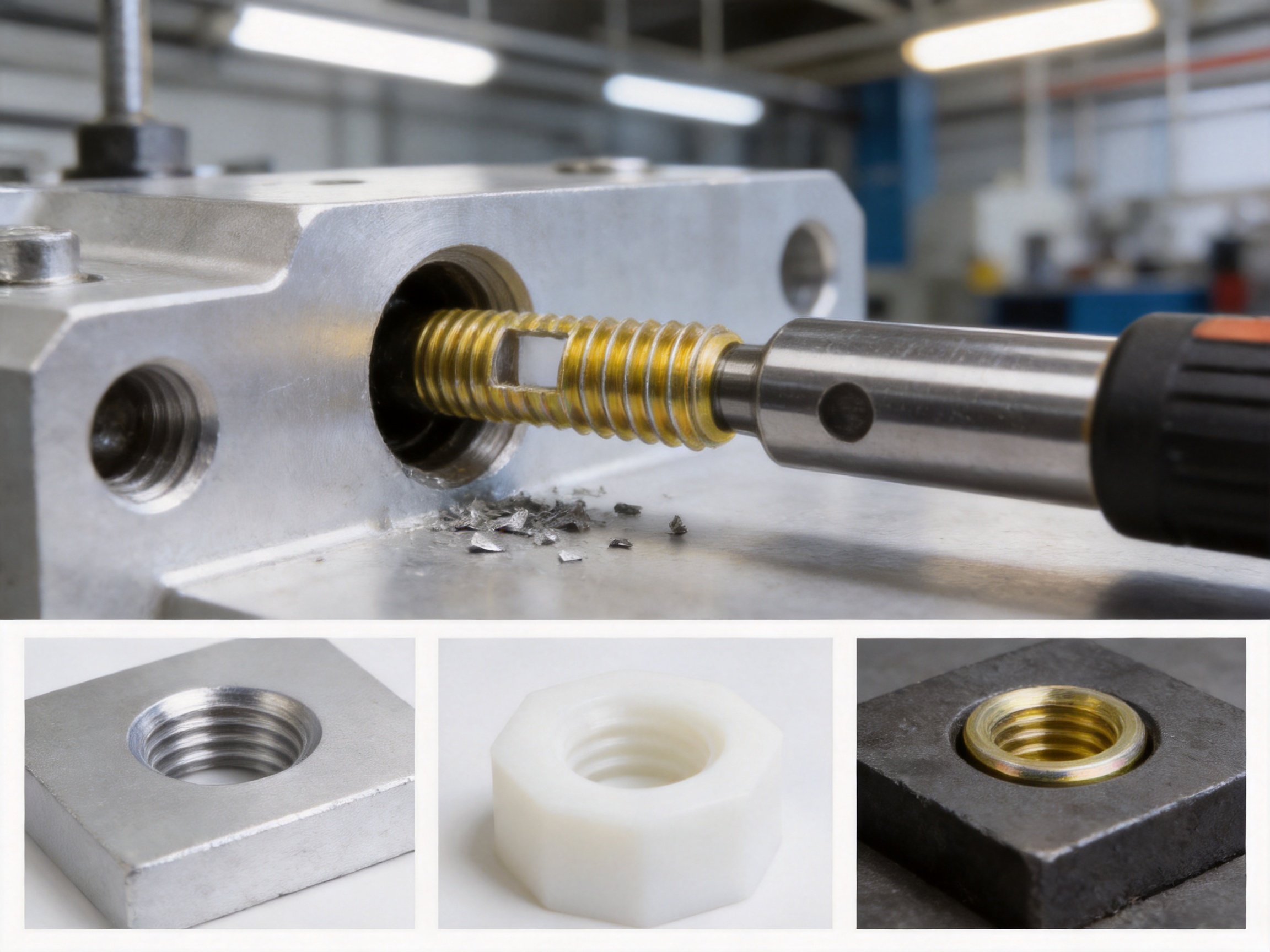
Place the insert squarely over the hole and use a compatible installation tool. Misalignment can damage the cutting groove, deform the first external thread, or cause the insert to enter at an angle. A powered driver may be used in production, but its speed and torque should be controlled to prevent excessive heat and coating damage.
Step 6: Drive the Insert to the Required Position
Apply steady installation force until the insert reaches the specified seating depth. Avoid over-driving the insert below the intended surface unless the design specifically requires a recessed position. Excessive driving can damage the parent material, distort the insert, or reduce the available internal thread length.
Step 7: Verify the Internal Thread
After installation, pass a suitable gauge or matching fastener through the internal thread. The fastener should engage smoothly without binding, contamination, or visible thread damage. Inspect the surrounding area for cracks, lifted material, or coating damage.
For controlled production, inspection may include installation torque, seating depth, pull-out testing, rotational resistance testing, and sample-based corrosion evaluation. The exact inspection plan should correspond to the criticality of the assembly.
Applications Across Major Industries
Industrial Equipment and Machine Tools
Machine tools and engineering equipment often use cast housings, aluminum covers, steel frames, and polymer components. Threaded connection points may be exposed to cutting fluids, lubricants, vibration, and repeated maintenance. A corrosion-resistant self-tapping insert can reinforce the connection while simplifying installation during production or repair.
In machine-tool housings, an insert may be used for covers, guards, sensor brackets, access panels, and service components. In engineering machinery, it can support connections in hydraulic equipment housings, control cabinets, and structural attachments. The ability to repair damaged holes can reduce downtime and prevent the replacement of expensive castings.
Automotive Manufacturing
Automotive components experience vibration, thermal cycling, moisture, oil, road contaminants, and repeated service operations. Self-tapping inserts can be used in chassis components, sheet-metal sections, aluminum housings, brackets, engine-related assemblies, and transmission components.
They are useful for both original equipment manufacturing and aftermarket repair. During vehicle production, the insert can establish a standardized thread in a lightweight component. During service, it can restore a damaged connection without replacing the entire part, provided that the surrounding material remains structurally sound.
Hardware and Building Materials
Outdoor doors, windows, railings, frames, brackets, and architectural hardware may be exposed to humidity and changing weather conditions. A yellow zinc finish provides an additional protective barrier for threaded parts used in these assemblies.
The insert can help create a stronger fastening point in aluminum profiles, plastic components, and thin sections. When combined with proper sealing and drainage, it can contribute to a longer-lasting connection in general outdoor hardware applications.
Electronics and Communication Equipment
Electronic housings and communication equipment frequently use aluminum or magnesium alloy enclosures to reduce weight and improve heat dissipation. Threaded points in these housings may be opened repeatedly for inspection, maintenance, or component replacement.
A metal insert reduces wear on the housing and provides a more consistent thread for covers, brackets, grounding components, and mounting hardware. Outdoor communication cabinets and base-station equipment may also benefit from the coating’s resistance to humidity and climate exposure.
Aerospace and Rail Vehicle Manufacturing
Transportation industries place strong emphasis on weight reduction, repeatable assembly, and traceability. Thread reinforcement can support lightweight structural and equipment components where a direct thread would not provide sufficient durability.
For aerospace and rail applications, product selection must follow the applicable engineering, material, quality, and qualification requirements. The insert’s general features may be suitable for such sectors, but final approval requires application-specific testing and documentation.
Manufacturing Strengths and Process Control
The performance of a self-tapping thread insert depends not only on its design but also on manufacturing consistency. Thread pitch, external diameter, internal diameter, cutting-groove geometry, length, surface condition, and coating adhesion must remain within controlled limits. Variations in any of these characteristics can affect installation torque, pull-out resistance, fastener fit, and corrosion performance.
Dongtai Jinzhize Metal Products Co., Ltd. operates a specialized manufacturing facility focused on threaded connection products. Established in 2015, the company operates from an owned manufacturing plant of approximately 10,000 square meters. Its production resources include hundreds of machine tools and automated production systems, supporting both standard product manufacturing and stable large-volume supply.
Integrated Production Capability
An integrated production environment can improve coordination between forming, machining, thread production, inspection, surface treatment, packaging, and delivery. It also supports better control of production scheduling and helps reduce dependence on multiple external processing stages.
For customers, integrated capacity can provide more consistent lead-time management and clearer traceability. It can also make it easier to address special requirements such as non-standard sizes, packaging specifications, production samples, and technical documentation.
Automated and Precision Equipment
Automated production systems help maintain repeatability in high-volume manufacturing. Machine tools support accurate production of the internal and external thread profiles, while process controls help manage dimensional consistency from batch to batch.
Automation does not eliminate the need for skilled personnel. Experienced production and engineering teams are necessary to establish tooling, monitor process conditions, evaluate defects, and improve product consistency. The combination of automated equipment and experienced staff provides a practical foundation for industrial fastener manufacturing.
Quality Management and Traceability
Threaded inserts used in critical assemblies must be traceable. Quality management should cover incoming raw materials, production batches, dimensional inspection, thread gauges, coating verification, packaging, and shipment records. Traceability helps customers identify the source of a batch and supports corrective action when a problem is detected.
Jinzhize emphasizes consistent and traceable products, supported by a quality management system and after-sales service mechanism. This approach is important for customers in automotive, aerospace, rail, and industrial sectors, where supplier reliability involves more than the physical product. It also includes documentation, communication, batch stability, and technical response.
Large-Scale and Stable Supply
The company reported an annual output value of 153 million RMB in 2024. This indicates established production capability and a substantial operating scale. For international customers, capacity is valuable when a product must be supplied continuously across multiple production lines or facilities.
A stable supplier can help reduce procurement risk, prevent frequent product substitutions, and support long-term assembly standardization. It can also provide a foundation for developing related products such as wire thread inserts, key-locking inserts, adapters, oil plugs, taps, and installation tools from one specialized source.
Quality Evaluation for Purchasing Teams
Purchasing and engineering teams should evaluate more than unit price when selecting self-tapping inserts. A lower-cost insert may create higher total cost if it causes installation problems, thread failures, corrosion, rework, or inconsistent supply. A complete evaluation should include the following factors.
Dimensional Accuracy
Confirm the internal thread, external thread, overall length, cutting-groove geometry, and dimensional tolerances. Use calibrated gauges and compare the supplier’s drawing with the assembly design.
Material and Hardness
Verify the base material, heat treatment if applicable, mechanical properties, and compatibility with the intended fastener. The insert must be strong enough to withstand installation and service loads without excessive deformation.
Coating Adhesion
Inspect the yellow zinc finish for uniformity, flaking, blistering, exposed base metal, or excessive deposits that could interfere with thread fit. Coating thickness and adhesion should be checked according to the customer’s technical requirements.
Installation Performance
Test installation torque and seating behavior in the actual parent material. A product that performs well in aluminum may require different process settings in plastic or cast iron. Production trials should evaluate the complete installation tool, speed, lubricant condition, hole preparation, and operator method.
Functional Testing
Depending on the application, functional testing may include tensile pull-out, torque-out resistance, repeated fastener installation, vibration testing, thermal cycling, corrosion testing, and visual inspection after assembly. Critical applications should define acceptance criteria before supplier approval.
Engineering Considerations for Better Results
Wall Thickness
The component wall must be thick enough to support the external thread. If the wall is too thin, the insert may break through the opposite side or cause local deformation. Engineers should evaluate edge distance, boss diameter, hole spacing, and the direction of applied load.
Fastener Engagement
The mating fastener should engage enough internal thread to develop the required load without bottoming out. The fastener length must account for component thickness, insert length, washers, brackets, and any clearance beyond the insert.
Load Direction
Pull-out, shear, torque, and vibration loads affect the insert differently. The correct insert length and external engagement should be selected according to the dominant load condition. Where high axial loads are expected, longer engagement and a stronger parent-material design may be necessary.
Installation Torque
Excessive installation torque can damage the coating, cutting groove, or parent material. Insufficient torque may leave the insert incompletely seated or vulnerable to rotation. A controlled process window should be established through samples and monitored during production.
Corrosion Compatibility
Consider galvanic interaction between the insert, fastener, and parent material. Aluminum, steel, zinc, and other metals can behave differently in the presence of moisture. Protective coatings, sealants, washers, and drainage features may be needed in outdoor or high-humidity applications.
Comparison with Alternative Thread Reinforcement Solutions
Several types of thread reinforcement products are available, and the correct choice depends on the assembly. Wire thread inserts are lightweight and useful for many precision applications, but they generally require a tapped hole and a dedicated installation process. Key-locking inserts provide strong mechanical locking features, but their installation may require additional machining and staking operations.
Conventional solid inserts without a self-tapping function may offer excellent strength but can require pre-tapping, adhesive, or other retention methods. Directly tapped threads are simple and inexpensive in strong materials, but they may not provide sufficient durability in soft materials or in assemblies requiring frequent maintenance.
The Type 302 yellow zinc plated insert is differentiated by the combination of a slotted self-tapping external thread, a reinforced internal thread, and a corrosion-resistant color zinc coating. This combination can reduce installation steps while addressing thread strength and environmental protection in one component.
The most suitable option should be selected through engineering analysis rather than based on coating color or installation convenience alone. Load, material, temperature, vibration, service frequency, corrosion exposure, and available tooling should all be considered.
Service and Maintenance Benefits
Thread inserts can improve the maintainability of equipment. When a cover or bracket must be removed repeatedly, the insert protects the internal thread from wear. If a failure occurs, the insert can often be replaced without scrapping the larger component, depending on the design and repair procedure.
In automotive and industrial maintenance, this can shorten repair time and reduce spare-part requirements. In production environments, it can also reduce rework caused by stripped holes. A standardized insert program allows maintenance teams to keep compatible inserts and installation tools available for common thread sizes.
The yellow zinc coating adds value during storage and handling as well. Inserts may pass through warehouses, transport systems, and assembly areas before use. Better resistance to surface corrosion can help preserve the component during these stages, especially where humidity control is limited.
Frequently Asked Questions
What is the main purpose of this insert?
The main purpose is to create or restore a strong internal thread in a soft or damaged base material. The insert provides a durable threaded interface for a screw or bolt while its external self-tapping thread engages directly with the prepared hole.
Can it be installed without tapping the hole first?
Yes. The Type 302 slotted design includes a cutting groove and external cutting thread that enable direct installation into a correctly drilled hole. Pre-tapping and adhesive are generally not required, although the hole must be prepared to the correct diameter and depth.
Which materials are suitable?
The listed applications include plastics, aluminum alloys, magnesium alloys, cast iron, and other industrial materials. Because material hardness and structure vary, the drilling diameter and installation conditions must be selected for the specific base material.
Does the yellow zinc coating prevent all corrosion?
No coating prevents all corrosion in every environment. The yellow zinc finish provides a protective metallic zinc layer and passivation treatment, with a stated salt spray resistance of approximately 96 to 120 hours under relevant test conditions. Severe marine, chemical, or high-temperature applications require additional validation.
What is the general temperature range?
The supplied product information identifies a working range of approximately -40°C to 300°C for stable coating performance. The complete assembly should still be evaluated for thermal expansion, fastener behavior, parent-material strength, and long-term service conditions.
Can the insert repair a stripped hole?
Yes, it can repair many stripped or damaged threaded holes. The original hole may need to be drilled or cleaned to the correct size before installation. The surrounding material must remain strong enough to support the external thread.
Is an adhesive necessary?
The product is designed for mechanical engagement through its self-tapping external thread, so adhesive is generally not required. Adhesive may be considered only when specified by the engineering design or when additional retention is needed for a special application.
How should the hole depth be selected?
The hole must be deeper than the insert length and should meet the listed minimum drilling depth. Blind holes may require extra depth for chips, tool clearance, and complete seating. The exact allowance should be established during process validation.
Can standard tools be used?
The insert can be installed using suitable standard or dedicated installation tools. The tool must hold the insert securely and maintain alignment. Powered tools should have controlled speed and torque to prevent damage during installation.
What should be inspected after installation?
Inspect seating depth, alignment, internal thread condition, surrounding material, and coating condition. Depending on the application, use a thread gauge, matching fastener, torque test, pull-out test, or rotational resistance test.
Are metric and inch sizes available?
The listed Type 302 range includes multiple metric sizes and several corresponding inch references. Customers should confirm the exact available size, thread designation, dimensions, and technical drawing before ordering.
Why is supplier manufacturing capability important?
Thread inserts require consistent control of thread geometry, dimensions, material, cutting features, coating, and packaging. An established manufacturer with dedicated equipment, automated systems, inspection procedures, and traceability can help reduce batch variation and supply risk.
Why Choose a Specialized Threaded Connection Manufacturer?
A specialized manufacturer understands that inserts are precision connection components rather than generic metal sleeves. Product quality depends on the interaction between thread geometry, material strength, coating, installation method, and parent-material behavior. A supplier focused on threaded connection products is better positioned to provide technical guidance across these factors.
Dongtai Jinzhize Metal Products Co., Ltd. focuses on threaded connection products for automotive, aerospace, rail, industrial, and related markets. Its portfolio includes helical wire inserts, self-tapping inserts, key-locking inserts, threaded adapters, oil plugs, installation taps, and complementary tools.
The company’s owned 10,000-square-meter plant, hundreds of machine tools, automated production systems, experienced technical team, quality management system, and after-sales service mechanism support consistent production and customer assistance. Its reported 2024 annual output value of 153 million RMB further demonstrates an established operating scale.
For international customers, the value of a manufacturing partner includes more than product availability. It includes design communication, sample development, inspection support, batch consistency, technical documentation, delivery coordination, and responsive after-sales service. These capabilities are particularly important when inserts are used in safety-related, high-volume, or difficult-to-replace assemblies.
Conclusion
Yellow zinc plated self-tapping thread inserts provide an efficient method for reinforcing or repairing threaded connections in soft materials. Their Type 302 slotted design enables direct installation into a properly prepared hole, reducing the need for conventional pre-tapping. The insert creates a stronger internal thread that can improve resistance to stripping, loosening, vibration, and repeated assembly.
The color zinc coating adds a passivation layer and metallic zinc protection, offering improved resistance to corrosion and wear compared with basic blue-white zinc finishes in general industrial environments. With a stated salt spray resistance of approximately 96 to 120 hours and a general coating performance range of -40°C to 300°C, the product is suitable for many machinery, automotive, electronics, communication, hardware, and outdoor applications.
Correct results depend on proper size selection, drilling diameter, hole depth, alignment, installation torque, and inspection. The reference table provides a useful starting point, but final dimensions should be confirmed through approved technical drawings and application testing.
Supported by dedicated manufacturing resources, automated production systems, experienced personnel, quality management, and broad threaded-product expertise, Jinzhize Metal Products offers a complete supply capability for customers requiring stable, corrosion-resistant, and high-strength threaded connection solutions. When correctly selected and installed, the yellow zinc plated self-tapping insert can reduce assembly time, extend component service life, improve maintainability, and lower the risk associated with stripped or unreliable threads.
References
1. Product technical information for Type 302 slotted yellow zinc plated self-tapping thread inserts, including size, drilling diameter, and minimum drilling depth data.
2. General principles of zinc coating, passivation, and salt spray corrosion evaluation for steel fastening components.
3. Engineering guidance on threaded connections in aluminum alloys, magnesium alloys, plastics, cast iron, and other soft or lightweight materials.
4. Manufacturing and quality-control practices for precision threaded inserts, fasteners, and mechanical connection components.
5. Application information supplied by Dongtai Jinzhize Metal Products Co., Ltd. regarding threaded connection products, manufacturing capacity, quality management, and customer service.



